HIPAA-Compliant App Development Cost: The Real 2026 Breakdown

Three firms, one brief, three quotes that don't look like they're pricing the same product. The app handles protected health information (PHI), so compliance work sits somewhere inside all three numbers. The spread between them is scope, and haggling won't close it. From the outside there's no way to tell whether the top quote is padded or the bottom one left half the compliance work out. Search for HIPAA-compliant app development cost and most of what comes back prices a compliance program rather than a build.
Compliance cost shows up at this grain. Datadog will sign a business associate agreement, and signing it costs you live chat support and the ability to share logs out of its explorer.
A compliant app built and shipped on our own platform runs about $7,100. Whatever number you end up defending to a board or a CFO, it has to come from somewhere you can point at. The breakdown below is line items, priced control by control. The last question is which path builds the app at all.
How much does it cost to build a HIPAA-compliant app?
Hiring it out runs $60K to $120K for a single-surface MVP and $220K to $450K and up for a multi-role app with EHR and revenue cycle scope, across 8 to 40 weeks. HIPAA adds five priced line items on top, from baseline agreements and audit logging through SOC 2 support. The bigger lever is the delivery path: generating the app yourself on a HIPAA-ready platform lands near $7,100, with upkeep at 15 to 25% of the build per year.
Key Takeaways:
- Read the cheapest quote hardest. One brief priced by three firms landed at $80K, $180K, and $320K, and the low number is usually the one that left the compliance work out.
- Ask what each compliance line buys, and refuse the percentage. Published percentages for what HIPAA adds run from a tenth of the build to most of it, each citing another guide. The five controls carry dollar ranges and added weeks.
- Decide who builds it before you argue about scope. Hiring it out runs $60K to $450K and up. Generating it and keeping the code lands near $7,100 plus your own vendor accounts.
Why the same app gets quoted at $80K, $180K, and $320K
The instinct is that somebody is padding, usually the firm at the top. Developer hourly rate is the first thing people compare across the three quotes. It explains geography and seniority. Scope explains the spread.
The brief leaves the expensive decisions to each firm
The brief is identical in all three cases. Each firm decided for itself what it meant. "A patient app with provider messaging" can be a scheduling front end bolted onto a system that already exists, or a regulated product heading for FDA review as software as a medical device (SaMD), and two pages of requirements settle neither.
The decisions that do most of the work in that gap:
- whether HIPAA infrastructure got scoped in or quietly deferred to a phase two with no budget behind it
- whether EHR integration was priced as engineering or waved through on the assumption it'll be simple
- whether the team has shipped a compliant product before, or is about to learn on yours, in which case the learning gets billed to you in hours and in time to market
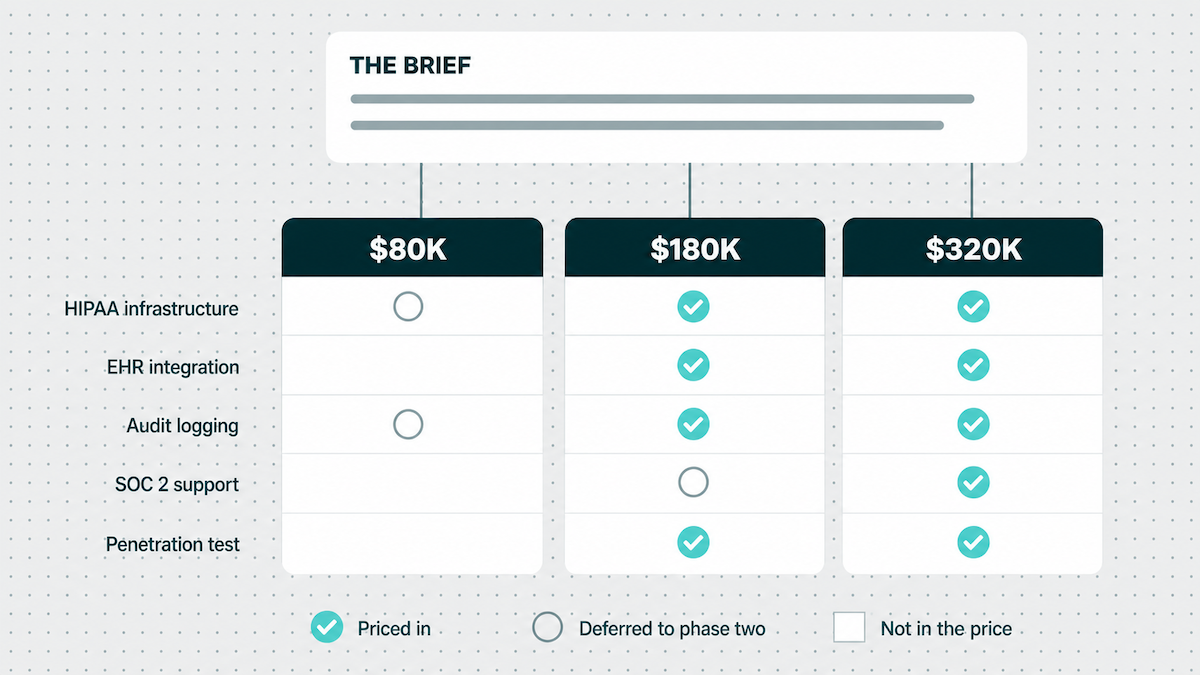
That reorders the three quotes. The cheapest one is usually the quote that left the compliance work out, which makes it the most expensive of the three by the time the app is live. Deleting the work from an estimate moves it later in the schedule, with somebody else's deadline attached to it.
Compliance program cost and build cost are two budgets
Two different budgets go by the same name, and one of them isn't about your app at all.
A compliance program is what a company buys to operate as a defensible covered entity or business associate: risk assessments, policy work, workforce training, tooling subscriptions, audit support. Build cost is what it takes to make the software exist. Aptible's range for the program side, about $2K to $200K and up, is that wide because it prices companies rather than products.
Almost every published figure filed under HIPAA compliance cost is answering the program question, which is why the numbers you collected before the quotes arrived don't map onto any line inside them. And no HIPAA certification exists at the end of either budget. OCR issues no certificates, so program spend never converts into a document that closes the question for a buyer.
Two of these quotes are six figures and one isn't, and that ranking tells you less than one line of scope would. How much does it cost to build a HIPAA-compliant app resolves into which line items a given quote contains and which ones it left for somebody later. So the comparison that works is line by line: what each compliance control costs as engineering work, and which of the three actually priced it.
The cost to build a HIPAA-compliant app, by scope tier
Three tiers cover almost every compliant build we've scoped, MVP through full platform. How much does it cost to build a healthcare app depends on which tier yours sits in, and the tier follows from what the app has to do.
Surfaces and integration depth decide the tier
What moves an app up a tier: how many surfaces it has to serve, whether EHR write-back is in scope or read-only will do, and how many integrations have to stay reliable at the same time.
Integration work prices in steps rather than on a slope. A read-only HL7 or FHIR feed from Epic, Cerner, or athenahealth adds $8K to $20K and one to three weeks. Limited write-back on orders or notes adds $25K to $60K and three to six weeks. An Epic connection plus a second vendor plus a clearinghouse adds 30 to 50% overhead on top of everything else.
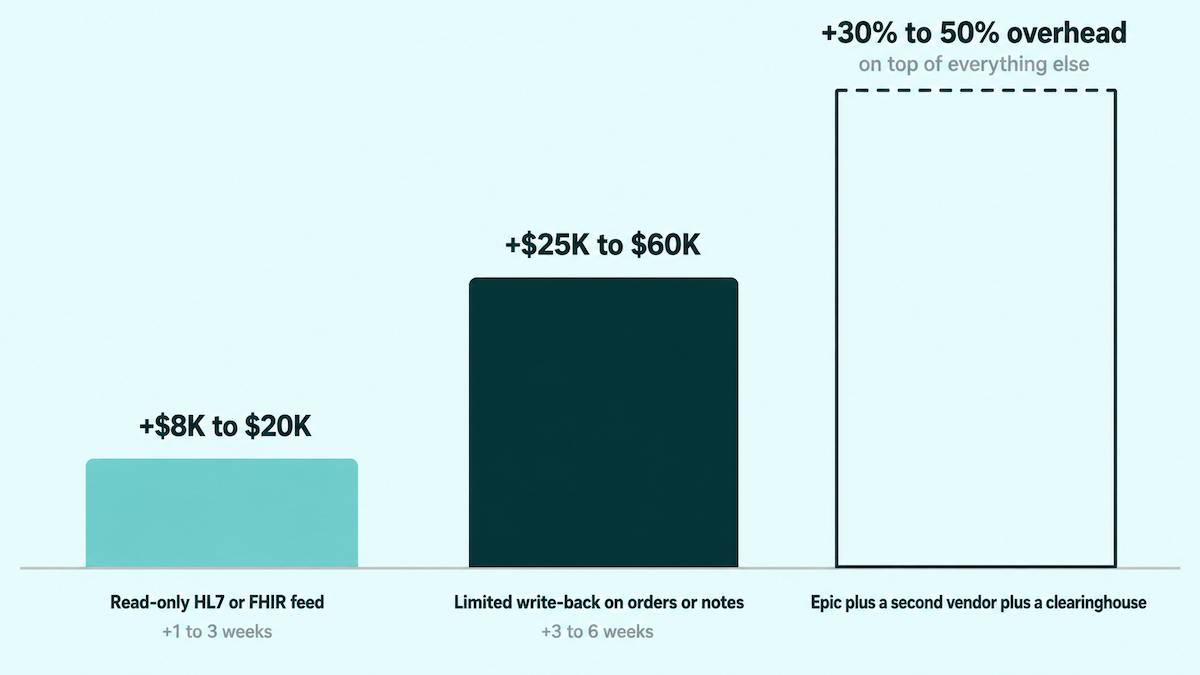
Two quotes can both say EHR integration and price entirely different work. One of them assumed read-only, the other assumed write-back, and the brief didn't say which.
Geography moves the total independently of all of this. The same scope quoted for offshore development lands between $30K and $120K.
Provider apps start higher than patient apps
Provider and hospital apps start at $150K to $200K. Patient-facing apps start at $100K to $150K. Role count and the systems sitting behind the login explain most of that gap.
If the build is virtual care specifically, our telemedicine app development cost breakdown runs the math for that vertical, and what it takes to launch a virtual clinic covers the operational side around the software. Without an engineering background, start with building a HIPAA-compliant health app as a non-technical founder. If the product is a pharmacy or delivery app, our guide on what it takes to build a medicine delivery app adds that vertical's own line items: state licenses, LegitScript, high-risk card processing.
Every band above assumes somebody builds the app from scratch, with a team and a calendar behind it. Swap that assumption and the cost to build a HIPAA-compliant app moves further than any scope decision inside the bands, which is why build versus buy versus generate is the comparison that decides the order of magnitude.
What HIPAA actually adds to app development cost, line by line
Everybody wants the answer as a percentage of the build: what does HIPAA add to app development cost? That form of the question has no honest answer.
Every published percentage cites another guide
We went looking for the number and found a citation loop. Published answers to this exact question run from roughly a tenth of the build to most of it, and each one cites another cost guide. Follow the chain far enough and it ends in nothing anybody measured.
Line items survive the next question a CFO asks: what does that buy? Ask it about a percentage and there's nothing on the other side.
Hold the quote against these five line items
Five controls carry almost all of the HIPAA app development cost on a new build, and each one prices as engineering work with weeks attached.
On the audit logging line, Aptible puts the work at capturing read events at the service layer rather than the interface: append-only storage plus that engineering, with the retention window a decision your team documents and defends.
Take the table into the quotes you're holding. Where a quote has no line that maps to one of these, the work is either bundled somewhere you can't see it or it isn't in the price.
The compliance premium redistributes the whole budget
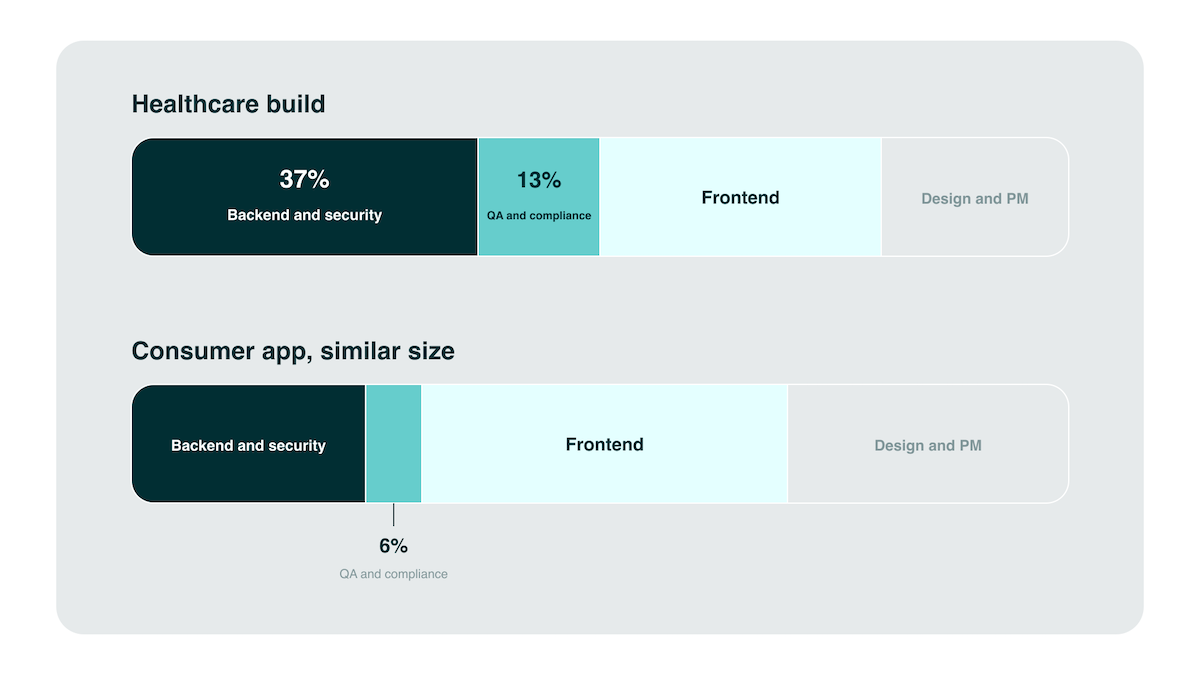
On a healthcare build, backend and security take 35 to 40% of the budget and QA and compliance take 10 to 15%. On a comparable consumer app, QA and compliance take 5 to 8%.
Compliance re-weights every discipline instead of adding a line at the end of the estimate. A firm that has only shipped consumer apps can quote honest rates against an honest scope and still land in the wrong place, because it's distributing the hours the way its last five projects did.
The penetration test that gets discovered late
Bright Defense prices a focused web application test at $5K to $15K, and HIPAA-focused testing commonly lists at $10K to $50K, where the premium covers scoping, documentation, and compliance reporting.
Penetration testing has a floor, and BSG puts it around $3K to $4K, below which a third-party test is an automated scan with a report attached.
Teams schedule the test against a launch date, then find out the findings need a sprint that was never in the plan.
The compliance bill starts when real PHI does. Build the app, pilot it with test users, and none of the five lines above has billed yet. That's a legitimate sequence and worth planning around, since it puts the spend after the point where you know the product works. What it costs to keep running once it's live is a separate bill.
Your HIPAA app maintenance cost is mostly a BAA vendor bill
Annual maintenance on a healthcare app runs 15 to 25% of the build per year, against 10 to 15% on a comparable consumer one. The gap is EHR upgrades and payer rule changes, vendor certifications and re-tests, plus parity checks between sandbox and production.
Every medical app development cost estimate quotes that percentage. The vendor bill underneath it is the larger half.
Every service that touches PHI needs its own agreement
Aptible's list runs:
- hosting
- database
- log management
- storage
- analytics
Each one needs its own agreement, and missing a single vendor leaves the gap open no matter what else is signed.
HIPAA-eligible vendors price eligibility as a plan feature, so the tier carrying the agreement is rarely the tier a lean team would otherwise buy. BAA cost shows up in that difference, whether the vendor is Twilio, SendGrid, Sentry, or Datadog.
Our post on the business associate agreement (BAA) covers what to read before signing one, and the leanest stack for a compliant healthcare app names the vendors worth keeping.
Signing the agreement can cost you features
Datadog's HIPAA compliance documentation spells this out. Datadog will sign for ePHI moving through its HIPAA-eligible services, and customers who sign give up Zendesk live chat support, the ability to share logs or security signals out of the explorer, and third-party generative AI services outside the eligible list. Only the services Datadog designates as eligible are in scope at all, and coverage depends on configuring those services the way the documentation requires.
The eligible tier is a smaller product at a higher price, so a team that budgeted for the higher tier still has to replace the capability the agreement takes away.
The chain stops where your own code starts
Aptible draws the boundary at the platform edge. A platform's agreement covers the infrastructure it runs, and the platform's own agreement with the cloud hosting underneath, AWS or Azure or GCP, covers that layer, so you need no direct agreement with the cloud unless your code calls cloud services itself. Everything your own code reaches out to needs an agreement of its own, which is where teams who assumed one signature covered the stack find the hole.
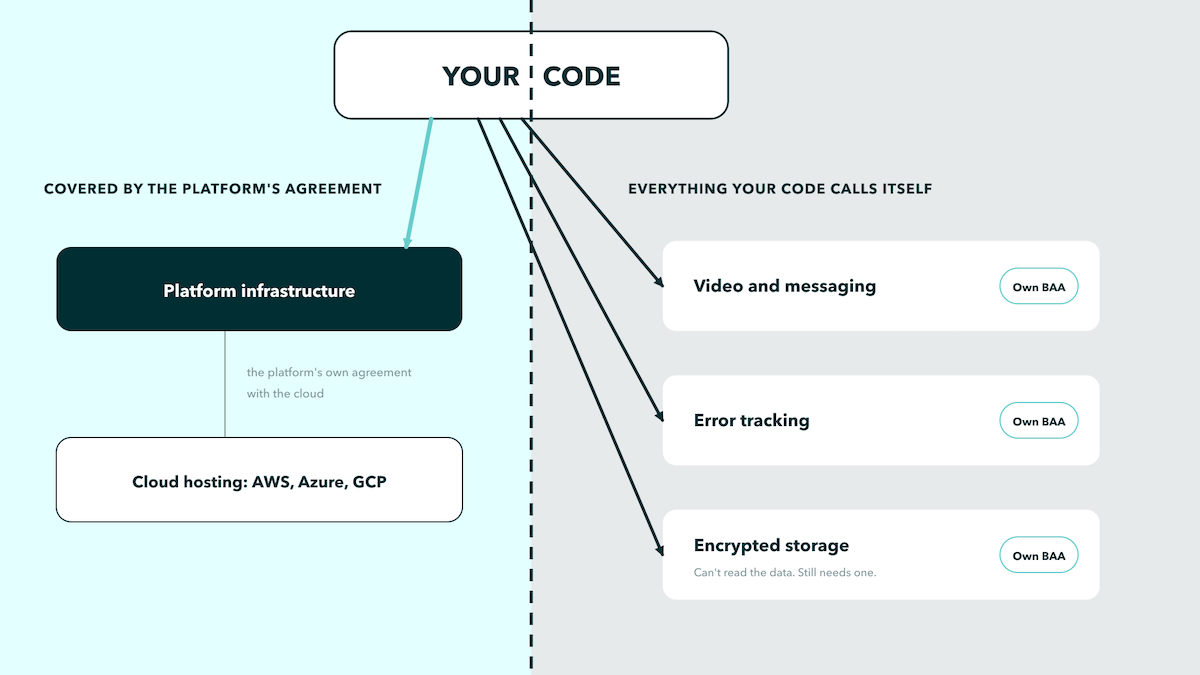
Encrypted PHI is still PHI, so a vendor that can't read the data still needs the agreement.
Some of these lines are design choices, not fixed costs. Email sits on the list above and doesn't have to: an app that mails a link the patient logs in behind, instead of content, takes that vendor off the list. Running the assessment in-house turns that line into staff hours. OCR and the Assistant Secretary for Technology Policy publish the Security Risk Assessment Tool for free, its user guide says using it isn't a guarantee of compliance, and it was built for small and mid-size providers.
Compliance retrofit multipliers trace back to nothing
Founders defer this work as a sequencing call: ship the product, get users, add the compliance layer when the first hospital asks for a security review. It's a defensible plan right up until the review lands on a calendar, and the deferred compliance cost arrives all at once.
The multipliers have no source
The cost of HIPAA compliance for an app that already exists usually arrives as a multiplier: two times the build, three times, pick a number. Chase any of them back and the trail ends in another cost guide. Published figures for a retrofit run from roughly doubling the build to several times it, and not one traces to a delivered project.
The bill itemizes, and the items are defensible.
The retrofit bill is six lines arriving at once
Aptible and Bright Defense price them like this:
- Third-party risk assessment. $2K to $25K.
- Compliance automation tooling. $5K to $20K a year.
- Legal work on agreements and a policy library. $3K to $15K.
- A HIPAA-focused penetration test. $10K to $50K.
- A fractional CISO or compliance consultant. $5K to $20K.
- Workforce training. $15 to $30 per person per year.
Low ends land near $25K. Midpoints reach roughly $78K. They arrive together because the trigger is one review asking for all of them at the same time.
None of those six requires anything to have gone wrong. Penalties attach to violations on their own, and a missing agreement or a skipped risk assessment each counts as one.
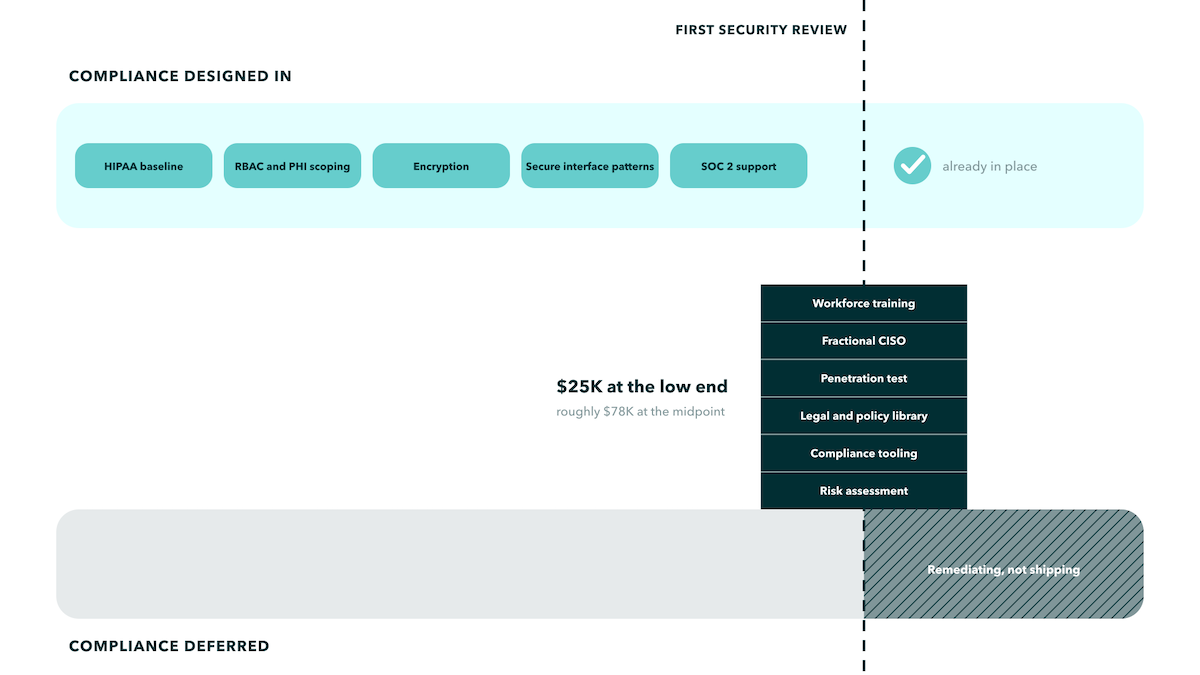
The expensive part is the data already in the system
The controls cost what they cost, priced earlier. A retrofit adds the data sitting in the app before anybody thought about scope. Moving audit logging to the service layer after the fact is a schema migration on live data. And PHI already sitting in logs, caches, analytics events, and exports stays PHI, since neither encryption nor aggregation strips that status, so every one of those places is in scope now.
Teams arriving here from a prototype builder usually want the platform-specific version, and making a Lovable app HIPAA compliant walks the same ground.
Then there's the line that never shows up on an invoice. While the team remediates, it isn't shipping, and the roadmap becomes a remediation roadmap. The deadline belongs to whoever asked for the review, which is what makes this the hardest part of the bill to control.
On the projects where we've been brought in to fix work delivered by a cheaper team, remediation cost at least double what the client had already spent, and some of those builds had to be rewritten from scratch.
2026 HIPAA Security Rule update: not law, build anyway
You've probably read that a new HIPAA Security Rule lands in 2026. It doesn't.
The rule is still a proposal, now aimed at 2027
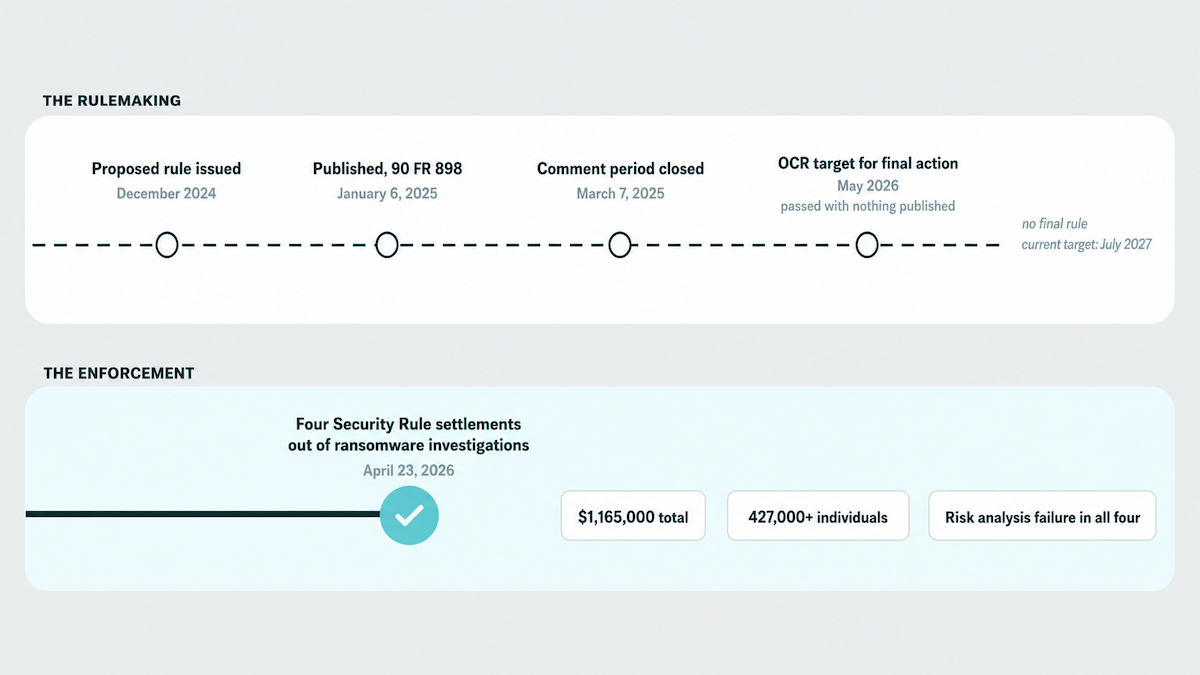
OCR issued the proposed rule in December 2024, and the Federal Register published it on January 6, 2025 at 90 FR 898, the first Security Rule update since 2013. The comment period closed on March 7, 2025 with roughly 4,745 comments. No final rule has been published.
OCR's own agenda targeted final action in May 2026. That date passed with nothing published, and the Office of Management and Budget's agenda for RIN 0945-AA22 now shows July 2027, per HIPAA Journal's July 2026 report.
The Department's regulatory impact analysis inside the proposal, dated January 6, 2025, put first-year costs at about $9 billion and roughly $6 billion a year across years two through five.
More than a hundred hospital and provider groups asked HHS to withdraw the proposal or scale it back, per Compliancy Group's May 2026 review. Signatories include CHIME, Cleveland Clinic, Yale New Haven Health, Advocate Health, the American Medical Association, and the American Academy of Pediatrics.
Sidley Austin's June 2026 analysis lists what the proposal would require:
- encryption of ePHI at rest and in transit, with the addressable label removed
- multi-factor authentication (MFA)
- technology asset inventories and ePHI mapping
- vulnerability management
- an annual audit of Security Rule compliance
Several 2026 publications write about these amendments as though they're already in force, which is why the dates above are worth having.
No percentage goes into your budget for it
A proposal can be finalized, narrowed, delayed, or withdrawn. None of those outcomes is a line in a build budget, and adding a percentage to your digital health app development cost for a rule that doesn't exist means spending real money against a document.
Fund the controls on the strength of what's already enforced.
OCR already enforces the controls the proposal would codify
On April 23, 2026 OCR announced four Security Rule settlements out of separate ransomware investigations, marking 19 completed ransomware investigations and 13 completed under its Risk Analysis Initiative. Assured Imaging paid $375,000 over a breach affecting 244,813 people, with impermissible disclosure and late breach notification found alongside the risk analysis failure.
Regional Women's Health Group, trading as Axia Women's Health, paid $320,000 over 37,989 people, with encryption deficiencies noted. The Star Group health benefits plan paid $245,000 over 9,316 people. Consociate Health paid $225,000 over 136,539, and Sidley Austin's analysis carries the per-settlement findings. The four total $1,165,000 across more than 427,000 individuals, each under a two-year corrective action plan. Every one of them rested on a failure to conduct an accurate and thorough risk analysis.
Consociate is a business associate and Star Group is an employer-sponsored health plan, so this reaches well past hospitals and clinics.
HIPAA doesn't explicitly require multi-factor authentication today. Aptible's point is that enterprise healthcare customers and their auditors expect it regardless.
Every control at the top of this section was already going to be paid for, by enforcement on one side and by the security review that precedes any enterprise sale on the other. The rulemaking only moves the deadline.
Build vs buy vs AI-generate: an order of magnitude apart
By this point the question is who builds it. Build vs buy vs AI-generate healthcare app totals separate by roughly an order of magnitude, and no scope decision inside a single path closes that gap.
Hiring it out buys a team and a process
Beyond the team and the process, the money buys somebody else carrying the compliance engineering. Where a project lands inside the bands above is the scope conversation from earlier in this post.
Buying a platform means inheriting its exit terms
You inherit the compliance layer already built, and Aptible's read is that how much of the infrastructure layer you inherit is the biggest driver of what compliance costs. Every no-code or AI app builder aimed at healthcare sells that inheritance. Check the exit before you commit: whether full code ownership is on the table, and on what terms. Our Blaze vs Specode comparison prices both platforms and marks where a BAA becomes available on each.
Our rundown of no/low-code healthcare platforms prices that path out, and HIPAA compliance in no/low-code development covers what the inherited layer does and doesn't include. HIPAA in 6 weeks, not 6 figures runs the comparison against one named platform, in weeks vs months. The number below is months.
Generating it keeps the code yours
Our own platform runs $1,000 a month, so three months of subscription is $3,000. Add a $3,000 penetration test and about $750 in extra credits across a productive stretch.
Two vendor accounts sit outside that. A Convex production account at $25 a month, which is where you sign your own agreement with the backend provider. CometChat on a HIPAA plan at $339 a month for video and messaging, at that rate through our partnership with them, counted here for the first month of piloting with real patient data.
Roughly $7,100. That's the HIPAA compliant MVP cost on this path, plus whatever the remaining agreement-bearing vendor accounts run, which you price yourself. Before real patient data enters the app, the subscription is the only line running.
For comparison, Aptible puts HIPAA compliance cost for startups before Series A at $1K to $5K a month on infrastructure and tooling, plus a one-time $10K to $30K. None of that includes building the application.
The path has an off-ramp. On a genuinely advanced project, handing the build to our own developers runs $25K to $49K.
Three months is a best case for someone who arrives with a clear picture of what they're building. Customers on genuinely complex health apps who started in the first quarter of this year are only now getting ready to launch, and each of them decided when their own app was ready. The variable is the person building.
How Specode can help
Compliance work prices out. Once the build is done it's mostly vendor and assessment spend, and the delivery path decides the order of magnitude. So: which of the three paths are you on, and what does each line on that path buy? If you came in holding three quotes, read them against the control table.
Specode is a HIPAA-compliant app builder built for the third path. Describe the app you want and it gets generated on HIPAA-ready foundations, which takes several of those line items off the estimate:
- Auth and access control, encryption, and audit logging handled by the platform instead of scoped as separate engineering.
- A built-in HIPAA compliance agent that scans your codebase on demand and splits what it finds into must-fix and nice-to-fix, with a file, a line, and a data-flow trace on every finding. Send an issue to Maestro to fix, then re-run the scan to verify what closed.
- A roadmap and a design system you approve before any code gets written.
- Source code that's yours to export, with the vendor accounts in your name.
- A security and HIPAA review by our team before you go live, and a penetration test on request.
Which tier depends on who's driving. Self-serve suits a founder who'll run the build themselves, prompt by prompt. When a project gets genuinely advanced, the managed tier puts our own developers hands-on in the code. If you want a number now, the Specode build estimator prices your healthcare app development cost against your own scope.
Frequently asked questions
$60K to $120K for a simple MVP in 8 to 16 weeks, $120K to $220K at moderate scope in 12 to 24 weeks, $220K to $450K and up for advanced builds in 20 to 40 weeks. Which path builds it moves the number more than scope ever does.
Five priced controls, from baseline agreements and audit logging through SOC 2 support, each with a range and one to six added weeks. No published percentage survives a source check.
Build it in. A retrofit arrives as six line items at once, low ends near $25K and midpoints near $78K, and none of them waits for a breach.
15 to 25% of the build, plus HIPAA-eligible hosting from $500 a month, eligible vendor tiers, and a risk assessment at least annually.
That question splits in two. A compliance program (assessments, policies, training) runs about $2K to $200K and up. Build cost is separate, $60K to $450K and up depending on scope.