Can You Build a Compliant Health App with Lovable?

Lovable's pitch is speed. A founder describes an app, the AI builds a working prototype, and you're looking at something shippable by lunch. For most projects that's fine. For healthcare it's where things start to break.
Can you build a compliant health app with Lovable? Technically yes, but only with significant extra work. Lovable doesn't offer a standard BAA, its default Supabase setup isn't HIPAA-grade, and the platform runs on shared infrastructure that won't pass a real risk analysis. (Is Lovable HIPAA compliant out of the box? Short answer is no, and we wrote that post separately.) Going from prototype to production means hardening work the platform doesn't do for you.
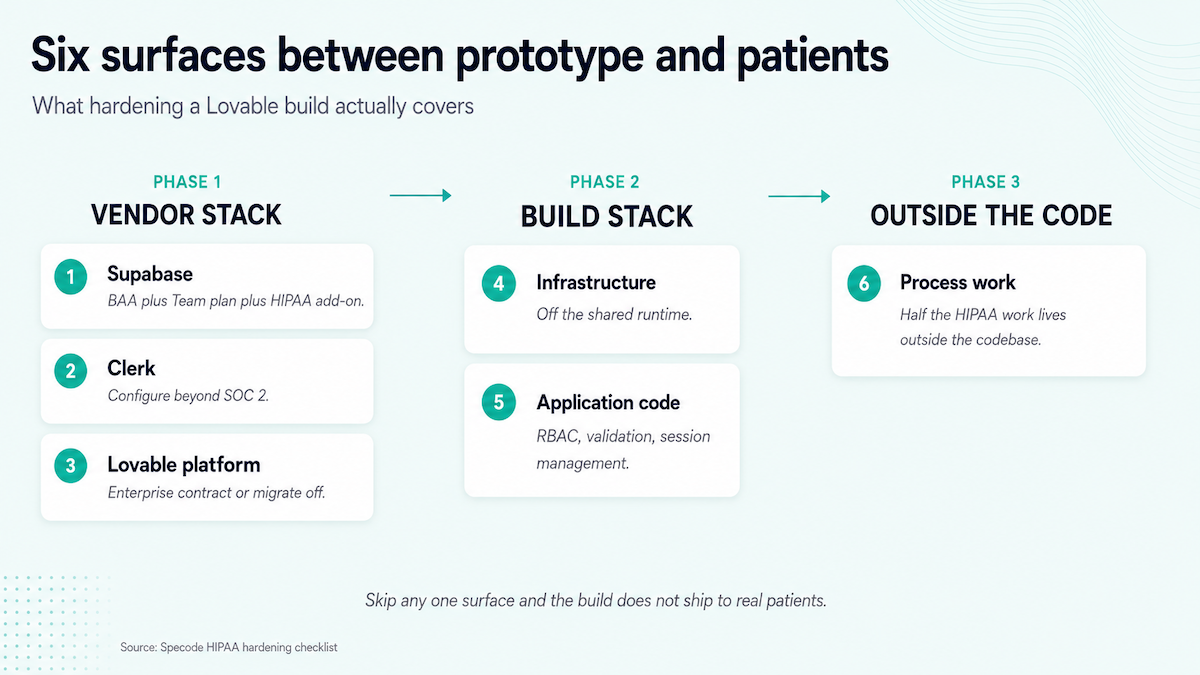
The hardening runs across six surfaces: Supabase, Clerk, the Lovable platform layer, the underlying infrastructure, the application code, and the process work HIPAA expects outside the codebase entirely. Each adds time, money, or both. The Lovable vs HIPAA question comes down to one thing: whether your use case warrants the tax, or whether the Lovable prototype is the right place to stop.
Can you build a HIPAA compliant app with Lovable?
Technically yes, but only with significant hardening work. Lovable doesn't offer a standard BAA, defaults to shared infrastructure, and ships AI-generated code that doesn't enforce HIPAA controls out of the box. Going production-ready means working through six surfaces (Supabase, Clerk, the Lovable platform, infrastructure, application code, and process work), with a typical cost of $250k+ and 9-12 months in year one.
Key Takeaways:
- Lovable doesn't ship HIPAA-compliant by default. The standard plan has no BAA. The runtime is shared. And the AI-generated code doesn't enforce HIPAA controls until you specifically configure them in.
- The hardening checklist covers six surfaces. Supabase (Team plan + HIPAA add-on), Clerk (configuration beyond the BAA), the Lovable platform itself, infrastructure (off the shared runtime), application code (RBAC, validation, session), and process work outside the codebase.
- The retrofit cost is six-figure and recurring. Roughly $250k+ in year one and 9-12 months of work, with process and infrastructure costs continuing annually.
- Lovable still earns its place inside scope. Prototyping with synthetic data, design validation before HIPAA spend, and non-PHI-touching features all run well on Lovable.
- For production healthcare apps, start on infrastructure built for HIPAA. Retrofitting a vibe-coded prototype takes about a year. Starting on a compliant stack takes weeks.
Why developers reach for Lovable for healthcare
The appeal is real. We've used Lovable for internal tools. A working CRUD app with auth, a Supabase backend, and a Tailwind-styled UI in 30 minutes used to be a weekend project. Now it's the time it takes to finish a coffee.
For healthcare founders, that speed compounds. Most early-stage Lovable health apps follow the same pattern: patient intake form, secure messaging, scheduling, document upload. When you build a health app with Lovable, you get a working version of all four before you've finished the pitch deck. And the stack is sensible. Postgres for data, Clerk for auth and MFA, Tailwind and React for the frontend.
Vibe coding has gone mainstream in 2026, with Lovable vibe coding healthcare workflows showing up in real product pipelines. PMs at health systems are prototyping clinical workflows on Lovable to show internal stakeholders before they brief engineering. Founders are using it to validate a concept with five users before they raise money for a real build. The work would have been Figma mockups three years ago. Now it's a running app.
So when someone asks if they can ship that prototype to patients, the question makes sense. The UI is clean. The data flows. (Lovable vs Replit for healthcare, if you're picking between AI builders, is the comparison we wrote separately.) Lovable for healthcare runs into one wall: the piece a healthcare-grade build is missing is everything HIPAA cares about, and you can't see most of it from the demo.
What HIPAA actually requires from a builder
Healthcare data security under HIPAA is mostly a known quantity. The HIPAA Security Rule has been stable since 2003, with the 2013 Omnibus rule expanding it to business associates. (SaMD-classified apps face the FDA digital health track in parallel; here we're scoped to HIPAA.)
What changed in 2026 is OCR's enforcement focus: risk management is now treated as a separately enforceable failure beyond risk analysis, and Tier 4 willful-neglect HIPAA violation penalties run up to $2,177,880 per identical violation per calendar year. The price of getting it wrong has moved.
For someone building a Lovable health app, six requirements drive almost every architectural decision:
- A Business Associate Agreement with every vendor that touches protected health information (PHI). That covers hosting, database, auth, analytics, AI model providers, email, SMS, error tracking, and EHR integration if you've got one. Each link in the chain needs a BAA, or that vendor can't touch PHI.
- Data encryption at rest and in transit, with key management you control or can defend. AES-256 and TLS 1.2 or higher are the floor.
- Audit logs for every PHI read, write, export, and admin action, retained for 6 years. Logs need to be tamper-evident and queryable.
- Role-based access control enforced down to the row level, with the minimum-necessary principle baked into queries.
- Breach notification with a documented 60-day timeline for affected individuals, plus chain-of-custody on the investigation.
- Workforce training, risk analysis, an incident response plan, and the bookkeeping to prove it all happened, none of which live in the codebase.
That last point is the one developers underweight. Roughly half of HIPAA work has nothing to do with the application itself. Policy documents, training records, vendor reviews, BAA audits. The platform you build on doesn't help with any of it.
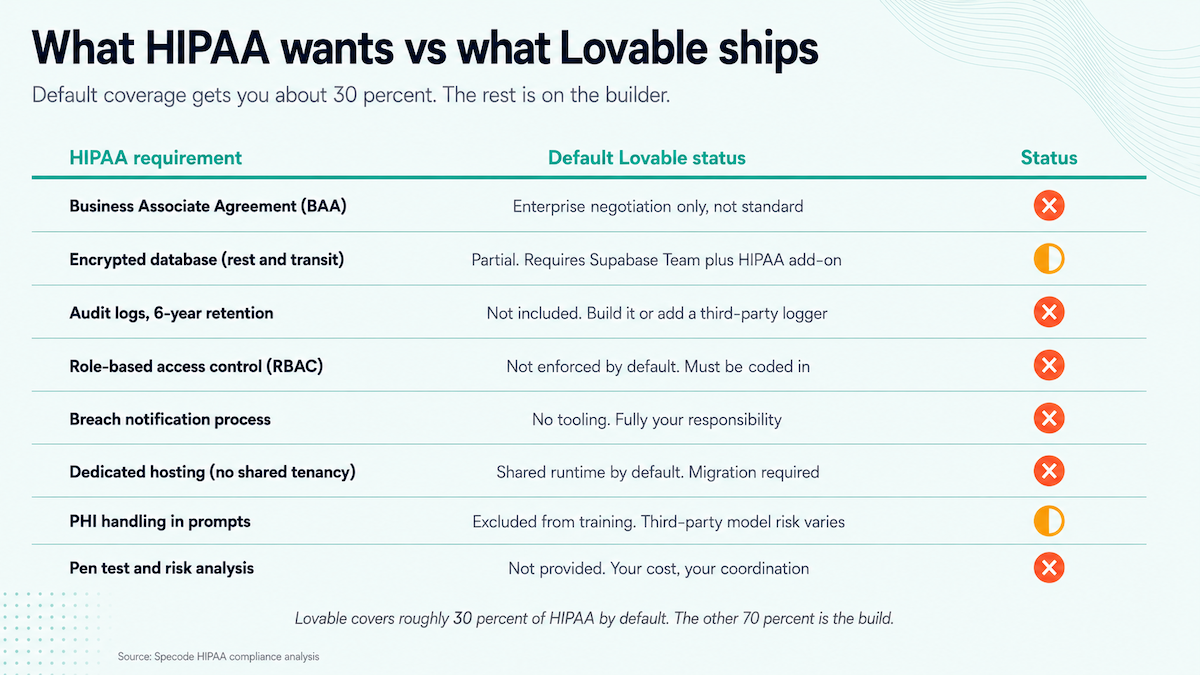
What HIPAA wants and what Lovable gives you by default look like this:
The shape of the compliance gap matters more than any single row. Healthcare app development lives inside a vendor chain HIPAA holds you accountable for, even when the platform abstracts it away. The honest version of Lovable HIPAA compliance gives you roughly 30% of what HIPAA wants and leaves the rest on your plate. A Lovable healthcare app meant for real patients has to close that 70%.
Does Lovable offer a BAA?
Short answer: no, Lovable doesn't offer a BAA on its standard plans. As of 2026, BAAs are an Enterprise-tier conversation, and the terms aren't published. You'd have to negotiate one and probably commit to a non-trivial contract before legal will engage.
Even when a Lovable BAA is on the table, it only covers Lovable's piece of the stack. Three of the other dependencies need their own paperwork before the build sees a single line of PHI:
- Supabase signs BAAs once you're on the Team plan ($599/mo) and add the HIPAA-compliance add-on ($350/mo minimum). The true HIPAA-compliant Supabase floor lands closer to $950/mo. The $599 on the pricing page only gets you part of the way.
- Clerk signs BAAs and holds SOC 2 Type II. Configuration is where the work actually sits.
- Any AI model provider Lovable proxies through (OpenAI, Anthropic, sometimes others). Each has its own BAA terms. Some are restrictive. Check before assuming.
"No BAA" by itself doesn't capture the full Lovable app HIPAA picture. The chain matters. If any link is missing a BAA and PHI touches it, you've got a violation regardless of how the rest of the stack is configured.
The hardening checklist: what you'd need to ship Lovable to real patients
Six surfaces stand between a Lovable prototype and an app you can ship to real patients. To build a HIPAA compliant app with Lovable, you work through all six.
Supabase: from default to HIPAA-grade
Supabase is the data layer for most Lovable apps. The default Free or Pro tier doesn't sign BAAs and doesn't configure for HIPAA. Going production-ready means:
- Upgrade to the Team plan ($599/mo) and enable the HIPAA-compliance add-on ($350/mo minimum). True floor is ~$950/mo.
- Flag projects as High Compliance in the dashboard. This is the toggle that puts the project under the HIPAA configuration.
- Enable Point-in-Time Recovery (PITR) and managed encrypted backups.
- Network restrictions (IP allowlist, no public access to the database).
- Negotiate the BAA with Supabase legal. This isn't auto-issued; you request it.
Done correctly, this is roughly $11,400/year before you've added a single audit log line. Done wrong, it's the surface that shows up in PHI data breach reports as "misconfigured Supabase backend." We've seen both.
Clerk: configure beyond SOC 2
Clerk holds SOC 2 Type II and signs BAAs, so the auth layer is one of the less painful surfaces. The catch is that the defaults don't enforce HIPAA-grade controls; you configure them. The list:
- MFA across all clinical users
- session timeouts (15 minutes for clinical workflows, longer for patient-facing)
- audit event export piped into a central logger with 6-year retention
- role-to-permission mapping tight enough that minimum-necessary actually means something
Clerk authentication is the surface developers underconfigure most. The platform looks ready out of the box, so they skip the configuration review. We've seen builds with Clerk plus a BAA still fail risk analysis because session timeouts were set to 30 days.
Lovable platform: Enterprise contract or accept the limits
The platform itself has two surfaces: the running app it hosts, and the AI pipeline that wrote your code. Both need attention.
On the standard plan, Lovable's runtime is shared tenancy, prompts route through third-party model providers, and there's no BAA. Lovable's current policy excludes customer prompts from model training, though contractual restrictions on third-party providers vary, and "current policy" is a moving target.
The Lovable Enterprise path negotiates BAA, dedicated runtime, and contractually pinned prompt handling. Expect a 5- or 6-figure annual contract minimum, plus a 4-to-8-week sales cycle that includes vendor security review. The alternative is to keep Lovable as the IDE and migrate the running app off Lovable's hosting entirely; some teams export the generated code to GitHub and host it themselves on a BAA-covered cloud. Code ownership matters either way: keep an exportable copy regardless of which path you pick.
Infrastructure: off the shared runtime
If you stay on Lovable's standard multi-tenant hosting, this surface stays broken. To get HIPAA-grade infrastructure underneath the application:
- Move to dedicated hosting on a cloud with a BAA in place
- VPC isolation, no public ingress to the database
- Managed KMS for encryption key rotation
- Append-only audit log storage with 6-year retention
- Encrypted backups with restore tested at least quarterly
- WAF, rate limiting, and IP-level monitoring at the public surface
This is the surface where the Lovable abstraction breaks completely. You're back to running ops and infrastructure security on a real cloud.
Application code: RBAC, validation, session management
Lovable's AI-generated code reads production-ready on first pass and quietly misses the controls HIPAA needs. Three areas matter most:
- Row-Level Security on every PHI table in Postgres. Lovable rarely writes RLS policies unprompted. You spec them, write tests against them, review every PR for drift, and pen-test the row-level enforcement before going live. A Lovable healthcare app without enforced RLS is a single buggy query away from cross-tenant PHI exposure.
- Input validation and PHI minimization. Every endpoint that handles PHI needs schema validation and a return contract that doesn't leak unrequested fields. AI-generated routes default to returning the full row.
- Session and access management. Enforce session timeout, refresh-token rotation, and re-authentication on sensitive routes. Audit the route handlers Lovable produced; sensitive actions need their own re-auth step.
This is also the area where pen tests find the most issues. Lovable-generated UIs have shown up in Proofpoint's phishing-campaign reports specifically because the AI-generated code is convincing while running loose around auth boundaries. Telehealth compliance work follows the same shape (HIPAA compliant telehealth app builds we've audited fail here roughly two-thirds of the time).
Process work HIPAA expects outside the codebase
Half the work isn't in the codebase at all. The pieces:
- Annual pen test by a qualified third party
- HIPAA risk analysis, updated annually and before major releases
- Workforce HIPAA training, with completion records
- Incident response plan with a runbook walked through at least once a year
- BAA tracking across every subprocessor, with renewal dates
- Annual subprocessor security review
Skipping any one of these is what turns a Tier 2 violation ("reasonable cause") into a Tier 4 ("willful neglect"), and Tier 4 caps at $2,177,880 per identical violation per calendar year. The math gets brutal if you've been operating without a real risk analysis for two years across multiple violation categories. This is the compliance retrofit work no codebase can do for you.
Reality check: time and cost to harden Lovable
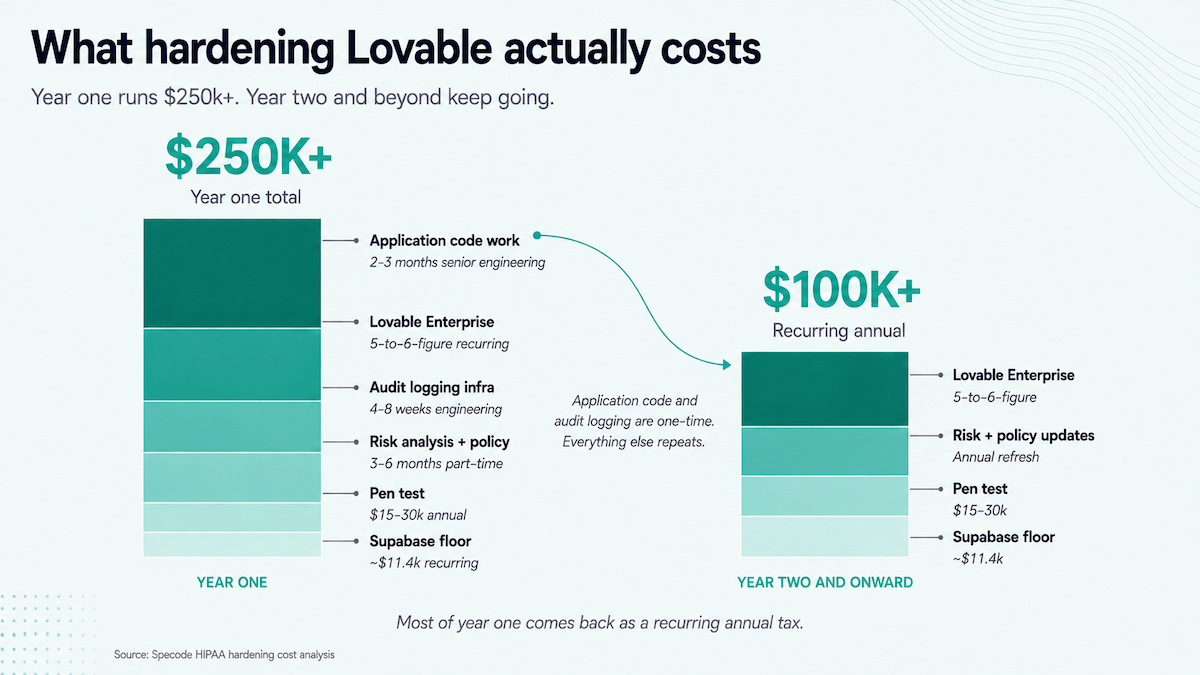
Add up the hardening costs and the math gets uncomfortable. The Supabase floor is ~$11,400/year. Lovable Enterprise lands in the 5-to-6-figure range annually. A first pen test runs $15-30k. Risk analysis and policy work, roughly 3-6 months of part-time consultant or in-house effort.
Audit logging infrastructure on a real cloud, another 4-8 weeks of engineering. Application-layer RBAC and route-level security review across an AI-generated codebase, another 2-3 months of senior engineering.
A conservative total for Lovable health app development against HIPAA: $250k+ in year one and 9-12 months of work, mostly to bolt compliance onto a stack you didn't design with compliance in mind. By year two it's still six figures because the process work (training, pen tests, risk analysis) repeats annually.
We've broken the math down in detail in our Specode vs Lovable cost comparison, but the headline number is the same: a HIPAA-ready build costs less when you start on infrastructure designed for HIPAA than when you retrofit a vibe-coded prototype.
When Lovable is the right call
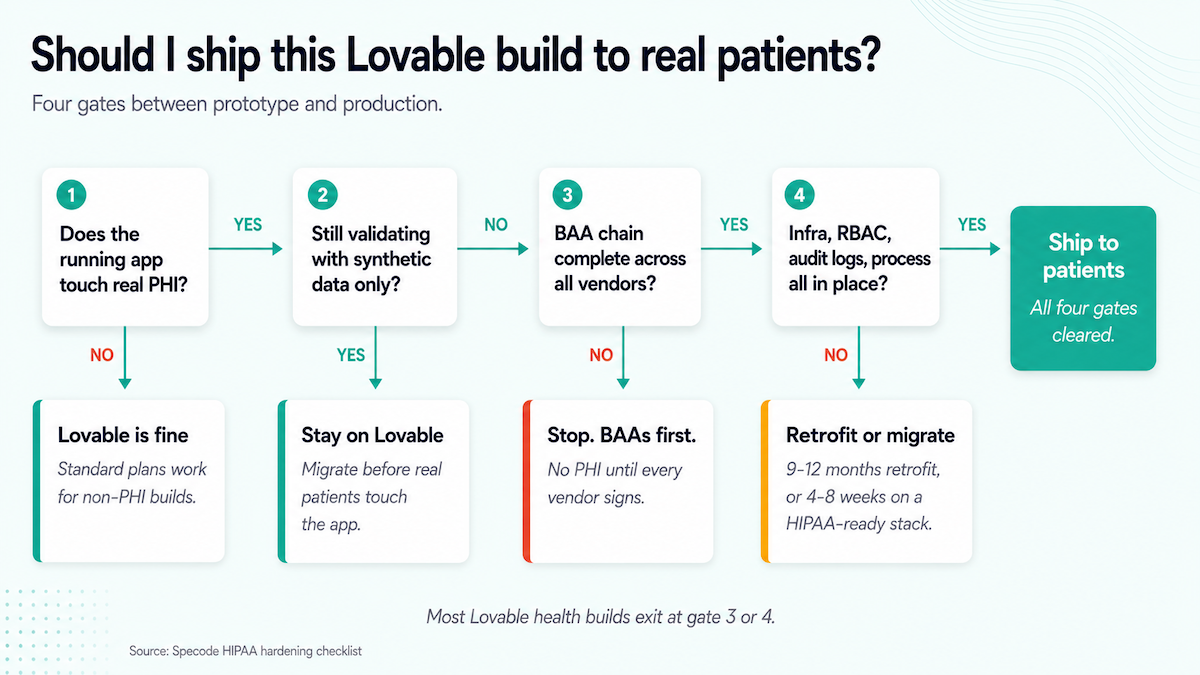
Lovable still has a real place in healthcare. The line is whether real PHI ever touches the running app. When it doesn't, Lovable's speed is exactly what you want.
Three scenarios where we'd recommend it:
- Prototyping with synthetic data.
Spin up a clinical workflow, populate it with fake patients, walk pilot users through it, and harvest the UX feedback. You're testing the UX. The data path stays out of scope. Lovable on Supabase Free tier with a faker library is enough. We've shipped versions of this in a week.
- Design validation before committing to HIPAA infra.
Before you spend the money to harden, prove the concept works. Founders we've worked with use Lovable to demo to investors, get clinical advisor feedback, or run usability tests with healthcare workers. If the design lands, you migrate. If it doesn't, you've spent a week instead of three months.
- Non-PHI-touching features.
Marketing site, provider directory, public scheduling page that doesn't carry diagnosis or insurance information, recruiting funnels for clinical trials. These can run on Lovable indefinitely. Anything that touches PHI gets carved out.
The vibe coding health app is real and useful inside its scope, and the same holds for mHealth app compliance work generally. The mistake is treating a Lovable prototype as the production system. Lovable is a great way to find out what to build, and a poor choice for the live build that touches patient data.
What to use when you're ready for real patients
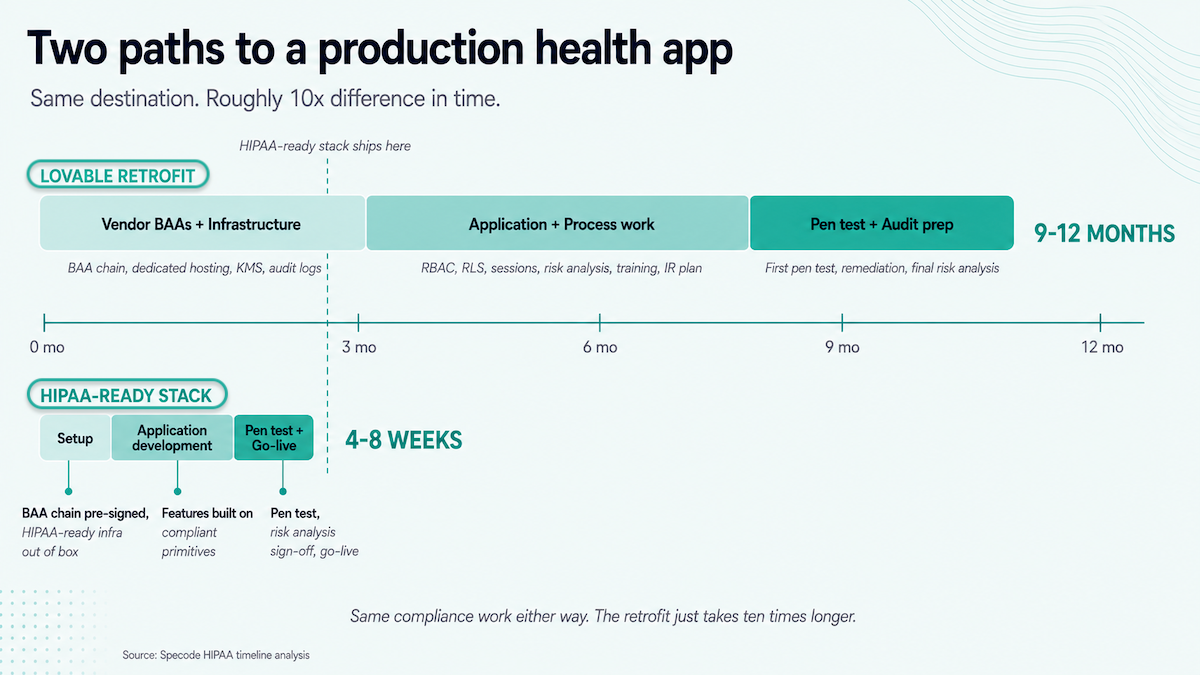
When the prototype is doing real work for real patients, you need infrastructure built for healthcare from the start. Two paths.
You can keep Lovable as the IDE, export the generated code, and host it yourself on a HIPAA-ready cloud. You still own the application-layer hardening, audit logging, RBAC, and process work. Faster than building from scratch, slower than starting on a stack designed for compliance.
Or you start on a Lovable alternative for healthcare: infrastructure that handles HIPAA by default, often with HITRUST certification layered on top. A purpose-built healthcare app builder handles the BAA chain, audit logs, RBAC, and dedicated hosting before you write a feature. Specode is one option in that category; the broader healthcare app builder comparison we maintain covers the alternatives so you can pick on fit.
A Lovable HIPAA compliant build is technically achievable on a 9-to-12-month retrofit timeline. A platform built for compliance turns the same work into a 4-to-8-week setup. The honest math: if you're still validating, stay on Lovable. Once you're shipping to real patients, the Lovable app HIPAA path costs a year of retrofit work, and a stack that arrived audit-ready costs weeks. Pick on which problem you're actually solving.
Frequently asked questions
Technically yes, with significant hardening: BAA negotiations, Supabase upgrades, audit logging, RBAC, pen tests, and process work. Plan on 9-12 months and $250k+ year one.
Not on standard plans. BAAs are available only through Enterprise contracts, which involve a 4-8 week sales cycle and 5-to-6-figure annual minimums.
Only with the Team plan ($599/mo) plus the HIPAA-compliance add-on ($350/mo minimum), high-compliance project flag, and a signed BAA with Supabase legal.
Costs can go up to $200k+ in year one and 9-12 months of work, including Supabase tier, Lovable Enterprise, pen testing, audit logging buildout, and process documentation. You're better off switching to a HIPAA-compliant builder like Specode.
The prototype handles synthetic data on shared infrastructure with no BAAs. The production app needs dedicated hosting, BAA chain coverage, encrypted audit logs, and ongoing compliance work.
An AI app builder HIPAA compliant by design (like Specode) handles the BAA chain, RBAC, and audit logging without retrofit. Faster path to production than the no-code HIPAA compliant app retrofit route.