Patient Peer-Support App Development Guide

Before you choose a chat interface, decide who will respond when a member needs help. That decision belongs at the start of peer support app development: it shapes matching, moderation and the budget you’ll need after launch.
Start with one defined adult cohort and a clear support relationship. Give members choices about whom they connect with and what they share, then test whether your team can operate that experience before adding more features.
This guide focuses on adult patient communities in the US, including consumer-run and provider-affiliated models with different data relationships. It covers the support model, a practical MVP, moderation, privacy, technology choices, funding, build steps and cost drivers. The goal is a launch plan that accounts for the people doing the work as well as the software.
What should you decide before building a patient peer-support app?
Choose one adult cohort and a clear support relationship, give members control over matching, and assign people to handle reports and escalation. Map privacy responsibilities around the operator and data flows, then test the complete member interaction and your team’s ability to run it before expanding.
Key takeaways
- Clinical value needs its own evidence. Evaluate usefulness and participation without presenting them as improved patient outcomes. Research findings remain mixed, so a community’s activity cannot establish what it achieves for health.
- The operator and data relationship determine privacy duties. A pseudonym does not settle HIPAA applicability or establish de-identification. Assess who handles the information and on whose behalf before making a compliance claim.
- A launch budget must fund the response workflow. Define report ownership and staffed coverage alongside the software. Include the people who review concerns, take action and record decisions.
Why build a patient peer-support app?
Give members a place to share lived experience and practical or emotional support. That’s a useful starting purpose for patient community app development, and a more specific one than simply asking people to post more.
A 2025 systematic review of online support groups for chronic physical conditions found potential benefits for social wellbeing and adjustment. Findings for physical health and quality of life were inconclusive, and some studies reported anxiety or distress. The studies varied, with substantial observational evidence; these findings don’t establish what a new app will achieve or extend automatically to mental-health-only programs.
If you’re planning a patient engagement community app, decide how you’ll assess usefulness before choosing how to count activity:
- Ask members whether conversations helped them.
- Inspect unanswered requests.
- Look at whether people choose to keep participating.
Patient engagement and patient outcomes answer different questions: participation alone cannot establish a clinical benefit.
Test those questions with one adult cohort before widening the service. Use the pilot to understand the support relationship and the work it asks of your team, without promising a faster launch or better health results.
Choose the support relationship before the feature set
Decide what members should expect from each other. Before you build a patient community platform, choose a starting relationship from these three models; you can combine them deliberately later. Write the chosen model into your MVP scope.
| Model | Member relationship | Operating commitment |
|---|---|---|
| Member-led condition community | Members exchange experiences through posts and replies. | Define membership boundaries and review reports. |
| Facilitated groups | Members join scheduled support groups with a facilitator. | Assign facilitation, joining rules and coverage. |
| Trained peer or buddy program | A participant connects with a trained peer. | Define training, supervision and matching choices. |
For example, a cancer support app might use facilitated groups; an online support group app for chronic illness might begin with member discussions. For formal behavioral-health peer work, SAMHSA emphasizes voluntary, person-centered support. Use that principle to guide member choice, not as software certification.
A mental health community belongs alongside broader behavioral health app development, but has a different job. A chronic care management app handles care coordination, while an addiction assessment tool has a screening purpose. Keep those clinical workflows distinct. When healthcare providers participate, assess the actual operator and data relationship; affiliation alone doesn’t determine HIPAA status.
Core features should support a complete peer interaction
Trace a member’s path from joining to finding a conversation, then consider what happens when that interaction goes wrong. This gives you a concrete way to decide how to build a patient community app without treating every possible feature as a launch requirement.
| Feature group | Member function | Operating requirement |
|---|---|---|
| Profiles and disclosure controls | Choose what other members can see. | Separate visible profiles from restricted account identity. |
| Peer matching and buddy matching | Find a suggested connection using selected preferences. | Allow acceptance, decline and rematching; define who can initiate contact. |
| Moderated groups | Join a group and take part in discussions or scheduled sessions. | Set joining rules, assign facilitators and manage scheduling. |
| Secure messaging | Converse with permitted members and report or block unwanted contact. | Enforce conversation access and disclose how reported messages are reviewed. |
| Curated content hub | Find reviewed resources alongside personal experiences. | Distinguish the two and assign an owner to review resources. |
| Ambassador and volunteer programs | Get a welcome or support from someone with a defined role. | Set responsibilities, training and supervision; separate these roles from clinical care. |
For matching, let members select what matters to them, such as shared experience, language and availability. Suggest a peer, ask the member to accept or decline, and start a conversation only after acceptance. Keep rematching and blocking available. A suggestion should reflect preferences rather than imply a clinical compatibility score.
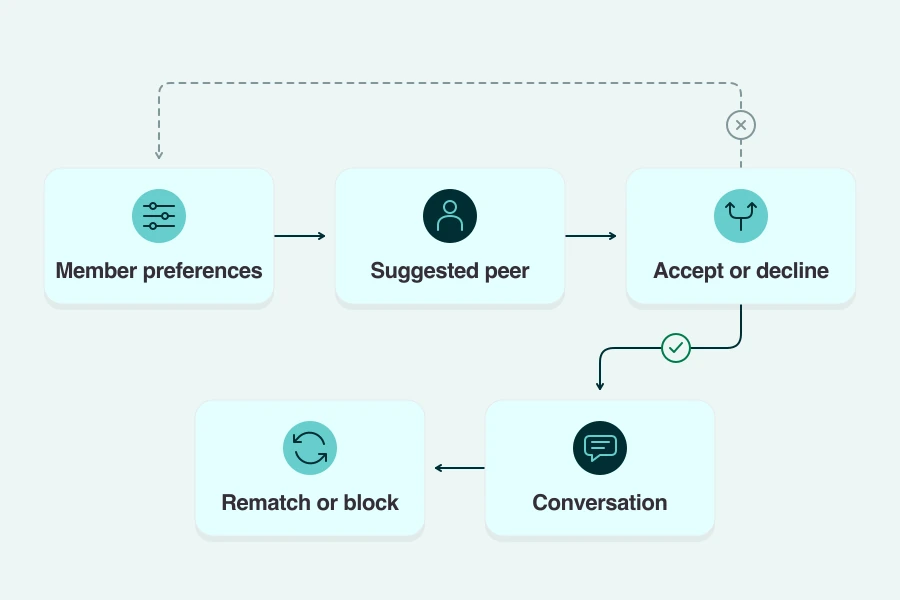
SAMHSA’s peer-worker competencies describe formal behavioral-health support as voluntary and person-centered, including support tailored to the individual. The matching flow above is a product recommendation based on that principle, not a process SAMHSA prescribes.
Give your ambassador program a clear welcome-and-participation role. For the volunteer program, spell out when a volunteer should hand a concern to a supervisor. Neither role should quietly acquire clinical responsibilities.
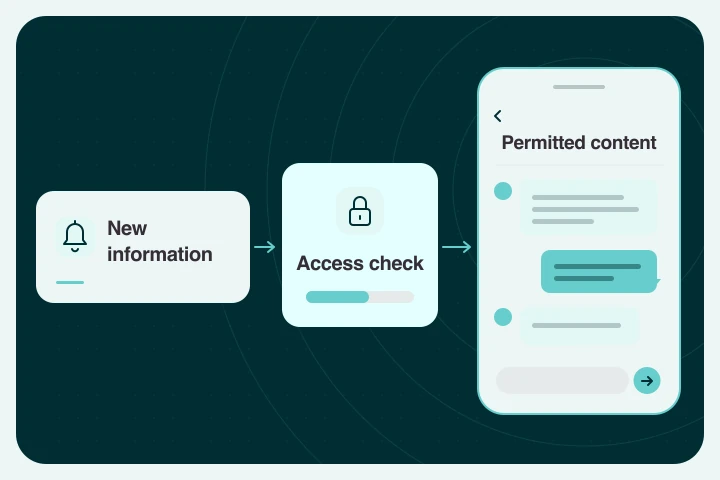
Apply least privilege to the underlying access rules: deny access unless permitted, and check authorization on every request. That engineering baseline helps define what members and operators may do; it isn’t a complete security assessment.
Moderation needs owners, coverage and an escalation path
A report button needs an assigned person and a process behind it. Put that work into your support group app development scope, including what the reporter sees while a concern is waiting for review.
Write community guidelines that distinguish sharing personal experience from giving someone medical instructions. Spell out:
- Prohibited behaviors.
- How members report content or block contact.
- How members can appeal a moderation decision.
Treat content moderation as an operating responsibility with coverage and a budget.
Macmillan’s community moderation approach offers a useful boundary: its UK cancer-community team handles reports and can escalate concerns to senior moderators or safeguarding leads, while diagnosis, clinical decisions and emergency support fall outside its moderation role. Use the distinction to define your own service, rather than borrowing its staffing assumptions.
For your app, route a member report into a review queue and assign a named reviewer. The reviewer takes the appropriate community action or passes the concern to the designated escalation owner. Record the decision and its rationale so the next reviewer can understand what happened. This is a recommended operating workflow, not a clinical protocol.
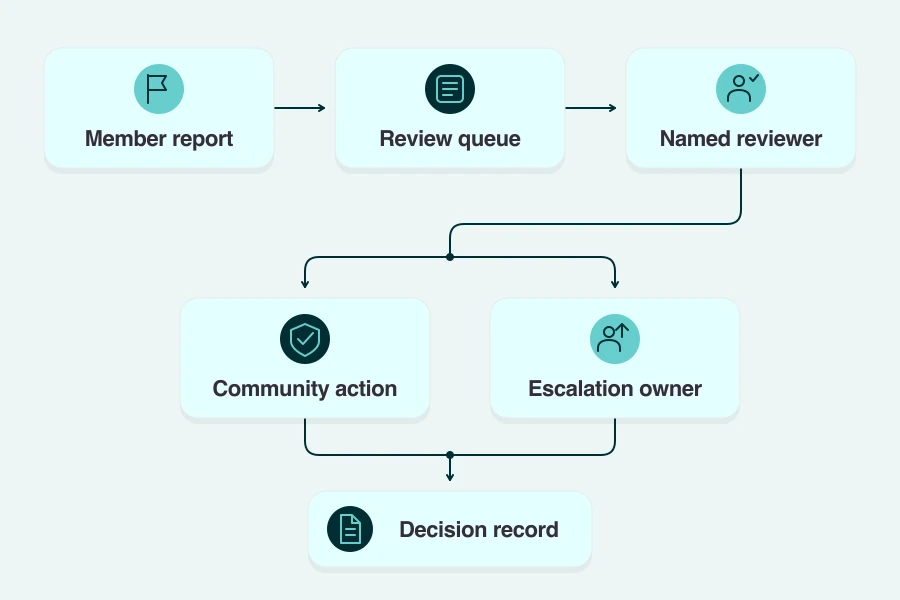
Your trust and safety plan should also specify who can access reported private messages and what context they receive. Explain that access to members. A report should trigger the disclosed review process, not silently give every moderator access to every conversation.
For crisis escalation, have qualified reviewers define locally appropriate protocols and destinations, with a named owner for each handoff. Publish the hours you actually staff, response expectations you can meet, and clear messaging for periods when nobody is monitoring. Make the boundary around emergency support explicit.
If you evaluate automated flagging, use it to assist triage within that accountable process. Keep a reviewer responsible for the action; a flag must not be presented as a diagnosis or a promise that urgent disclosures will always be detected.
HIPAA and privacy depend on who operates the community
Map who handles the information and on whose behalf before making a compliance claim. Under HHS guidance on covered entities and business associates, HIPAA applies to those entities and relationships. Discussing health in an app does not, by itself, make the operator subject to HIPAA.
| Community context | What to assess |
|---|---|
| Consumer-run community | Determine the operator’s role; health discussions alone do not establish HIPAA coverage. |
| Service working on a covered entity’s behalf | Assess whether its handling of identifiable health information creates a business associate relationship. |
These are contexts to investigate, not automatic classifications. Identifiable user-generated content about a person’s health can be protected health information, or PHI, when held or transmitted in a covered entity or business associate context. The member writing the post or message does not create an exemption. Both the information and the relationship matter.
Be precise about anonymity. A member-facing pseudonym is a display choice; account links, narrative details or other information may still identify someone. HHS de-identification guidance recognizes Expert Determination and Safe Harbor. Changing a display name alone does not establish either method or promise that another member cannot infer identity.
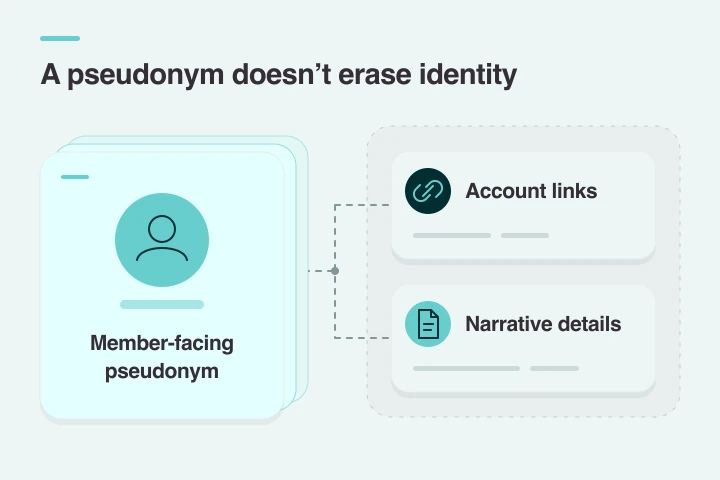
Make data privacy decisions explicit before choosing integrations: who can view a profile, which group can read a post, what a reviewer receives with a report, and how retention or deletion works. Define any handoff into a clinical workflow separately, including what information crosses that boundary.
Outside HIPAA, assess whether the FTC Health Breach Notification Rule applies. It covers defined personal health record vendors, related entities and service providers; an unauthorized disclosure of covered information can trigger notification duties. It does not automatically cover every consumer community.
Use this focused federal overview to frame HIPAA compliance and related questions for your reviewers. A complete determination still needs the facts of your service and the jurisdictions it serves.
Choose technology around permissions and data flows
Choose each component by what it must protect and operate. For health community app development, start with this reference architecture. Decide whether the member journey needs a responsive web app or native distribution; the Specode section below covers the responsive web path.
| Layer | What to decide | What to verify |
|---|---|---|
| Web or mobile client | Member journeys | Joining and reporting work. |
| Authentication | Account identity | Identity stays separate from permissions. |
| Membership and permissions | Allowed actions | Enforce them on the server. |
| Post/message storage | Audience and retention | Records respect access rules. |
| Moderation queue | Reviewer ownership | Restrict case access. |
| Notifications | Generic alerts | Fetch content after access checks. |
| Operational reporting | Usefulness, unanswered requests and workload | Limit access to reports by staff role. |
Follow OWASP authorization guidance: deny by default, grant least privilege and check every request. Test removed members, blocked contacts, direct links and cross-group access. Login alone must not open every conversation.
Keep push notifications generic and retrieve sensitive content inside the app after access checks. For HIPAA-compliant in-app messaging, assess data flows, retention and moderator access alongside the vendor relationship.
HHS cloud guidance treats a provider handling ePHI on a covered entity’s or business associate’s behalf as a business associate even without the decryption key. Address the applicable BAA and risk-management duties; the agreement alone does not establish app-wide compliance.
For native App Store distribution, Apple’s user-generated-content guidelines require filtering, reporting with timely responses, blocking and contact information. Apple also restricts apps used primarily for random or anonymous chat. Pseudonyms do not guarantee acceptance.
Choose a funding model that can sustain moderation
Decide who will fund the community’s ongoing work before you decide which features to charge for. Evaluate these options against the service you can actually staff; each is a model to test, not evidence that customers will pay.
| Funding option | Buyer/funder | Decision or constraint |
|---|---|---|
| Member subscriptions | Participating members | Fund access to a defined paid service; decide what remains available to people who cannot subscribe. |
| Organization-funded access | An organization supporting the community | Fund access and operations for a defined cohort; make membership eligibility clear. |
| Grants or donations | Grant makers or donors | Fund a defined program; plan how access continues when funding changes. |
| Disclosed sponsorship | A sponsor | Fund specified activities or operations; disclose the relationship and set boundaries on sponsor influence. |
Keep basic reporting and safety controls accessible in your design. A member should be able to report unwanted contact without first buying an upgrade. Price the support you intend to deliver, then test the offer with the proposed buyer or funder.
If you add paid professional services, treat the healthcare marketplace as a separate scope with its own provider workflow. Community participation does not establish reimbursement eligibility. Avoid a model built on selling identifiable health stories; make the funding relationship understandable to the people sharing them.
Solve participation and staffing problems in the pilot
Invite a defined cohort and watch how the service actually operates before widening access. When you’re building a health support community, use the pilot to examine four practical risks.
- Empty or poorly matched cohorts: Ask members what they hoped to find, review unanswered requests, and revisit matching preferences. Keep the option to decline or change a connection.
- Unwanted contact or misinformation: Exercise reporting and blocking with your operators before inviting pilot members. Check who owns the report, what they can see and where they record the action.
- Moderator workload: Review the queue with trained staff, including unresolved reports and handoffs. Adjust coverage or the pilot’s scope when the operating commitment needs to change.
- Activity replacing usefulness: Evaluate retention alongside member-reported usefulness and report resolution. Don’t present participation as proof of better health; the clinical evidence remains qualified.
Treat gamification as an optional choice to scrutinize. Avoid public leaderboards for illness disclosure or streaks that pressure people to share. Offer notification preferences that members opt into, without promising that nudges improve engagement or health. In interviews, make room for the person who found a useful conversation and then chose to participate less.
How to build a peer-support app in seven steps
Use the following sequence to turn the operating decisions into a testable release. If you’re deciding how to build a peer support app, require a concrete output from each step before moving to the next. If peer support is one feature in a bigger product, see what it takes to build a mental health app, from V1 features to cost.
1. Define the cohort and support promise.
Choose the adult population and the relationship you want to support. Write the scope and exclusions, including where clinical services sit outside the community. This gives the next step a defined service to staff.
2. Assign roles and coverage.
Name the moderation and escalation owners, their access and staffed hours. Produce the operating model, including what happens to a report outside coverage. Use those responsibilities to inform the data map.
3. Map data and vendor relationships.
Document permissions, privacy requirements and the actual operator’s HIPAA context. Identify cloud services handling ePHI and the applicable BAA and risk-management responsibilities. Give the prototype team those boundaries rather than a generic compliance label.
4. Prototype the full interaction.
Test joining, accepting or declining a match, conversing and reporting. Use synthetic data rather than real patient stories in public prototypes. Gather usability feedback on both the member journey and the operator’s response.
5. Build the MVP and operator tools.
Implement the agreed member flow, permissions and report queue together. Produce a release your team can test against the written scope, including the screens and records operators need to carry out their assigned responsibilities.
6. Run release scenarios.
Test removed-member access, blocked contact, notifications and report handoffs with trained reviewers. Check authorization on every request and fetch sensitive content only after access checks. Record a release decision; clinical workflow review remains assigned human work.
7. Pilot and review.
Open the service to the bounded cohort and review usefulness, unanswered requests and workload. Turn those findings into a prioritized next iteration. When a test exposes a gap, revisit the earlier decision that created it before adding features.
Budget the build and the community’s ongoing work
Ask for an estimate against a written scope. A quote for peer support platform development should explain the member experience and the operating work it includes, so you can compare more than the final number.
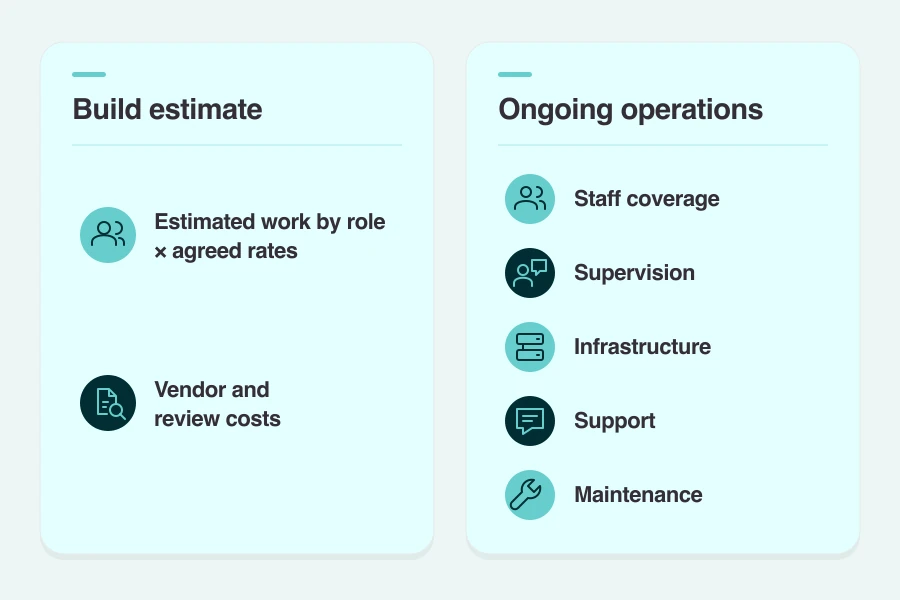
Use this build model: estimated work by role multiplied by agreed rates, plus vendor and review costs. Budget ongoing operations separately: staff coverage, supervision, infrastructure, support and maintenance. Don’t let the launch estimate stand in for the cost of running the community.
| Quote scenario | Added scope | Inputs needed for an estimate |
|---|---|---|
| Closed text community | Membership, posts, messaging and report handling | Cohort size, access rules, retention and moderation coverage |
| Matched peer program | Preferences, suggested connections and peer oversight | Matching choices, roles, training and rematching workflow |
| Integrated provider-affiliated community | Defined handoffs and external integrations | Data relationships, interface scope, review responsibilities and release checks |
Ask each bidder to state assumptions about user roles, identity rules, messaging or media, integrations and testing. Specify whether the quote includes operator tools, privacy review and the release obligations your team has identified. If the assumptions differ, reconcile them before comparing prices.
Estimate timing after the scope, staffing, dependencies and release checks are defined. A text community and an integrated service are different estimation problems; a generic calendar range would hide those differences. Keep the build estimate and the ongoing staffing commitment visible when deciding what your first release can support.
How Specode can help you build the first release
Bring your cohort, operating model and MVP requirements to Specode. Its AI-powered healthcare application builder lets you:
- Describe your responsive web app in plain English.
- Define the UI, workflows, data model, permissions and integrations.
- Send HIPAA Agent findings to the AI coder for changes, then re-run the scan.
- Get a single team review for security and HIPAA readiness before production.
Discuss the member roles, matching choices and group access you need, alongside the report queue and staff handoff. Describe these as requirements for your application rather than assuming a ready-made peer-support module.
The HIPAA Agent scans code inside your project from the Compliance Center, reporting potential issues and separating findings it treats as must-fix from recommended hardening. The scan supports review; it does not certify compliance.
The scan and pre-production review do not replace your risk analysis, audit, or clinical, legal, privacy and compliance responsibilities. Your team still owns the community’s staffing, policies, training and safeguards.
If you’re ready to create a peer support app, start with those requirements and the people accountable for running the app. Discuss your community app with Specode.
Frequently asked questions
It’s a digital space where people share lived experience and practical or emotional support through groups or matched peers. Participation and connections should be voluntary; the community’s support role is distinct from clinical care.
Use clear rules, reporting and blocking, trained reviewers, recorded decisions and a staffed escalation process. Define the team’s coverage and service boundaries explicitly; moderation does not imply continuous monitoring, clinical decision-making or emergency support.
It can be. Identifiable health information in a covered entity or business associate context may be PHI. Member authorship or a pseudonym does not itself remove protection; assess the information and the operator’s role.
Evaluate member subscriptions, organization-funded access, grants or donations, and disclosed sponsorship. Define who pays and what they fund, then test the offer. These are options to assess, not guarantees of demand or profitability.
Timing depends on the feature scope, integrations, staffing, privacy review and testing. Estimate the schedule after those requirements and dependencies are defined, with a release decision that covers the operator’s work as well as the software.