Med Spa App Development: How to Build a HIPAA-Compliant Aesthetics Platform

Aesthetics founders, med-spa owners, MSO operators, and product teams face a deceptively simple brief: connect discovery, booking, care, payment, and follow-up in one branded experience.
The catch is that many reviewed aesthetic procedures are regulated clinical care, while superficial services may be treated differently. Texas, Connecticut, and California already show materially different rules for assessment modality, clinician roles, supervision, and ownership or control. That makes a single national workflow unsafe as a starting point.
Good med spa app development therefore begins with requirements, not a feature catalog. Build a state-configurable map of jurisdictions and services, the people authorized to make each clinical decision, the records and vendor controls that govern the data, and the evidence created at every handoff. Only then should the team choose a web or store channel, compare platforms with a custom build, and estimate the work.
How do I build a HIPAA-compliant med spa app?
Start by proving which rules and clinical decisions apply to each launch workflow. To determine how to build a med spa app, treat software as the evidence system around care, not as a substitute for authorized people or operations. It can support legal and regulatory work, but it cannot guarantee compliance, and HHS does not certify products. The Texas example illustrates why launch-state review matters.
Key takeaways
- Validate regulatory applicability before selecting technology. Create a launch matrix for each launch state, service, clinician role, and delivery modality, then record the current source and reviewer for approval before choosing controls, labels, or vendors.
- Make the patient-specific clinical decision a real treatment gate. Require evaluation, decision, order, consent, and reassessment before treatment, with an authorized author, reviewable evidence, and an explicit exception path before release. Keep assessing, ordering, prescribing, injecting, supervising, reviewing, and administering as separate permissions; a job title alone cannot grant runtime authority.
- Control the data lifecycle. Map PHI, vendor, security, consent, and audit controls to named owners and evidence. Cover records, photos, access, changes, retention, exports, vendor data flows, and support access from capture through deletion.
- Scope before choosing or estimating. Select the channel and build model, then compare buying and building against one complete, scoped workflow. Launch-state research and operational ownership continue after selection under formally named owners.
Why med spa software must model clinical care
Medical classification changes what the product must prevent, permit, and record. Texas treats nonsurgical medical cosmetic procedures such as cosmetic injections as delegable medical acts with patient-relationship, record, order, protocol, supervision, and emergency-readiness elements.
Connecticut separately requires an initial in-person assessment by a physician, PA, or APRN before a cosmetic medical procedure, although an RN can be among the procedure performers. California offers another state-specific example: physicians may inject Botox or direct supervised RNs or PAs to inject, while unlicensed medical assistants may not.
That does not turn every facial or retail service into medicine, nor does it settle HIPAA applicability. It means aesthetic clinic app development needs a service-by-state table before screens are designed. Retail tasks can present catalog, availability, and payment options. Clinician tasks may need:
- credential checks,
- patient-specific evaluation,
- orders,
- consent,
- supervision,
- and controlled records.
In medical spa app development, those classifications become treatment blockers, role-based permissions, and evidence requirements. The representative states differ enough that each launch state, provider type, treatment, and modality needs current review rather than a copied national rule.
The compliance backbone starts with applicability
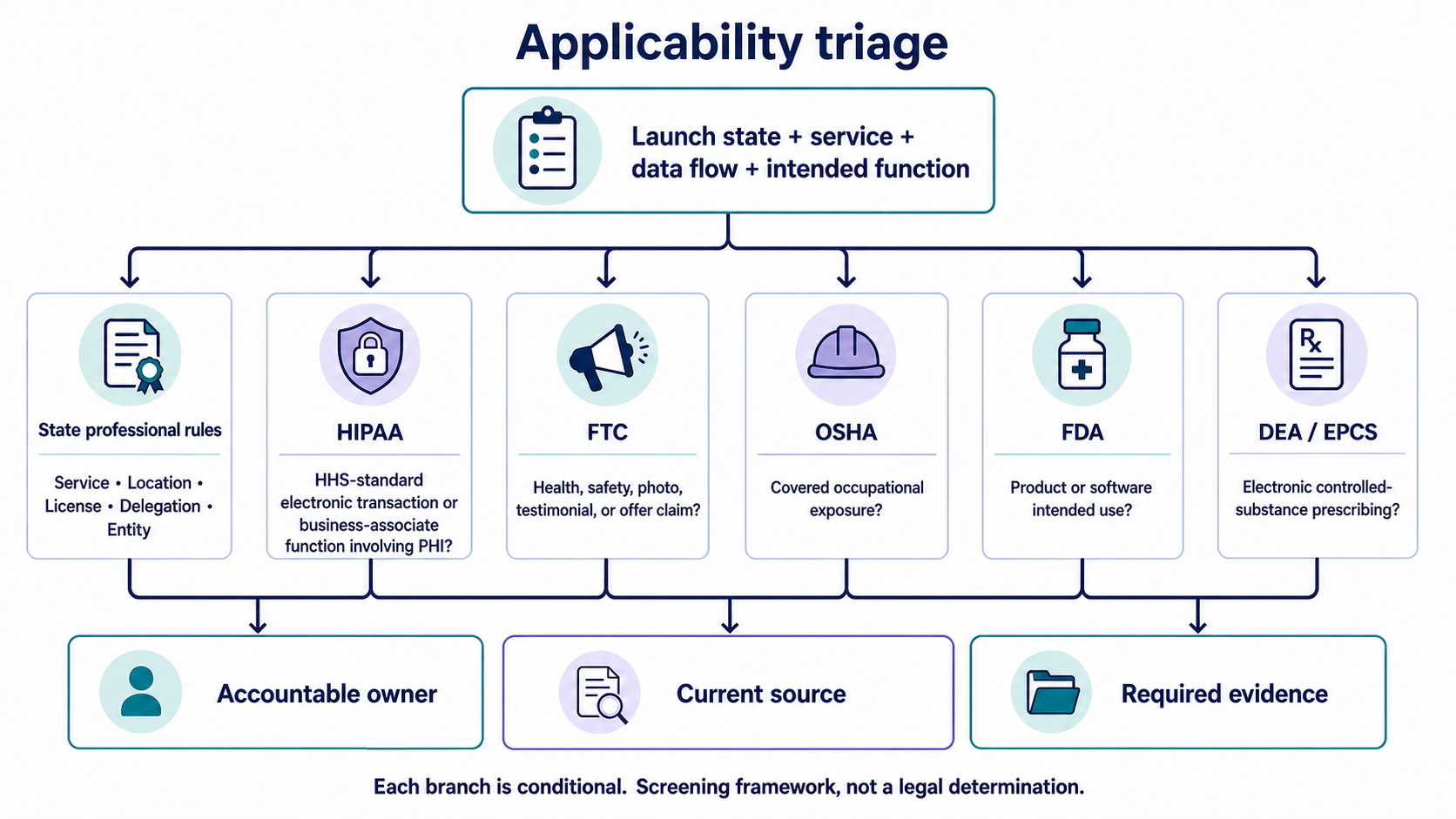
Start with the launch state, service, data flow, and intended function; each regulatory branch is conditional and requires a current source and accountable owner.
HIPAA is a branch, not an automatic label. Under HHS covered-entity guidance, a provider is covered when it electronically conducts an HHS-standard transaction. A vendor can be a business associate when its function creates, receives, maintains, or transmits PHI for that entity; a software sale alone does not always do so. Trace hosting, support, and downstream access with HHS business-associate guidance, its software-vendor analysis, and a written business associate agreement (BAA).
If HIPAA governs, the term HIPAA compliant med spa software is a buyer phrase, not a certification. HHS and OCR do not certify products, as the HHS warning on misleading HIPAA claims explains.
HIPAA compliance depends on risk analysis and operation: roles, unique identities, authentication, access, audit controls, integrity, transmission security, incidents, vendors, and activity review under the HIPAA Security Rule and its technical safeguards. Aim for auditable, jurisdiction-configurable evidence, not a guarantee.
Build the good faith exam as a documented encounter
A good faith exam (GFE) is useful industry shorthand, but it is not a uniform federal term. The Texas delegation rules for nonsurgical cosmetic procedures require a patient-provider relationship (PPR), adequate record, disclosure, patient-specific written order, protocol, supervision, and emergency readiness for the covered delegated procedures.
The Connecticut medical-spa statute instead requires an initial in-person physical assessment by a physician, PA, or APRN. Those examples make the assessment name, author, modality, and cadence configurable.
Good faith exam software should capture:
- patient identity and location; assessor identity, credentials, and authority;
- history and evaluation evidence; the treatment decision and patient-specific order;
- informed consent, authorship, authentication, and timestamps;
- the governing rule version, protocol version, exception path, and follow-up or reassessment trigger.
A telehealth good faith exam is appropriate only where current law and clinical standards permit it. The workflow should record identity, patient and practitioner location, participants, consent, privacy context, and follow-up, while securely handling any recording.
HHS offers telehealth privacy guidance, and California requires telehealth disclosure, consent, and documentation under BPC section 2290.5.
The FSMB telemedicine model guidance is a model, not binding law, and rejects questionnaire-only care when it cannot gather the information the standard of care requires. A separate implementation guide covers HIPAA-compliant video for telehealth where HIPAA applies.
Standing orders do not replace patient-specific decisions
Texas shows how standing orders and individualized care can coexist. A written protocol can define patient-selection criteria, instructions, required supervision, emergency steps, and review.
The same workflow can still require a patient relationship and record, an authorized patient-specific order, supervision, emergency readiness, and later review before a delegated procedure proceeds.
A reusable template should never auto-clear a patient when current rules or clinical standards require individualized review.
For each protocol, capture:
- version, approving clinician, approval and review dates, and eligibility criteria;
- required physician oversight and supervision, escalation contacts, and emergency steps;
- the exact version applied to the patient, including author, timestamp, exception, and outcome.
Permissions should also separate the medical director, assessor or orderer, injector, reviewer, and administrator. The title of medical director does not itself settle who may assess, order, prescribe, supervise, or control the practice. Configure those authorities from current state law, entity structure, credentials, and the actual operating model.
CPOM and MSO structure shape permissions and accountability
Corporate practice of medicine (CPOM) and management services organization (MSO) boundaries are state-dependent. California illustrates the concern: specified clinical decisions and medical-practice control remain with licensed professional ownership and control, while an MSO may provide administration without exercising clinical control.
The Medical Board of California corporate-practice guidance places diagnosis, treatment, clinical hiring, records, and related decisions on the professional side. Use state-specific counsel to design the entity and authority model.
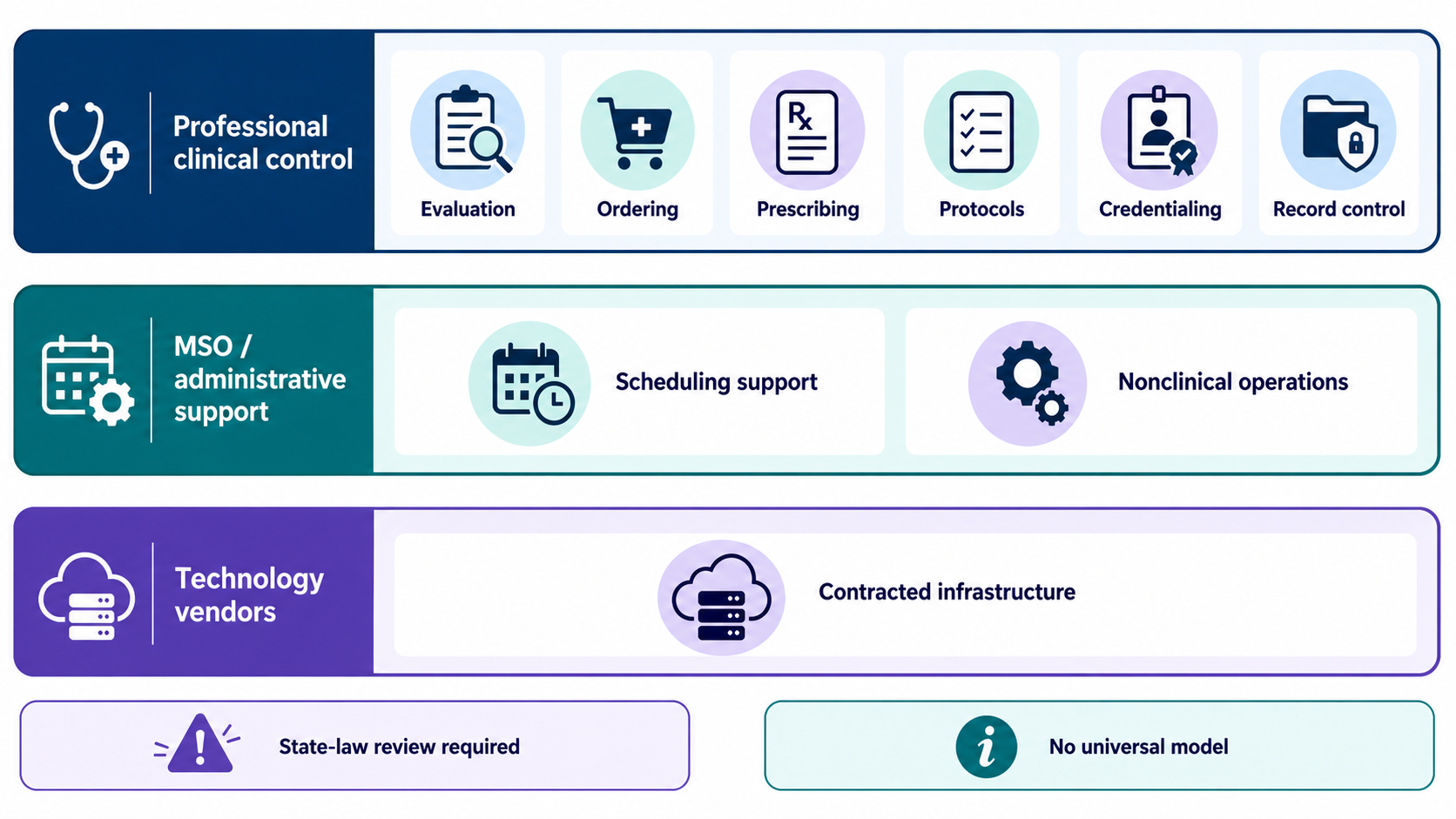
Clinical, administrative, and vendor responsibilities should be mapped separately and reviewed against current state law.
In medical spa software, an admin may support scheduling or billing without gaining authority to change treatment, prescribing, protocol, or record-control decisions. Texas, Connecticut, and California remain examples, not one national entity model.
Encode injector scope state by state
A medical aesthetics app needs a rule matrix that separates assessment, ordering, prescribing, injecting, and supervision.
This is not a 50-state survey. Check scope of practice with the current state medical board and nursing authority. For a non-physician injector, RN injector, nurse practitioner, or physician assistant, record the source URL, effective date, reviewer, and revalidation schedule. The NCSBN scope-of-practice framework is educational, not binding law.
An injectables and Botox clinic app can then check patient state, service, credential, approved protocol, prescribing authority, and patient-specific decision before permitting treatment. Apply that same separation to neuromodulators and dermal fillers rather than assuming injection permission also confers assessment, ordering, or prescribing authority.
Build the product around clinical and operational handoffs
The clinic needs an end-to-end evidence chain, not a universal label. A med spa booking app or online booking app can be the entry point, while a med spa scheduling app, aesthetics platform software, and med spa management software coordinate patient, assessor or prescriber, injector, reviewer, front-desk, and admin surfaces. Generic booking, billing, storage, or display functions are not automatically medical-device functions; intended use and operation drive that analysis.
- Intake: collect identity, location, requested service, disclosures, and consent context.
- Eligibility: test state, age or service rules, prerequisites, and unresolved exceptions.
- Evaluation: route to the authorized assessor and preserve evidence.
- Decision and order: authenticate the author, bind the protocol, and block treatment until approval.
- Scheduling, reminder, and deposit: open eligible slots, issue reminders, and separate the financial commitment from treatment authorization. A related implementation guide covers HIPAA-ready scheduling with Stripe payments where its assumptions fit.
- Treatment: verify the injector and supervision, then record completion.
- Chart and photos: attribute the record, originals, changes, reviews, and exceptions.
- Product use and prescription: capture inventory and lot tracking when required; connect e-prescribing only where needed, with separate controlled-substance controls; see the e-prescription app integration pattern.
- Payment: post integrated payment processing and point of sale (POS) events to the ledger without rewriting clinical status.
- Follow-up and rebooking: trigger monitoring, escalation, reassessment, and the next eligible appointment.
Vendor function and PHI access determine contracting and downstream obligations, while risk-based identity, access, integrity, transmission, and activity-review controls remain operational requirements.
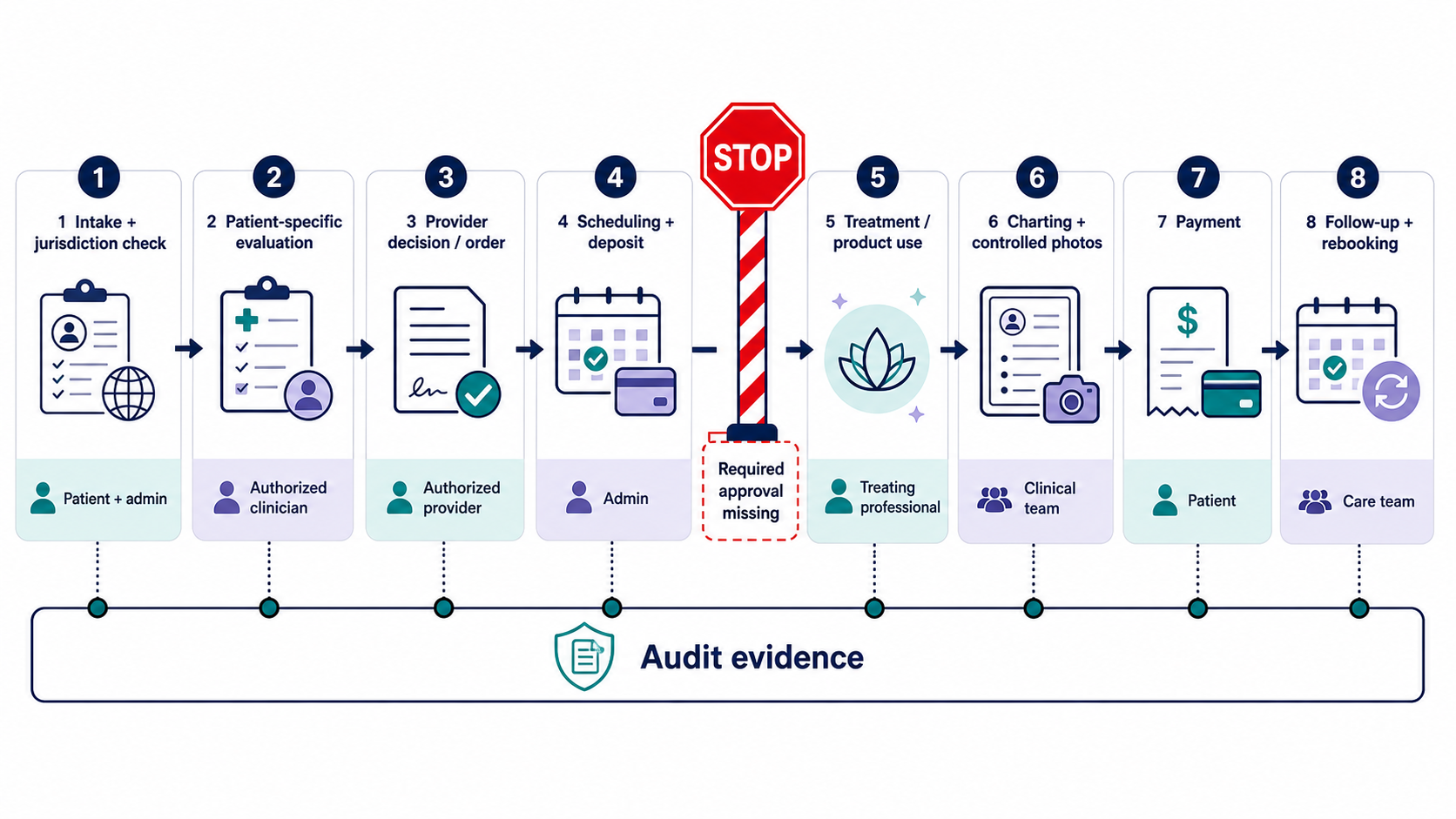
At every handoff, preserve the authorized role, decision, record, timestamp, and audit evidence; block treatment when required approval is missing.
Choose web, PWA, and native channels by workflow
The native app vs PWA decision should follow validated work, not branding alone. A med spa patient app or patient-facing app may prioritize low-friction intake, booking, payments, and follow-up. A med spa provider app or provider or staff app may need reliable camera capture, rapid chart access, and constrained offline work. Specify whether a mobile app (iOS or Android) is actually required before committing to a med spa mobile app.
Neither channel is inherently more secure or compliant. Test workflows, devices, accessibility, distribution, release ownership, support, and total cost, then recheck platform policies. If branded telehealth is part of the scope, use the white label telehealth platform guide as adjacent channel analysis, not as proof of compliance.
Treat photos and charting as controlled clinical data
In med spa software, a photo should move through a controlled data flow: original capture, clinical derivative with photo markup, inclusion in treatment records and charting, and, only when separately authorized, a marketing copy.
A med spa EMR may combine before-and-after photos with SOAP notes, but each object still needs its own:
- provenance,
- purpose,
- access boundary,
- permissions,
- and documented retention context.
Whether an image is protected health information (PHI) is conditional. It is PHI when it is identifiable health information maintained or transmitted by a covered entity or business associate under the HIPAA definitions. Full-face photographs and comparable images are Safe Harbor identifiers, and cropping the face may still leave identifying context. De-identification must satisfy the HIPAA de-identification standard, not a later blur assumption.
Keep treatment consent, photography consent, and marketing authorization separate. When HIPAA governs, public marketing use of identifiable patient information generally requires a valid authorization under the HIPAA authorization rule.
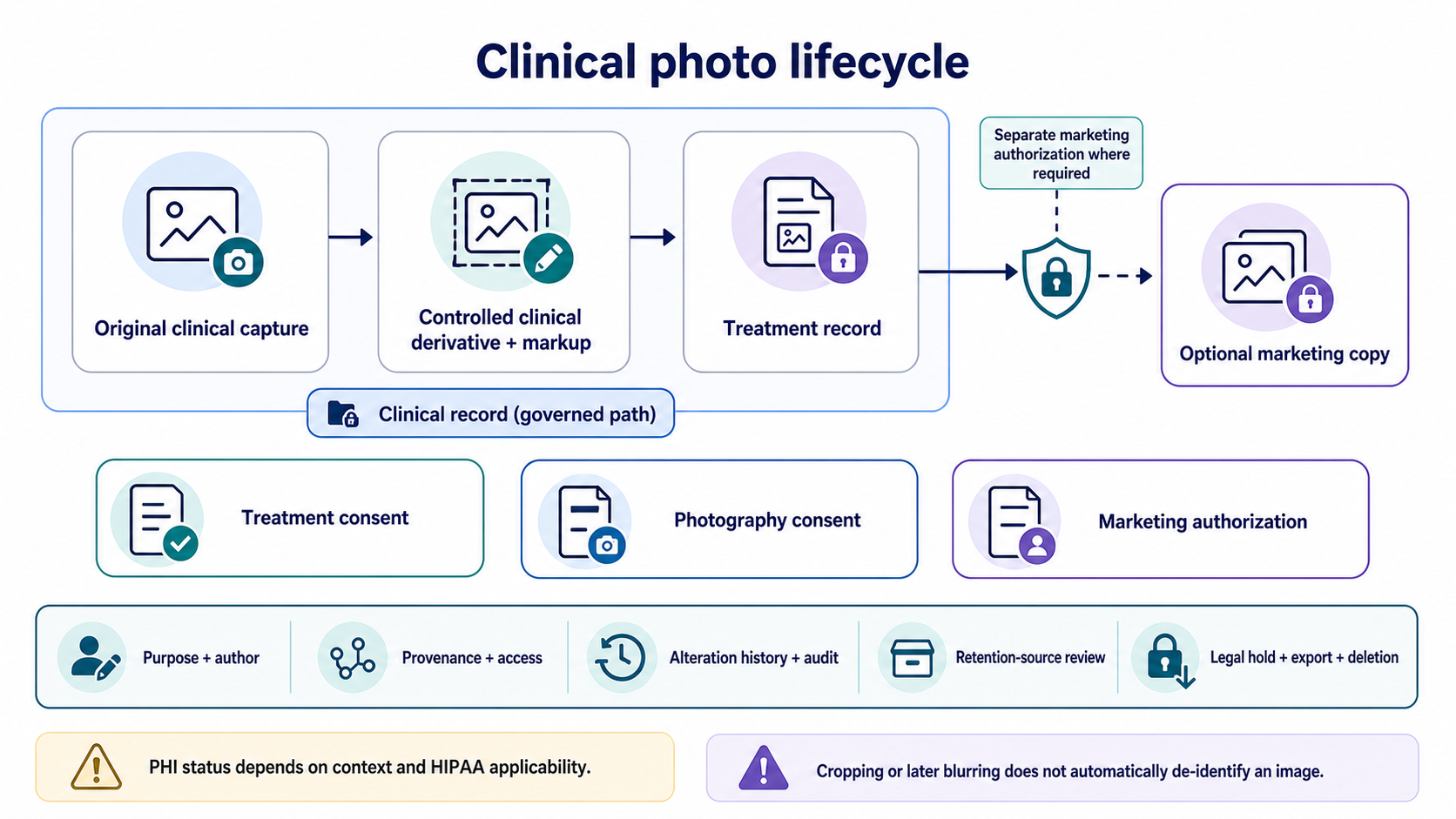
One capture can become distinct clinical and marketing objects, each with a separate purpose, access boundary, history, and approval evidence.
The control checklist should cover originals and derivatives, authorship, role-based access, alteration history, authentication, integrity, transmission, legal hold, export, deletion, and an audit trail.
Record the authority for retention rather than hard-coding a universal period: HIPAA does not set the patient medical-record retention period, while applicable state law generally does, as the HHS medical-record retention FAQ explains. Risk-based safeguards and system-activity review still apply where HIPAA governs.
Crossover services expand the clinical workflow
These services can require additional prescription, pharmacy, protocol, monitoring, product, safety, follow-up, and escalation records. Booking, billing, storage, or display alone is not automatically a device function; diagnosis, analysis, dosing, recommendations, or device control needs function-specific review under FDA device-software guidance.
Treat OSHA, FDA device rules, and DEA requirements as conditional branches, not a universal bundle. For adjacent requirements work, consult the telemedicine platform for peptide and longevity clinics guide and the GLP-1 virtual clinic guide without importing their product claims.
Add growth features without weakening clinical controls
Aesthetic clinic software can combine a med spa CRM with memberships, packages, and loyalty, plus a no-show and deposit policy. The commercial ledger and the clinical record must remain separate.
For example, buying an injectable package may create a balance and booking entitlement, but it cannot mark the patient eligible, record clinical consent, or authorize treatment. Cancellation and refund decisions likewise should not rewrite a clinician's assessment.
Marketing needs its own controlled path. Under FTC advertising rules for medical claims, the net impression of photos, testimonials, headlines, offers, and surrounding context must be truthful, nonmisleading, and adequately substantiated. A testimonial or disclaimer does not automatically cure an unsupported implication. Use the FTC health-products advertising guidance as the review framework.
For each campaign, record:
- the authorized purpose and permitted audience segment;
- substantiation and the boundary between care data and marketing data;
- the review owner, approval timestamp, published version, and campaign audit history.
When HIPAA governs, public marketing use of identifiable patient information generally needs a valid authorization under the HIPAA marketing-authorization rule, separate from treatment and photography consent.
Compare configuration limits with ownership burden
As of August 15, 2026, vendors list clinical and operational functions. These are vendor-stated, not proof of quality, equivalence, outcomes, fit, or compliance. Verify plans, add-ons, integrations, exports, APIs, BAAs, contracts, and exit terms.
Compare platform configuration and med spa software development against the same requirements. A custom med spa app puts governance, security, validation, maintenance, integrations, incident response, and change control on named owners; it does not guarantee compliance or code ownership.
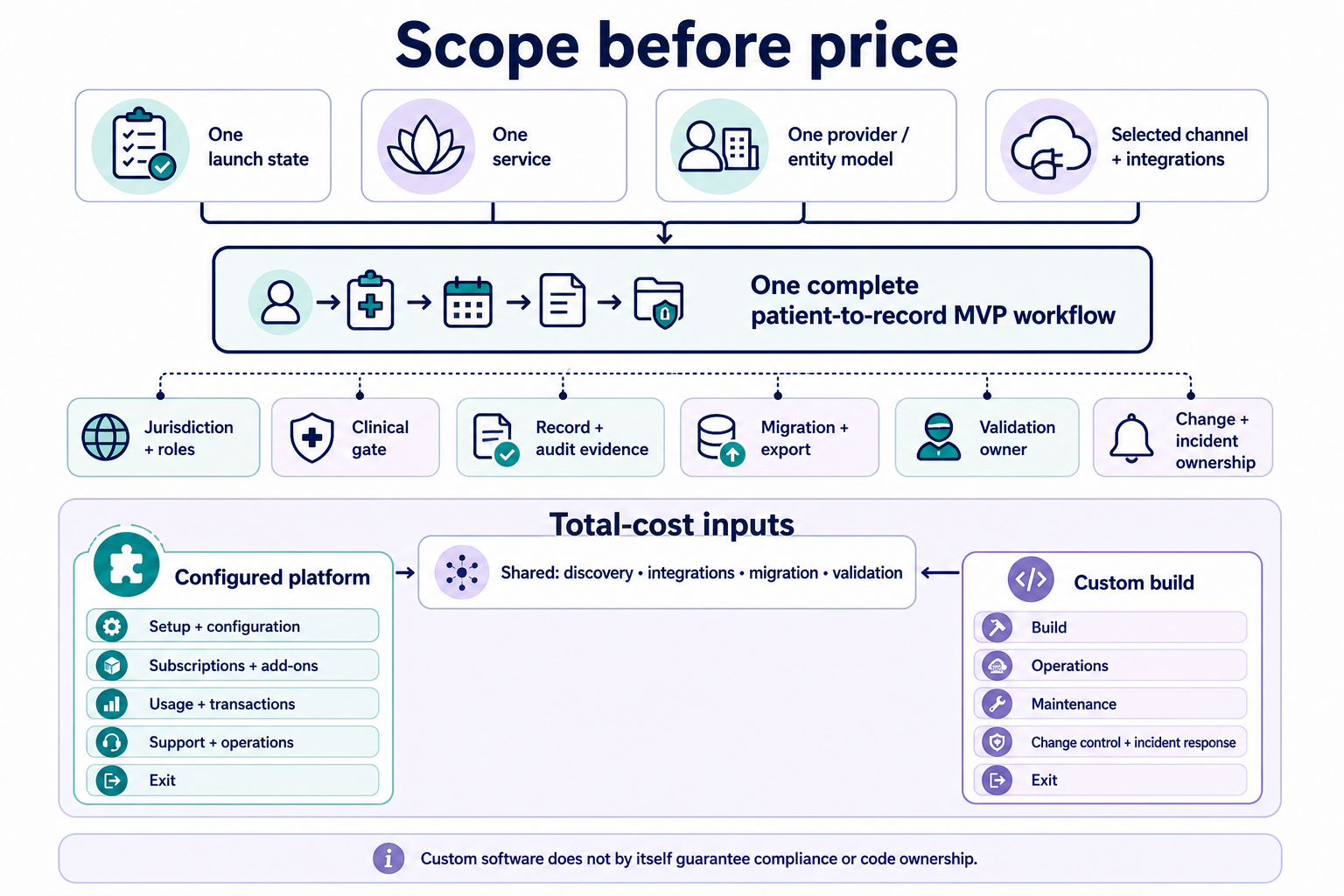
Estimate one complete, scoped workflow first, then add implementation, validation, operating, maintenance, and exit costs across the chosen build model.
Estimate total cost from clinics, states, services, roles, channels, integrations, migration, validation, support, and operating period. Separate build work from subscriptions, implementation, add-ons, usage, transactions, support, and exit. Incremental planning lets estimates improve as scope and delivery evidence become known, but the GAO Agile Assessment Guide supplies no med-spa price or timeline.
Define the minimum viable product (MVP) as one complete safe workflow for a named jurisdiction, service, and provider model. Defer optional growth features, not the clinical evidence required to treat that patient.
How Specode can help
A healthcare AI app builder, AI med spa app builder, or no-code or AI healthcare app builder may help a founder build a med spa app with AI at prototype stage. It does not remove the need for clinical, legal, privacy, security, product, validation, and operating owners.
Bring a requirements brief that names:
- launch states and services; entity and control boundaries; authorized roles;
- clinical gates, consent and records, integrations and vendors, and the delivery channel;
- migration and export needs, validation owner, operator, and reassessment triggers.
According to Specode documentation, Specode translates plain-English requirements into a configurable responsive web application whose UI, workflows, data model, permissions, and integrations the customer defines.
Under the current Specode Terms of Service, customers retain rights in their data, content, code, and applications, with code and application export during subscription and for 60 days after termination, subject to Specode and third-party rights and customer-managed-integration responsibility.
Bring Specode your launch-state authority matrix and complete patient-to-record workflow. We can use them to scope med spa software development around the clinical, data, integration, and ownership decisions your team has reviewed.
Frequently asked questions
Not automatically. Test whether a provider conducts electronic HHS-standard transactions and whether vendors perform business-associate functions involving PHI. Otherwise, state privacy, records, security, advertising, and consumer duties may apply. HHS does not certify products; labels or BAAs alone are insufficient.
It is shorthand for a patient-specific assessment or relationship requirement whose legal name, clinician, modality, content, and cadence vary. Texas requires a relationship; Connecticut requires in-person assessment. Software should record assessor, evidence, decision, order, consent, timestamps, rule, and treatment gate.
Jurisdiction, license, procedure, delegation, supervision, and competence control authority. Connecticut separates RN performers from physician, PA, or APRN assessors; California permits supervised RN Botox injections. Injection does not confer assessment, ordering, or prescribing. Check current medical and nursing rules.
Photos can be PHI when identifiable health information is handled by a covered entity or business associate. Full-face images are Safe Harbor identifiers; cropping may be insufficient. Keep clinical records separate: treatment or photography consent does not replace marketing authorization.
Buy after dated review confirms Zenoti, Boulevard, or Aesthetic Record fits your workflow, integrations, exports, add-ons, contract, and exit terms. Build custom if you can own governance, validation, security, maintenance, and change control; neither path proves compliance or code ownership.
App development cost has no universal figure. Define jurisdictions, services, access roles, workflow, channels, integrations, migration, security, validation, and lifecycle. Estimate one complete MVP, refine with delivery evidence, and separate build from subscriptions, implementation, add-ons, usage, transactions, support, and exit.