How to Build a GLP-1 Virtual Clinic in 2026

Updated October 2026
GLP-1 virtual clinic development starts with a care model you can put into software. Decide which patients and states you'll serve, who reviews treatment, how prescriptions reach a pharmacy, and who handles follow-up. Those choices determine the workflows your team has to build and the agreements it needs before opening.
Keep the clinical decisions visible throughout the product. A completed intake needs a review path. A prescription needs a record of what the clinician authorized.
Patients need a way to report symptoms and reach the care team after dispensing. Each handoff deserves an owner and a test case.
For an adult weight-management clinic in the U.S., the build also has to accommodate different medication indications and formulations, state practice requirements, and the pharmacy arrangement you've selected. Set those boundaries before commissioning a broad feature list. You can then ask vendors for a quote tied to the same scope and decide which work belongs in the first release.
How do you build a GLP-1 virtual clinic?
Define the clinical service and launch states, arrange prescribing and pharmacy access, then build the patient and clinician workflows. Test the complete care path and prepare the production safeguards and vendor agreements before accepting patients.
Key Takeaways:
- Keep clinicians in control: Screening and payment must lead into an authorized prescribing decision and a supported follow-up path.
- Price a defined scope: Published agency estimates cover different implementations. Separate development work from recurring technology and clinical operations.
- Test the handoffs: Check patient-state routing, pharmacy exceptions, access permissions and recovery before opening the clinic.
What is a GLP-1 virtual clinic?
A GLP-1 virtual clinic delivers a remote care program around prescription treatment and follow-up. The software connects patients with the clinical team and supports the work between encounters: intake, treatment records, pharmacy questions and ongoing communication.
For a founder, the opportunity starts with choosing the service you can actually deliver. An existing practice adding remote weight-management care has different needs from a new program building its clinical operations. Establish who owns the patient relationship and which clinical systems the team already uses before deciding how much new software to commission.
Keep each medication's approved use visible
The 2026 prescribing information gives these brands different approved uses. Keep those distinctions in the product catalog and clinician workspace.
Wegovy / Zepbound / Ozempic
| Product | Ingredient | Adult-use distinction relevant to this guide |
|---|---|---|
| Wegovy, June 2026 label | Semaglutide | Weight-management indications include obesity, or overweight with a weight-related condition, alongside reduced-calorie eating and increased activity. The label includes injection and tablet forms. |
| Zepbound, August 2026 label | Tirzepatide | Approved for long-term weight reduction in adults with obesity, or overweight with a weight-related condition, alongside reduced-calorie eating and increased activity. |
| Ozempic, June 2026 label | Semaglutide | Approved indications concern adults with type 2 diabetes, including specified cardiovascular and kidney risk reductions. It isn't approved for weight management. |
This comparison is scoped to the development decisions in an adult weight-management program. The products have additional label details that the clinical team must review. Store the prescribed formulation and instructions with the treatment record, and let clinicians control the treatment decision.
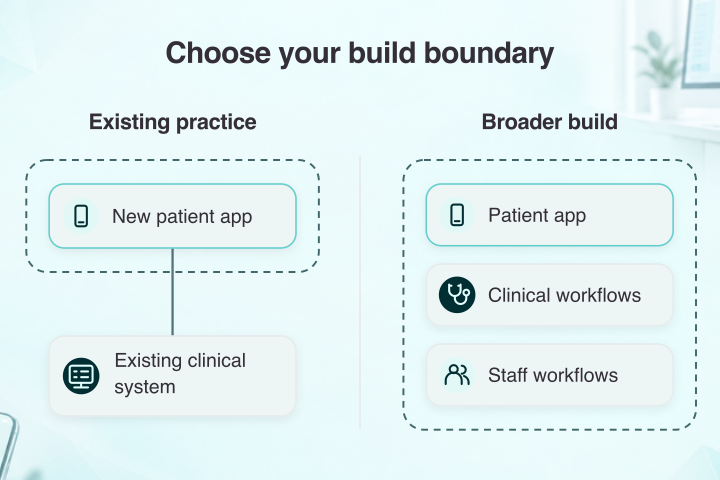
Choose the operational gap you intend to address. You might need a patient front end that connects to an existing clinical system, or a broader service with staff workflows and pharmacy coordination.
Write that choice into the brief for your development team. It determines which records the new app owns, which systems it connects to, and who has to accept the finished workflow.
GLP-1 clinic software needs a clinical review path
Choose GLP-1 clinic software features by following a patient through the service. Work out what the clinician needs to see at each decision and what staff must do when the normal path stops.
Give each feature an operational owner
The feature table can double as a first-release acceptance checklist. Assign a person to approve each workflow, including its exception path, before marking it complete.
| Feature or workflow | What the first release should support | Acceptance check |
|---|---|---|
| eligibility & BMI screening | Capture height, weight, relevant history and current medications for clinician review. Record the encounter location and route patients to an authorized clinician. | Test an incomplete intake and a patient whose location changes between enrollment and the visit. |
| Clinical review and documentation | Give clinicians access to the relevant history and a way to ask follow-up questions. Preserve the evaluation and treatment decision in the record. | An intake submission or successful payment can't create a prescription. |
| titration & dose tracking | Record the prescribed product, formulation, dose and clinician-authorized changes over time. | Each change retains the previous instruction and the clinician's decision. |
| side-effect logging | Let patients report symptoms and give staff a visible review and escalation path. | A report reaches the responsible clinical queue, with an owner for follow-up. |
| Scheduling and communication | Support appointment availability, patient access and communication around the encounter. | Rehearse a rescheduled visit and a patient who needs further evaluation. |
| pharmacy fulfillment | Keep the prescription and pharmacy response connected, with room for questions, changes and refill requests. | Staff can find an unresolved pharmacy request without searching separate message threads. |
| insurance verification | Scope benefits checks, required documentation, prior authorization and denial follow-up around the actual payer arrangements. | An eligibility response doesn't automatically mark the medication covered or the claim paid. |
| RPM / smart scales | Add connected-device data when the care model needs it. Keep manual entries distinguishable from device-transmitted observations. | A patient-entered weight doesn't automatically create an RPM billing event. |
NIDDK's June 2024 guidance describes adult medication consideration at BMI 30 or above, or 27 or above with a weight-related health problem. Use screening to collect information for the clinician. The clinical review also needs the medication history and relevant contraindication information identified in the product labels.
Keep the treatment record specific enough for a clinician to understand what happened between visits. A patient may report symptoms after a prescribed change or ask a pharmacy question through messaging. Connect that communication to the relevant treatment record so the reviewer can see the context and document the response.
Design the clinician workspace around pending decisions. Keep the intake submitted for review visible with subsequent updates. Mark incomplete information.
Ask the clinical owner to rehearse a record that needs clarification before a prescription can be authorized. The acceptance check is whether the reviewer can identify the missing information and record the next action.
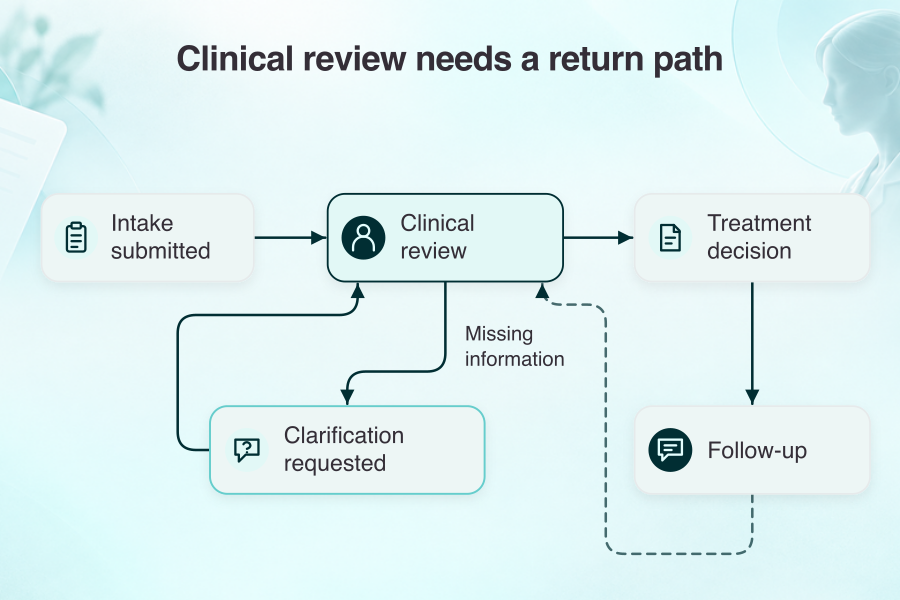
Give patients an equally clear view of their next step. Show whether the team is waiting for information, reviewing the encounter or following up with the pharmacy.
Use status wording that matches the event your app can establish. Confirm with operations who answers when a patient asks why the process hasn't advanced, and make that response part of the service design.
Separate monitoring from billing scope
CMS's May 2026 RPM overview describes connected medical devices, transmitted physiologic data, setup and education, and treatment management. A weight-entry screen alone doesn't establish eligibility for reimbursable RPM. If reimbursement is part of the model, verify the current payer and service requirements before building the billing rules.
You can launch with manually entered observations if that fits the approved care workflow, then scope device connectivity separately. Give the clinical team a clear way to distinguish the source of each observation and decide what needs review. Avoid adding device support solely to populate a feature checklist.
Patient and provider workspaces also need different permissions. Patients should see their own information; clinicians need the records relevant to their work.
Support staff need a defined access scope. Test these boundaries directly, including exports and staff offboarding.
For the intake flow itself, use our guide on how to improve patient intake efficiency. Keep the GLP-1-specific clinical review and prescribing decisions in the workflow you design here.
GLP-1 clinic compliance depends on the care model
Map compliance to the service you're opening and the data each vendor handles. Assign an owner to resolve practice requirements and another to validate the software and production setup. Record the decisions so implementation doesn't depend on an assumption made during a sales call.
Confirm patient-state authorization before routing care
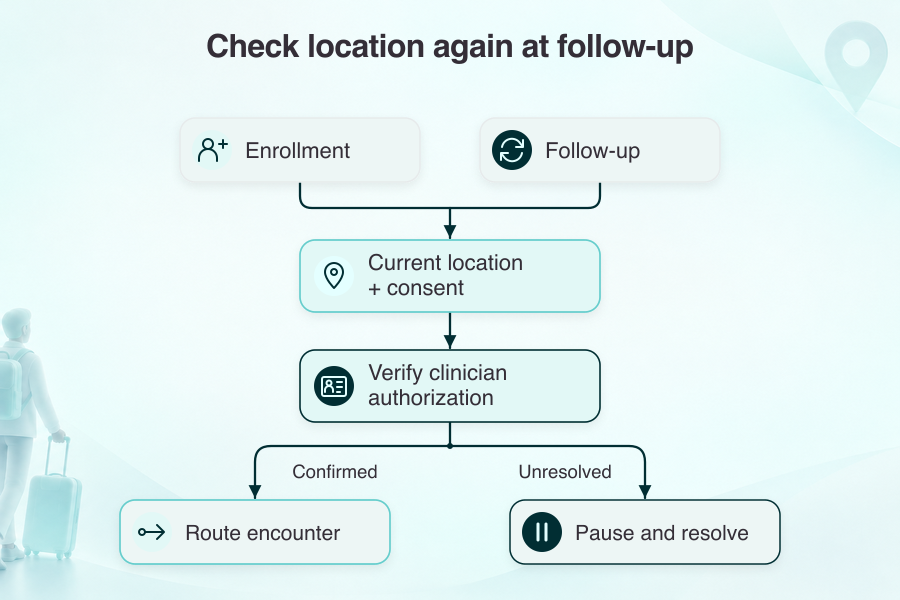
HHS's April 2025 cross-state guidance advises verifying the patient's location and obtaining consent before the appointment. Confirm that the assigned clinician has the license or other authorization required for the state where the patient receives care. The available pathways can include full licensure, qualifying exceptions or telehealth registration.
Design location checks into follow-up encounters as well as enrollment. A saved home address won't tell you where a traveling patient is receiving care. Your routing should pause an unsupported encounter and give staff a way to resolve it.
FSMB's April 2022 model guidance calls for a documented evaluation and relevant clinical history before prescribing. It's model guidance, so check the applicable state rules and standard of care when choosing synchronous or asynchronous workflows. Give clinicians a path to request further evaluation.
Separate e-prescribing / EPCS requirements
Review e-prescribing / EPCS requirements against the actual formulary.
The 2026 Wegovy, Zepbound and Ozempic labels list no DEA controlled-substance schedule. EPCS means electronic prescribing for controlled substances; the DEA's July 2023 EPCS answers describe the additional application, practitioner identity-proofing and two-factor signing requirements for that scope.
Confirm your actual formulary with the prescribing vendor. If the clinic adds controlled medications, review that expanded scope before changing the prescribing flow. Continue to check applicable state prescribing rules for the noncontrolled products too.
Keep compounded GLP-1 rules tied to dated FDA guidance
For compounded GLP-1 products, FDA's guidance on unapproved GLP-1 drugs, reviewed in October 2026, states that compounded drugs aren't FDA-approved and recommends them only when an individual's needs can't be met by an approved drug.
FDA resolved the tirzepatide injection shortage in December 2024 and the semaglutide injection shortage in February 2025; the shortage-related transition periods ended in 2025. In its April 2026 clarification, FDA said neither ingredient appeared on the shortage list or the 503B bulks list. Check those statuses and the applicable policy before launch.
The same clarification explains section 503A's patient-specific prescription requirement and restriction on compounding drugs that are essentially copies of commercially available drugs regularly or in inordinate amounts. A relevant exception can depend on a prescriber's documented significant difference for an identified patient.
For outsourcing facilities under section 503B, the bulk ingredient must appear on the 503B bulks list or the compounded drug must be on the shortage list at the time of compounding, distribution and dispensing. Other conditions still apply. An individual prescription alone doesn't establish that every compounding condition is met.
Preserve individualized clinical documentation. In a September 2026 warning letter, FDA questioned repeated, apparently pre-generated significant-difference statements and pre-selected menu options on technology platforms. Treat that case-specific concern as a design check when reviewing the prescriber's workspace.
Assign HIPAA & telehealth prescribing responsibilities
Determine the clinic's HIPAA status and each vendor's role. The HHS Security Rule summary, reviewed August 2026, covers risk analysis and administrative, physical and technical safeguards. Access controls, audit controls, authentication and transmission security need attention across the deployment.
Use a responsibility record covering workforce access, incident response, backup/restoration and periodic evaluation. Recommend MFA for workforce accounts and test that users can't cross patient or role boundaries.
HHS's cloud guidance, reviewed December 2022, explains that a provider handling ePHI on a regulated entity's behalf is generally a business associate even when it can't decrypt the data. Assess the complete vendor chain and put the required agreements in place. Include messaging, notifications, logs and support tools in that review.
Use a working responsibility table during implementation. The entries below are review questions for your team, with the final requirements determined by the actual service and data flow.
| Review area | Decision to record before go-live |
|---|---|
| HIPAA & telehealth prescribing | Who confirms patient-state authorization and the prescribing review path, then assigns the clinic/vendor responsibilities? |
| Vendor data flow | Who confirms the agreements and configuration for every service receiving ePHI? |
| Workforce access | Who grants access, reviews permissions and removes access when a person's role changes? |
| Recovery and incidents | Who directs incident response and verifies restored records, including their reconciliation? |
Walk through a real configuration with the responsible owners. Review the information entering each service and the actions each role can take. Keep the record current when you add an integration or change the clinical workflow so the next release gets the same review.
How to build a GLP-1 virtual clinic, step by step
When you plan how to build a GLP-1 virtual clinic, give the clinical and engineering teams the same release scope. These recommended phases give GLP-1 virtual clinic development a set of acceptance decisions that your team can track alongside implementation.
1. Define the first service you can operate
Write down the patient population, launch states and formulary. Name the clinical owner and document the encounter model, follow-up access and escalation to further care. Decide who handles pharmacy questions and which commercial arrangement supports the service.
If you plan to build a weight loss clinic app for an existing practice, identify the records and workflows it already uses. Reusing that clinical backend may be the appropriate scope. A new patient-facing experience doesn't automatically require replacing the practice's record system.
2. Establish prescribing and pharmacy access
Ask the selected vendors to confirm the production path before committing to a date:
- Which contracting, certification and clinician-onboarding steps apply?
- Which prescription transactions and pharmacy responses are supported?
- Who owns support when a prescription needs clarification or a pharmacy changes?
- Which test environment and acceptance checks can your team use?
Surescripts' e-prescribing documentation, reviewed in October 2026, describes certification for its network participants. Confirm the requirements of your chosen vendor and product arrangement. Document any work that needs completion outside the app team.
3. Draw the stack around responsibilities
A GLP-1 telehealth platform needs clear boundaries between the app and the services it uses. Choose components against the care workflow and the contracts you can obtain.
| Component | Scope decision to settle |
|---|---|
| Patient and clinician web app | Which screens and role permissions belong in the first release? |
| Clinical records | Will the app connect to an existing system, or does the scope include new documentation workflows? |
| Prescribing and pharmacy services | Which vendor handles transmission and returns prescription-status events? |
| Communications | Which service supports the approved visit and messaging model, with the required agreements? |
| Payments and insurance workflows | Which charges can the processor support, and which payer tasks need separate services or staff? |
| Optional monitoring | Which device data does the clinical team need, and who reviews it? |
| Hosting and operational tooling | Who configures access, reviews logs, restores records and responds to incidents? |
For the broader app architecture, see How to Build a Telehealth App. Keep the prescribing and fulfillment decisions explicit in your GLP-1 scope.
4. Build with synthetic records and visible states
Use synthetic patient records to rehearse enrollment through follow-up. Keep intake, clinician review, signed prescription, pharmacy status and payment as distinct records or states. A successful payment callback must never advance the prescription without the authorized clinical action.
Give staff a visible queue for work that needs attention. Make ownership clear on an incomplete intake or a pharmacy question, and preserve the actions taken to resolve it.
Review the patient, clinician, support and administrator roles against the same synthetic record. Test access through both the screen and the underlying request.
Include exports and revoked sessions in the review. Ask the team to demonstrate which information a support user can see and what happens after that user is removed from the role.
Keep notifications in the test run. Review outgoing messages, analytics and error logs against the mapped data flows. A generic-looking reminder still needs the full service configuration and data path reviewed by the person responsible for it.
5. Test the exception paths with the people who own them
Have the clinical and operations teams run the workflow themselves. Include cases that a successful demonstration can miss:
- A patient changes location before a follow-up.
- A pharmacy callback arrives late or twice.
- A prior authorization is denied and needs follow-up.
- A staff member loses access while work is still assigned to them.
- A backup is restored and its clinical records need reconciliation.
Test that alerts and notifications reach the intended role without exposing clinical details in URLs or logs. Review how the team will recover from an integration failure and identify who can approve a release after a fix.
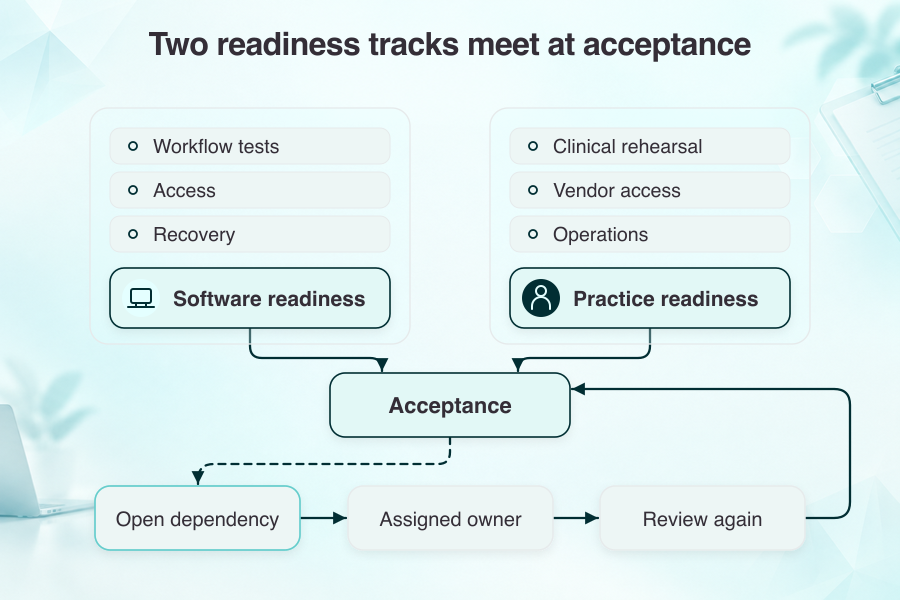
6. Accept the software and the practice separately
Track production software acceptance alongside practice readiness. HHS's May 2025 sustainability guidance addresses preparation such as staffing, practice requirements, insurance and workflow fit. Rehearse the service before accepting real patients, with the required vendor access and safeguards in place.
Keep a release record that the owners can sign off against:
- Clinical acceptance: The clinical team has rehearsed evaluation, follow-up and escalation using the intended workflow.
- Vendor acceptance: The selected prescribing, pharmacy and communication services are ready for the contracted scope.
- Security acceptance: Access and data flows have been reviewed against the production configuration. The team has also reviewed recovery checks.
- Operations acceptance: Staff can find and resolve outstanding patient and pharmacy work, including an integration failure.
An unresolved dependency stays visible in the release record, with an owner and the evidence needed to close it.
For a published schedule example, Idea Usher's service page, checked in October 2026, advertises 14-19 weeks for its project process. Your schedule depends on the agreed scope, integration access, clinical staffing and acceptance criteria. Confirm the critical dependencies with the people responsible for them.
Use the Guide to Launching a Virtual Clinic with Specode for the broader clinic-launch context. Keep this release plan accountable to the GLP-1 service you're opening.
GLP-1 virtual clinic cost depends on scope
Get a GLP-1 virtual clinic cost estimate against a written scope, including the integration and testing work. Public agency figures can help frame that conversation, provided you preserve the supplier's definitions and confirm the commercial inclusions.
Taction's January 2026 guide publishes the following development estimates. The later stages add to the initial platform amount.
| Taction's published stage | Example scope | Its published estimate |
|---|---|---|
| Initial platform | Core telehealth, patient portal, prescribing workflows and EHR connectivity | $150,000-$300,000 |
| Automation addition | Intake and insurance workflows, automation and basic device links | Add $75,000-$150,000 |
| Advanced-feature addition | Broader monitoring, laboratory and billing workflows | Add $100,000-$200,000 |
Taction publishes $325,000-$650,000 for the combined full-featured platform. These are that agency's planning figures, with commercial inclusions to confirm. Ask for the implementation services and third-party charges covered by a quote, and price clinical operations separately.
Idea Usher's service page, checked in October 2026, lists $80,000-$150,000 for its MVP covering onboarding, provider tools, pharmacy connectivity, monitoring and analytics. Its scope differs from Taction's stages. Compare written inclusions before using either figure in your own budget.
Keep the budget lines separate
Use a budget worksheet that lets the relevant owner price each category. A subscription proposal and a development proposal need different review questions.
| Budget line | What to scope or confirm |
|---|---|
| Initial software work | Discovery, design, implementation, integration and testing; identify who delivers each item. |
| Recurring technology | Hosting, communications, prescribing services, optional devices and support, using contracts and expected usage. |
| Practice setup | Legal/licensing work, insurance, staff preparation and validation of the operating workflow. |
| Clinical and pharmacy operations | Care delivery, medication/dispensing arrangements, fulfillment and other patient-service costs the business is responsible for. |
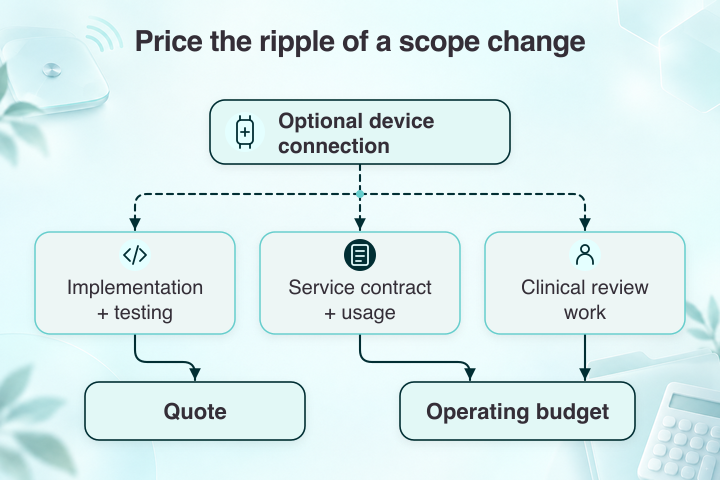
Request a clear change process as part of the quote. An existing clinical backend, a new record system and a native mobile app are different scope decisions. Ask vendors to price the implementation you've selected and identify the acceptance work that remains with your team.
Make integrations specific enough to compare. For pharmacy work, name the vendor and supported transactions, then assign responsibility for exceptions.
For insurance work, identify the benefits and prior-authorization tasks covered, including denial handling. Use the same questions when reviewing support after launch.
Leave unsupported maintenance percentages and flat hosting allowances out of the first budget. Obtain the relevant usage assumptions and service terms, then update the worksheet as the architecture and commercial arrangements become clear.
Ask how the supplier will demonstrate completion. Have the quote identify the patient and staff workflows it will test and the supported external transactions. Record the work your own team must accept.
Confirm whether the proposal covers configuration of the contracted services and test support. Ask who will resolve integration defects found during acceptance.
Keep optional work visible as separate scope. Device connections, additional service states and expanded clinical workflows can trigger further implementation or review. Ask the responsible owners what changes before assigning a price or delivery date to that expansion.
Business models and monetization start with the care contract
Set the services you're selling before designing checkout. Patients need to understand what a payment includes and where medication or other charges sit. The clinical team needs a workflow that preserves independent prescribing decisions throughout the commercial arrangement.
| Model | Product and operating questions |
|---|---|
| subscription / cash-pay | Define included encounters and follow-up access, medication charges, and refund/cancellation handling. Keep membership status separate from the clinician's treatment decision. |
| Insurance-supported care | Scope benefits checks, required documentation, prior authorization, claims and denial follow-up around the actual payer contracts. |
| Medication-related revenue | Confirm the lawful commercial arrangement and which party receives each payment. Review acquisition, dispensing/fulfillment and support costs before treating a receipt as contribution to the clinic. |
HHS's January 2025 private-insurance guidance advises verifying coverage with accepted insurers and having patients confirm benefits. A telehealth benefit doesn't establish coverage for a particular medication. Record the status of those decisions separately so staff can explain what is still pending.
Medication-related compensation deserves its own review. HHS OIG's fraud-and-abuse guidance, reviewed in October 2026, explains that the federal Anti-Kickback Statute can apply to remuneration intended to induce or reward federally reimbursable referrals or business.
State ownership, fee-splitting and pharmacy requirements also need review for the selected arrangement. Cash-pay pricing doesn't settle those questions.
Build the financial view around the service contract. Track gross receipts separately from clinician time, medication acquisition, fulfillment, payment fees and support costs where those expenses belong to the business. Ask the finance and clinical owners to approve how charges and patient obligations appear in the app.
Plan what happens when an insurance decision or prescription changes. Staff need a way to explain the remaining options and revise the relevant charge where appropriate. Keep the clinical record consistent during that work, and include it in the operating scope before forecasting revenue from an automated checkout.
Rehearse cancellation and refund handling with the same care as enrollment, confirming which party owns each charge and how staff check the service already delivered. Decide where an unresolved pharmacy or clinical question goes.
Keep the payment record linked to the relevant workflow without letting a financial status overwrite the clinician's decision.

Pharmacy fulfillment and eRx need an exception queue
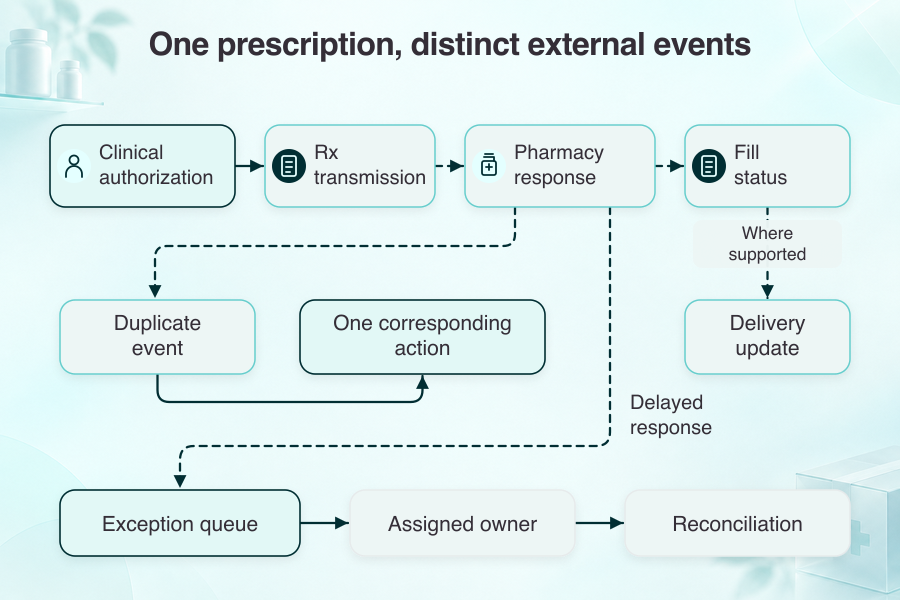
Define the return path from the pharmacy when you scope pharmacy fulfillment. A sent prescription, a fill event and a delivery update describe different work. Keep them distinct so staff can answer the patient's actual question.
Surescripts' current e-prescribing page, reviewed in October 2026, describes transaction families including new prescriptions, change requests, renewals, cancellations and fill-status notifications. Confirm which transactions your vendor and pharmacy support, and agree on the status your app can display for each one.
Follow the prescription through the handoffs
Use a workflow that preserves the clinician's decision and each external response:
- The clinician reviews the patient and authorizes a specific prescription.
- The prescribing service transmits it and returns the supported acknowledgment.
- Pharmacy processing can produce a question, change request or fill-status event.
- A contracted fulfillment service may supply shipment or delivery information.
Show unresolved questions to the responsible team. Keep the prescribed product, formulation, dose and subsequent authorized changes connected to the medication history. Patients should be able to ask for help when the dispensing instructions need clarification.
Rehearse a duplicate or delayed event
Test the same pharmacy event arriving twice. The application should preserve a single corresponding action and give staff a consistent view of the prescription. Then test a missing response: keep the item open and visible for follow-up.
For a cancellation after transmission, confirm the external system's response before marking the issue resolved. Review the supported transaction with the prescribing vendor and pharmacy, and give staff an escalation path when the app can't establish the final status.
These are acceptance checks for the workflow you commission. The contracted services determine which callbacks and transaction states are available. Keep a documented reconciliation path for exceptions that require a person to contact the pharmacy.
Agree on the information staff need to reconcile an exception. Keep the external reference and the latest supported response with the prescription, and record who contacted the vendor or pharmacy.
If the service can't supply a delivery event, choose patient-facing wording that reflects the status you do have. Test the wording with the operations team before using it in notifications or the patient portal.
Keep clinical follow-up available after dispensing
FDA's GLP-1 concerns page, reviewed in October 2026, identifies dosing errors, inadequately refrigerated deliveries and lack of clinician access among its concerns about unapproved products. Include a process for dosing clarification, shipment-quality complaints and clinical follow-up in the operating design.
Assign the next action when a patient reports a problem, and preserve the report with the relevant medication and pharmacy context. Review with the clinical team which concerns need direct clinical attention and which belong with the pharmacy or fulfillment partner. The app should make that routing and its outcome visible to authorized staff.
Specode builds around your clinic workflows
Specode generates healthcare app interfaces and workflows from plain-English prompts. You define the screens and data models, including permissions and clinical review paths. Teams can build intake forms, scheduling, patient/provider portals and administrative dashboards around the service they've scoped.
You own the generated code and can export it. Specode builds responsive web apps; native mobile app generation is outside its current scope.
The integration work still needs attention. Vendor accounts, credentials, agreements and testing belong in the build scope. Video and messaging can use CometChat with the appropriate HIPAA service plan before patient-data use, as described in the Specode integration guide.
Prepare production separately from development
Use synthetic test data in the builder and previews on every plan. Real patient data belongs only in a separately prepared production deployment.
For production, create your own Convex Pro account and sign Convex's BAA directly; the Specode team handles the transfer. The going-live guide covers the setup and required service agreements.
The HIPAA Compliance Agent scans the codebase for potential issues and helps your team review and address findings. Treat those findings as part of the security review process. Production readiness also depends on the app's safeguards, configured services and agreements.
Specode Pro is $1,000 per month. Budget that as a platform subscription, with separate scoping for the clinic project, third-party services and operating costs.
Bring a defined care workflow and its acceptance checks to GLP-1 virtual clinic development. Use Specode to build the app around those decisions, then validate the clinical and vendor handoffs before opening the service.
Frequently asked questions
Idea Usher lists $80,000-$150,000 for its defined MVP scope, checked October 2026. Obtain a scoped quote and budget recurring technology and clinical operations separately.
Idea Usher advertises 14-19 weeks for its project process, checked October 2026. Your launch also depends on clinical staffing, vendor access and production acceptance.
Confirm patient-state authorization, clinical evaluation, applicable prescribing rules, HIPAA/vendor responsibilities and compounding requirements for your service model. Check the relevant jurisdictions and arrangements before launch.