Knack vs Caspio: Which App Builder Is Better?

Written by the Specode team. Specode is an alternative to Knack and Caspio for building healthcare apps. Knack and Caspio facts checked November 16, 2026.
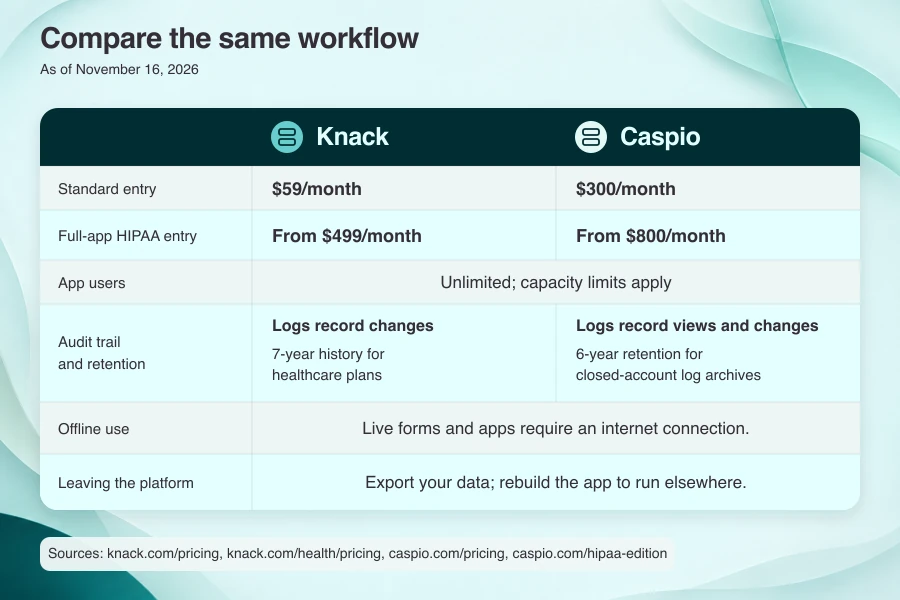
You’ve narrowed your shortlist to Knack vs Caspio. Which one can handle your workflow, how much can your team build without writing SQL, and what will it cost once patient data is involved? Both have flat monthly fees and unlimited app users: Knack starts at $59 and Caspio at $300. Both sell dedicated HIPAA offerings.
Is Knack or Caspio better?
Choose Knack for lower-cost, configurable workflows: HIPAA Forms starts at $159/month; full apps at $499. Choose Caspio for SQL Server, record-view logging, or more included records and storage. Caspio's HIPAA offering starts at $800/month on a one-year term.
Key takeaways
- Knack has the lower entry price. Standard monthly rates start at Knack's $59 versus Caspio's $300, with different allowances.
- Both offer a BAA, but the HIPAA purchase differs. Knack separates $159 forms from $499 full apps; Caspio starts at $800 with a one-year commitment.
- Data export is different from source-code export. Neither platform exports an independently runnable app. Move your data, but rebuild the app to run elsewhere.
Knack vs Caspio at a glance
In a Caspio vs Knack comparison, lean toward Caspio if you need to investigate who viewed patient information: its HIPAA offering logs reads as well as edits, while Knack’s audit trail tracks changes. If change history meets your needs and your app fits within 10,000 records, Knack’s HIPAA Starter offers a lower starting price: $499/month versus Caspio’s $800.
As of November 16, 2026:
What is Knack?
Knack software is an online database builder for turning spreadsheets into apps with forms, reports, and logins. Permissions control which records people see and update.
A Knack database is a relational database linking records such as patients, referrals, and appointments. After a spreadsheet import, set user roles for access to your no code database.
For healthcare projects, Knack offers Knack Health, a separate, US-hosted line launched on March 3, 2026. You can adapt its intake, patient portal, telehealth, or mental health EHR templates to your organization, then host the app on Knack (with a custom domain on HIPAA Core or above) or embed it in your website.
Your plan determines the app’s record and storage allowances, while all tiers include unlimited users.
What is Caspio?
Caspio, Inc., founded in 2000, serves 15,000+ organizations in 150 countries. Its forms and pages use a managed Microsoft SQL Server database on AWS, with global data residency options.
Caspio has two builders: Flex for drag-and-drop screen design, previews, and user roles; Bridge for developer customization with CSS and JavaScript. Forms and reports count toward plan limits: DataParts in Flex and DataPages in Bridge.
As a Microsoft Access alternative, Caspio puts related tables, forms, and reports online. Customize its patient portal or medical history form templates, permissions, and workflows.
Caspio HIPAA Edition adds a dedicated environment and signed BAA: $800/month combines TEAM's $300 with the $500 HIPAA add-on.
Knack vs Caspio pricing
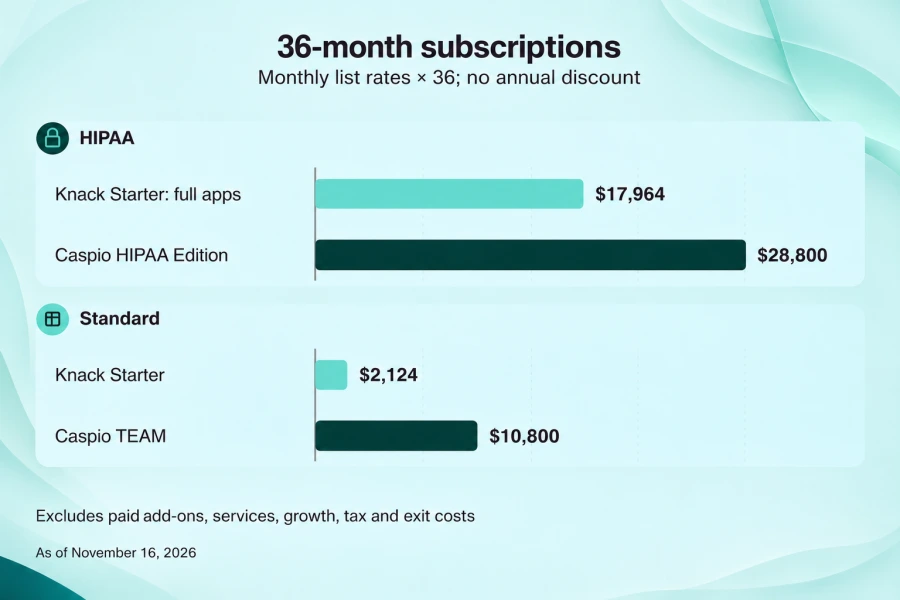
For full HIPAA apps, Knack pricing starts at $499/month versus Caspio pricing at $800/month. For HIPAA-compliant intake forms, Knack's forms-only tier starts at $159.
Standard plans cost less for apps without PHI. USD list prices below show monthly billing and annual equivalents. Caspio offers a 10% annual discount and 14-day trial, but no free plan.
Knack's new-customer offer: Starter $19/month and Pro $49/month for three months.
Standard Knack Starter includes one extra app editor (“shared builder”). Build limits count apps in Knack and form/report components in Caspio. Standard Knack record history lasts 1 month on Pro, 2 on Corporate, and 3 on Enterprise. Both offer a custom-priced enterprise plan.
With flat pricing, budget for:
- A higher records limit or more storage for accumulated visits and files.
- Company sign-in: standard Knack SAML requires Corporate+, or Pro's add-on; HIPAA Starter includes Google SSO; SAML starts on Core.
- More builders, implementation help, or integrations.
- Paid add-ons: standard Knack scheduling costs $29/month through November 30, 2026, then $49 from December 1.
List-price arithmetic, not a quote: Over 36 months, monthly list rates total $17,964 for Knack HIPAA Starter and $28,800 for Caspio. Standard Knack Starter and Caspio TEAM total $2,124 and $10,800, respectively. Knack record or SSO upgrades can narrow the gap. These totals exclude discounts, paid add-ons, and price changes. Total cost of ownership includes implementation, integrations, usage growth, taxes, and exit costs.
Ease of use: who can build and maintain it
Knack calls Caspio “low-code”; Caspio describes itself as no-code. Operations managers can build routine workflows in either no code app builder; customization determines who maintains them.
- Knack: edit fields and permissions visually, or draft apps with AI. Custom code in CSS/JavaScript may need developer maintenance.
- Caspio: Flex provides visual editing; Caspi builds tables, pages, roles, and navigation from plain-language prompts. More complex calculations and screen behavior can require SQL or JavaScript, so you may also need a developer to build and maintain those customizations.
Have your maintainer build the same workflow in both, then change a field and access rule. Knack offers docs, a forum, experts, and implementation help. Caspio offers training and implementation help, plus 24/7 chat; Business and Enterprise add 24/5 phone support.
HIPAA and security: how the plans compare
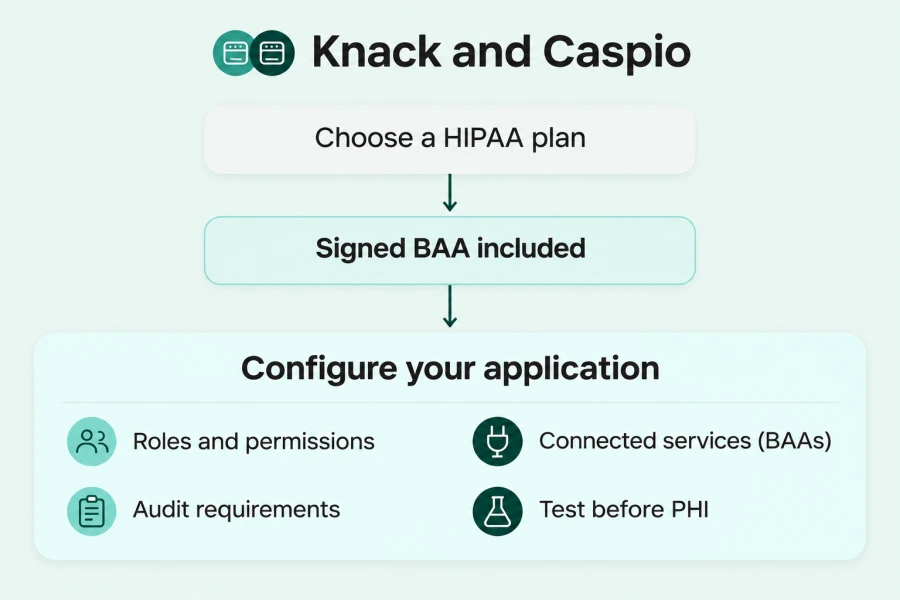
To use either platform as a HIPAA compliant database, choose a healthcare plan with an included business associate agreement (BAA).
Knack's period covers active change history; Caspio's covers log archives after account closure.
Beyond HIPAA, Caspio supports FERPA (education), GDPR (privacy), PCI DSS (payments), and WCAG/508 (accessibility), with a separate GovCloud edition.
Both provide encryption in transit and at rest. You configure role-based access, record rules, and exports, inspect audit logs, and handle ePHI risk analysis and connected-service agreements.
To compare more platforms, see our hipaa compliant app builder guide. For help with sign-in and configuration, read secure authentication in healthcare apps and HIPAA compliance in no-code and low-code apps.
AI, integrations, and EHR connections
Both platforms offer an AI app builder that turns plain-language prompts into screens and data structures. For healthcare teams, the next question is which AI features are covered for use with patient data.
In 2026, Knack added HIPAA-plan AI on April 24; its AWS BAA covers prompts. Caspio's full-app builder Caspi launched on August 27; its June 3 OpenAI BAA covers native HIPAA Edition AI. Separately, Caspio's OpenAI GPT extension processes new or updated records, saving responses in tables.
Both platforms also offer an MCP server, which connects external AI tools to app data or the backend. That same year, Knack launched MCP on August 26 for custom frontends on its HIPAA backend. Caspio's MCP beta had launched earlier, on March 11. It reads and changes permitted records, requires the Integrations feature, and excludes files. External AI tools need their own PHI coverage; backend-only vs full-platform HIPAA explains why.
If you build a separate frontend on either backend, its code needs attention too. A private API key exposed in the browser can grant unintended access, while debug logs or analytics can send patient details to another service. Budget for securing and hosting that custom frontend, as well as the backend subscription.
For EHR integration, compare how you would complete the same task:
- Knack: HIPAA plans connect Epic, athenahealth, and ModMed through Flows. Epic FHIR supports patient and appointment lookups with organizational authorization. API and Zapier integrations are also available.
- Caspio: use its REST API, webhooks, or services such as Keragon. Other options include Zapier, Make, and n8n; choose services appropriate for your data.
Request a live demonstration: can the portal read an appointment or write changes back to the EHR?
Portals, users, and scale
Both Knack and Caspio include unlimited app users. Per-user pricing won't decide between them; accumulated records might.
Knack counts users toward its record allowance; visits can add more records per patient. Caspio's entry HIPAA setup includes more records and storage.
Both support hosted or embedded portals; live forms and apps require an internet connection.
Limitations of Knack and Caspio
Knack limits to check
HIPAA Starter's 10,000 records, 2 GB, and Google-only SSO may push you toward Core. Standard Starter allows one shared builder. Built-in record history cannot be exported. Downloadable logs require extra setup: a separate table in your app that records changes.
Caspio limits to check
Entry pricing is higher; advanced calculations can need SQL. Closing a HIPAA account triggers a log-archiving fee: twice its highest monthly fee during the preceding six years. A peak of $800 means a $1,600 closing charge.
Moving away means exporting data and rebuilding. Knack's app structure stays on Knack; Caspio's app archive requires Caspio.
What users say: Knack and Caspio reviews
On November 16, 2026, ratings from Knack reviewers on Capterra averaged 4.5/5 across 99 reviews; Caspio reviews averaged 4.6/5 across 249. These are overall product ratings.
Healthcare-specific examples show what people built:
- Knack: healthcare operations, with expert help. Frank H. (Capterra, May 2025; incentivized review) built quality, risk, and compliance apps. He valued permissions and reporting; a Knack expert completed the apps after he built their basic structure.
- Knack: HR workflows and Medicaid claims. A healthcare reviewer (G2, August 2024) used Knack to build HR workflows and prepare Medicaid claims for state submission. They valued customization but reported slower load times than some alternatives.
- Caspio: a clinic caseload app. Stephanie K. (G2, November 2024) reported getting her app ready to launch in under a month. She still needed time to learn the platform.
- Caspio: connecting patients and pharmacies. Brian K. (G2, May 2024) used the HIPAA platform to connect pharmacies, patients, and health systems. He praised reliability and customization but wanted a lower price.
Which should you choose?
Knack suits smaller workflows and budgets. Caspio's premium buys record-read logging and more included records and storage.
Choose Knack if…
- Your team wants to build and maintain intake forms or a small clinic workflow without writing SQL.
- You want a lower-cost starting point for replacing spreadsheets and manual processes.
- You need to see who changed patient information and what changed.
Choose Caspio if…
- You need to investigate who viewed patient information, including access that didn’t change anything.
- You expect substantial patient histories and attachments, and want more capacity included before upgrading.
- Your IT team requires Microsoft SQL Server, or your project needs accessibility support or a government-cloud option.
When neither fits: where Specode stands out
Knack and Caspio suit apps that stay on their managed platforms. Specode, an AI builder for healthcare, gives you 100% ownership of your customer-created app code and the freedom to develop it in-house.
Specode helps you build and secure the whole healthcare app. You get a HIPAA-ready foundation, with role-based access controls and audit logging built for your app. Its HIPAA Agent flags risks such as patient details leaking into logs or access rules exposing records to the wrong user. Send the findings to the AI for fixes, then scan again as you develop.
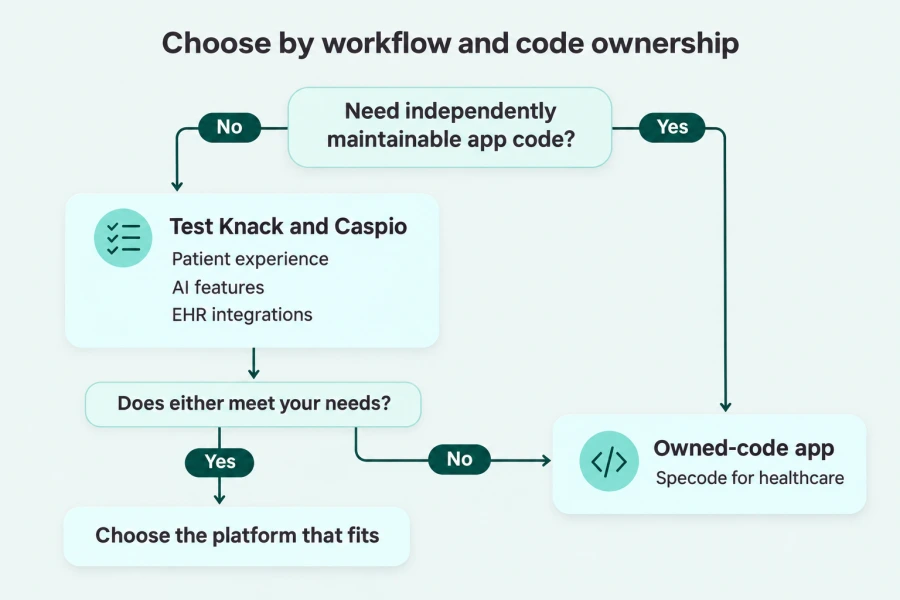
Consider moving beyond your current builder when:
- Its screens cannot deliver the patient experience your product needs.
- Its available AI features cannot support your clinical workflow.
- Investors or buyers require independently maintainable application code.
- An EHR or pharmacy integration needs logic you cannot implement within it.
Knack and Caspio support customization and integrations; test your workflow before switching. For control over the underlying application, compare knack alternatives and Caspio alternatives offering code ownership. A healthcare app builder that lets you own the application outright reduces vendor lock-in: your team can continue developing the app in-house.
With Specode, you describe your healthcare app in plain English and refine it by talking to the AI. It builds a responsive web app using healthcare playbooks for features such as patient intake. Project-specific integrations are scoped around the systems your app needs to connect to.
Specode can also migrate apps with exportable source code from Lovable, Base44, or Replit, so you can build on work you've already done. The migration rebuilds the backend and sign-in system for Specode.
Specode's MCP supports Claude Code, Codex, Lovable, Replit, and Base44. Run HIPAA checks from your coding session, apply the fixes, then rescan. Basic costs $250/month for this workflow. If your own frontend uses Knack as its backend, you can scan that frontend's source code while keeping Knack. Pro covers building and migration within Specode.
Built on Specode with the Specode team, AlgoRX reached $20 million in annual recurring revenue as of September 2026. Its medication storefront lets patients buy multiple medications in one checkout, with prescriptions routed to partner pharmacies behind the scenes. You can estimate your build to see what it would take to launch your own healthcare product.
How to test Knack and Caspio before you sign
If Knack or Caspio still fits, test the choice before signing:
- Build the same workflow with synthetic data. Keep PHI out of standard trials; request Knack's guided HIPAA assessment.
- Test search, export, and shared links with the most restricted role; check for records outside its permissions.
- Inspect Knack's change history; request a sample Caspio audit-log export. Check retention and how investigators retrieve evidence.
- Test company sign-in with your identity provider on your chosen plan.
- Obtain the BAA and document safeguards and agreements for connected services, including any external AI client.
- Estimate records, storage, and builders at 18 months, including accumulated visits, attachments, and additional staff.
- Open exported data and attachments. Knack exports tables separately, with attachment URLs rather than bundled files. Export before cancellation; budget for Caspio's closing archive fee.
- Demonstrate the EHR task you need, from start to finish.
Conclusion
Knack has lower starting prices; Caspio includes more capacity and record-read logging. Both can serve patient portals. Choose based on your records, access requirements, and maintenance skills.
When you need to take ownership of the application itself, explore Blaze vs Specode and Bubble alternatives for HIPAA apps.
Outgrowing your no-code database? You can book a Specode demo to explore your workflow as a HIPAA-ready app with code you own.
Frequently asked questions
Knack offers lower prices and seven-year change history; Caspio also logs record reads. Both include a BAA and support SAML sign-in, with Knack requiring Core or above. Caspio suits investigations into who viewed patient records.
Yes. Knack includes a BAA on its healthcare HIPAA plans for covered entities; Caspio includes one with HIPAA Edition. Your app configuration and connected services still need appropriate safeguards.
Caspio supports both: visual editing and Caspi AI build apps without coding. More advanced calculations can use SQL, while JavaScript customizes behavior.
Knack is cheaper for a smaller portal. Caspio offers more included capacity and logs record reads, useful for access investigations. Both support hosted or embedded portals; neither charges by app-user headcount.
Neither charges per app user. Knack counts user records toward the plan's record allowance; Caspio limits records, storage, and app components. The people who build apps have separate plan allowances.
No. Knack keeps its app structure on-platform, and Caspio's app archives require Caspio. You can export your data, but running the app elsewhere requires a rebuild.
Their live forms and apps require an internet connection.
Yes. Knack offers Epic FHIR and other connectors; Caspio uses APIs and workflow integrations. Have the vendor demonstrate your task, including whether it reads EHR data or writes changes back, using your organization's authorized connection.
Choose Specode to build a responsive, HIPAA-ready web app with code you own. Pro costs $1,000/month for app building with healthcare-specific checks and fixes. Custom includes a team to build and maintain your app.