Custom Healthcare Software Development Guide 2026: Build HIPAA-Compliant Solutions Fast

Say "healthcare custom software development" out loud and most people picture the same thing: a year of coding, a budget that keeps climbing, and a real chance the finished product still won't fix the workflow that sent you looking in the first place.
That fear is earned. Off-the-shelf tools work right up until your intake or your billing rules don't match the template, and then you're running a clinic on someone else's assumptions. Every workaround you bolt on is a tax you pay forever.
By 2026, the decision that actually matters is how much of your care model you rent from generic SaaS and how much you own outright, and how fast you can get there without rebuilding the plumbing every health app needs.
Key Takeaways:
- Custom healthcare software development services give you software shaped around how your team actually works, instead of bending your workflows to fit a generic tool. Done right, that shows up as less wasted admin time and better patient care.
- A custom healthcare software development company can wire your app into your EHR and telehealth stack, so patient data and staff workflows live in one place instead of scattered across a dozen portals.
- Done well, custom software development for healthcare pays for itself over a few years: fewer manual workarounds, a tighter security and regulatory compliance posture, and headroom to add things like AI-powered tools and IoT integrations later.
- Describe the app and let the AI build it on a HIPAA-ready foundation. Pair custom healthcare software development with a HIPAA-ready healthcare AI builder: build by chat with live previews, connect EHR/EMR, labs, and IoT, own 100% of the code, and ship in weeks instead of months, without the lock-in of generic low/no-code.
Custom healthcare software development in 2026
The 2026 opportunity is software you actually own
The ground is shifting fast. The global digital health market should pass roughly $1T by 2034, growing at double-digit CAGR on the back of AI, IoT, and remote monitoring. Telehealth alone is expected to reach around $175B by 2026, driven by virtual care and the hybrid clinics now blending in-person and digital visits.
Providers have largely settled the go-digital question. What they're deciding now is how much of the care model to hand to generic SaaS, and how much to build as workflows they own. The 2026 opportunity for custom software is encoding your clinical playbook and outcomes model into software you actually own.
Custom platforms are also becoming the glue between fragmented point solutions: EHR, telehealth, remote monitoring, billing, AI documentation. The healthcare organizations that orchestrate these into one coherent experience, instead of bolting on one more portal, are the ones that get adoption from burned-out clinicians.
You still shouldn't build everything custom
A rule of thumb that holds up in 2026:
- Buy anything that's a regulated commodity (video infrastructure, payment rails, generic ticketing, off-the-shelf analytics).
- Customize when you need deep EHR integration and multi-stakeholder workflows, but can live on top of proven healthcare foundations.
- Build net-new only where your competitive advantage lives: your clinical content, triage logic, pathways, and reporting model.
Compare custom against pre-built healthcare software and the pattern is consistent: off-the-shelf wins on time-to-first-deployment, custom wins on total cost of ownership once you count the workarounds and license creep that pile up over 3-5 years.
The smarter move for most teams in 2026 is a hybrid: start from a HIPAA-ready healthcare foundation (auth, PHI storage, audit-ready data handling, portals) and keep the workflows and data model under your control. That's exactly the gap AI builders like Specode are built to fill, which we get into later. If you're weighing those builders against each other, our Blaze vs Specode breakdown compares them on HIPAA readiness and code ownership.
Make the ROI case in hard numbers
The ROI story has moved on from "we digitized a form." Now it's hard numbers on throughput and revenue capture. Healthcare organizations using AI to automate claims, clinical documentation, and back-office work report real cost cuts and faster cycle times, sometimes north of 30% ROI on automation programs.
To make a custom build pencil out, model three levers:
- Cost avoidance: fewer FTEs on manual data entry, less swivel-chair time between systems.
- Revenue lift: more billable encounters, better code capture, faster launch of services like RPM, and fewer denials.
- Risk reduction: fewer security incidents, a defensible compliance posture, lower lock-in risk when you need to pivot.
If your ROI case rests on "better UX," you'll lose that budget meeting. Show fewer hours, fewer denials, more reimbursable services, and a clear path off brittle tooling, and custom starts to look cheap.
Tie the build to 3-5 KPIs up front
By 2026, "number of logins" is table-stakes. Mature teams track a blend of:
- Clinical: treatment success rate, readmission rate, preventive-care adherence.
- Patient engagement: portal adoption, repeat-visit rate, completion of digital care plans, NPS.
- Operational: time to close a chart, wait times, no-show rates, admin hours per encounter.
- Financial: revenue per patient, margin per program line, days in A/R, cost per digital encounter.
The litmus test for any 2026 custom healthcare project: can you tie the build to 3-5 of these KPIs up front and instrument them in the product itself? If you can't, you've built an expensive redesign and called it custom development.
Strategic advantages of custom healthcare software
Custom healthcare software development pays off for medical practices and institutions when off-the-shelf tools stop fitting how you actually work. Think of it as the difference between renting a generic office and designing a clinic around your exact workflows and patients.

Better clinical outcomes start with software that fits
Patient care gets a real lift when the software is built around how your clinicians actually work. The patient information you need sits at your fingertips, organized and reachable at the point of care, so decisions get faster and follow-ups stop slipping through the cracks. Care teams stay aligned.
Custom software can also handle patient monitoring: vital signs, medication schedules, treatment progress. It keeps a watchful eye on every patient around the clock, without burying your staff.
Your team stops working around the software
Off-the-shelf software often feels like wearing someone else's shoes. Custom software fits. You shape intake, documentation, scheduling, messaging, and handoffs around the way your team already works, instead of forcing everyone into awkward UX contortions. It tightens the workflows that generic tools leave clunky. Most teams wonder how they ever managed without it, like trading a bicycle for a sports car.
The financial math changes once the busywork goes
Once those workflows tighten up, the financial story changes. Fewer manual steps mean less staff time lost to copy-paste and duplicate data entry. Better visibility into your patient pipeline means smarter scheduling and fewer no-shows.
You also dodge the hidden costs of bolt-on tools and the constant "we'll fix it in Excel" patches. Over a few years, that usually outweighs the higher upfront cost of custom healthcare software development.
Polish a lookalike clinic can't copy
Custom really shines on patient engagement. With custom patient portals, patients get the VIP treatment: checking records, booking appointments, filling out forms, even messaging you, all from the couch in your branded experience.
That kind of polish is hard to match with generic tools. It builds your reputation and patient loyalty, and it makes it much harder for a lookalike clinic down the street to copy your model.
An architecture you extend instead of replace
Regulations change and care models evolve. Your organization won't look the same in 3 years. Custom software gives you an architecture you can extend instead of endlessly patch, so a new service line, location, or care program goes in without ripping everything out.
PHI security and HIPAA compliance get baked into the core from day one, so you're not scrambling to retrofit privacy and security every time you grow.
Integration capabilities earn their keep
Integration capabilities are where custom healthcare software development solutions quietly pay for themselves. Instead of living with a disconnected stack, you design your platform from the start to talk to EHRs, lab systems, telehealth tools, billing, and analytics.
That cuts data entry and errors, and it gives you a single, coherent picture of the patient and your operations. Off-the-shelf software rarely delivers that without painful compromises.
Related: A Guide to Improving the Patient Intake Process
Comprehensive healthcare software development services
When off-the-shelf software can't keep up with how your clinic runs, you need a suite of custom healthcare software development services tailored to the way you work. Generic tools break down fast once your workflows touch real patient data and full HIPAA compliance, and that's where custom healthcare software development services step in. We can build you a polished mobile app, but these services run deeper than that.

Enterprise healthcare platforms that connect a fragmented stack
For larger organizations, we build enterprise healthcare platforms that tie together your electronic health records, practice management system, telemedicine tools, and billing stack. Most enterprise stacks are a pile of silos. We connect them into one system that mirrors how care and operations actually run.
What that work usually covers:
- EHR customizations and integrations
- Interoperability with legacy systems
- Secure data flows across the stack
- Performance that holds up at scale
All of it keeps PHI protection and compliance front and center.
Also Read: EHR Integration Guide
Specialty practice software built around your workflows
Run a specialty practice and the generic "one-size-fits-all" system fights you on your visit types and documentation patterns. You want software shaped around how you actually schedule and chart.
We build mobile and web applications that fit how your practice runs, from practice management and appointment scheduling to the clinical workflows your staff repeats a hundred times a week. This is where we go deep: specialty-specific templates, referral flows, and patient-facing booking experiences.
Read more on doctor appointment app development.
Patient engagement platforms that feel like the apps people already use
Patients expect the same consumer-grade experience from their healthcare providers that they get from every other app on their phone. We design patient engagement platforms that feel as smooth as those apps, from onboarding and intake through follow-ups and long-term care plans.
That means branded patient portals, secure messaging, telehealth visits, self-service scheduling, and remote monitoring, all wrapped in a patient-centered UX that your staff and your patients can actually navigate without a manual.
Clinical decision support systems wired into real workflows
AI in healthcare earns its keep only when it's wired into a real clinical workflow. We design and build clinical decision support systems that read your data to surface risk, flag the follow-ups about to slip, and back up treatment decisions with evidence.
Our AI work, including generative AI, stays on real use cases: triage support, risk stratification, guideline prompts, and context-aware assistants that give clinicians signal instead of noise.
Healthcare analytics solutions that make your data usable
Every provider says they're "data-driven." The real question is whether your data is usable at all. We build healthcare analytics solutions that sit on top of the systems you already run, your EHRs, practice management, claims, and patient apps, and pull them into a single source of truth.
The output ranges from operational dashboards and cohort analytics to forecast models that help you plan for demand and staffing. The goal is plain: turn raw data into decisions your clinical and leadership teams can act on this week.
Regulatory compliance software, built in from the ground up
We get it: data security isn't negotiable. Our builds start with HIPAA compliance assumed, so patient data stays protected no matter where or how it's accessed. That usually looks like:
- End-to-end encryption of sensitive data
- Role-based access controls
- Detailed audit trails
- Regular security audits against current standards
We also help you formalize the workflows and guardrails around all this, so the software enforces compliance by default instead of leaving it to a policy document nobody opens.
Behind the build, our DevOps and maintenance services keep the platform healthy for the long haul: continuous monitoring, performance tuning, regular updates for the latest security and compliance standards, and fast fixes when something breaks.
We work with you from initial design through implementation and well past launch. If your team is ready to move, let's talk about what we can build with our custom healthcare software development services.
Technical architecture for healthcare software
Your tech stack is more than a pile of buzzwords. In healthcare, architecture decisions quietly decide whether you stay compliant, scale past a pilot, and sleep through the night without sweating downtime on a busy clinic day.

Cloud vs. on-premise deployment
For most modern healthcare products, cloud wins on speed and cost, as long as you design it right for PHI. A HIPAA-ready cloud setup, with proper network isolation, BAAs in place, and strong access controls, usually beats running everything in a closet server room.
On-premise, or private cloud, still makes sense with large hospital systems, strict data-residency rules, or data centers that aren't going anywhere. The pragmatic middle path is common: core PHI services in a hardened environment, less sensitive stuff like marketing sites and public APIs in standard cloud accounts.
The tradeoffs get clearer when you put cloud and on-premise side by side:
Microservices only where they earn their keep
Microservices are a tool. The real question is whether you need them. For a lot of early-stage products, a well-structured "modular monolith" is easier to secure, test, and deploy.
Where microservices do earn their keep is in clearly separable domains: authentication and identity, PHI storage, audit logging, analytics, notification services. Split those into services with their own data stores and permissions and you cut blast radius and make compliance boundaries much clearer, as long as you put in the observability and deployment discipline to run them.
API-first is how you survive integrations
An API-first approach treats your platform as a set of well-defined capabilities behind stable interfaces, instead of building a UI first and bolting APIs on later. In healthcare, that's how you survive integrations.
Design RESTful (or FHIR-based) APIs from day one and plugging into EHRs, billing, labs, telehealth vendors, and partner apps gets far easier. Your own web and mobile front ends become "just another client," which keeps you honest about versioning, authentication, rate limiting, and data contracts.
Make the secure path the default path
Security architecture goes well past "we use HTTPS and encryption at rest." You need a clear, layered model:
- Network isolation, private subnets, and strict ingress/egress rules
- Identity and access management with least-privilege roles
- Role-based access control at the app layer, plus row-level and field-level controls for PHI where it matters
- Centralized audit logging for access, changes, and admin actions
- Secrets management and key rotation
The point is to make security the path of least resistance. Every new feature inherits the right controls instead of reinventing them.
Clinicians won't wait on a slow screen
Healthcare users have a low tolerance for slow systems, especially during clinic hours. Performance starts with the architecture: split read-heavy operations from writes, push long-running tasks like report generation and heavy analytics onto queues, and scale horizontally where it counts.
What the user feels is perceived speed: snappy interactions and response times that stay predictable even when load spikes during the morning clinic rush or telehealth blocks. Monitoring at the application, database, and infrastructure levels is non-negotiable.
Rehearse disaster recovery before you need it
In healthcare, "we lost some data" is not an acceptable status update. You need a disaster recovery plan that spells out:
- How often data gets backed up, and where
- Recovery Point Objective (RPO): how much data you can afford to lose
- Recovery Time Objective (RTO): how fast you have to be back online
- How you'll handle regional outages, cloud-provider incidents, or major database failures
Regular restore tests and documented runbooks matter more than glossy diagrams. When something breaks, your team should know exactly which steps to follow, and your patients should never notice more than a brief hiccup.
Healthcare software solutions portfolio
We don't believe in "one health app to rule them all." Our portfolio spans the full stack of custom healthcare software, from Remote Patient Monitoring (RPM) apps to AI/ML development (including computer vision and generative AI tools), so you can pick what actually moves the needle for your organization.

Clinical care solutions
Software that sits closest to clinical outcomes:
- Remote Patient Monitoring (RPM) apps that pull vitals from wearables and connected medical sensors (IoMT)
- Telehealth for virtual visits and care-at-home programs
- Patient and provider portals tuned for day-to-day collaboration
A good example is Dedica Health, a remote patient monitoring platform for cardiology that combines RPM, telehealth, a web portal, and medical IoT to meet Medicare RPM/CPT requirements while replacing spreadsheet chaos with a real system.
Administrative software
On the back-office side, we build revenue cycle management solutions and clinical admin tools that untangle billing, coding, authorizations, and documentation.
With GaleAI, we turned an AI-powered medical coding concept into a production platform that speeds up coding and recovers underbilled revenue, running NLP models on top of existing EHR and documentation workflows.
If you're tired of wrestling with medical billing, this is where we smooth out the financial wrinkles so your team can get back to patient care.
Patient-facing applications
Patient-facing apps are where experience makes or breaks adoption. We ship:
- Mobile patient apps and portals for scheduling and results
- Secure messaging and follow-up flows
- Sports and fitness apps tied to clinical goals
- Telehealth front ends that don't feel like clunky EMR screens pushed to mobile
MyPaperwork, a mobile-first STI testing app, is a good illustration: it blends lab integration with an anxiety-reducing UX, HIPAA-grade privacy underneath, so users can handle sensitive testing from their phones without stigma.
Healthcare analytics platforms
Data analysis and data analytics are where strategy happens. We build analytics layers that sit on top of your clinical systems and RPM/IoMT feeds, so you can see what's working and what isn't.
For Medable, we extended their API and Axon mobile stack so large research organizations could run EHR-interoperable clinical studies at scale, turning patient-generated data into trial and care insights.
Interoperability solutions
When your data lives in 10 systems, every report turns into a scavenger hunt. We focus on:
- EHR integrations and customizations
- Apps that run inside or alongside major EHRs (we even build health apps that work right inside popular EHRs like Epic or Athena)
- Bridging legacy systems with modern cloud and IoMT services
Our work on LnQ, a cloud-based radiology staffing and workflow platform, is a good example: it integrates with PACS for study review, automates on-demand staffing, tracks RVUs, and keeps everything HIPAA-compliant in one environment.
AI-powered healthcare tools
We build AI-powered healthcare tools that actually ship. Plenty of healthcare AI never makes it past the demo. Ours runs in production: medical chatbots and virtual assistants, computer-vision-powered Remote Therapeutic Monitoring, predictive models and generative AI co-pilots embedded into clinician and patient workflows.
With Allheartz, we used computer vision to analyze movement in physiotherapy and sports care, powering an RTM platform that helped cut in-person visits by up to 50%, reduce clerical time by ~80%, and lower injury rates for screened athletes by as much as 70%, all while keeping clinicians firmly in control of decisions.
Across all of these categories, the through line is the same: custom healthcare software that fits your workflows like a glove and plugs cleanly into the rest of your stack.
Comprehensive cost analysis and budget planning
You're probably wondering what a custom healthcare software solution actually costs. The honest answer is that it's a wide range. For most projects, custom healthcare software development or healthcare app development lands somewhere in the $80,000 to $250,000 band, and complex multi-integration platforms run higher. Here's what moves that number.

What moves your budget more than any hourly rate
A few levers move your final number more than anything else:
- Feature complexity: a simple patient portal versus full RPM plus telehealth plus workflows plus analytics is a different universe of cost.
- Integration surface: how many EHR, lab, billing, and device integrations, and how messy each one is.
- Data security requirements: PHI boundaries, audit logs, fine-grained access, encryption, key management.
- Regulatory scope: HIPAA-only versus HIPAA plus SOC 2, or FDA / CE if you drift into SaMD.
- Team composition and location: seniority mix, onshore or nearshore, and whether you need product, UX, data, and DevOps all in the loop.
How the budget breaks down by phase
Most custom healthcare software development firms structure the budget around phases instead of one lump sum:
- Discovery and product design (10-20%): workshops, user flows, UX/UI, requirements, and technical architecture.
- Core implementation (50-65%): front end, back end, integrations, data model, infrastructure-as-code.
- Security, compliance, and testing (10-20%): pen tests, hardening, audit logging, RLS and permissions, performance and load testing.
- Launch support and training (5-10%): go-live prep, documentation, handover, and initial hypercare.
On a $150k build, that shakes out to roughly $20-30k for design, $80-100k for implementation, and the rest on hardening, testing, and launch.
Infrastructure and hosting still cost money
Even in the cloud, infrastructure isn't "free." The line items add up: app and API hosting (Kubernetes or containers), databases and storage (transactional DB, analytics warehouse, object storage), security and observability tooling (logging, monitoring, WAF, backups), and non-production environments like staging, QA, and load testing.
For early-stage products, infra often starts in the hundreds per month and climbs into the low thousands as usage and environments grow. Multi-tenant SaaS or heavy RPM and video usage pushes it higher.
What compliance and certification add to the bill
Patient data security and regulatory compliance are non-negotiable, and they carry a real price tag:
- HIPAA readiness: threat modeling, PHI data-mapping, encryption, access controls, BAAs, policies.
- SOC 2 / ISO 27001: if you need formal attestations for enterprise buyers, budget for the extra audit and prep.
- FDA / SaMD work (if applicable): documentation, risk management, validation protocols, and sometimes outside consultants.
These can add tens of thousands on top of the engineering, but skipping them is how you end up with stalled sales cycles and ugly security reviews.
The maintenance budget people forget to plan
Don't forget the "forever budget." A realistic rule of thumb: annual maintenance and roadmap work runs about 20-25% of the initial build cost per year. That covers keeping dependencies and infrastructure patched, monitoring and incident response with small fixes along the way, and the minor feature iterations users ask for once they're in the product.
For a $150k build, that's $30-40k a year for maintenance and incremental improvements. Call it the normal cost of keeping the thing healthy.
How long until the build pays for itself
Think about it as a payback period:
- Direct monetization: subscription or per-member-per-month models for your healthcare app development.
- Operational savings: less admin time and fewer errors.
- Clinical and patient impact: better adherence, fewer preventable readmissions, more billable remote-care touchpoints.
Most teams aim for a 12-36 month ROI window, depending on whether revenue, cost savings, or strategic positioning is the main driver. The tighter your MVP scope, the easier those timelines get.
And this is where Specode changes the math. Instead of funding a full custom build from scratch, you describe what you need and the AI builds it on a HIPAA-ready foundation, so your budget goes to the 20-30% of features that actually set you apart.
- If you want our team to handle the build end-to-end, Custom projects start around $5,000 per month.
- If you'd rather "vibe code" it yourself on the platform, the Pro plan starts at $1,000 per month.
Same regulatory bar, much lower starting line.
Healthcare software development lifecycle
Most write-ups on custom healthcare software development quietly pretend the build runs in a straight line: scope → design → code → launch. In reality, a healthcare app development project looks more like a series of gated clinical and compliance experiments. Here's how we run it.

Discovery starts with three questions
In healthcare, discovery goes past collecting user stories. Three questions run in parallel. Clinically, what decision or outcome should change if this product works? Operationally, who's doing less manual work when we're done, and how do we measure it? And on the business side, how does this tie to revenue, reimbursement codes, or real cost savings? Instead of a 200-page PRD, we aim for a tight stack: a high-level service blueprint, 2-3 core workflows, success metrics, and a first pass at "must launch with X, can wait on Y."
Bolt compliance on later, pay for it twice
We map PHI flows, data residency, and regulatory scope during discovery:
- Which entities are covered under HIPAA, and who needs BAAs?
- Does anything we're building drift toward SaMD territory, like clinical decision support or diagnostics?
- What's the minimum viable logging and retention story a security officer will sign off on?
From there we set explicit "compliance gates" in the roadmap: points where we won't ship a feature until the right controls and documents exist.
Lock architecture only after the constraints are clear
By the time we lock architecture, the clinical and compliance constraints are already set. We're working through a short list of decisions:
- cloud vs. hybrid vs. on-prem for the PHI core
- modular monolith vs. microservices for this stage, as a risk trade-off
- which systems we integrate with in v1, and which stay manual
The output is a set of non-negotiables: how we handle identities and roles, how we separate PHI from non-PHI, and where the integration boundaries sit so we don't paint ourselves into a corner later.
Sprints with a healthcare twist
We work in sprints, but each slice runs thin and end-to-end through one real workflow, say a patient enrolling in an RPM program and syncing first data. Clinical reviews are baked into the cadence, so clinicians don't get a giant reveal three months in. And feature flags plus tight environment discipline keep experimental ideas from ever touching real PHI. The point is to keep feedback loops tight without burning out your subject-matter experts or tripping compliance.
"Does it work?" is the wrong bar
Here's what we test for instead:
- Workflow safety: is it impossible, or very hard, to mis-route a message, mis-assign a device, or lose a result?
- Negative testing for PHI: what happens when someone with the wrong role hits a sensitive endpoint?
- Performance under clinic reality: Monday 9 a.m. traffic, bad Wi-Fi, staff switching between tabs all day.
- UAT with real clinicians and frontline staff, the people who'll live in the product day to day.
For AI-assisted features, we add guardrail tests: what the system must never do or say without a human reviewing it.
A healthcare go-live is an engine swap mid-flight
Nobody flips a switch and walks away. We start with pilot cohorts, one clinic or one service line, before any broad release, and run the old workflow in parallel or shadow mode alongside the new one for a defined stretch. Rollback and contingency plans get rehearsed, since a plan nobody's run is just paper.
And we watch adoption from week one: log-ins, completed workflows, time-to-task, and error rates. Only after a pilot behaves as expected do we expand. In the next section, we show how Specode compresses this lifecycle with an AI builder on a HIPAA-ready foundation, without skipping the gates that keep your clinicians, compliance team, and patients safe.
Build faster with Specode's AI platform
Stop turning requirements into tickets. Specode is an AI builder: you describe the healthcare app you want in plain English, and it builds production-grade software on a HIPAA-ready foundation, faster than a from-scratch build and without the lock-in of pure no-code. You still get what a serious healthcare app development company would deliver (real code, real architecture, clear EHR paths), but you start from a HIPAA-ready foundation instead of a blank repo.

You describe it, the AI builds it
You describe what you're trying to launch, say "RPM for cardiology with patient-reported vitals, telehealth follow-ups, and Stripe payments," and the AI:
- Scopes the build with you, whatever the use case: telehealth, RPM, care coordination, mental health, or e-pharmacy.
- Builds the screens, data models, routes, auth, portals, messaging, basic EMR, tracking, and payments on HIPAA-ready rails.
You iterate in plain English ("remove labs," "add intake before scheduling," "brand to midnight blue") and it keeps generating real code you own.
The AI builds the parts every health app rebuilds
Under the hood, the AI builds the plumbing every health product ends up rebuilding:
- Patient, provider, and admin portals
- Intake and e-consent, provider search, availability, and scheduling
- Telehealth visits, messaging, notifications, resources
- Basic EMR with encounters and audit-ready data handling
- Outcomes tracking: symptoms, mood, vitals, goals
Instead of spending months re-implementing these as one-off features, the AI builds them, so your energy goes to the 20% that encodes your clinical playbook.
Integration without the magic-toggle promise
Specode doesn't pretend to be a universal EHR. The stance is clear:
- EHRs: Epic, Cerner, athenahealth, and others through native APIs or middleware, scoped case by case.
- eRx, labs, wearables: through partner integrations. No magic toggles.
The AI builds the integration surfaces (routes, data models, UI), and Specode's team or your own engineers handle the actual wiring to vendor APIs. The result is a realistic path from prototype to production data flows, without pretending every integration is a one-click toggle.
Customization, because you own the code
Specode is not a drag-and-drop toy. You can:
- Reshape flows: adjust intake logic, visit types, dashboards, and follow-up rules through prompts.
- Apply full branding: colors, typography, and layout in natural language, then refine in code.
- Drop to code whenever you hit your "secret sauce" layer: custom rules engines and AI agents.
Because you own the source, nothing boxes you in, and there's no rebuild tax later. You can extend or replace pieces at will.
Compliance features shaped around PHI
Most generic builders treat HIPAA as a marketing badge. Specode's stack is shaped around PHI from day one:
- Role-based auth with least-privilege defaults for each role
- PHI-safe patterns for storage and messaging
- Audit-ready handling of access and key EMR actions
- Compliance checks that keep the AI inside HIPAA-safe patterns rather than letting it invent its own security model
You still need a proper compliance program. But the platform removes a lot of the "don't forget to log that" and "we'll fix access later" risk that haunts bespoke builds, and a built-in HIPAA compliance scan flags potential issues in your code on demand.
Timelines when you stop reinventing the basics
Directionally, here's how timelines shift when you stop reinventing the basics:
- Traditional from-scratch build: 6 to 12 months or more to a HIPAA-ready MVP, once you add auth, portals, scheduling, messaging, EMR slivers, and integrations.
- Specode: the AI builds a focused, branded MVP in weeks, with the heavier EHR, eRx, labs, and custom AI work moving into a managed Custom lane.
Pricing lines up with that split:
- Pro: $1,000 a month, with credits, a published project, production deployment, hosting, and a custom domain.
- Custom: starts at $5,000 a month, for when you want Specode's team to own the hard edges: deep EHR work, advanced integrations, complex AI, and custom agents.
Always check pricing at specode.ai/#pricing
Bottom line: let the AI build the standard 80% so you can move like a startup, and bring in the Custom tier only where you genuinely need a top-tier healthcare app development company to solve the hard problems.
Healthcare system integration strategies
Integration is where healthcare software either becomes indispensable or turns into shelfware. Six domains matter most here, each with real-world constraints that shape the call.
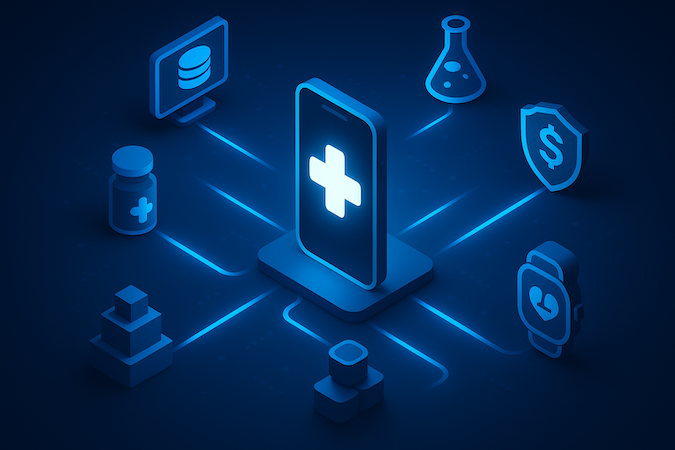
EHR/EMR integration starts with who owns the truth
Every integration opens with a blunt question: what data flows, in which direction, and who owns truth? A few patterns hold up:
- Scheduling → the EMR stays the source of truth; your app proposes slots, the EMR confirms.
- Clinical notes and patient-reported data → your app contributes to the record, but behind review gates.
- FHIR vs. HL7 v2 vs. proprietary APIs → decide upfront; FHIR is improving, but not universal.
- SMART on FHIR apps → best for clinicians inside hospital workflows, but compliance review slows timelines.
Rule of thumb: integrate only what improves a clinical or revenue event in the first phase. Everything else goes to the backlog.
Lab integrations are still the Wild West
No two labs connect the same way. Some support HL7 v2 ordering and results, some only take SFTP batch files, and CLIA means ordered tests need licensed-provider attribution. Settle two design questions early: results as images and PDFs or structured into flowsheets, and who validates reference ranges before a patient sees them.
Start with one or two high-volume lab partners, then expand on feedback.
Pharmacy network integration is a compliance minefield
eRx comes loaded with rules. EPCS (Electronic Prescribing for Controlled Substances) needs identity proofing and certified vendors, medication history needs specific payer and pharmacy agreements, and pharmacy directories are inconsistent across networks. The practical path:
- Integrate eRx through a certified intermediary.
- Keep early scope to renewals and common meds.
- Defer compounding and prior-auth flows to phase two.
Patients only remember one thing: "Did my medication arrive without hassle?" The arriving half is its own discipline; our medicine delivery app development guide covers the courier layer, cold chain and the state license map that decide it.
Insurance system interfaces still run on X12
Everyone wants eligibility and claims status in real time, and then reality hits. X12 transactions (270/271, 837, 835) still dominate payer data, clearinghouses help but add fees and mapping quirks, and coverage rules change constantly, so externalize your rules engine early. A good default pattern:
- Eligibility check → at registration and before high-cost events.
- Cost transparency → only when payers allow it in contract.
- Prior authorizations → avoid in V1 unless they're essential to the clinical use case.
Medical device integration changes your risk profile
The moment devices enter the picture, risk classification shifts. Three questions decide how far:
- Is the data used for monitoring, or for driving clinical action? (That's an FDA line.)
- Do devices pair over BLE, stream via cloud, or both?
- How do you handle data provenance and dropouts?
Best practice: run device ingestion separate from your PHI systems, route smoothed data and alerts to clinicians with a human approving any escalation, and audit every "new" and "missed" data event.
Manage third-party APIs like a product
Add multiple vendors (telehealth, payments, messaging, identity) and complexity explodes unless you treat the interfaces like a product:
- Versioning contracts, because vendors will deprecate eventually.
- Central error logging and alerting across integrations.
- Graceful degradation when a dependency fails.
- A single Integration Switchboard pattern to mediate traffic.
Skip this up front and your support inbox becomes the only monitoring system you've got.
TL;DR: you earn trust by integrating slowly, safely, and around proven clinical or revenue motions, then widening the pipe once adoption warrants it. Not every integration belongs in V1.
Regulatory compliance in healthcare software
Compliance is a system you keep running. The fastest way to stall a launch is to treat HIPAA, state rules, and FDA oversight as afterthoughts. Here's the real terrain for healthcare software development.
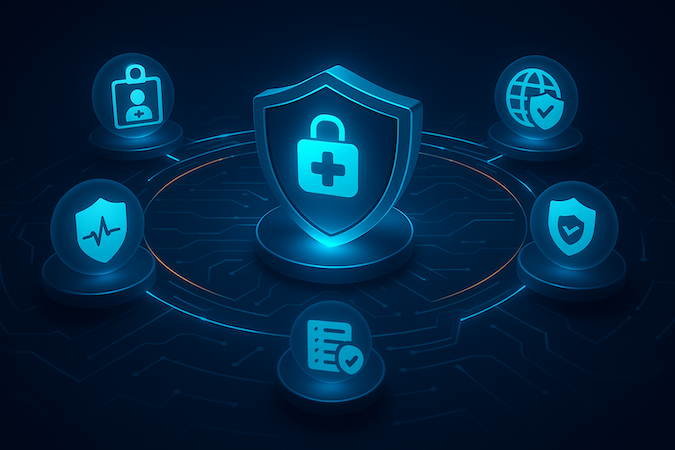
HIPAA's real work is designing PHI boundaries early
Three overlapping categories define how you treat PHI:
- Privacy Rule: who can access what, and why
- Security Rule: how PHI is protected, through technical, physical, and administrative safeguards
- Breach Notification Rule: what to do when something goes wrong, i.e. incident response
The key for modern digital health: design PHI boundaries early. Build first and you're left guessing where protected data lives.
Where teams lose points:
- Row-level access rules (who can see whose data)
- Immutable audit logs for clinical actions
- A clear map of where PHI lives across your stack
- Confident answers to "Show us how you enforce least privilege."
Some apps drift into FDA territory by accident
Most healthcare apps don't start as Software as a Medical Device (SaMD), but some drift into that scope. You're likely in SaMD territory once the software analyzes data to recommend treatment rather than just display it, or starts changing clinical decisions and diagnoses instead of merely assisting. At that point you're past "HIPAA plus good engineering."
FDA triggers depend on:
- Intended use: what you claim the product does
- Risk level: what happens if it makes a mistake
- Human-in-the-loop: is a clinician reviewing the output?
You want a clear statement early in discovery: "Clinical decision = human responsibility." Then build your workflows around it.
If PHI crosses borders, assume extra constraints
For multinational expansion, two regimes matter most. GDPR governs the data side in the EU, with consent, data residency, and the right to be forgotten, and it clashes with U.S. retention rules in ways that force a design choice. CE marking governs SaMD, pulling in ISO 13485, ISO 14971, IEC 62304, and post-market surveillance. Canada, the UK, and Australia run on similar dynamics with different paperwork.
Federal law sets the floor, states raise the ceiling
A few practical flashpoints where state rules bite:
If you're expanding state to state, compliance turns into a rules-engine problem, handled in code.
Missing documentation kills deals
Auditors don't want to hear "it's secure, trust us." They want:
- Proof of access governance (logs and alerts)
- Incident response evidence
- Version history of permission changes
- Reproducible deployment configs
Documentation won't win you deals, but missing it will lose them. Procurement stalls hard right here.
Compliance has to survive constant change
Compliance has to keep up with everything that changes: new providers joining, new integrations, new feature flags, new care programs across new states. The long-term move is to treat it like a continuous delivery pipeline, automate your privacy tests and permissions regression checks, and put ownership on a named group across product, dev, and legal. If you can't re-prove compliance every quarter, you're not compliant.
Healthcare organizations that need custom software
Not every healthcare organization needs custom software. But if your workflows, risk profile, or growth plans don't fit neatly into an off-the-shelf template, that's where a custom healthcare software development agency actually earns its keep.

Large health systems
Large health systems usually have an EHR, a portal, a thousand spreadsheets, and a backlog of frustrated clinical leads. Here's what actually eats their time:
- Bridging gaps the EHR vendor will never prioritize
- Orchestrating care across service lines, regions, and partner networks
- Adding new digital front doors without breaking existing governance
Here, custom healthcare software development solutions sit around the core EMR: rounding tools, command-center dashboards, care-coordination layers, and patient apps that respect enterprise security and change-management realities.
Specialty practice groups
Specialty practices rarely get good tooling out of the box. Neuro, oncology, cardiology, fertility, and behavioral health each run on nuanced workflows, niche data, and unique consent rules. They need custom healthcare software to encode subspecialty workflows like scoring tools and checklists, map scheduling, documentation, and billing to how they actually practice, and build patient engagement flows tailored to the specialty. For them, custom software is how you operationalize your clinical "secret sauce."
Healthcare startups
Healthcare startups live at the intersection of "move fast" and "don't get sued." They're testing new care models, reimbursement angles, and patient experiences. They typically need:
- A HIPAA-ready foundation so they're not burning seed capital on boilerplate
- Fast iteration on product-market fit: MVP → pilot → payer/provider deals
- A path from prototype UI to something an enterprise security team won't laugh at
This is where a platform like Specode plus a focused custom build lets a healthcare app development company help them skip the 0→1 plumbing and concentrate on differentiation.
Medical research institutions
Research groups drown in fragmented trial data, manual recruitment and follow-up, and one-off REDCap or Excel "systems" that break the moment a postdoc leaves. Custom software here means ePRO apps, remote trial platforms, PI dashboards, and integrations that make data usable across protocols without tripping IRB constraints. The win is cleaner data, fewer protocol deviations, and trials that don't crumble at scale.
Telehealth providers
High-performing telehealth operations run on more than video calls with a calendar duct-taped on. They need:
- Eligibility, triage, and routing that respects licensure and state rules
- Custom visit types and decision-support nudges
- Deep integration with EHRs, pharmacies, and scheduling systems
Off-the-shelf video + chat is fine for a pilot. Once you touch multi-state operations, mixed specialties, and value-based contracts, custom telehealth platforms start to pay for themselves.
Healthcare technology companies
There's a whole ecosystem of healthtech vendors building on top of the existing stack: analytics tools, population health platforms, device ecosystems, revenue intelligence, and more. They typically need OEM-quality components they can embed (portals, auth, messaging, audit). Add hardening for HIPAA, SOC 2, and sometimes FDA or EU MDR, plus integration frameworks that make them "play nice" with Epic, Cerner, athenahealth, payers, and device clouds. For these teams, partnering with a custom healthcare software development company is about speeding up the roadmap and getting enterprise-ready faster.
If you recognize yourself in any of these groups and the phrase "we've outgrown our spreadsheets/point solutions" sounds uncomfortably familiar, you're exactly who we build for.
Future trends in healthcare software development
Custom healthcare software development is shifting from "let's build an app" to "let's rewire how care gets delivered." No single technology defines the next decade; the momentum is in how AI, data, and cloud-native design stack together. Here's where it's real.

AI and machine learning integration is past the toy-chatbot phase
The interesting work has moved well past chatbots. The real action is in:
- Workflow copilots that draft notes, summarize charts, and surface risk signals inside the tools clinicians already use.
- Structured-data extraction from PDFs, faxes, and free text, the stuff buried in coding and prior auth.
- Safe, bounded agents that handle repeatable tasks under strict guardrails.
Any credible healthcare app development company architects AI as a set of services wrapped in audit logs, PHI boundaries, and human review, rather than dropping it into the middle of the stack as a magic oracle.
Platforms like Specode push this further: you describe the AI-powered flow you want and the AI builds it on a HIPAA-ready foundation, instead of re-implementing the plumbing every time.
Blockchain won't fix healthcare
It still earns a place in a few narrow, high-friction pockets: proving the provenance and integrity of clinical data or device events, keeping shared append-only logs across organizations that don't fully trust each other, and running tokenized incentives in research or wellness programs where everyone needs to see the same rules.
For most medical custom software development, blockchain is a niche tool you reach for rarely. Treat it like any other subsystem: pull it in only where auditability and multi-party trust actually justify the complexity.
IoMT and wearable integration that collects what changes decisions
The Internet of Medical Things (IoMT) is where "app" stops being metaphorical and starts touching real physiology:
- Wearables and sensors streaming vitals and activity data.
- At-home devices (BP cuffs, scales, glucometers) feeding RPM dashboards.
- Condition-specific kits for cardiology, pulmonary, or rehab programs.
Custom health software development around IoMT is moving from "collect everything" to "collect what changes decisions." The platforms that win normalize noisy device data, route exceptions to the right humans, and keep clinicians from becoming alert firefighters.
Cloud-native is no longer controversial; it's table stakes
What's changing is how healthcare teams use it: microservices where they help and modular monoliths where they don't, infrastructure-as-code so environments stay reproducible and auditable, and multi-tenant SaaS that still honors PHI boundaries and enterprise isolation.
For custom healthcare software development, that means the team stops babysitting servers and gets to shape domain logic. Specode leans into this: the AI builds the cloud-native baseline (auth, portals, messaging, scheduling, basic EMR) so teams spend their time on the 20-30% of workflows that set their product apart.
Voice-first interfaces, where voice beats touch
Clinicians talk faster than they type, and patients don't want to wrestle with forms forever. Voice is quietly becoming a first-class interface for ambient clinical documentation during visits, voice triage and symptom capture for telehealth and nurse lines, and accessibility for patients with low digital literacy or disabilities.
For a healthcare app development company, the real work is the flow design, getting to where voice genuinely beats touch and handling transcripts, commands, and consents with the same rigor as any other PHI. Speech-to-text is the commodity part.
Analytics that change what you do on Monday
The shift is from dashboards that say "interesting" to tools that ask "what will you do differently on Monday?"
- Risk stratification that actually routes patients to different care paths.
- Operational forecasting for capacity, staffing, and inventory.
- Financial and contract analytics to keep value-based care deals from imploding.
Future-facing medical custom software development bakes these models into everyday workflows: flags inside task lists, dynamic care plans, and automated nudges, instead of separate BI portals that sit unopened.
If you zoom out, all of these trends point the same way: smarter software, less plumbing to hand-build, and cleaner integration with the messy real world of care. That's the bar we're building toward with Specode and with every custom healthcare software project we touch.
Implementation best practices
A good build isn't enough. In healthcare, a launch succeeds when people change how they work. What that takes: clinical adoption, operational reliability, and measurable improvement.

The real risk is a silent user revolt
It's the users whose workflows you're reshaping who can quietly sink a launch. Effective change management here means:
- Clinician-led governance: design approval and clinical QA from the practitioners who'll live in the product
- Role-based messaging: what the change means for a nurse is different from what it means for a scheduler
- No-surprises policy: preview changes early and often, in familiar clinical context
- Champions in every department: people who can translate tech to peers in their own language
Design for psychology and identity, or the workflows won't budge.
Train for your hardest users
Good training is a learning pipeline, tuned to the people who'll struggle most with the change. Run live, role-specific sessions, since front desk, MDs, and care coordinators each need a different version. Put micro-learning inside the app, so "how do I order labs?" surfaces an inline tooltip instead of a support ticket.
Rehearse high-stakes workflows in shadow mode before go-live, and use in-product prompts to guide first-time interactions and surface clinical guardrails. And never ship "training" without fast support routes alongside it: chat, a hotline, or on-site presence. Fear of embarrassment kills productivity faster than bugs.
A staged go-live beats a binary flip
Pilot with one site or cohort and let reality write the backlog. Start in shadow or read-only mode to check technical safety without workflow risk, then unlock functionality progressively as proficiency grows. Set explicit expansion criteria up front: adoption, error rates, clinical throughput. The mantra is prove value, broaden exposure, then scale intentionally.
Without telemetry, you're just collecting anecdotes
So wire up telemetry and watch the real signals:
- Operational KPIs: task completion time, throughput, cancellation rates
- Clinical KPIs: escalations, care-gap closures, follow-up completion
- Reliability: latency, uptime, error rates, integration job success
- User friction: rage-clicks and drop-off points
Automated alerts beat incident retrospectives. Catch "slow failures" before they shape sentiment.
Four tactics that beat a memo
Adoption is earned. Start by making the new system the path of least resistance, so going digital is the easiest option. Celebrate your early superusers and track results where everyone can see them. Get visible executive sponsorship, with leadership using the tool in public. And release quick wins early, because something measurable has to improve in week one. If people don't feel the benefit personally, they'll quietly slip back to old habits.
Measure success like a clinical outcome
Work it in three layers:
- Baseline: how slow, expensive, or painful is today?
- Leading indicators: behavior changes that show traction before ROI arrives
- Lagging indicators: concrete business and clinical impact
A healthcare scorecard looks like this:
Implementation is a competency you build. When governance, rollout, training, telemetry, and incentives work together, digital health sticks, and the organization comes out permanently better for it.
Custom healthcare software success stories
What actually moves the needle in custom medical software development services is measurable impact: faster clinical workflows, fewer dropped revenues, better patient engagement, and companies that don't die before product-market fit. These five projects show what that looks like in the real world.
Enterprise implementation cases
A radiology workforce solution built from the ground up for enterprise healthcare: PACS-integrated study assignments, RVU tracking, HIPAA-secure messaging, and instant payouts, replacing brittle scheduling spreadsheets with a cloud platform built for 24/7 imaging demand. This upgrade has improved radiologist efficiency, reduced turnaround times, and provided flexible coverage that legacy staffing systems simply can't match.
Impact:
- Faster coverage of urgent imaging needs
- Automated admin = more productive radiologists
- Built for enterprise-grade compliance, uptime, and 24/7 load
Startup success stories
Walker Tracker went from 2-star laggard to 4.6-star category leader through a strategic refactor and UX overhaul, including a smart in-app review flow that boosted positive reviews by 1.7×. Today, it powers 316B+ steps across 73,000 employee wellness teams, won two major mobile app awards, and was later acquired by Terryberry.
Impact:
- Ratings 2.3 → 4.6
- Massive engagement + corporate expansion
- Strategic exit → validation of product value
ROI achievement examples
Dedica Health. We transformed RPM operations from spreadsheets to automation, delivering CPT-compliant monitoring, billing reporting, and high-risk patient triage. Now: 1,100+ patients monitored daily, >80% billing thresholds hit, and a $300k/year SaaS contract with ROI inside months.
AlgoRX. A lean ePharma flow (eligibility → clinical review → payment → pharmacy routing) launched fast and scaled faster: 12× ROI, $1M+ sales by month 2, 7-figure ARR by month 3.
Shared Lesson:
- Automate the billing engine → revenue follows
- Narrow scope → faster path to measurable value
Integration success cases
GaleAI proves that EHR integration is the product: SMART on FHIR, Mirth, Epic, Athenahealth, and OCR/NLP/ML, fused into a coder-friendly workflow. It cuts coding time by 97% and recovers $1.14M in annual revenue by finding 7.9% more billable codes than humans, while costing providers <1% of the uplift.
Impact:
- Zero workflow disruption → max adoption
- Data flowing both ways = automated RCM
- AI where it matters: revenue integrity
Innovation in production
Frontline caregivers were expected to memorize ~1,300 pages of care protocols. Mi-Life introduced a HIPAA-compliant AI copilot using GPT-4o + RAG + structured knowledge to surface patient-specific steps instantly via text or speech: medication rules, behaviors, emergency action. The result: fewer med errors, higher staff satisfaction, and fewer behavioral incidents, a repeatable blueprint for safe AI deployment in high-stakes settings.
Impact:
- Real-time guidance → safer shifts
- Measurable quality + workforce outcomes
- Built for multi-tenant healthcare AI
Lessons learned
- Choose one economic metric and commit: ratings → acquisition (Walker Tracker); billable RPM → SaaS revenue (Dedica); checkout conversion → ARR (AlgoRX).
- Workflow > features: GaleAI and Mi-Life win because they live in the clinician/caregiver flow.
- Automate the reimbursement engine: CPT/RPM and revenue capture are where ROI is born.
- If you don't measure it, you didn't improve it: analytics and audits must ship with v1.
- Innovation needs plumbing: integrations, PHI controls, audit logs. Without them, everything breaks.
Choosing a healthcare software development partner
By this point, you've moved past "custom vs off-the-shelf." The question now is who you trust to build this without blowing up your budget, timeline, or compliance posture. Treat this section as a filter rather than a checklist: if a vendor misses more than one or two of these, you probably have your answer.
Technical expertise that ships real HIPAA-aware systems
You need someone who ships production-grade, HIPAA-aware systems that integrate with the rest of your stack. A generic web shop will learn healthcare on your time, and you'll pay for the education.
What to look for:
- Can walk you through a recent architecture for a healthcare app, not just slides.
- Has shipped on your target stack (React Native, cloud, Postgres, FHIR APIs) with real users and PHI.
- Talks in trade-offs ("modular monolith vs microservices for your stage") instead of buzzwords.
- Can explain observability, RLS and permissions, and audit logging in plain language.
Red flags:
- "We'll figure out HIPAA later."
- No concrete examples of EHR, lab, or billing integrations.
Domain knowledge separates good teams from great ones
Good teams understand React and Kubernetes. Great teams understand prior auth, CPT codes, and clinic schedules. Look for a portfolio that maps to your reality (RPM, RCM, telehealth, behavioral health, ePharmacy), PMs and strategists who can describe a clinic day, intake flow, and billing cycle without guessing, and a willingness to push back ("Do you really need this in v1 for reimbursement?").
Red flag: every case study is fintech or SaaS with "healthcare" only on the sales page, or no one on the call has ever sat in on a clinic or billing session.
Compliance track record: don't be their first HIPAA rodeo
Here's what to ask, and what a good answer looks like:
If their answers stay at "we're secure, don't worry," worry.
Development methodology: "agile" on a slide is meaningless
In healthcare you want thin vertical slices that run end-to-end through a real workflow, shipped every sprint. The giant six-month reveal is how projects die.
Healthy patterns:
- Sprints ship end-to-end flows (for example, "patient enrolls in program and completes first visit").
- Clinical and operations stakeholders sit in the review loop regularly.
- Feature flags and environment discipline so experiments never touch real PHI by accident.
- A clear definition of done: tests, logs, access rules, and documentation all included.
Red flags:
- No mention of pilots, shadow mode, or rollback plans.
- "We'll test with real users at the very end."
Support and maintenance: launch is just the starting line
A credible partner talks about the "forever budget" without flinching. Expect a realistic guideline of about 20-25% of the initial build cost per year for maintenance and incremental improvements, defined SLAs for uptime and incident response, a plan for security patches, dependency updates, and compliance drift (HIPAA, state regs, payers), and a named team owning the ongoing work rather than "whoever is free."
Red flag: "we hand over the code and you're on your own," or support sold only as hourly with no roadmap or guardrails.
Cost and timeline: a quote that looks too good hides the painful parts
Too-good quotes leave out the parts that hurt: integrations, compliance, and support.
Healthy signals:
- Budget broken down by phases (discovery, build, hardening, launch, post-launch).
- Explicit line items for integrations, security, and testing, not buried in "misc."
- Timeline framed around pilot → rollout, not just a single "launch date."
- Willing to de-scope v1 to hit your ROI window instead of quietly inflating the budget.
Red flags:
- One flat number, no breakdown, and a suspiciously short schedule.
- No mention of how cost changes when you add clinics, regions, or integrations.
Run potential partners through this lens and still feel comfortable handing them PHI, your roadmap, and your reputation, and you're probably looking at a custom medical software development company worth shortlisting.
Frequently asked questions
Depends on what problem you're solving. A lot of teams come to us for electronic health record (EHR) systems that keep patient data in one place, or telemedicine platforms that connect patients with doctors remotely. Other common builds:
- Medical imaging software for diagnostics
- Practice management systems
- Patient portals so people can read their own health information
- Healthcare analytics tools that turn raw data into decisions
Compliance is the part that stalls launches, so it can't be an afterthought. Work with developers who build security in from the start: encryption for sensitive data, role-based access controls, and regular audits as defaults rather than add-ons. And the rules keep changing, so your team needs to stay current on HIPAA and GDPR requirements. The security measures that pass an audit are the ones designed in early.
Yes, and for most healthcare organizations, integration isn't optional. Your new software has to play nice with the EHR systems and billing platforms your staff already lives in every day. Custom healthcare software development usually includes API integration, so the new system exchanges data with the rest of your stack instead of becoming one more silo.
It swings a lot with complexity. A simple app might take 3-6 months, while feature-rich systems can exceed a year from planning to deployment. Healthcare adds time on top of that, mostly for the testing and regulatory compliance checks you can't skip. Rushing those is how you end up rebuilding after launch, so build the extra weeks into the plan from day one.
If you want to stand out, chase the features tied to real clinical or operational value. A few that tend to earn their place:
- AI-powered diagnostic assistance
- Virtual reality for medical training
- Blockchain for secure health data sharing
- IoT integration for real-time patient monitoring
Custom medical software can also use machine learning to predict patient outcomes or personalize treatment plans. The feature that survives is the one that measurably improves patient care or takes real work off your staff's plate; the demo-friendly stuff that doesn't move a number quietly gets dropped.