EHR Integration Guide 2026: FHIR, Middleware & Cost

Updated: August 17, 2026
Let's be honest: EHR integration is still a headache. You already know it's expensive and slow, and you've read the same recycled advice a dozen times: use FHIR, follow the regulations, choose the right API.
This EHR integration guide digs into what that advice skips: how to choose among the four build approaches and what each one actually costs in 2026.
The ground has moved under the old advice, too. TEFCA has been live since December 2023 and now runs at national scale. FHIR R4 is the regulatory floor for certified EHR APIs. Mirth Connect, long the default free integration engine, went commercial in 2025. And AI-assisted builds have rewritten what a sane integration timeline looks like.
What is EHR integration and how do you approach it in 2026?
EHR integration connects a healthcare application to electronic health record systems like Epic or Oracle Health (formerly Cerner) so clinical data moves between them securely. Four approaches dominate: SMART on FHIR apps on the EHR's certified APIs, middleware like Redox, custom point-to-point integration, or building core EMR functionality directly into your app instead of integrating an external EHR. In our project experience, a custom integration runs 6 to 12 months and $50,000 to $200,000 or more; middleware compresses that to weeks. FHIR R4 support is mandatory in certified EHRs; TEFCA participation remains voluntary.
Key Takeaways:
- Traditional EHR integration is a sinking ship: Hand-built interfaces and manual data mapping bleed time and money. AI-assisted integration runs roughly 10x faster than traditional builds, compressing timelines that historically ran 6-18 months into weeks (Specode estimate).
- FHIR is mandatory, TEFCA is voluntary: Certified EHRs must expose FHIR R4 APIs under ONC's 170.315(g)(10) criterion. TEFCA participation is voluntary, though with more than a billion records exchanged per HHS's June 2026 announcement, staying out is an increasingly costly choice.
- The best apps extend the EHR: The strongest 2026 builds launch inside the clinician's chart via SMART on FHIR or layer AI-assisted workflows on top of EHR data, working within and beyond the traditional system.
- Specode turns EHR integration into a build-by-chat workflow, not a six-month project. It's a HIPAA-ready healthcare AI builder: integrate by chat (prompt → live preview) on healthcare rails. We can bootstrap your Specode app to Canvas Medical via its FHIR R4 API/SDK; Epic and Oracle Health (Cerner) integrations are built case-by-case through the platform; when you want Specode's engineers hands-on for the heavy mappings, that's the Custom plan's managed coding. Guardrails for safe iteration, and full code ownership with no lock-in.
The future of EHR integration
EHR integration is the backbone of modern healthcare applications. The regulatory ground has settled: FHIR support is baked into EHR certification, and TEFCA is a live nationwide interoperability network.
Whether it's a telehealth platform pulling real-time patient data or a clinical decision support tool embedded in the EHR, reliable integrations separate a working app from one that collects dust.
The state of EHR interoperability today
FHIR (Fast Healthcare Interoperability Resources) is the de facto language of modern integrations. Under the 21st Century Cures Act Final Rule, the Office of the National Coordinator for Health IT (ONC) requires certified EHRs to expose a standardized FHIR R4 API under certification criterion 170.315(g)(10), so every major certified EHR you integrate with already speaks FHIR R4.
Those APIs must also support the United States Core Data for Interoperability version 3 (USCDI v3), the certification baseline since January 1, 2026 under ONC's HTI-1 rule.
FHIR R5 exists (HL7 published it in March 2023) but has little vendor adoption and no regulatory mandate. Build against R4.
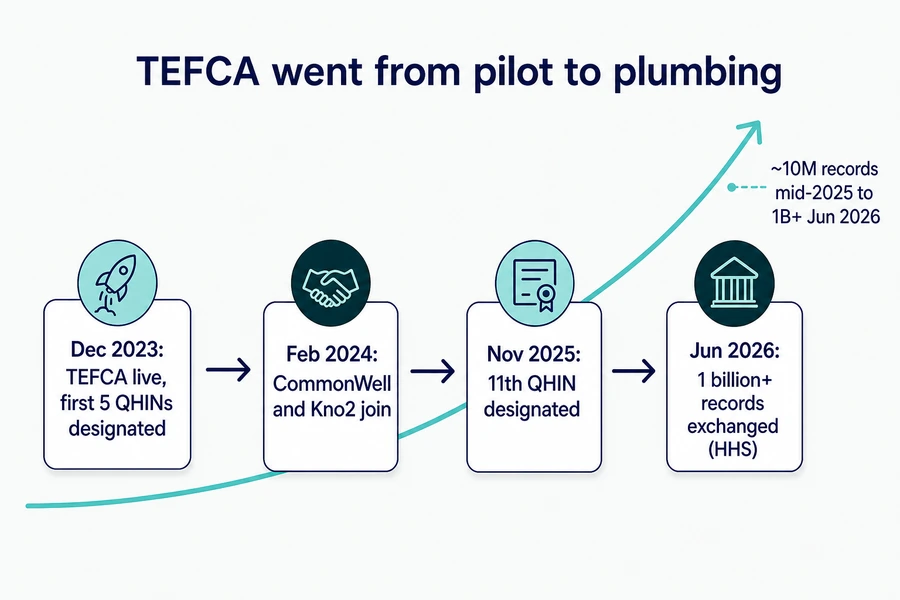
TEFCA (Trusted Exchange Framework and Common Agreement) went live in December 2023, when the first five Qualified Health Information Networks (QHINs) were designated. In June 2026, HHS announced that more than one billion health records had been exchanged through the network, up from about 10 million a year earlier.
As of August 2026, the Sequoia Project, which oversees TEFCA as its Recognized Coordinating Entity, lists 11 Designated QHINs: CommonWell Health Alliance, eClinicalWorks, eHealth Exchange, Epic Nexus, Health Gorilla, Kno2, KONZA, MedAllies, Netsmart, Oracle Health Information Network, and Surescripts. Epic Nexus, Epic's own QHIN, was among the first five designated. Participation is voluntary; the network effects are doing the persuading.
Old plumbing persists: expect HL7 v2 feeds and CDA documents next to the FHIR endpoints.
Why EHR integration is a must-have for healthcare apps
The meaning of EHR integration is plain: your app reads and writes the same records clinicians already work in. That matters whether you're building practice management, patient engagement, chronic disease management, or AI-assisted diagnostics.
The benefits are concrete, and so is the cost of skipping them. Without direct EHR connectivity:
- your app sits outside the workflow, one more tab to remember
- clinicians re-key data, and duplicate entry breeds errors
- patients end up with fragmented care coordination
The rest of this comprehensive guide covers the various aspects of EMR/EHR software integration: core challenges, current trends, costs, and when building core EMR functionality into your app beats full EHR integration.
What is EHR integration? The core challenges
So what is EHR integration, in practice? It's the work of connecting healthcare systems so they exchange data in real time and stay in sync. It's also still one of digital health's biggest hurdles. Four challenges account for most of the pain; this ultimate guide keeps coming back to them.
The interoperability dilemma: why data sharing is still hard
FHIR and TEFCA keep pushing toward interoperability, yet data fragmentation persists: adoption is inconsistent and legacy formats hang around.
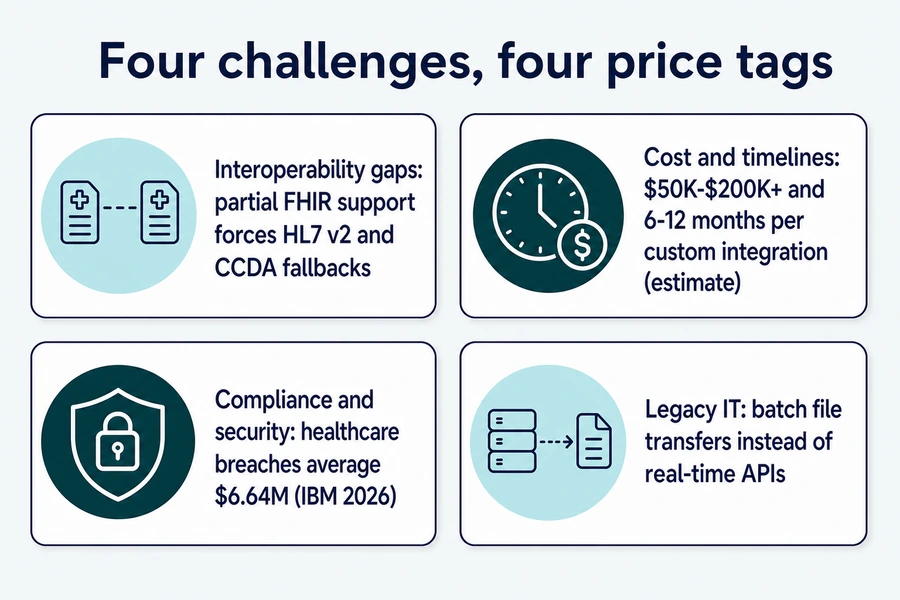
- Not all EHRs speak the same language. Many vendors have only partial FHIR support, forcing developers to fall back on HL7 v2 messages, CCDA documents, or custom APIs for certain types of data.
- Data silos are real. Hospitals often run multiple EHR systems that barely talk to each other.
Even with standardized APIs, you'll still build custom workflows to sync clinical data cleanly.
High costs and long timelines: why traditional EHR integrations take months
EHR integrations have long been a financial and operational headache. In our project experience, a single custom EHR integration lands between $50,000 and $200,000 or more, and runs 6 to 12 months from scoping to go-live (planning estimates; the cost section below breaks down what drives them).
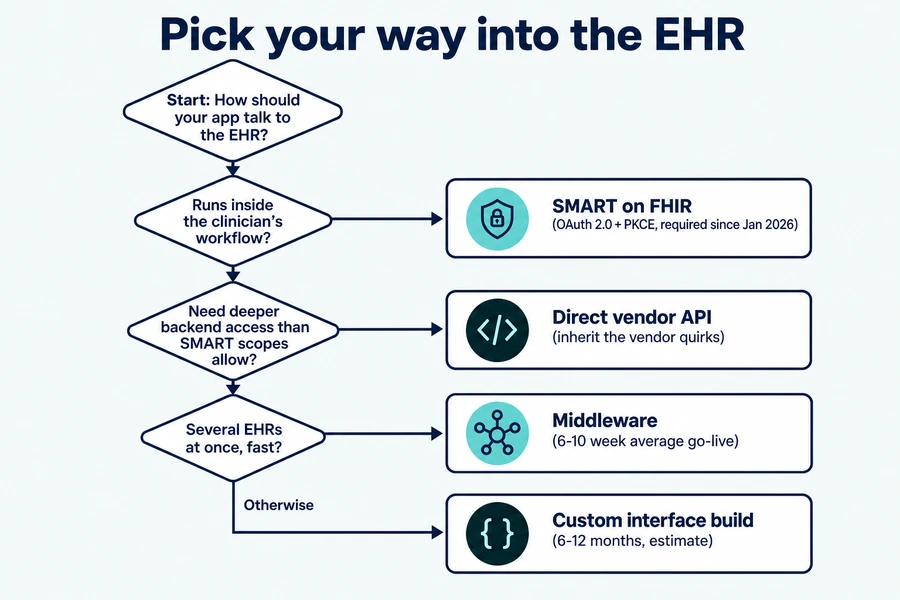
Middleware compresses the calendar dramatically: Redox reports an average of 6 to 10 weeks from kickoff to go-live in its implementation documentation (accessed August 2026). Why the gap?
Vendor gatekeeping
Many EHR vendors charge exorbitant fees for API access and certification. The pressure is industry-wide: in a 2024 national survey published in JAMIA, 47% of digital health companies called high EHR API access fees a substantial barrier.
Extensive development effort
Mapping structured data and handling edge cases takes time and skilled people. Security work adds more.
Testing and compliance delays
Every integration gets tested for data integrity and security, then reviewed for regulatory compliance before go-live.
Compliance and security roadblocks
Healthcare remains the most expensive industry for data breaches, averaging $6.64 million per incident, per IBM's 2026 Cost of a Data Breach report. So compliance dominates integration planning: you're navigating HIPAA, TEFCA's trust framework for cross-network exchange, ONC's information blocking rules, and state-specific regulations all at once.
In practice, that means proving patient consent and access control under the information blocking rules, and keeping sensitive PHI secure against cyber threats.
Legacy IT infrastructure: outdated tech stacks and technical debt
Many hospitals and clinics still run legacy EHR systems on outdated architectures. These systems:
- Lack API-first design, so you're stuck with batch file transfers instead of real-time data exchange.
- Operate on-premises, which complicates cloud integrations.
- Have rigid workflows, so customization risks breaking existing functionality.
Scope these four challenges early and your healthcare software development team can plan integrations that hold up as the product grows.
Key trends shaping EHR integration
For a decade, electronic medical records integration looked the same: point-to-point interfaces and vendor queues you couldn't rush. That's finally shifting. Regulatory deadlines have done their work, and AI tooling has matured to the point where automation and modular architectures are the working standard rather than next year's promise.
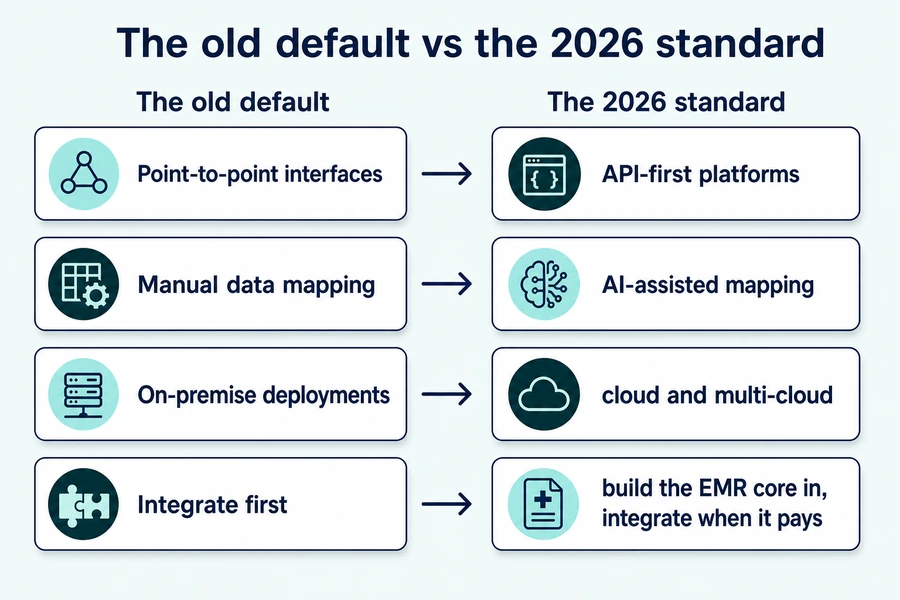
Four trends account for most of what's changing in electronic health record integration. Here's each one, and what it means for healthcare companies trying to stay lean.
FHIR & TEFCA adoption is now mainstream
FHIR spent years as a buzzword. The mandate ended that: certified vendors had to roll standardized FHIR R4 APIs out to their customers by the end of 2022, and they did.
TEFCA is past the aspirational stage too: live since December 2023 and, by HHS's June 2026 count, past a billion records exchanged. Joining is voluntary, but sitting out gets harder to justify every quarter.
FHIR still isn't universal inside hospital walls, though. Plenty of production interfaces run on legacy HL7 v2 messages or CDA documents, so plan for a hybrid integration strategy.
Pro tip: Treat FHIR R4 as your default, and keep an adapter layer for the HL7 v2 and proprietary endpoints you'll inevitably meet.
AI & automation for faster integrations
EHR integrations have historically been manual, resource-heavy projects. AI is taking over the repetitive parts:
- Automated data mapping. AI reads structured and unstructured data and maps FHIR resources onto existing EHR schemas, the work that used to be done by hand, spreadsheet by spreadsheet.
- Error detection and pre-deployment testing. Anomaly detection flags inconsistent or incomplete data in real time, and machine learning models simulate API calls to catch compatibility issues before go-live.
The aggregate effect: AI-assisted integration runs roughly 10x faster than traditional builds, and timelines that historically ran 6-18 months compress into weeks (Specode estimate).
Cloud & API-first architectures
On-premise, monolithic EHR deployments are on their way out. Two things keep pulling integration work into the cloud:
- API-first integration platforms. Redox and the Google Cloud Healthcare API turn what used to be point-to-point projects into managed services you subscribe to.
- More RESTful vendor APIs. EHR vendors keep exposing them, which lets healthcare apps pull real-time patient data instead of waiting on overnight batch jobs.
Hospitals and digital health companies increasingly ask for multi-cloud compatibility on top, which pushes everyone toward vendor-agnostic designs. The payoff shows up in your budget: API-first designs cut integration complexity, while serverless setups trim hosting and maintenance costs.
Pro tip: When you evaluate EHR vendors, weight API documentation quality and cloud-based integration support heavily. They predict successful deployments better than the feature list does.
Our medical app development guide covers why cloud infrastructure and API-first design belong among your day-one decisions.
Built-in EHR functionality for new healthcare apps
More new healthcare apps now embed core EMR functionality instead of starting with a full-scale EHR integration.
The logic holds up: most digital health products need patient records and encounter documentation long before any customer demands a live Epic connection, so teams build that core into the app and defer the heavy electronic health record integration until it earns a spot on the roadmap.
Why this matters:
- Faster go-to-market. No months of vendor approvals standing between you and your first release.
- Lower costs. EHR program fees and interface budgets wait until you have the revenue to justify them.
- Full data control. You own the patient data structure instead of renting access to a third-party EHR with limited visibility.
Specode's AI-built basic EMR core
Specode's AI builds a basic EMR core into your app: patient records, encounter notes, medication and allergy lists, and coded data where you need it (ICD-10 for diagnoses, RxNorm for medications). All of it runs on HIPAA-ready infrastructure with full code ownership, next to scheduling and real-time messaging in the same build. For the visit-side workflows, our telehealth platform development guide shows how the pieces fit together.
Timeline-wise, expect a working prototype in about 10 minutes and a production-ready basic app in 1-2 weeks.
When to use a built-in EMR vs. full EHR integration
A built-in EMR core fits products where the clinical record starts inside your app: telehealth services documenting their own encounters, or chronic care management platforms tracking structured patient history over time. If your data originates in a hospital's system of record, or has to write back to one, you need the real integration.
The two approaches also sequence well. For apps that will eventually talk to Epic, Oracle Health (Cerner), or athenahealth, the AI-built core doubles as a staging environment: validate your workflows against your own records first, then promote them to the live connection, built case-by-case through the platform (with managed coding on the Custom plan when you want our engineers on the heavy mappings).
For plenty of apps, the built-in core is the whole story for the first year. And when the Epic conversation finally happens, you walk in with working workflows instead of a spec document.
Best practices for integrating a healthcare app with an EHR
Most decisions here reduce to two questions: how your app talks to the EHR, and how much of the data pipeline you want to own. Answer both early and EMR system integration becomes a bounded project instead of a standing engineering tax.
SMART on FHIR vs direct EHR API access: when to use Epic, Cerner, and athenahealth APIs
You have two main ways into an EHR.
SMART on FHIR
The standardized path. Your app runs inside the EHR itself, with single sign-on (SSO) for providers; under the hood it's OAuth 2.0 for authorization and FHIR for data exchange. This is how most Epic EMR integration projects work, and Oracle Health follows the same pattern.
One date matters: since January 1, 2026, certified EHR APIs must support SMART App Launch v2, which makes PKCE mandatory for every app.
Direct EHR API access
Some vendors expose custom APIs outside SMART on FHIR for deeper backend work. You get more flexibility, and you inherit every vendor-specific quirk that comes with it.
Where to start with each vendor
For an Epic integration, open.epic and Epic on FHIR are the free tiers: API documentation and sandbox testing at no cost, with Epic Vendor Services as the optional paid program for deeper support and an expanded sandbox.
Once your app is live with at least one Epic customer, you can request a Connection Hub listing on Epic's Showroom, the 2026 equivalent of the old App Orchard listing. Health systems browse the Epic Showroom directory when they evaluate vendors, so the listing doubles as marketing.
A Cerner integration is now an Oracle Health integration. You register through the Oracle Health Developer Program and build against the Millennium Platform FHIR R4 APIs; Oracle no longer supports DSTU2, so R4 is the floor. If you run into the name Oracle Health Ignite in older docs, that's legacy Cerner naming for the same APIs.
An athenahealth integration starts sandbox-first: you build against the developer portal APIs, then apply to the Marketplace program for production access and a listing. In a June 2026 release, athenahealth called its athenahealth Marketplace one of the largest healthcare app stores, with over 500 solutions serving an athenaOne network of more than 160,000 providers.
Mirth Connect, Redox, and middleware solutions: balancing flexibility and cost
Middleware sits between your app and the EHR, translating formats and sparing you a hand-built connection to every system. The 2026 map has three positions, and the honest comparison looks like this:
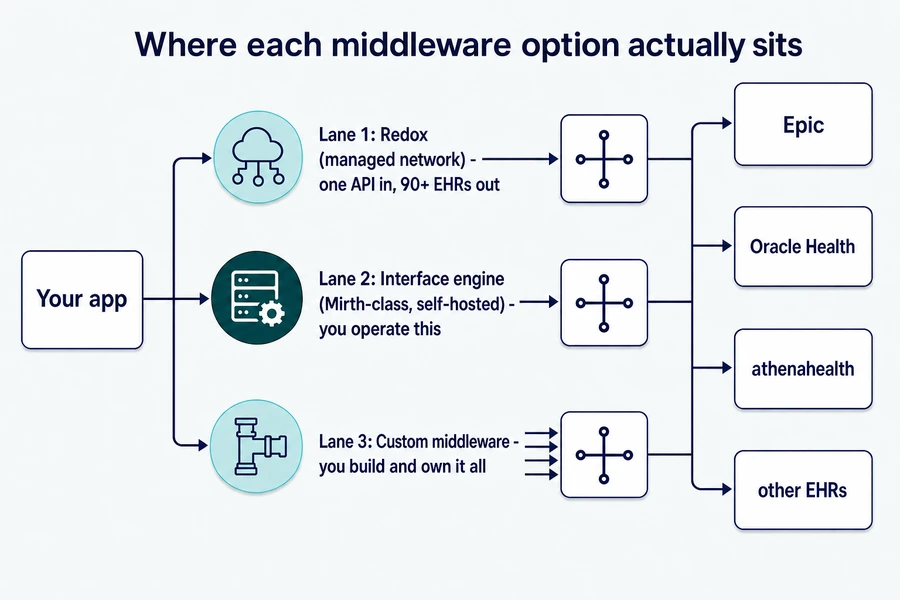
Redox: the managed API network
Redox is a managed integration platform: your product codes to one standardized API, and Redox handles the connection to more than 90 EHRs on the other side, including bi-directional exchange and discrete writes. The company reports over 12,000 connected healthcare organizations and 20 billion+ transactions in the past year (redoxengine.com, August 2026). Speed is the pitch, and Redox's own implementation docs back it with a number: an average of 6 to 10 weeks from kickoff to go-live (accessed August 2026).
Pricing is the part to model carefully. Redox doesn't publish list pricing, but third-party procurement data gives a rough anchor (Vendr marketplace data, accessed August 2026):
- median annual cost: about $49,500
- observed contracts: roughly $12,000 to $148,000 per year
- the final quote scales with the number of connections and message volume
The structural tradeoff: you're renting the integration layer, so your control over routing is limited and the bill grows with your traffic.
Mirth Connect: the engine that went commercial
For years the standard advice was "just use Mirth, it's free." That advice has expired. NextGen Healthcare took Mirth Connect closed-source with version 4.6, announced March 19, 2025, and the last open-source release, 4.5.2, no longer receives updates. Teams that want the open-source path have moved to community forks, most notably Open Integration Engine, which shipped its 4.6.0 release in July 2026 and is moving toward Eclipse Foundation governance.
What hasn't changed is the model. An interface engine gives you:
- full control over channels and routing
- support for HL7, FHIR, X12, DICOM, and vendor-specific formats
- real-time vs batch processing on your terms, not a vendor's
- no pre-built EHR connections, so you configure every channel yourself
Budget for engineering time either way; a Mirth-style engine is self-hosted infrastructure you build and operate, and an unpatched Mirth server is exposed PHI infrastructure.
Two more names come up in middleware conversations, and they do different jobs. Health Gorilla is a health information network with APIs for pulling nationwide patient records, lab data, and medication history; it was also among the first QHINs designated under TEFCA in December 2023 (healthgorilla.com, August 2026).
By contrast, 1upHealth is a FHIR-first health data platform now focused primarily on payer interoperability under the CMS interoperability rules (1up.health, August 2026), so if you're building a provider-facing app, it's probably not your middleware.
As telehealth EHR integration becomes standard in virtual care, middleware often does the heavy lifting: telehealth platforms need structured patient data and real-time encounter notes moving in both directions. The same goes for medicine delivery app development, where pharmacy fulfillment leans on medication lists and e-prescriptions drawn from the same records.
Custom middleware: when to build instead of buy
Sometimes commercial middleware can't carry your workload. Building custom middleware, typically from integration tools and microservices you assemble yourself, makes sense when:
- your transactions are real-time and high-frequency (medication reconciliation, remote patient monitoring)
- you're connecting systems middleware vendors don't cover (IoT devices, clinical research platforms)
- you want a vendor-neutral integration layer you fully own, with no SaaS dependency costs
The bill for that control is a higher upfront cost and a longer build, followed by dedicated DevOps and security management for as long as the middleware lives. Teams without in-house integration engineers usually hire an EHR integration company for this work. If you go that route, get the maintenance plan in writing before the build starts; owning the middleware means owning its upkeep.
The hybrid approach most teams land on
Plenty of teams mix layers instead of picking one: a managed network like Redox for the standard connections, plus a self-hosted engine or custom services for the workflows that make their product different. A multi-layered strategy comes down to owning what differentiates you and renting what doesn't.
Specode's AI-built EMR core: a faster alternative to full-scale integration
Some apps just need their own clinical record, without any connection to a hospital EHR. For those, Specode's AI builds a basic EMR core into your app, records and encounter documentation included, on HIPAA-ready infrastructure with full code ownership. That's often enough for telehealth apps and chronic care platforms that want structured clinical data without full EMR integration.
Key steps to a seamless integration process
Four steps cover the integration process, from scoping data needs to clinician adoption.
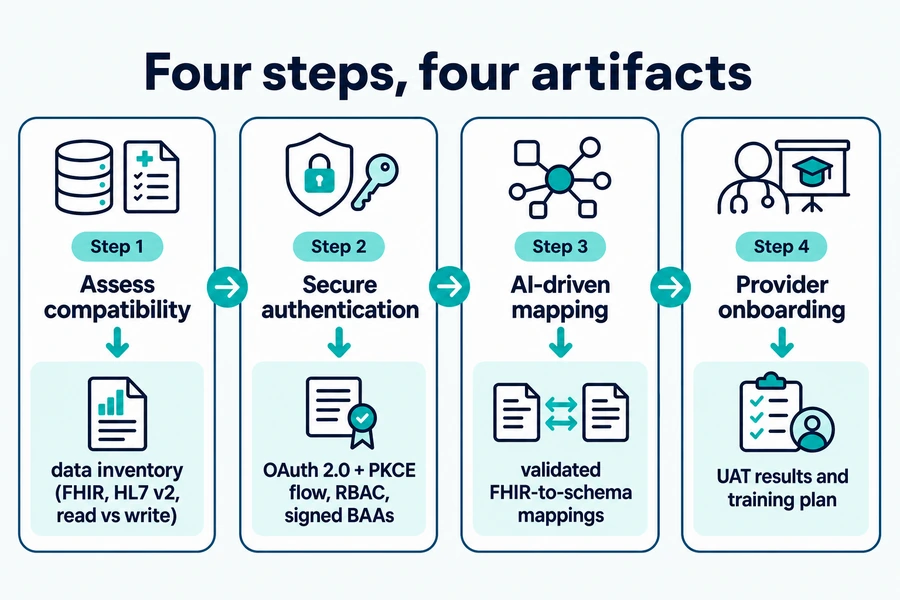
Step 1: Assess EHR compatibility and data needs (FHIR, HL7, custom APIs)
Before starting integration, define:
- Which EHRs your app must connect to: Epic, Oracle Health (Cerner), athenahealth, or all of the above.
- Data exchange formats: FHIR where you can get it, HL7 v2 where you can't.
- Read vs. write access. Not all EHRs let apps modify patient records, and write scopes are gated more tightly than read.
Pro tip: Work with provider users early to pin down which data fields the app actually needs. Choosing the right EHR integration software at this stage heads off compatibility problems later.
Step 2: Establish a secure authentication mechanism (OAuth 2.0, PKCE, role-based access)
EHR app authorization runs on the SMART App Launch framework, which layers OAuth 2.0 onto FHIR. Since January 1, 2026, certified EHR APIs must support SMART App Launch v2, which makes PKCE with the S256 method mandatory for every app. So plan your authorization flow around OAuth 2.0 plus PKCE from day one.
Authorization is the front door. HIPAA expects the rest of the house locked too:
- Role-Based Access Control (RBAC): only users who need patient data see it.
- Multi-factor authentication: blunts credential-based attacks.
- Encryption in transit and at rest: AES-256 for storage, TLS 1.2/1.3 on the wire.
- Audit logging: who accessed what, when, and which API calls failed.
And get the paperwork done before real patient data moves: every vendor touching PHI (Protected Health Information) in your chain, middleware and hosting included, needs a signed BAA.
Step 3: Implement AI-driven data mapping and validation
Data mapping eats more hours than any other step. Every EHR models the same clinical facts a little differently, and someone has to reconcile them. AI handles the repetitive part:
- matching FHIR resources to EHR schemas
- flagging inconsistent or missing data before a record saves
- fuzzy-matching patients so duplicates don't spread across systems
Keep a human on the edge cases. AI flags; your team decides what's safe to merge.
The payoff is speed. Most of the roughly-10x compression that AI-assisted integration claims over traditional builds (Specode estimate) is earned right here, in the mapping work.
Step 4: Plan for provider onboarding and workflow fit
Even a perfect EHR integration can fail if providers don't adopt it. Before launch:
- Run user acceptance testing (UAT) with real clinicians.
- Watch where the new workflow adds clicks; extra clicks are where adoption quietly dies.
Budget real time for training and support. If your app automates tasks clinicians do by hand today, show the time saved inside their own workflow; that wins buy-in faster than any feature list.
For the rollout itself, our EHR implementation guide picks up where this EHR integration guide leaves off, with implementation best practices and real-world case studies.
How much does EHR integration cost?
The honest answer on EHR integration cost: it's a range, and the range is wide. In our project experience, a single custom EHR integration typically lands between $50,000 and $200,000 or more once you account for the EHR vendor's program fees, interface development, testing, and go-live support.
Treat these as planning estimates rather than quoted prices; no vendor publishes standard per-interface rates. The approach you pick moves the number more than anything else.
What moves you inside those ranges:
- which EHRs you connect, because each vendor has its own program rules and fee schedule
- scope, since writing data back always costs more than reading it
- the vendor's own access fees, a sore point across the industry: in a 2024 national survey published in JAMIA, 47% of digital health companies called high EHR API access fees a substantial barrier
- compliance and testing around PHI
- maintenance, because a live interface needs rework every time the EHR updates its API
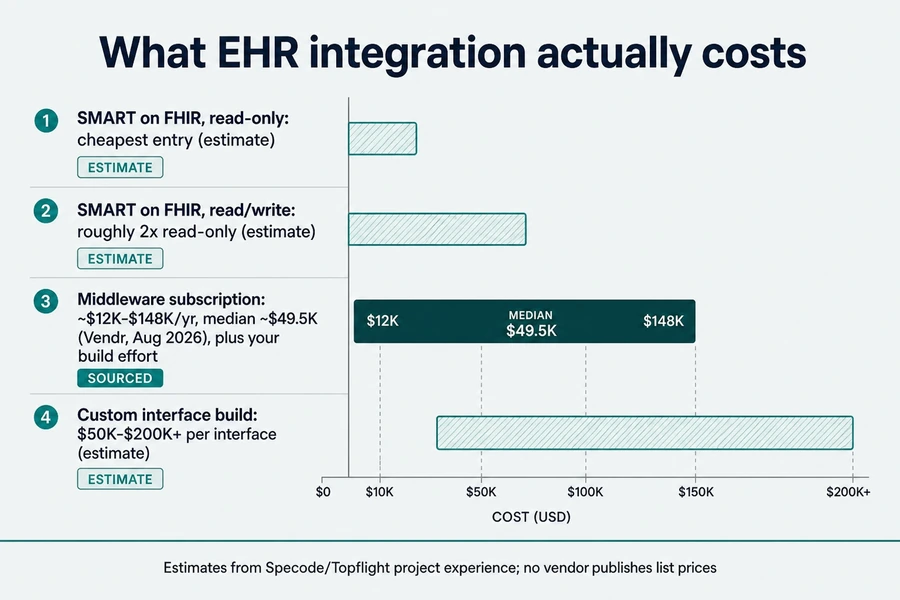
When you compare quotes for EHR integration services, ask which of these the price actually covers. A low bid that leaves out vendor fees and maintenance will find them for you later.
One more line item you shouldn't trim. Cutting security review and test coverage is the classic way to squeeze an integration budget, and against the $6.64 million average healthcare breach (IBM's 2026 figure again) it's a false economy. Spend there first.
Overcoming common integration pitfalls
Avoiding data fragmentation and workflow disruptions
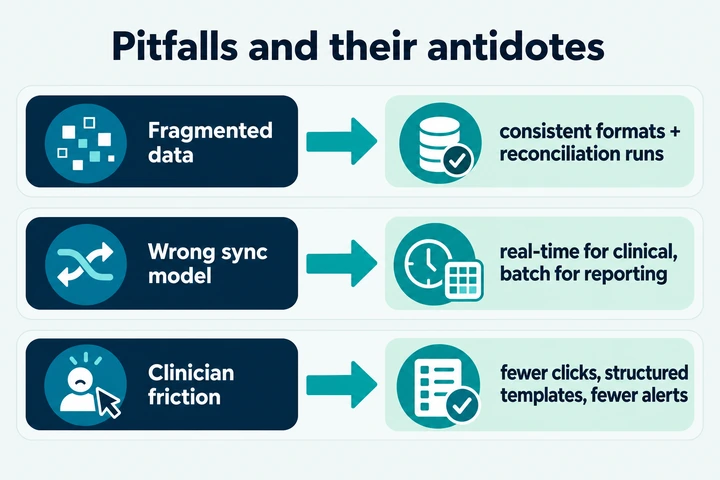
One of the biggest mistakes in EHR data integration is poor data synchronization.
- Keep data formats consistent (FHIR, HL7) across integrations.
- Run data reconciliation to catch duplicate or missing records.
Choosing the right EHR software solutions helps standardize data exchange and keeps systems interoperable.
Choosing real-time vs. batch data syncing
Not all healthcare apps need real-time EHR data access.
- Use real-time APIs for decision support tools and urgent clinical workflows.
- Batch sync patient data for reporting, billing, and administrative tasks.
Pro tip: Hybrid syncing strategies (real-time + batch) keep performance up while holding costs down.
Reducing burden on clinical staff with usable UX
A technically flawless integration doesn't matter if clinicians hate using it.
- Minimize clicks so data entry and retrieval stay fast.
- Use structured templates for common workflows (SOAP notes, encounter summaries).
- Reduce alert fatigue: notify only when truly necessary.
Pro tip: The best EHR-integrated apps feel invisible, embedded in clinical workflows without adding extra effort.
Specode: the AI-powered solution for EHR integration
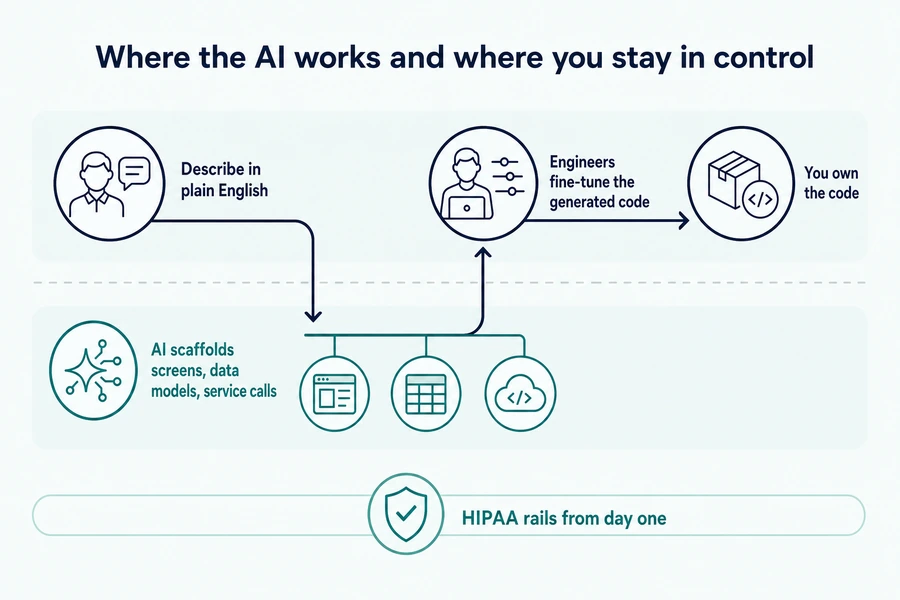
Specode is a HIPAA compliant app builder: describe what your app needs in plain English, and the AI builds it on HIPAA-ready rails, EHR touchpoints included. Here's what that looks like when your app has to talk to an EHR, or be one.
How Specode cuts EHR integration time
Manual integration methods front-load the slow parts, data mapping and API plumbing, before anyone sees a working screen. Three things change that math on Specode.
HIPAA compliance built in from day one
Auth, access patterns, and audit-friendly workflows come wired in: role-based access control plus encryption in transit and at rest, handled for you. The compliance layer ships with the platform, so your integration work starts on top of it instead of underneath it.
The AI scaffolds, your engineers fine-tune
Describe the integration surface in plain English and the AI scaffolds the screens, data models, and service calls. Your engineers fine-tune the generated code from there. That first pass is where traditional projects burn their first quarter.
Full code ownership and no vendor lock-in
Your integration stack stays under your control: export the code, modify it, deploy it anywhere (formalized in our terms, Section 8.2). Project states auto-save, so you can roll back to any previous state, and auth-enabled apps ship with seed test logins for each role you define, for role-scoped testing.
SMART on FHIR integration with Specode
Most SMART on FHIR pitches lean on the word "seamless." Ours leans on a build path you can inspect: the AI scaffolds the FHIR integration work, OAuth flows and resource handling included, and your team finishes the job.
For SMART on FHIR integration with the big names, Epic and Oracle Health (Cerner) work happens case-by-case through the platform, and the Custom plan's managed coding puts our engineers hands-on for the heavy mappings. The same process covers athenahealth.
The fastest route is Canvas Medical: we can bootstrap your Specode app to Canvas Medical via its FHIR R4 API/SDK. Pharmacy networks, lab systems, insurance verification, or any other system with an API wire in the same way.
Specode's AI-built basic EMR core
Plenty of health apps can run on their own clinical core instead of an external EHR. Specode's AI builds a basic EMR core into your app: patient records, encounter notes, meds/allergies lists, and coded data where you need it (ICD-10, RxNorm, SNOMED CT, LOINC) for billing touchpoints and medication tracking.
These capabilities get built to your data model and wire into the scheduling and telehealth features you build alongside them.
Why build the EMR in instead of integrating an external one?
- Faster go-to-market: there's no EHR approval queue between you and launch, which allows you to ship on your own schedule. Expect a working prototype in about 10 minutes and a production-ready basic app in 1-2 weeks.
- Lower costs: you skip API licensing fees and middleware subscriptions.
- Full data control: you own the patient data model instead of renting access through an EHR's API terms.
- Compliance you inherit: the EMR core sits on the same HIPAA groundwork as the rest of your app.
For startups and specialized health apps, that core is often the whole job. Outgrow it, and those flows can be promoted to a live EHR integration later.
Why teams pick Specode for EHR integration
Whether you're building a SMART on FHIR app that runs inside Epic or a standalone product with its own EMR core, the working promise is the same: HIPAA compliance built in from day one, with a security review before every go-live. If you want AI-assisted workflows on top, intake summarization or note assistance, custom AI agents are part of the Custom plan.
Specode compresses EHR integration timelines roughly 10x versus traditional development, without giving up code ownership.
Measuring success: key KPIs for EHR integration
Go-live is the halfway point. The months after tell you whether the EHR integration actually works: clinicians keep using it, or they quietly route around it.
If you're the CIO or product manager who owns this budget, you need a short list of concrete KPIs, and the time to capture baselines is before launch.
Performance metrics: system uptime and API response times
Technical performance decides adoption. An app that slows a physician's workflow or keeps dropping mid-clinic loses trust fast, and abandoned integrations rarely get a second budget cycle.
Key performance KPIs
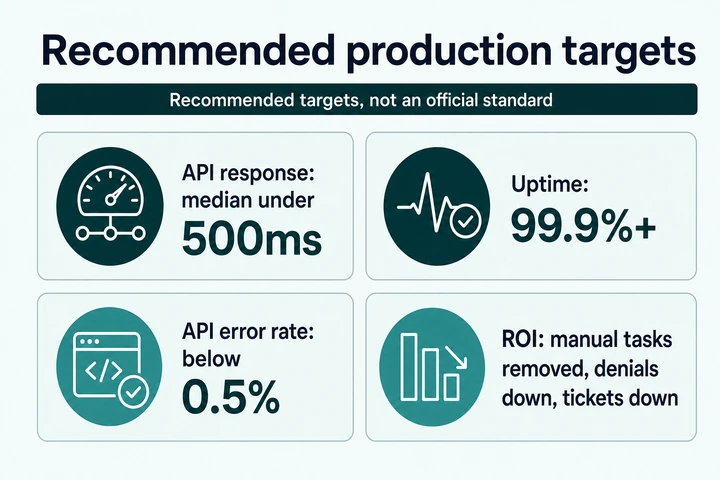
There's no official performance standard for FHIR APIs, so treat these as recommended production targets from our integration work:
- API response time: how quickly FHIR, HL7, or custom API requests return data. Hold median responses under 500ms.
- System uptime: 99.9% or higher, because clinical decision-making doesn't pause for your maintenance window.
- Data latency: how long patient data updates take to sync across systems.
- Error rate and API failures: keep the API error rate below 0.5%.
Your EHR vendor's sandbox won't hold you to these numbers; your clinical users effectively will.
ROI tracking: cost savings and efficiency gains
EHR integration should pay for itself in reclaimed staff hours. If it's adding work instead, you want the dashboard to say so early, while the fix is still cheap.
Key ROI metrics
- Administrative workload: count the manual data-entry tasks the integration removed. Duplicate entry is usually the first win.
- Billing and claims efficiency: are the billing touchpoints you've built through the EHR cutting claim denials?
- Support tickets: fewer integration-related help desk requests means the connection is holding up.
- Time-to-integration: how long scoping to go-live actually took, against what a traditional build would have taken.
On that last one, the yardstick we use is the roughly-10x compression over a traditional build (Specode estimate); the trends section covers what that means in calendar time.
Compliance and security benchmarks: incident rates and SLA adherence
The $6.64 million average healthcare breach from IBM's 2026 report is the number your security KPIs are protecting you from. HIPAA sets the audit floor for any EHR integration; if you've joined TEFCA, the Common Agreement's query-response obligations belong in the same audit scope.
Key compliance and security KPIs
- Compliance audit pass rates: track results for encryption, access control, and data-sharing policies across every audit cycle.
- Incident reduction rate: are PHI (Protected Health Information) breaches and unauthorized access attempts trending down quarter over quarter?
- SLA (Service Level Agreement) adherence: whether vendors hit their contractual uptime and response-time guarantees.
- Access logs and anomaly detection: watch for unusual API usage patterns; they surface problems before your incident count does.
None of this needs an elaborate BI stack. A weekly report that catches a creeping error rate in week 2 beats a quarterly review that finds it in month 3.
The future of EHR interoperability and AI-driven healthcare apps
EHR integration has become the foundation that modular, AI-driven healthcare applications get built on. And the regulations that spent years marked "coming soon" are mostly in force now. Here's where the three big trends stand.
AI in EHR data exchange: predictive analytics and clinical decision support
The interoperability work pays off when the data starts doing something. The AI applications already earning their keep in EHR data exchange are narrower and more concrete than the pitch decks suggest:
- AI-powered data normalization
- Real-time clinical decision support (CDS)
- Automated chart summarization
- Predictive health analytics
One regulatory note: ONC's HTI-1 rule added transparency requirements for AI-driven decision support in certified EHRs. If your roadmap includes predictive features that plug into a certified system, plan that documentation during design, when it's cheap.
The shift toward modular, interoperable healthcare apps
Monolithic, all-in-one EHR systems keep losing ground to modular, API-driven applications: specialized, interoperable modules wired together over standard APIs instead of one massive system doing everything.
Four things drive the shift:
- FHIR and TEFCA standardization
- microservices and API-first architectures
- demand for vendor-agnostic tooling
- lower development and integration costs
Many digital health startups skip building a full EHR entirely and launch with FHIR-compliant modular EMR components for patient management and clinical documentation, staying interoperable with the larger EHRs their customers already run. And if one codebase will serve multiple clinics or provider groups, pair the modular approach with multi-tenant architecture for healthcare platforms; the two decisions compound.
Regulations for EHR integrations: what's in force and what's pending
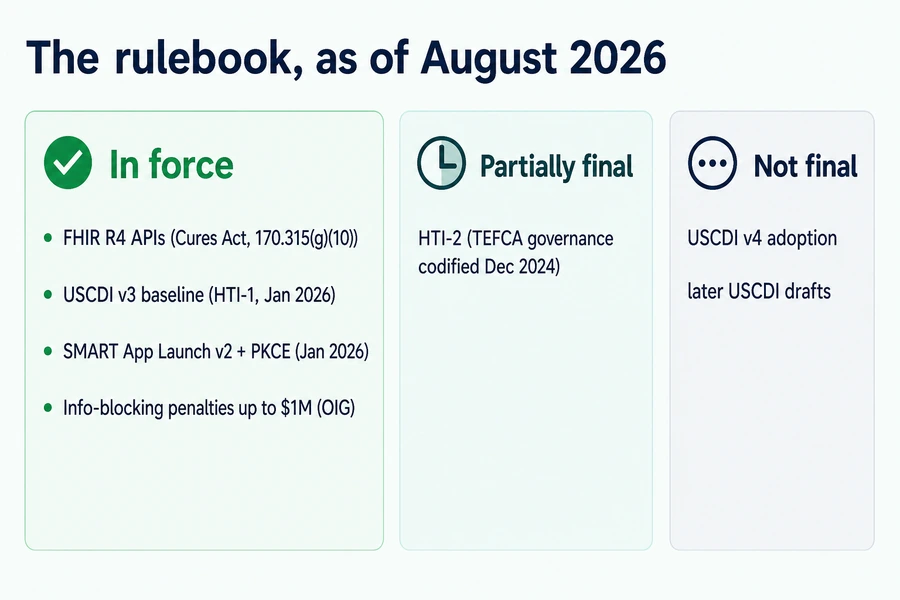
Earlier versions of this guide framed these rules as things to prepare for. Most of them arrived. The status as of August 2026:
TEFCA is live and getting hard to ignore
TEFCA went live in December 2023, when the first five Qualified Health Information Networks (QHINs) were designated. It's now a working nationwide exchange: in June 2026, HHS announced that more than 1 billion health records had been exchanged through the TEFCA network, up from about 10 million a year earlier. Joining is still voluntary, though with 11 Designated QHINs as of August 2026, the network's reach makes staying out an increasingly costly choice.
FHIR API certification is the floor for digital health apps
Under the 21st Century Cures Act Final Rule, ONC requires certified EHRs to expose a standardized FHIR R4 API, and certified vendors had to roll those APIs out to customers by the end of 2022. HTI-1, effective February 2024, raised the bar: the United States Core Data for Interoperability version 3 (USCDI v3) became the required data baseline on January 1, 2026, and certified APIs moved to SMART App Launch v2.
The follow-on HTI-2 rulemaking is only partially finalized: ONC codified TEFCA governance and the TEFCA Manner Exception in December 2024, and a separate Protecting Care Access rule added a new information blocking exception, but broader proposals such as adopting USCDI v4 remain unfinalized. So USCDI v3 and FHIR R4 stay the working baseline in 2026.
Design FHIR-first; every certified EHR you'll integrate with already speaks it.
Enforcement of data access rules is active
Information blocking enforcement is live. Health IT developers, HIEs, and HINs face OIG civil penalties of up to $1 million per violation, while providers face Medicare disincentives, such as a zero Promoting Interoperability score, under HHS's June 2024 final rule.
OIG and ONC jointly declared enforcement active in a September 2025 alert. No penalties have been publicly announced yet. We wouldn't count on that lasting.
How to keep EHR integrations ahead of the next rule
The moves are the same ones this guide recommended before the deadlines hit; they've just stopped being optional. Build FHIR-native so you're not maintaining HL7-to-FHIR translation layers that strain with every rule update. Keep mappings vendor-agnostic, because betting your architecture on a single vendor's roadmap is how lock-in happens.
And put AI to work on compliance itself. Anomaly detection across audit logs and access patterns flags gaps before an auditor does.
The teams that treated the January 2026 deadlines as engineering dates hit them without drama. Put the next set in your sprint plan the day a final rule publishes.
How Specode helps with EHR integration (sans vendor handcuffs)
If this guide has you thinking "we need FHIR, but without a six-month rewrite," you're our kind of builder. Here's how we keep your integration fast without locking you in.
Start on a working clinical core, then integrate deliberately
Specode's AI builds a basic EMR core into your app, from patient records and encounter notes down to the coded data you need, with HIPAA audit logging (stored permanently) wired in.
Spin up care workflows against that core to validate UX and data contracts before you wire into a hospital-grade EHR. Role-based access and PHI-safe templates ride along, so compliance scales with the integration from day one. When you're ready, promote those flows to a live integration.
Pick the right EHR path for your roadmap
- Canvas Medical (fastest path): we can bootstrap your Specode app to Canvas Medical via its FHIR R4 API/SDK, with clean read/write on core resources and sensible dev ergonomics. You get a real integration without dragging your timeline.
- Epic and Oracle Health (Cerner): built case-by-case through the platform, using native APIs and integration middleware patterns, scoped to what your workflow actually needs. When you want Specode's engineers hands-on for the heavy mappings, that's the Custom plan's managed coding. Same deal for athenahealth.
FHIR where it fits, bridges where it doesn't
We map the resources you'll really use (Patient, Encounter, Appointment, Observation, ServiceRequest/Task, DocumentReference, Communication) and version those mappings so they survive upgrades.
When HL7v2 or vendor-specific APIs show up, we build the bridge without derailing your FHIR-first plan. Same playbook when you're integrating with behavioral health EHRs, where those bridges earn their keep.
Don't forget the PM/RCM reality
Most "EHR integrations" die on scheduling and billing. We plan for practice management and revenue cycle rails (eligibility checks, appointment status, billing touchpoints) so your clinical sync doesn't break revenue. (Your ops team will thank you.)
AI that helps you build and operate
- Build faster: describe the integration surface in plain English ("pull meds/allergies, write back a SOAP addendum") and the AI assistant scaffolds the screens and data models, plus the service calls behind them. Engineers fine-tune in code, and you own that code.
- Run smarter (optional): add AI-assisted workflows such as intake summarization and note assistance once the pipes are flowing (custom AI agents are part of the Custom plan).
Customization without lock-in
Everything is adjustable (routing, forms, roles/permissions, queues, note templates) so your integration matches real clinical ops. And because you ship real code, you can keep iterating with your team (we're on call for the hairy bits).
Proof from the pharmacy rails: algorx
Fair warning: this one is a pharmacy-network integration, which sits next to EHR work rather than inside it. Take algorx: a HIPAA-compliant medication storefront built on Specode with prescription routing wired into pharmacy networks. It returned a 12x ROI, passed $1M in sales by Month 2, and hit 7-figure ARR within six months of launch. That's the same integration discipline, applied to pharmacy rails.
A pragmatic launch path
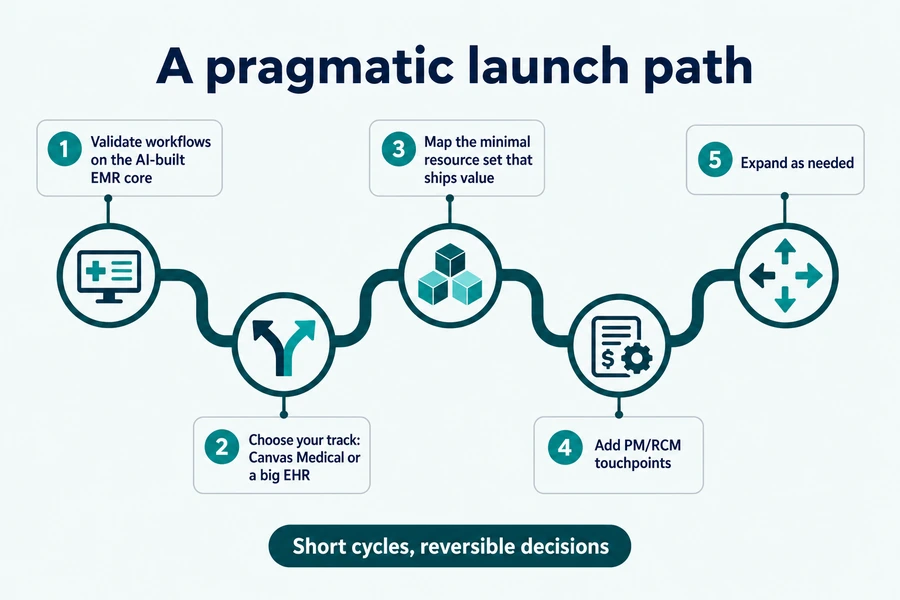
1) Validate workflows on the AI-built EMR core → 2) choose your track, Canvas Medical or a big EHR → 3) map the minimal resource set that ships value → 4) add PM/RCM touchpoints → 5) expand as needed. Short cycles, reversible decisions.
Let's build your ideal EHR integration
EMR integration historically ran 6-18 months; AI-assisted development compresses that into weeks, roughly 10x faster than traditional builds (our estimate). Specode's AI builds a basic EMR core into your app, and Epic and Oracle Health (Cerner) integrations are built case-by-case through the platform. Want our engineers hands-on for the heavy mappings? That's the Custom plan's managed coding. Either way, the code is yours.
Hopefully this guide has answered "what is EMR integration" and left you with a clearer path to your own build.
See a working prototype of your EHR-connected flow in about 10 minutes, then wire the real FHIR mapping, auth, and read/write on HIPAA-ready rails.
Frequently asked questions
Build FHIR-first against the certified R4 APIs and keep the integration layer in code you own. Middleware speeds go-live: Redox reports an average of 6 to 10 weeks from kickoff to go-live in its implementation docs.
The Cures Act requires certified EHRs to expose FHIR R4 APIs, so every major vendor already speaks FHIR. TEFCA went live in December 2023; by June 2026, HHS counted over one billion records exchanged across 11 QHINs.
No. ONC's July 2024 data brief states TEFCA participation isn't mandated by law; obligations start only once you sign the Common Agreement. The mandatory piece is separate: FHIR R4 support in certified EHRs under ONC's certification program.
Not fully; mappings and edge cases still need humans. But AI-assisted integration runs roughly 10x faster than traditional builds, compressing historical 6-18 month timelines into weeks (Specode estimate).
Build FHIR-first on R4 and keep vendor-specific logic behind an integration layer you own, with role-based access control from day one. When a vendor or standard shifts, you rework one layer instead of the whole app.
Underestimating what comes after API access. An Epic agreement or Cerner partnership gets you a sandbox; the months go into data orchestration and compliance testing against real clinical workflows.
Plan for $50,000 to $200,000 or more per custom integration, a range from our project experience; no vendor publishes per-interface rates. Middleware is separate: Vendr pegs the median Redox contract near $49,500 a year.
Worth it when you need several connections fast. Mirth went commercial with version 4.6 in 2025, so open source now means forks like Open Integration Engine. Build in-house only if integrations are your product.
An EMR holds one organization's charts; an EHR shares records across organizations. For integration work the distinction barely matters: you connect to the same vendor systems through the same FHIR APIs either way.