The 6 Best Blaze.tech Alternatives for Healthcare Apps in 2026

You run a healthcare app on Blaze.tech, or you're close to signing, and three questions decide your next move: what it costs once patient data is involved, who signs the BAA, and whether your app can leave with you. If you're comparing Blaze.tech alternatives on those three, here's the short answer.
For most healthtech teams that want an AI-built app and their own code, pick Specode. Caspio fits teams that want mature no-code with a signed BAA on its HIPAA Edition. For covered entities, Knack Health has the lowest published price here on a plan that includes a BAA. VertiComply, Base44 and Bolt follow, each with a condition to read first.
We make Specode, and it's first on this list. That's why every price and BAA term here comes from each vendor's own pages, checked in September 2026, so you can verify any cell.
What are the best alternatives to Blaze.tech for healthcare apps?
Specode ranks first for AI-built healthcare apps with source code you own. Patient data stays out of Specode's build environment, production runs on your own Convex account under a Convex BAA you sign, and Specode signs its own BAA on Custom. Next come Caspio, which signs a BAA on its HIPAA Edition, and Knack, whose Knack Health plans start at $159 a month for forms (September 2026) and include a BAA for covered entities. VertiComply suits low-cost code generation, but it has no published BAA plan or PHI hosting yet. Base44 and Bolt are prototype tools with no published BAA.
Key takeaways:
- Check what leaves with you before you compare prices. Caspio, Knack and Blaze.tech's pricing, product and security pages document data export, not code export. Specode, VertiComply, Base44 and Bolt export code, with different limits.
- Ask who signs the BAA, and on which plan. Blaze.tech, Caspio, Knack Health (for covered entities) and Specode (on Custom) sign BAAs. On Specode Pro, PHI stays out of Specode's build environment and in your own Convex account under a Convex BAA you sign; VertiComply's is by request, and Base44 and Bolt publish none.
- Compare cost of ownership, not the entry price. At September 2026 prices, Blaze.tech starts at $750 a month plus an implementation fee, with growth quoted and a rebuild to plan for if you leave. Specode Pro is $1,000 a month, month to month, plus your Convex account, and your code goes with you.
- Base44 and Bolt are for prototypes; production means migrating code or rebuilding. Code in GitHub can move to Specode, while an app without exportable code is rebuilt from its requirements. Confirm in writing what Blaze.tech lets you take.
Blaze.tech alternatives at a glance
Start with the first table, which shows whether a tool can hold patient data and let your app leave; the second matters only for the tools that pass, and Blaze.tech sits in the top row of both as your baseline.
Every figure was verified on the vendor's own pages in September 2026. "Cost of ownership" starts from the cheapest published plan that allows PHI under a BAA and adds the one-time fees, growth pricing and exit path each vendor documents, before usage fees. Table prices are monthly list prices (Caspio, Base44 and Bolt list lower annual-billing rates), and vendors reprice without notice.
If Specode's row fits what you're building, book a Specode demo and check it against your own requirements.
What is Blaze.tech and why teams switch
Blaze.tech, from Blaze Technology, Inc., builds custom web apps such as patient portals, internal tools and dashboards, and it positions itself as a HIPAA compliant no code app builder for healthcare. It also covers what regulated buyers check first: it signs a BAA with every customer from Production up, and it says it holds HITRUST e1 and SOC 2 Type 2.
Four documented points can still send teams looking elsewhere:
- Exit. Blaze.tech says you can export your data in standard formats at any time, including after you cancel, and that your app stops running on Blaze when your subscription ends. Its pricing, product and security pages document data export, not code export, though the pricing page advertises "No vendor lock-in." Get in writing what you can take before you plan a move.
- Caps and cost. Production covers up to 100 end users from $750 a month, plus a one-time implementation fee (verified September 2026). More apps, users and EHR integrations are quoted, and Blaze lists direct EHR integration and SCIM enterprise controls under custom Enterprise, so price your growth before you sign.
- Pricing on a call. The exact price and the implementation fee are set on an intro call, so your real number comes from a sales conversation.
- Logic. Rules live in Blaze.tech's visual workflows, with custom JavaScript running inside them, so plan on rebuilding those workflows if you leave.
What we checked in a HIPAA compliant app builder
We make Specode and ranked it first, so every cell is sourced to the vendor's own pages. The table columns are the criteria, and three decide the choice: who signs the BAA and on which plan, what it costs to own once patient data is involved (the entry price plus one-time fees, growth pricing and what leaving costs), and whether your code leaves with you.
Why lead with the BAA? HHS's Office for Civil Rights doesn't certify products, and HHS doesn't recognize private "certifications" as relieving a covered entity of its Security Rule obligations. HITRUST e1, which Blaze.tech says it holds, is a one-year private security certification, not an HHS determination. What does count: a vendor that creates, receives, maintains or transmits PHI for a covered entity is a business associate and must sign a BAA (What is a BAA covers the basics). Even then, the BAA is necessary but not sufficient: HHS also expects you to comply with the HIPAA Rules, including your own risk analysis.
Vendor facts come from each vendor's own pricing, terms, security and help pages, checked in September 2026, not from third-party lists. Blaze.tech's pages disagree on price (a legacy healthcare page still shows an older plan table), so we cite only its pricing page. We compared published documentation rather than running hands-on builds; our healthcare app builder comparison covers a wider field.
The best Blaze.tech alternatives
The six options run in ranked order: Specode, Caspio, Knack, VertiComply, Base44 and Bolt. Each entry uses the same labeled lines so you can compare them, and each ends with a one-line comparison against Blaze.tech.
1. Specode: AI-built healthcare apps with code you own
Specode is an AI-powered healthcare app builder where you define the UI, workflows, data model, permissions and integrations, with a guided first build in stages you approve. New apps start from a blank template, with AI playbooks for intake, scheduling, provider search and MFA; a few integrations come pre-configured and EHR integrations are built per project; encryption is platform-level, and the AI adds access controls and audit logging when you ask (it'll likely suggest them), while the HIPAA scan flags them if missing, with a one-click fix.
Best for: Healthtech teams, from seed-stage founders to clinic operators with a product plan, who want an AI-built custom web app, a BAA-backed production path and code they own.
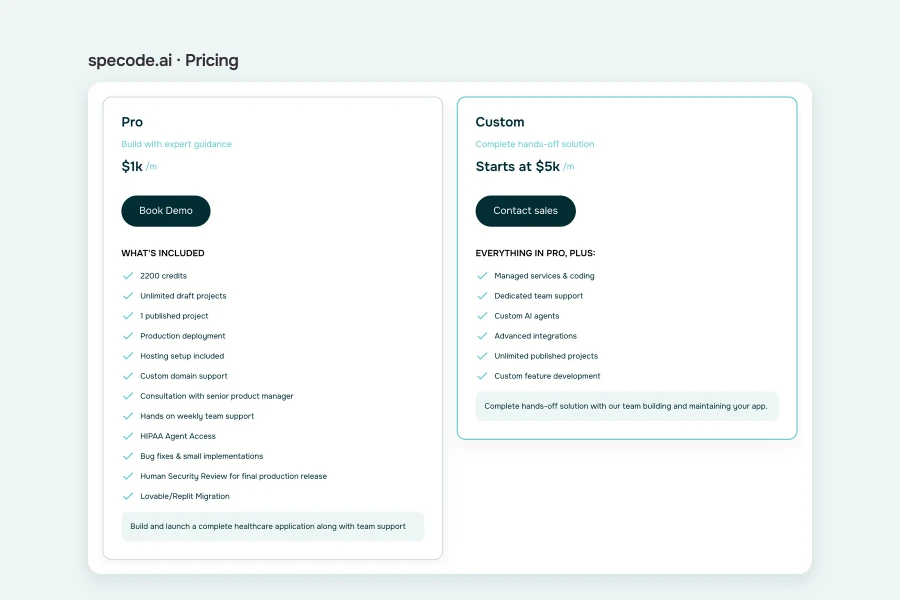
Pricing (verified September 2026): Pro is $1,000 a month, month to month, with 2,200 monthly credits, unlimited drafts, one published project and production deployment. Custom starts at $5,000 a month and is the hands-off option: the Specode team builds and maintains your app. Your own Convex account is billed separately by Convex.
BAA and HIPAA: Patient data never enters Specode's build or preview environment, and production runs on your own Convex account, so on Pro Specode isn't handling your patient data: the hosting BAA is Convex's standard BAA, which you sign. On Custom, Specode signs a BAA too, and third-party services you add may need their own. A Specode team member reviews the app for security and HIPAA readiness before launch, typically within one to two business days, and the HIPAA Agent scans your code on demand, separating must-fix issues from recommended hardening.
Code and portability: You own your app's code. It's built on React, shadcn/ui, Tailwind CSS and Convex and goes to your own private GitHub repository at go-live, and you keep rights in it and can export it during the subscription and for 60 days after termination. The live app runs on your own Convex account, apart from Specode's development environment, so if you cancel, it keeps running and you lose only continued development in Specode.
Migration: If your app's code is in GitHub or can be exported there, Specode migrates it (Lovable, Bolt, Replit and Base44 are common starting points); an app whose code can't be exported is rebuilt from its screens, data model and workflows instead. It starts with a conversation: the team reads your codebase, maps what transfers, what needs adjustment and what won't carry over, reviews the plan with you, and rebuilds the app on Specode's HIPAA-ready stack. Simple to moderately complex apps commonly move in about a week, with viability confirmed once the team has reviewed the codebase.
Team: Pro includes senior product manager consultation, hands-on weekly team support, and bug fixes and small implementations, so the team helps you customize beyond the basic app. Custom adds managed coding and dedicated team support, and you can stay completely hands-off.
Built on Specode: AlgoRX, founded by Adam Hotchkiss, went from launch to $10 million in under a year and is at $20 million in ARR as of September 2026; Hotchkiss says the Specode team delivered on the exact day it promised. Maternal Intelligence, founded by nurse Imani Bradford, was built on Specode without an engineering team: she rebuilt it from a prototype in about two months, working on it part-time.
Pros:
- Full ownership of your app's code, in your own GitHub repo, with a live app that keeps running if you leave
- An AI builder with a healthcare team behind it
- A team that customizes beyond the basic app with you, or builds and maintains it hands-off on Custom
- A published price and a clear BAA path: Convex's hosting BAA on Pro, Specode's own on Custom
Cons:
- Responsive web with PWA support, but no native mobile apps
- One published project on Pro; more on Custom
Blaze.tech vs Specode: Blaze.tech runs your app on its managed no-code platform, and its pricing, product and security pages document data export, not code export, while Specode puts the code in your own repository and production on your own Convex account; Blaze vs Specode has the full head-to-head.
If that fits, book a walkthrough with the Specode team.
2. Caspio: mature no-code with a HIPAA Edition
Caspio is a long-running no-code database and app platform that says it has supported healthcare organizations with HIPAA-compliant infrastructure since 2014. Caspi, its AI app builder for Flex apps, has been generally available since September 3, 2026.
Best for: Regulated-industry teams that want no-code apps with no per-user fees and a signed BAA.
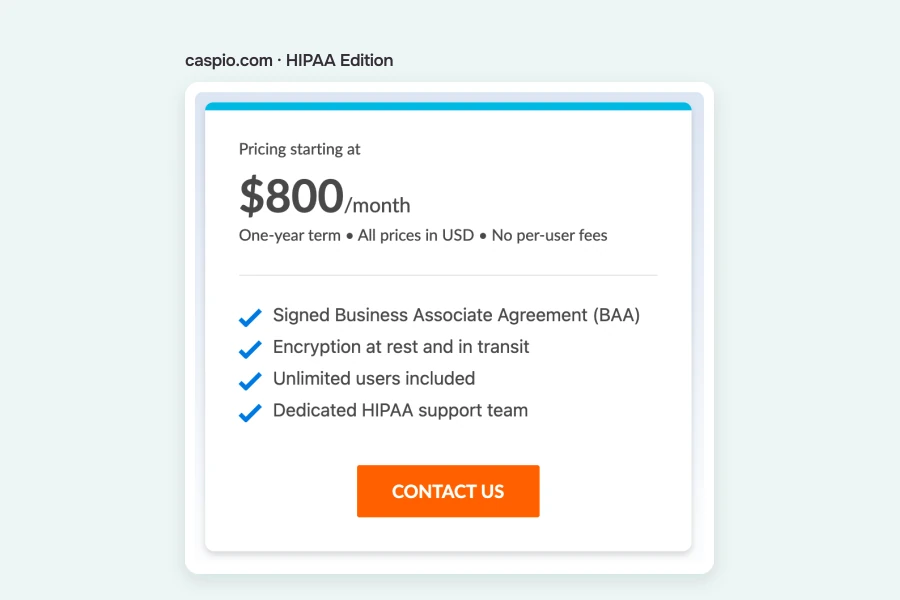
Pricing (verified September 2026): Caspio HIPAA Edition starts at $800 a month on a one-year term. Caspio also lists a $500-a-month HIPAA add-on for Team and Business plans (Team is $300 a month on a monthly term).
BAA and HIPAA: Caspio signs a BAA with HIPAA Edition customers. It says it completes annual SOC 2 Type II audits plus an annual independent review of its HIPAA controls; its compliance pages list no HITRUST.
Code and portability: Caspi produces no code artifact. Apps move only into another Caspio account, and data exports to Excel, CSV and Caspio XML, so leaving means taking your data and rebuilding. Deployed apps also stop working if the account is suspended for non-payment.
Pros:
- Long HIPAA track record and annual audits, per Caspio
- No per-user fees
- 24/7 in-house live chat, plus paid onboarding and services
Cons:
- No source code
- One-year HIPAA term; Team limits such as five app authors
- Responsive web only; no native mobile builder found
Blaze.tech vs Caspio: Caspio publishes its HIPAA Edition price and makes onboarding optional, while Blaze.tech adds a one-time implementation fee and holds HITRUST e1, per Blaze.tech.
3. Knack: low-cost HIPAA plans for database apps
Knack is a no-code database and app builder whose Knack Health plans are its HIPAA offering; its AI Builder, a beta per Knack's help center, builds tables and pages from a chat prompt.
Best for: Small clinic and operations teams running forms and database workflows who want the lowest published price here on a plan with a BAA.
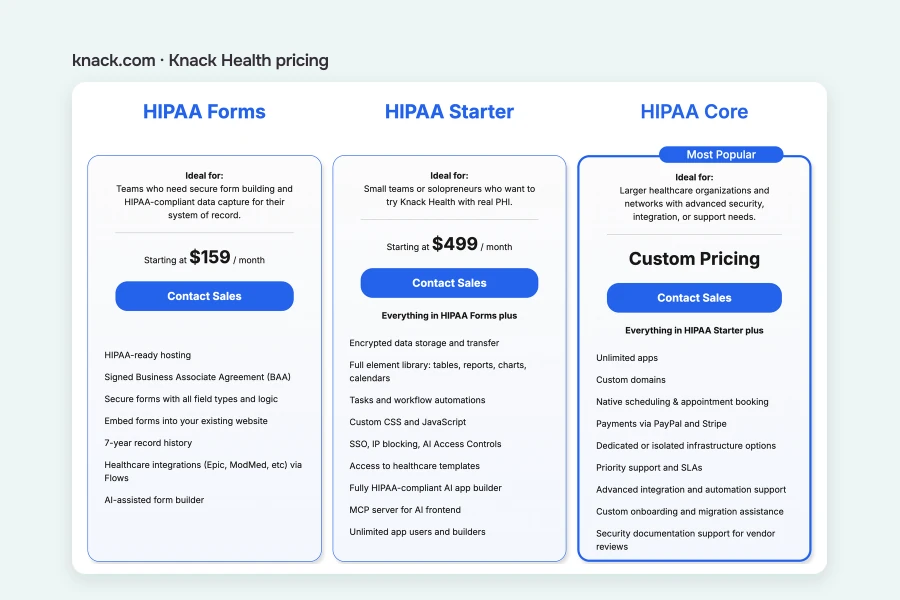
Pricing (verified September 2026): HIPAA Forms runs from $159 a month for forms, Knack HIPAA Starter from $499 for full apps, and HIPAA Core is custom, all sold through sales. Forms and Starter cap you at three apps, 10,000 records and 2 GB.
BAA and HIPAA: Knack Health plans include a BAA for covered entities; standard Starter, Pro and Corporate plans have no HIPAA option. Knack says it maintains SOC 2 Type 2 compliance, with reports under NDA.
Code and portability: Knack's help center says there is currently no option to create an external copy of an app's structure. Data exports one table at a time or through the API, so moving means rebuilding around your data.
Pros:
- Lowest published BAA-plan price here
- No per-user pricing
- Healthcare templates and listed EHR integrations
Cons:
- Three-app, 10,000-record caps on lower tiers
- No app structure export currently; responsive web only
- BAA stated for covered entities
Blaze.tech vs Knack: Knack Health's BAA plans start lower, from $159 for forms and from $499 for full apps (for covered entities), while Blaze.tech's BAA starts at Production, from $750 plus an implementation fee; for Knack itself, see Knack alternatives.
4. VertiComply: low-cost code generation, BAA still to confirm
VertiComply, founded in 2023, is an AI generator of full-stack application code with a healthcare template gallery; the 15-plus compliance frameworks it markets describe how generated apps are configured, not certifications it holds.
Best for: Budget-first founders who'll host exported code in their own cloud under their cloud provider's BAA.
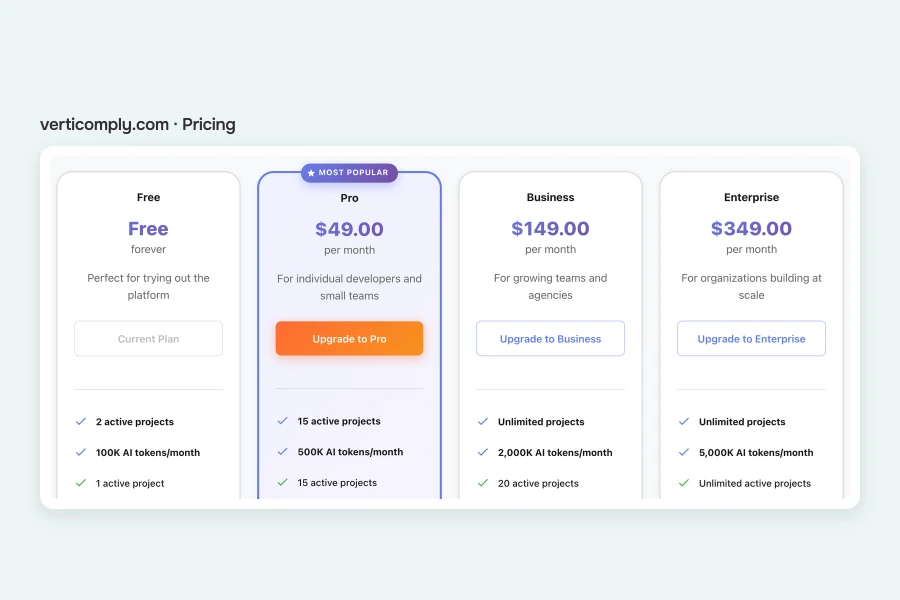
Pricing (verified September 2026): Free; Pro $49, Business $149 and Enterprise $349 a month, billed monthly.
BAA and HIPAA: VertiComply's terms of service treat a signed BAA as a separate agreement requested from its compliance team, with no self-serve plan named. Its CTO wrote on September 16, 2026, that hosted deployments are for demos and staging rather than PHI workloads until per-tenant isolation is in place.
Code and portability: ZIP or GitHub export starts on Pro; the code is licensed (perpetual, non-exclusive), not assigned, so read the license before telling investors you own it.
Pros:
- Low monthly prices; code export from $49
- Says it generates iOS and Android apps too
Cons:
- Community support on Free, email on Pro and Business, priority only on Enterprise
- Its pages disagree on its SOC 2 status and template count
Blaze.tech vs VertiComply: VertiComply costs far less and exports code, while Blaze.tech signs a BAA from Production and hosts PHI today.
5. Base44: prompt-built prototypes, no BAA today
Base44, operated by Wix, is an AI app builder that generates full-stack apps from plain-language prompts. If your prototype lives there and you're weighing Base44 alternatives before real patients arrive, read the BAA line first.
Best for: Prototypes and demos with synthetic data.
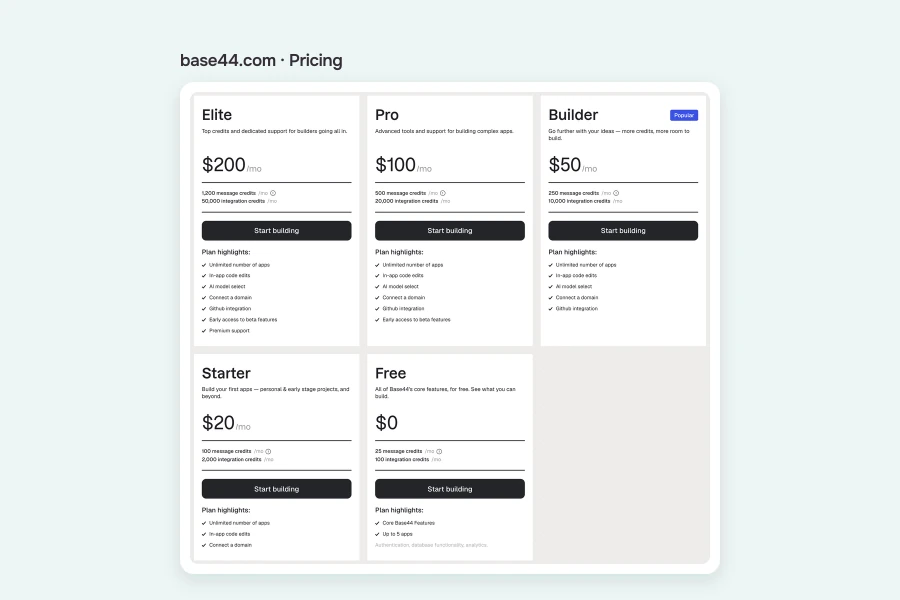
Pricing (verified September 2026): Free; Starter $20, Builder $50, Pro $100 and Elite $200 a month, or less billed annually.
BAA and HIPAA: Base44's terms of service bar PHI unless Base44 has expressly agreed in prior writing and an appropriate agreement is in place, and its own blog says it does not currently offer a signed Business Associate Agreement. Base44 says it holds SOC 2 Type II and ISO 27001, which doesn't change those PHI terms.
Code and portability: GitHub sync or ZIP export starts on Builder, but hosting, authentication and database infrastructure stay on Base44.
Pros:
- Prompt-to-app builds
- Exportable frontend and functions
- App-store wrapper
Cons:
- The managed backend doesn't export
- No clinical integrations documented
Blaze.tech vs Base44: Blaze.tech signs a BAA from Production, while Base44 generates full-stack apps from prompts but doesn't currently offer a signed BAA.
6. Bolt: prototypes and mobile, no published BAA
Bolt (Bolt.new) is StackBlitz's AI builder for websites, web apps and mobile apps. If you're comparing Bolt alternatives because a prototype needs to hold patient data, start with the BAA line.
Best for: Prototypes, including mobile apps, without patient data.
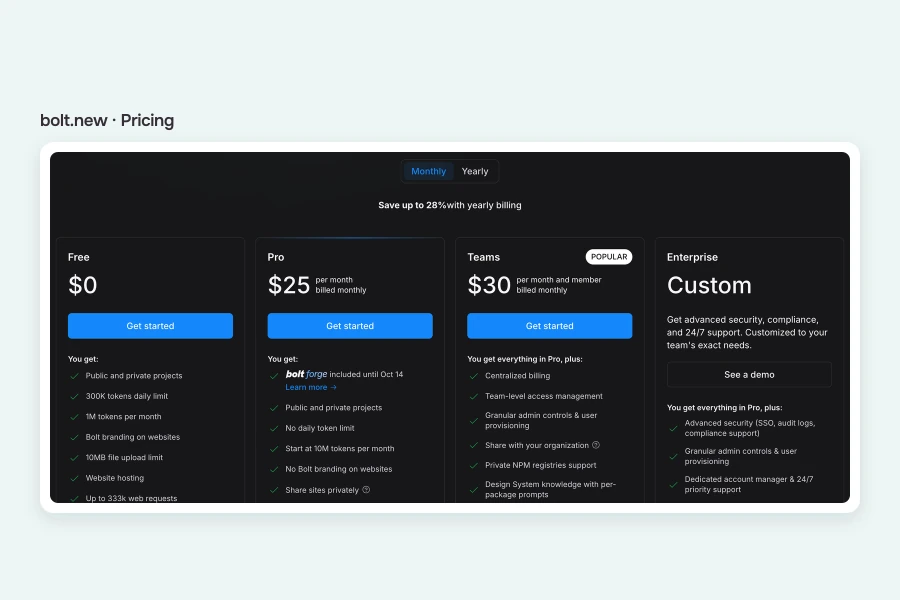
Pricing (verified September 2026): Free; Pro from $25 a month or $18 billed yearly; Teams $30 per member; Enterprise custom.
BAA and HIPAA: No Bolt pricing, legal, trust or help page offers a BAA. Enterprise can run in your own AWS or Azure tenant, which Bolt markets as meeting HIPAA requirements, but without published BAA terms. Bolt's security page lists SOC 2 Type 2, though its trust center's report section describes only a Type 1 audit.
Code and portability: Download a ZIP or sync to GitHub, then publish on Bolt hosting, Netlify or another host; StackBlitz assigns you whatever rights it has, if any, in the AI output.
Pros:
- Code export by ZIP or GitHub
- iOS and Android apps through Expo
Cons:
- No healthcare templates or integrations documented
- Email support only on paid plans, with an account manager on Enterprise
Blaze.tech vs Bolt: Bolt hands you the code but publishes no BAA, while Blaze.tech signs a BAA from Production and runs the app for you.
Can you build HIPAA apps with Base44 or Bolt?
Not on any plan either vendor publishes today. Base44 bars PHI without its prior written agreement and says it doesn't currently offer a BAA (Is Base44 HIPAA compliant? has the detail). Bolt publishes no BAA, and its Enterprise tier can run in your own cloud without published BAA terms (Is Bolt HIPAA compliant? covers it). A vendor that creates, receives, maintains or transmits PHI for you is a business associate that must sign a BAA, so both tools suit synthetic-data prototypes.
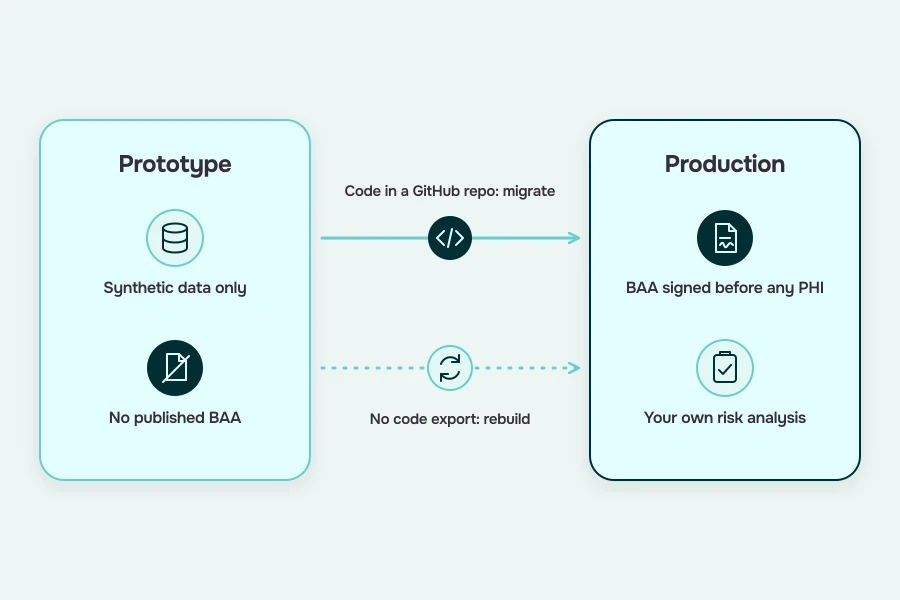
Going live needs what a prototype never did: those BAAs, including one with whatever host you pick for exported Bolt code, and compliance with the HIPAA Rules, starting with your own risk analysis.
One Base44 catch: it exports the frontend and functions but not its hosting, authentication or database, so those parts get rebuilt.
Which Blaze.tech alternative should you choose?
Start from the constraint you can't bend:
- Choose Specode if you want an AI-built app you fully own, a BAA-backed production path, and a team that can build with you or take it off your hands, especially as a seed-stage founder or a founder leaving a prototype.
- Choose Caspio if you want mature no-code with a signed BAA and no per-user fees, and you don't need the code.
- Choose Knack if you're a small clinic or operations team running forms and database workflows on a tight budget, as a covered entity.
- Choose VertiComply if price is the constraint and you'll host the exported code in your own cloud under your own BAA.
- Choose Base44 or Bolt for prototypes with synthetic data only.
If you run a clinic or practice and want a team to build with you, compare the help on offer: Specode Pro includes senior product manager consultation and weekly team support, and Custom hands the build and upkeep to the Specode team; Blaze.tech provides implementation specialists for a one-time fee, and Knack Health runs a done-for-you build program.
Stay on Blaze.tech if your buyer's checklist requires HITRUST e1, which Blaze.tech lists on its security page, or if you want its team and module library to run implementation. If you're leaving instead, the next section covers the move.
Migrating from Blaze.tech to Specode
If you're on Blaze.tech today, plan a rebuild. Its pricing, product and security pages document data export, not code export, and Specode's migration starts from code in GitHub. So an app without exportable code gets rebuilt on Specode, and what you have today becomes the requirements: screens, roles, data model and workflows.
On the Blaze.tech side:
- Confirm in writing what you can take with you.
- Book a demo with the Specode team to talk through the rebuild.
- Keep Blaze.tech running until the new app is live, since your Blaze app stops running when the subscription ends.
- Export your data in standard formats before you cancel (Blaze.tech says you can also do it after).
No real patient data goes into the Specode build or preview, and PHI enters production only after you sign Convex's BAA and any third-party BAAs; on Custom, Specode signs its own BAA too. Any BAA must also provide for returning or destroying PHI at termination where feasible, and HHS says the agreement's terms shouldn't block your access to your ePHI.
The payoff is a cleaner exit. Your Specode app runs on your own Convex account from go-live, so if you cancel, it keeps running and you lose only continued development in Specode. The code already sits in your GitHub repository, and you keep rights to export it during the subscription and for 60 days after termination.
Build your next version on Specode
Coming off Blaze.tech, you probably want an AI-built healthcare app, a BAA-backed production path, code you own, and a team that can build it with you or for you. Specode is built for that. You describe the app in plain English, shape its workflows, data model and permissions, and go live with the Specode team.
If you're weighing Blaze alternatives with a live app, book a demo and bring your current Blaze.tech app's screens and workflows, so the conversation starts from your real requirements. You can also create a Specode account if you'd rather start there.
Frequently asked questions
Specode, for most healthtech teams that want an AI-built app, a BAA-backed production path and their own code. Caspio offers mature no-code with a signed BAA (HIPAA Edition); Knack Health has the lowest-priced published BAA plans here, for covered entities.
Blaze.tech (from Production), Caspio (HIPAA Edition), Knack Health (for covered entities) and Specode (Custom) sign BAAs. Specode Pro keeps PHI in your Convex account, under a Convex BAA you sign. VertiComply's is by request; Base44 and Bolt publish none.
Base44 bars PHI unless it has expressly agreed in prior writing, and it says it doesn't currently offer a signed BAA. Keep it to synthetic-data prototypes, and move to a platform with a BAA path before real patients arrive.
Bolt publishes no BAA on any plan. Its Enterprise tier can run in your own AWS or Azure tenant, which Bolt markets as meeting HIPAA requirements, but without published BAA terms. Keep patient data out of Bolt prototypes.
Blaze.tech's pricing, product and security pages document data export in standard formats, including after you cancel, but no code export. Your app stops running when the subscription ends. Confirm in writing what you can take with you.
No. Blaze.tech is a no-code healthcare app builder. Blaze.ai comes from a different company, Almanac Labs, Inc., and sells marketing software and a done-for-you marketing service, so its prices and features don't apply here.