Is Base44 HIPAA Compliant?

The rise of AI app builders has made it possible to go from idea to working prototype in a weekend. For founders and product managers in healthcare, that speed is intoxicating — until someone asks about compliance.
It's the central tension of the AI app builder HIPAA question: the tools that move fastest are rarely the ones that meet healthcare regulations out of the box. And when vibe coding HIPAA-sensitive applications, the gap between "it works" and "it's compliant" is wider than most builders realize.
If you're googling "Is Base44 HIPAA compliant?" before committing to a build, you're asking the right question at the right time. Building on a platform that can't support HIPAA requirements doesn't just create technical debt — it creates legal exposure. And unlike a buggy UI, compliance gaps can't be patched in a sprint.
This article breaks down what Base44 offers, where it falls short for healthcare use cases, and what alternatives exist for builders who need genuine HIPAA compliance from day one.
Is Base44 HIPAA compliant?
No. As of March 2026, Base44 does not offer a Business Associate Agreement (BAA), its Terms of Service explicitly restrict protected health information (PHI), and it lacks HIPAA-specific audit logging or compliance documentation. Base44 is a strong general-purpose app builder, but it should not be used to handle patient data.
Key takeaways:
- No BAA, no PHI. Base44 does not publicly offer a BAA — the legal agreement required before any vendor can handle protected health information under HIPAA.
- SOC 2 ≠ HIPAA. Base44 holds SOC 2 Type II and ISO 27001 certifications, which demonstrate solid general security but do not satisfy HIPAA's specific legal, technical, and administrative requirements.
- Purpose-built alternatives exist. Platforms like Specode provide a BAA as standard, PHI-aware data models, and HIPAA-ready infrastructure out of the box — so healthcare builders don't have to retrofit compliance onto a general-purpose tool.
What Is Base44?
Base44 is a general-purpose AI-powered no-code app builder that lets users create web applications by describing what they want in natural language. It's positioned as a rapid prototyping and deployment tool — part of the broader "vibe coding" movement where builders with strong product instincts use AI to generate functional software without traditional development expertise.
The platform has gained traction for its speed and accessibility. Users can go from a text prompt to a deployed application with authentication, database, and UI in hours rather than weeks. Base44 is operated by Wix.com Ltd., with servers located in the United States, and it serves a broad range of use cases — from internal business tools to customer-facing SaaS products.
For general-purpose applications, Base44 is a capable tool. But evaluating Base44 for healthcare means confronting a hard truth: the platform wasn't designed for regulated industries. Building a Base44 healthcare app is fast — but fast doesn't help if your compliance foundation is missing.
What Does HIPAA Actually Require from a Platform?
Before evaluating any platform for healthcare, it helps to understand what HIPAA demands. The Health Insurance Portability and Accountability Act rests on three core rules.
- The Privacy Rule governs who can access protected health information (PHI) and under what circumstances. It establishes patients' rights over their data and sets limits on how covered entities and their business associates can use or disclose it.
- The Security Rule requires administrative, physical, and technical safeguards to protect electronic PHI (ePHI). This includes access controls with unique user IDs, audit controls that log all PHI access and modifications, integrity controls to prevent unauthorized changes, and transmission security through encryption.
- The Breach Notification Rule requires covered entities and business associates to notify affected individuals, HHS, and in some cases the media, when unsecured PHI is compromised.
For any platform that will store, process, or transmit PHI, these rules translate into specific requirements:
- a signed Business Associate Agreement (BAA)
- data encryption at rest and in transit
- role-based access controls
- HIPAA-specific audit logs
- documented security risk analysis
- breach response procedures
A platform doesn't need a HIPAA certification — no such certification exists. But it does need to provide the technical safeguards and legal agreements that let healthcare organizations meet their obligations under the law.
Is Base44 HIPAA Compliant? The Direct Answer
No. Based on publicly available documentation as of March 2026, Base44 is not HIPAA compliant and should not be used to build applications that handle protected health information.
Here's what the evidence shows:
Base44's Terms of Service Explicitly Restrict PHI
The terms state that "no sensitive data that is protected under a special legislation and requires unique treatment (such as protected health information or credit, debit or other payment card data) will be shared with the Platform, other than if expressly agreed by the Company in prior writing and the appropriate agreement in place."
In other words, Base44's own legal documents tell you not to put PHI on the platform unless you've negotiated a separate written agreement. The Base44 PHI restriction is unambiguous — and it means Base44 patient data handling for healthcare use cases is not supported under standard terms.
Base44 Does Not Publicly Offer a BAA
The platform provides a Data Processing Agreement (DPA) for personal data under GDPR, but a DPA is not a BAA. These are fundamentally different legal instruments serving different regulatory frameworks. Without a signed BAA, a healthcare organization cannot legally allow Base44 to handle PHI.
Base44 Holds SOC 2 Type II and ISO 27001 Certifications
These are legitimate, rigorous information security standards — and they demonstrate that Base44 takes general data security seriously. However, SOC 2 and ISO 27001 do not equal HIPAA compliance. They cover overlapping but distinct requirements, and neither addresses the specific legal, administrative, and technical obligations imposed by HIPAA.
Base44 Does Not Publish HIPAA-Specific Compliance Documentation
There is no public evidence of HIPAA-specific audit logging, PHI-aware data handling, or healthcare compliance guides in Base44's documentation.
Important note: This assessment is based on Base44's publicly available Terms of Service, Privacy Policy, DPA, Trust Center, and support documentation as of March 2026. If Base44 adds HIPAA support in the future, builders should verify directly with the company and request written confirmation of BAA availability before processing any PHI.
Where Base44 Falls Short for Healthcare Use Cases
Base44's compliance gaps for healthcare aren't incidental — they reflect the platform's design as a general-purpose builder. Here are the specific shortfalls:
No Signed BAA Pathway
This is the most fundamental gap. Under HIPAA, any vendor that creates, receives, maintains, or transmits PHI on behalf of a covered entity must sign a BAA. OCR has used the absence of a BAA to extract settlements ranging from tens of thousands to over a million dollars. Without a BAA, every patient record that touches Base44 is a potential violation.
General-Purpose Data Infrastructure
Base44 offers row-level security, encryption, and SSO — solid security features for a general-purpose platform. But HIPAA requires more than baseline security. PHI needs to be identified, classified, and handled differently from other data types. Base44's data models don't distinguish between a marketing email address and a patient's medical record.
No HIPAA-Specific Audit Logging
HIPAA's Security Rule requires audit controls that track who accessed PHI, when, what they did with it, and from where. Base44 offers application-level security scanning, but there's no public evidence of the granular, tamper-proof audit logs that HIPAA demands. For any Base44 medical app handling real patient records, this gap alone would be a finding in a compliance audit.
No Healthcare-Specific Compliance Documentation
Healthcare builders need documented evidence of their platform's compliance posture for risk assessments, audits, and due diligence. Base44's Trust Center addresses SOC 2 and ISO 27001 — not HIPAA.
AI-Generated Code Introduces Additional Risk
When Base44's AI generates application code, that code may not implement PHI safeguards unless explicitly prompted. There's no built-in awareness of healthcare data handling requirements, which means security-critical details can be missed in ways that are invisible until an audit or breach.
Can You Make a Base44 App HIPAA Compliant?
Theoretically, a determined team could try to layer compliance on top of Base44. In practice, this approach is risky, expensive, and fragile.
Here's what you would need to do manually:
- negotiate a custom written agreement with Base44 (their ToS leaves the door open, but there's no standard process)
- implement your own audit logging for all PHI access
- add encryption layers beyond what the platform provides by default
- build custom access control logic that meets HIPAA's minimum necessary standard
- conduct and document a full security risk analysis
- establish breach detection and notification procedures
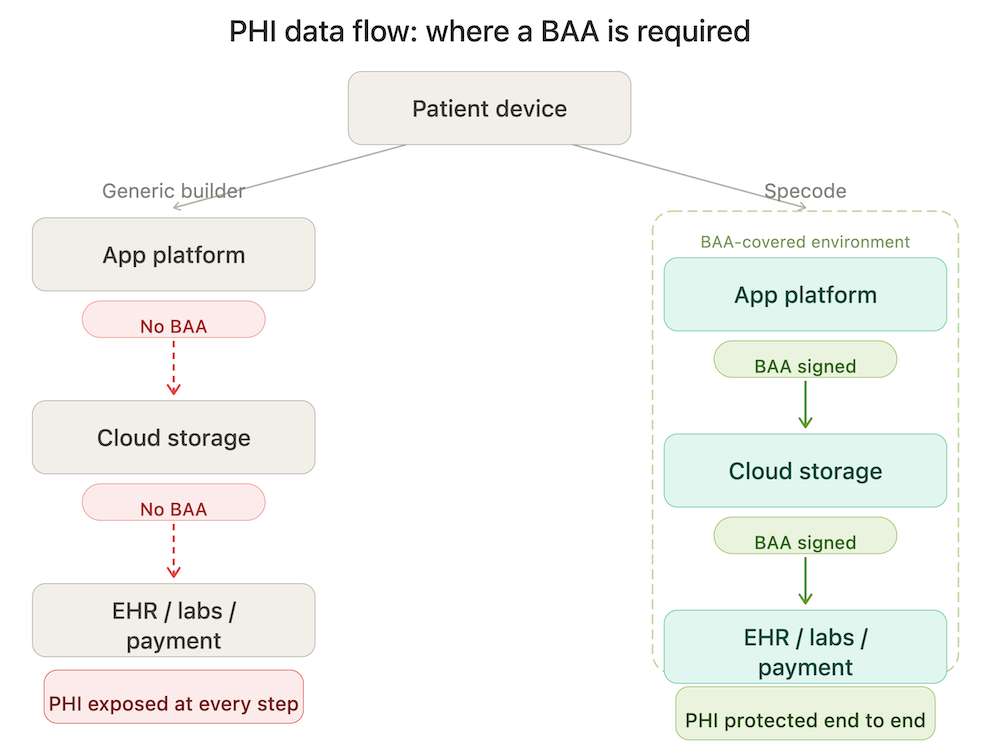
- ensure every third-party integration in your stack also has BAA coverage
Even if you managed all of this, you'd face ongoing risks. Platform updates could break your custom compliance layers. You'd have no guarantee that Base44's infrastructure changes won't affect PHI handling. And you'd be responsible for re-validating Base44 health app compliance with every significant change — an ongoing software compliance burden that compounds over time.
The honest math: by the time you've bolted on HIPAA compliance to a platform that wasn't designed for it, you've likely spent more time and money than you would have by starting on a purpose-built platform. Teams that try to retrofit compliance into general-purpose platforms frequently burn through entire funding rounds on rework.
Bottom line: Base44 is a strong choice for non-PHI prototypes and demos using synthetic data. But if real patient data will touch your application within 90 days — whether you're building a symptom tracker app, a care coordination tool, or a telehealth platform — start on a platform that's HIPAA-ready from the ground up.
HIPAA Compliant App Builder Alternatives
Several platforms are designed specifically for healthcare or offer HIPAA-compliant configurations. If you're searching for a Base44 alternative that's no-code HIPAA compliant out of the box, the market has matured significantly. When evaluating a HIPAA compliant no-code platform, look for these non-negotiables: BAA availability without custom negotiation, encryption at rest and in transit as a default, HIPAA-specific audit logging, documented compliance posture, and ideally, PHI-aware data models that treat regulated data differently by design.
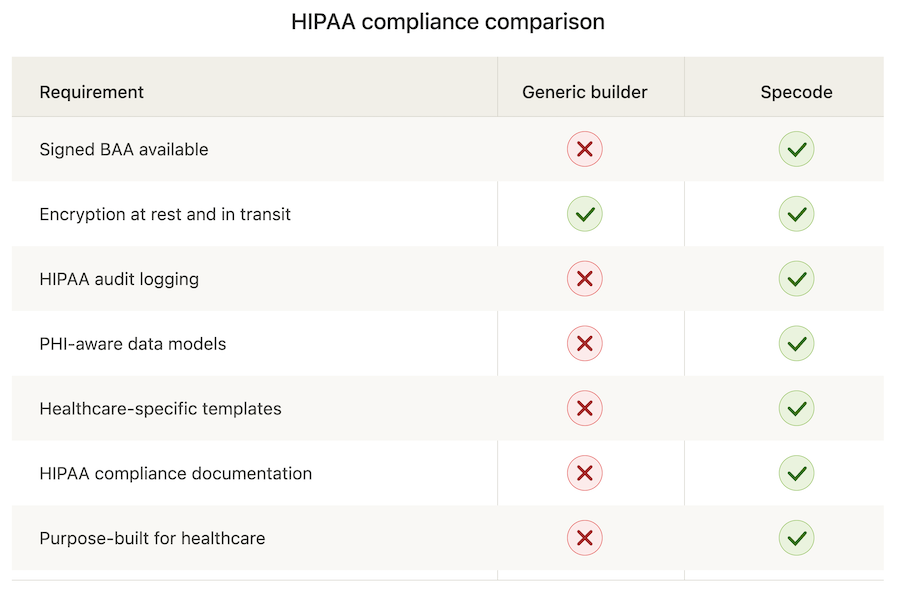
The table below compares Base44 and Specode across the features that matter most for healthcare compliance:
Other platforms worth evaluating include Caspio (offers a HIPAA Edition with BAA support), Blaze (HIPAA compliance with BAA on its Enterprise plan), and Knack (dedicated HIPAA plans with BAA, encryption, and audit logging).
However, most general-purpose no-code platforms — including Bubble, Lovable, and Replit — share the same fundamental limitation as Base44: they weren't designed for regulated healthcare data. The low-code healthcare space is growing, but not every healthcare no-code builder delivers on compliance claims.
For a direct Specode vs Base44 comparison, the table above captures the key differences — but the short version is that one was built for healthcare, and the other wasn't.
For a deeper look at what purpose-built means in practice, see our guide to custom healthcare software development.
Why Specode Is Built for Healthcare Compliance
Specode is an AI-powered healthcare app builder created specifically for teams building regulated health applications. It combines the speed of vibe coding healthcare app PHI workflows with the compliance infrastructure that healthcare demands.
Here's what makes it different from general-purpose builders:
BAA included as standard. Every app built on Specode is covered by a Business Associate Agreement. Your entire build pipeline — data modeling, deployment, and ongoing operation — sits within a BAA-protected environment. No custom negotiations, no legal fees for vendor agreements.
HIPAA-ready infrastructure by default. Encryption at rest and in transit isn't an add-on — it's the baseline. TLS is mandatory. You don't configure compliance; you inherit it. This is security by design applied to healthcare — and it's what separates the Specode AI builder from general-purpose platforms where compliance is an afterthought.
PHI-aware data models. When you define a data field in Specode, the platform understands the difference between general application data and protected health information. Regulated data gets the appropriate protections automatically — a fundamental shift from platforms that treat all data identically.
Healthcare-specific templates and components. The first version of Specode shipped with pre-built, reusable HIPAA-compliant components for common healthcare workflows: telehealth app development, patient intake, scheduling, care coordination, remote patient monitoring, and more. These weren't generic form builders — they were clinical-grade building blocks. We're bringing them back as part of the Specode roadmap, so future versions will once again include ready-made healthcare modules alongside the AI builder.
Full code ownership. Unlike platforms that lock you into their ecosystem, Specode gives you complete ownership of your code from day one. Export everything, modify freely, and deploy on your terms.
EHR and healthcare integrations. Specode supports HL7, FHIR, eRx, lab integrations, wearable data, and payment processing.
For teams evaluating whether to start on a general-purpose builder and migrate later, consider this: the cost of rebuilding a non-compliant app on compliant infrastructure typically exceeds the cost of building correctly from the start. Specode is designed to eliminate that rebuild entirely.
Base44 for Healthcare: the Verdict
Base44 is a capable AI app builder for general-purpose applications. It has strong security fundamentals — SOC 2 Type II, ISO 27001, encryption, row-level security — and it delivers impressive speed for non-regulated use cases.
But for healthcare applications that handle protected health information, Base44 HIPAA compliance simply isn't there. Its own Terms of Service restrict PHI on the platform. It does not publicly offer a BAA. And it lacks the HIPAA-specific audit logging, PHI-aware data handling, and compliance documentation that healthcare builders need.
If you're building a health app prototype with synthetic data to validate UX and pitch to stakeholders, Base44 can serve that purpose well. But the moment real patient data enters the picture, you need a HIPAA compliant app builder designed for healthcare from the ground up.
For builders who need genuine HIPAA compliance without sacrificing development speed, purpose-built platforms like Specode offer the infrastructure, legal coverage, and healthcare-specific tooling that general-purpose builders simply can't match.
The compliance decision you make today determines whether your app scales smoothly — or requires a costly, painful rebuild when regulations catch up with your roadmap. If you need hands-on support, work with a healthcare app development company that understands both the technical and regulatory landscape.
If you're ready to build a healthcare app on HIPAA-ready rails, get started with Specode.
Frequently asked questions
No. As of March 2026, Base44 does not publicly advertise HIPAA compliance, does not offer a standard Business Associate Agreement, and its Terms of Service explicitly restrict the submission of protected health information unless a separate written agreement is in place. While Base44 holds SOC 2 Type II and ISO 27001 certifications, these do not constitute HIPAA compliance.
You can use Base44 to prototype a healthcare app with synthetic or de-identified data. However, you should not process real PHI on Base44 without a written agreement that specifically addresses HIPAA — and no such agreement is publicly available through standard channels.
Base44 offers a Data Processing Agreement (DPA) for GDPR purposes, but a DPA is not a BAA. There is no publicly documented BAA available from Base44. Healthcare organizations should verify directly with the company before processing any patient information.
Specode is purpose-built for healthcare with a BAA included as standard. Caspio offers a HIPAA Edition with BAA support, and Knack and Blaze both provide HIPAA plans with BAA on their higher tiers. When evaluating any platform, confirm BAA availability, encryption practices, audit logging, and documented compliance procedures.
Base44 is a general-purpose AI app builder; Specode is designed specifically for healthcare with HIPAA compliance built in. Specode provides a BAA as standard, offers PHI-aware data models, and includes healthcare-specific components for telehealth, scheduling, intake, and EHR integrations — none of which Base44 offers out of the box.
You face significant legal and financial exposure. HIPAA violations carry civil penalties up to $2 million per violation category per year. Notable settlements — including $12.25 million (Advocate Aurora Health) and $7.8 million (BetterHelp) — show that regulators actively pursue organizations that mishandle patient data.