Blaze Tech vs Specode: The Better Health App Builder

Updated: September 2026.
Two things decide this one, and neither is on a feature checklist: where PHI is allowed to live, and who owns the code when your requirements change. Everything else in a Blaze Tech vs Specode comparison sits downstream of those two.
Compliance posture, integrations, deployment, and what each platform actually costs to run. All four re-checked against both vendors' live pages, because comparison pages rot fast and this one had rotted.
Verified September 2026: Blaze restructured its pricing between July and September 2026, so every competitor figure below was re-checked against blaze.tech on September 16.
Which is better: Blaze Tech or Specode?
Blaze is usually the better fit for fast, platform-shaped internal workflow apps with named healthcare integrations. Specode is usually the better fit when you need production deployment with a BAA path, deeper customization via AI, and full code ownership you can harden and take with you.
Key Takeaways
- An auditor reads your configuration: the roles you set, the third-party services you wired in, the PHI flows you allow in production. A platform's HITRUST or SOC 2 certificate speeds up procurement and stops there.
- Auth scopes, data mapping, validation and operational guardrails are where EHR integration work actually lives, which makes how a platform lets you integrate worth more than its connector list.
- Where production runs, whether you can take the codebase with you, and how fast you can change the app all outweigh the subscription line over three years.
Why this decision matters more than it did two years ago
Telemedicine use is off its pandemic peak. The CDC's National Center for Health Statistics put it at 30.1% of U.S. adults in 2022, down from 37.0% the year before.
Three in ten adults is still a lot of adults, and Grand View Research sizes the global telemedicine market at $141.19 billion in 2024, heading for $380.33 billion by 2030. Digital care settled into infrastructure and stayed there.
The environment around it got less forgiving. HHS OCR announced a $1.5 million civil money penalty against Warby Parker in February 2025, imposed the previous December, over three HIPAA Security Rule failures that started with a missing risk analysis.
The HIPAA Journal's tally of breaches reported to OCR puts 2024 at 289,162,330 individuals whose protected health information was exposed or impermissibly disclosed.
So the bar moved. A health system's security reviewer now reads your architecture before procurement signs anything, and "we shipped it in a weekend" is not an answer to that reading. The best health app builder for you is the one whose output survives it.
Blaze tech vs Specode in 60 seconds: deployment decides it
Choose Blaze if…
- You're primarily building internal workflow automation (admin ops, back-office processes) and want a no-code platform with a drag and drop interface.
- Standardization is worth more to you than deep app customization, and you want the platform making most of the architecture decisions.
- You're shipping an internal tool your ops team uses on Monday, rather than a patient portal or telehealth platform that has to keep evolving for years.
Choose Specode if…
- You're building healthcare software that healthcare organizations will actually buy, which means a security review by their healthcare providers and IT, real patient data, and an audit trail somebody else reads.
- You want full code ownership (export anytime) and a path to custom software development when you outgrow template thinking.
- You need a production model where HIPAA compliance is a go-live gate:
- No PHI in preview, and the product says so
- A hosting-level BAA you sign self-serve with Convex when you go live
- A pre-deploy team review covering data security, role-based access, user permissions, audit logging, and third-party integration hygiene
For Specode vs Blaze on a HIPAA-sensitive product, the deployment model is where they separate, well before the UI does.
Where Specode vs Blaze tech actually diverge
What you're actually buying: builder vs build system
A platform comparison usually assumes the product is the builder. In health tech that holds right up until your first security questionnaire, your first integration request, your first workflow change the visual model won't take, and the clinical role that never made it into the original scope.
A builder is tuned for creation. You move fast and you ship something that demonstrates value. That's the promise behind a Blaze health app builder: speed, and a shorter path from idea to usable app. For plenty of internal tools that's the right trade, and we'd make it too.
A build system is tuned for ownership: launching, then operating, extending and governing the thing once it becomes real healthcare software. Your future gets decided by unsexy questions.
- HIPAA compliance: Where does PHI exist, who touches it, and what controls stay enforced as the app evolves?
- Enterprise security: Can you prove access boundaries, role-based access and audit trails, rather than assert them?
- Scalability: What happens when usage grows, requirements change, and the first "can we integrate with X?" request lands?
- Interoperability: How painful will it be to connect to electronic health records, or anything that behaves like them? FHIR integration means scopes, mapping and validation before it means data.
The build step reads like the finish line, which is why most app builder comparison tables stop there. In digital health it's where the expensive part starts.
Which is why custom healthcare software development keeps showing up even when teams start on a platform. Clinical workflows don't stay still and patient engagement features expand.
The deployment story then has to survive environments, rollbacks and mid-week changes that can't take the product down, and the compliance posture has to hold up to somebody else reading it. A tool for assembling an app and something like the Specode health app platform, built to be operated for years, are designed and priced for different jobs.
So the question underneath this comparison is how long you expect to run the thing. Most teams answer it after they've already chosen.
Blaze overview: fastest when the app stays platform-shaped
In Specode vs Blaze, Blaze is the no-code healthcare option you reach for when speed to a usable workflow is the win condition and the codebase isn't something you plan to keep.
Blaze shines when you're building software that behaves like an internal operating layer for a healthcare organization: intake workflows, staff-facing dashboards, admin tooling, other forms of workflow automation where the UX needs to be good and the product doesn't need to become a long-lived, deeply customized codebase.
That distinction matters because the moment you cross into anything that smells like telemedicine, or broader telehealth app development, expectations change fast. You're proving governance: access boundaries, operational controls, change management, and a deployment posture that holds when requirements move mid-quarter.
Buyers usually meet Blaze one of two ways: turning a messy internal process into something structured without pulling a development team into sprint planning, or standing up an early product proof to validate a workflow before committing to heavier engineering.
Worth being precise about Blaze's own positioning: its homepage, healthcare page and security page all say HIPAA-compliant outright, and it has the certifications to point at.
Where teams get surprised is procurement. Even on a modest use case, healthcare buyers jump straight to "show me your SOC 2 and HITRUST story," or at least to the controls those frameworks imply. Every vendor in this category gets the same treatment the moment patient data enters the conversation.
So Blaze is usually the pick when you want a builder tuned for speed and iteration, you're fine with the platform doing the heavy lifting, and your roadmap doesn't depend on bespoke customization later.
Specode overview: you describe it, you keep the code
The best health app builder for a team like that is the one that lets you ship this quarter and still change the data model next year without a rewrite. That's the lane Specode is built for, and whether it's your situation is most of the decision.
Specode is conversation-to-software: you describe the UI and the logic, the AI builds them, and you keep iterating without getting boxed into whatever the platform thinks a standard healthcare app should look like.
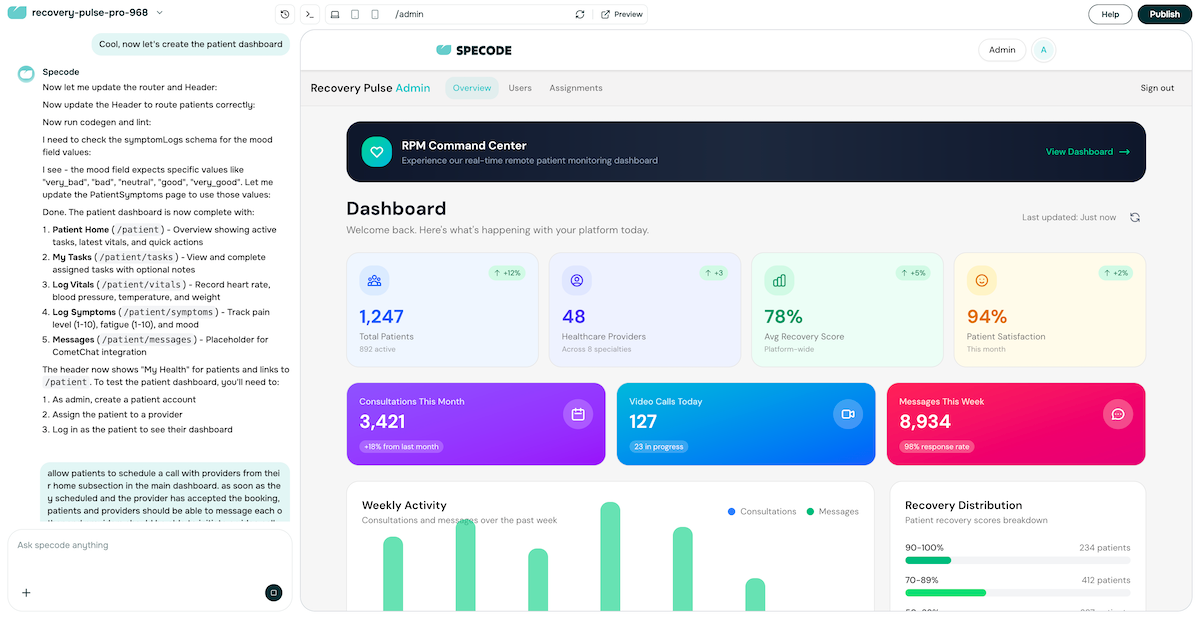
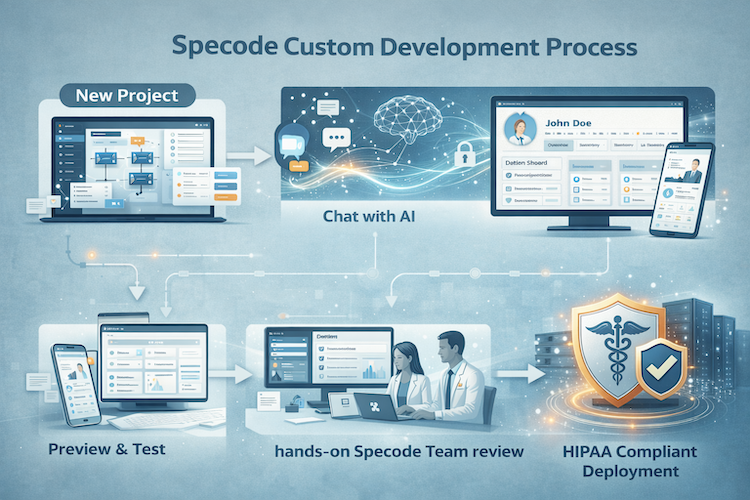
Under the hood that's a multi-agent system called Maestro: a planning agent scopes the MVP, a design agent turns brand direction into a design system, and an implementation agent writes the app. You approve each handoff, and a first working build usually lands in about 10 minutes.
That matters because past the demo stage you start needing very specific things:
- permission rules that reflect real clinical roles
- workflows that match how clinicians actually work, rather than how a template designer guessed
- changes that don't require rebuilding the whole thing when requirements shift
Specode's claim of shipping up to 10x faster is measured against traditional custom healthcare software development cycles, the kind where you spend weeks turning requirements into tickets before anything visible exists.
The newer piece, and the one that changes security-review conversations, is the built-in HIPAA Compliance Agent. It scans your codebase by category, scores it, proposes fixes and rescans against your latest changes.
Findings are graded against the Security Rule OCR enforces today. The proposed 2027 requirements, mandatory MFA among them, surface as recommendations you can adopt early or suppress.
Practically, that's teams whose requirements won't hold still: founders who want the option to own and export the code, and anyone whose non-standard logic would die inside a template.
The tradeoff is real. You're steering an agent, so the first screen takes longer to appear than it would on a drag-and-drop canvas, and the fifth revision takes far less.
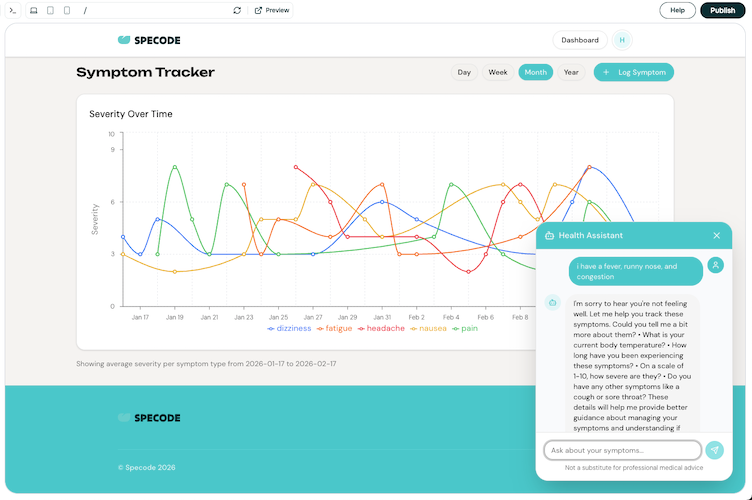
HIPAA and BAA reality check: platform compliance vs app compliance
Compliance is a system outcome: the platform, plus your configuration, plus your integrations, plus how the app moves patient data in production. Those layers get approved separately, and only the first one comes with a certificate. Getting that distinction right is most of what a no-code health app development comparison is for, and it's what a HIPAA app builder comparison usually flattens.
Blaze: the certifications are real, and they cover Blaze
Blaze holds HITRUST e1 certification, announced October 2025 and validated by an independent third-party assessor. Its security page states SOC 2 Type II, its pricing page lists both from the Production tier upward, and its homepage claims Blaze is the only no-code platform with HIPAA compliance and HITRUST e1.
Two things to pin down before a security review. e1 is HITRUST's entry tier, certified for one year, below i1 and r2. And Blaze publishes no auditor, report period or trust portal for the SOC 2, so what you have is a statement. Ask for the report on the call.
Those certifications validate Blaze's own security program. They don't make every app built on top of Blaze compliant once you add custom workflows, user roles, data flows and third-party services.
Specode: no PHI until the go-live review clears
Specode takes a go-live stance. Nothing ships until a review passes.
- Pre-deploy means no PHI: that's the trust boundary, so you can iterate freely without creating a leak by accident.
- The hosting BAA is self-serve: you sign Convex's BAA in your own Convex dashboard at go-live, no negotiation, no separate hosting account to stand up. Third-party services that touch PHI, video, messaging, eRx, still need their own.
- Go-live is reviewed: before launch the Specode team checks integrations, RBAC and user permissions, audit logging expectations and PHI boundaries, typically within 1 to 2 business days.
The gaps belong here too. Specode is not SOC 2 certified, and there's no HITRUST e1 at this time.
What goes in front of procurement is Convex's SOC 2 Type II attestation, covering the infrastructure production runs on, plus an optional $3,000 penetration test for teams who need a report to hand over.
Both postures are legitimate. They fail in different places, and which failure you can afford depends on who's buying.
Integrations: the PHI answer sets the whole price
In any healthcare app builder comparison, integrations are where "looks easy in the demo" meets "welcome to healthcare." The deciding factor is whether the data flow touches PHI, and if so, who provides the BAAs and how painful interoperability gets against real systems.
Step 1: does this integration touch PHI?
- No (non-identifiable analytics, marketing ops): usually low compliance friction.
- Yes (appointments, messaging, clinical notes, claims, anything EHR-related): now you're in BAA plus access controls plus auditability land.
Step 2: if it's PHI, the integration model decides the pain
EHR or EHR-adjacent, the question becomes who normalizes the data and who owns the vendor relationship. Blaze and Specode answer it differently.
Blaze: a connector network gated at the top tier
Blaze claims read and write access to 95+ EHR systems through one normalized API, with TEFCA support and SMART on FHIR launch inside the chart. Its named connector cards include Epic, Cerner Oracle Health, DrChrono and Kareo.
Two caveats, both from Blaze's own pages. Direct EHR integration is an Enterprise feature, so the reach is priced separately. And the cards carry no changelog: Kareo has been part of Tebra since 2023, and the card still says Kareo, which tells you when that list was last checked.
Specode: AI-guided integrations on a HIPAA-tier rule
Specode ships a handful of pre-configured integrations: CometChat for video, Telegra for telehealth, Junction Health for wearables and lab results, Stripe and BAA-signing processors for payments, plus a Canvas Medical integration. Everything else you ask for.
You describe the integration in chat, the AI tells you which credentials it needs, you add the key-value pairs in project settings, and the AI wires and verifies it. Epic, Cerner, lab systems, pharmacy networks and insurance verification are all reachable this way, alongside any service with an API.
One constraint doesn't move: a vendor touching PHI has to be on a HIPAA plan, and you own that vendor relationship and its BAA.
When the work is genuinely heavyweight, and Cerner Oracle Health, DrChrono, eClinicalWorks or Athenahealth integration usually is, Specode customers can move to the Custom tier and have the Specode team do it. That's often faster. The work is auth scopes, data mapping, sandbox access, validation, and the edge cases that never make it into a vendor's docs.
Step 3: "FHIR integration" is rarely a checkbox
Even on a platform that supports FHIR, real interoperability comes down to:
- read versus write scope
- auth, usually SMART on FHIR patterns
- mapping and validation
- retries and error handling
- logging and audit expectations
Every one of those is a conversation with somebody who does not work for your platform vendor.
Against the common systems, Blaze's normalized API is the faster start, and Enterprise pricing is the gate. Specode will reach anything with an API, on one unchanging condition: PHI in the pipe means a HIPAA-tier vendor plan and the controls to match.
Deployment and operations: what leaves with you
This is where a custom healthcare app builder proves its value or turns into an expensive prototype generator.
Blaze: platform-managed deployment you can't take with you
Blaze runs dedicated development, staging and production environments with instant rollbacks, all inside the platform. For standardized internal tools that's a better operational story than most teams would build themselves.
The trade is the usual one: the more your requirements diverge, through custom roles, unusual workflows or bespoke UI, the more you're negotiating with the platform's boundaries. Which raises the question every healthcare buyer eventually asks. What leaves with you?
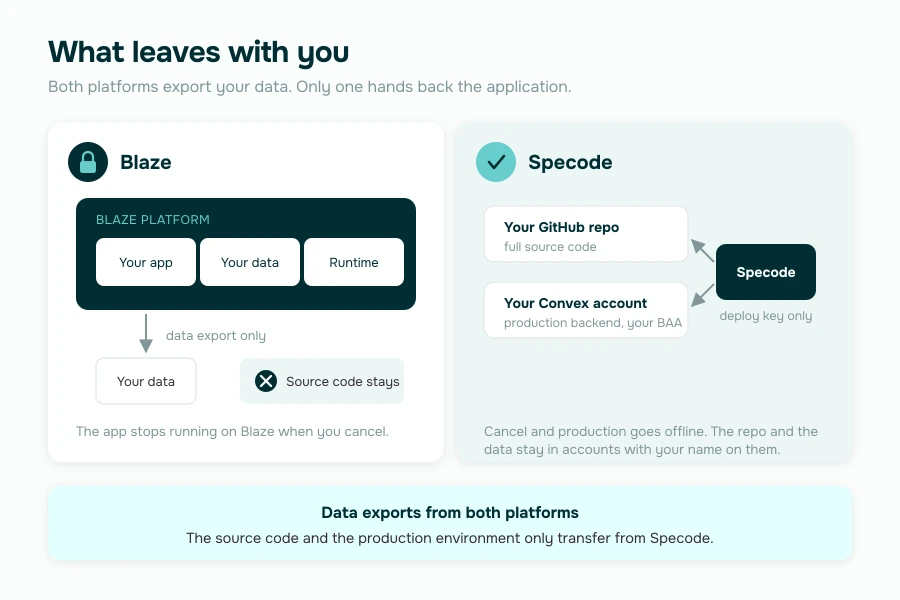
Blaze answers that in its own terms of service, which reserve the platform to Blaze and define what you own as your app's content, design, workflow and data. Source code isn't in that list, its own comparison page calls the model "platform-managed visual applications", and its own blog says plainly that Blaze doesn't offer self-hosting. There's a JSON project export you could parse into JavaScript or Python, which is a rebuild.
So your data leaves Blaze in standard formats, any time, including after you cancel. Your running application stays.
Specode: production is a gate, and ownership is the exit
Pro is the deployment tier, where the hosting BAA becomes relevant and "no PHI in preview" turns from a warning into an operational boundary. Publishing is a button, and the Specode go-live review sits between the button and the world.
The part that surprises people is where production actually runs. Your code is pushed into your own private GitHub repository through a deploy app you install, and your production backend runs on your own Convex Pro account, under the BAA you signed with Convex.
Specode holds a deploy key. Each release is tagged with a rollback path.
The terms back it up: code transfer to your repo within 5 business days on request, and a 60-day export window after termination. Cancel and production goes offline, but the repo and the data are already in accounts with your name on them.
Blaze is built to keep you in the platform, and does it well. Specode is built so that leaving is a normal operation.
Blaze vs Specode features: ownership and caps decide it
If you're weighing Blaze.tech healthcare against Specode, the comparison that matters is what happens once your app becomes a living system with real users on it, especially in messy domains like medical billing and revenue cycle management where edge cases are the product.
The four rows in the 60-second table stand. What follows is everything underneath them. If you want the wider field, our four-way healthcare app builder comparison puts Replit, Lovable, Blaze and Specode side by side.
Blaze's security page and its pricing page disagree about where EHR integration and SSO sit. Both readings are in the rows above.
Total cost of ownership: Blaze vs Specode is decided after month one
Four things decide what Blaze vs Specode costs you: the tier you need before PHI is allowed near the app, the caps that force the next tier, what third parties bill you directly, and what it costs to change course later.
Blaze: HIPAA moved down the price list, and the caps became the ceiling
Blaze prices by published apps and total users, not per seat: a free Sandbox, Production from $750 a month, Growth from $2,500, custom-priced Enterprise. The table above has the caps. Paid plans add a one-time implementation fee scoped on a sales call.
One correction out loud: HIPAA and the BAA are no longer Enterprise-only at Blaze. That was true until July 2026, when Blaze restructured with no changelog, so check the date on any Blaze comparison written before September 2026, including ours.
So the constraint on Blaze's lower tiers moved from compliance to capacity. One published app and 100 end users is tight for anything patient-facing, and a second app means Growth.
Specode: two tiers, and code export as the risk reducer
Pro, $1,000 a month, is the deployment tier: 2,200 credits, one published project, hosting setup, HIPAA Agent access, weekly team support, and Lovable or Replit migration. Custom starts at $5,000 and adds managed coding, a dedicated team and unlimited published projects.
There's no Startup tier and no free trial; the $500 a month plan Blaze's comparison page quotes was discontinued. Credits top up at 50 for $20, 300 for $100 or 800 for $260, and don't roll over.
Rebuild risk belongs in this arithmetic too. Because code export is contractual and production already runs in your own GitHub and Convex accounts, outgrowing Specode costs a handover of vendor relationships instead of a rewrite.
The other bills that hit both sides
Neither subscription is the whole bill. On Specode a Convex Pro account runs $25 a month for database, backend and frontend hosting, and an optional penetration test is $3,000 one time. On Blaze there's the implementation fee plus whatever "EHR integrations scale your plan" turns into. Both sides pay third parties directly for HIPAA-tier video, messaging, eRx and analytics, which is the line teams underestimate most.
Blaze starts cheaper and caps you at one published app and 100 users. Specode starts at $1,000 with Convex on top, and the difference buys code export and production in your own accounts. Fuller arithmetic in our HIPAA compliant app development cost guide.
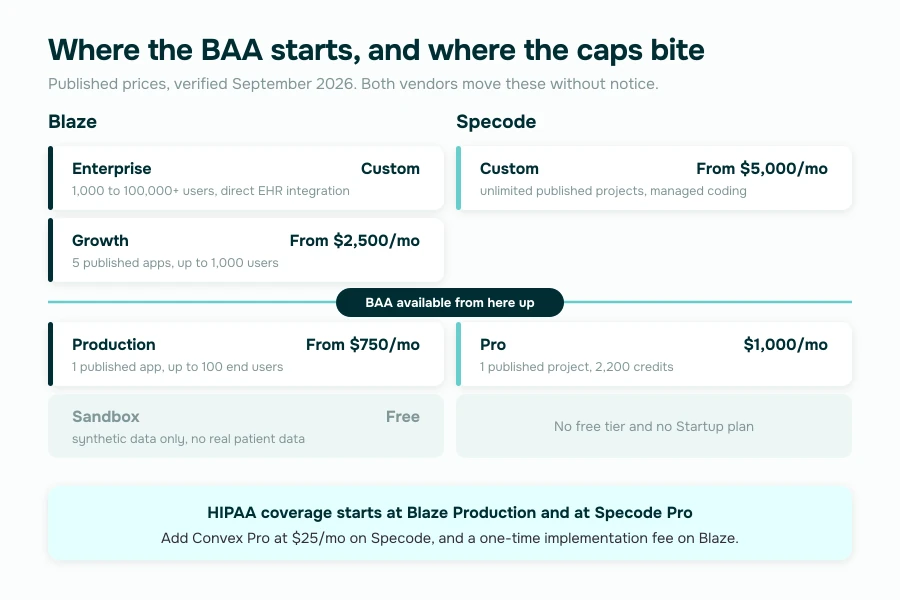
Pricing verified September 2026 against both vendors' live pricing pages. Competitor pricing moves without notice, and Blaze's has changed twice since early 2025.
Migrating off Blaze, or any no-code platform, means a rebuild
Teams looking for a Blaze alternative usually aren't unhappy with the builder. They've hit a ceiling:
- an integration the platform won't reach
- a security review asking for artifacts
- a workflow that no longer fits the visual model
- a second product they don't want a tier jump to pay for
What moving costs depends entirely on what the platform gives you back. If you're still choosing where to go, our Blaze.tech alternatives list compares six builders on price, who signs the BAA, and whether your code leaves with you.
Leaving a platform that exports source code is a migration. Your repository moves, you re-point infrastructure, you keep your logic. Leaving one that doesn't is a rebuild: you're reconstructing screens, data models and workflows from a running app you can look at but can't take. Blaze sits in the second category by its own account, so a Blaze to Specode move is a rebuild.
The rebuild is faster than the original build, at least, because the requirements are already settled and visible in the app you're leaving.
None of that helps you leave Blaze specifically. Specode's migration agent, in beta, only works where the source platform hands code back: Lovable, Bolt, Replit, Base44, Emergent, Supabase stacks, and custom React or Next.js apps on non-compliant hosting.
It reads the repo through a read-only GitHub app, maps pages, data models and authentication, and produces a plan you approve before any work starts. Then it rebuilds on HIPAA-compliant infrastructure and hands off to the HIPAA Compliance Agent for hardening.
Specode's own site puts a simple case at roughly 3 days. We've written up how that works coming off Lovable or Replit in more detail.
The reason any of this matters is vendor lock-in, and lock-in is a spectrum. The deployment section answered what leaves with you; the part to get in writing before you sign is the format. A repository you can run is one answer. A JSON export and a quarter of engineering to turn it back into an app is a very different one.
Verdict: pick by what you're willing to hand over
Choose Blaze when the app can stay platform-shaped: ops dashboards, intake workflows, admin automation. You want prebuilt connectors, speed to a usable workflow, and a certification on a procurement checklist more than you want the codebase. Our wider healthcare app builder roundup covers the rest of the field.
Choose Specode when you're building a production product, a patient portal with permissions that mirror real clinical roles, and requirements that move weekly. You want the code and the infrastructure in your own accounts so security reviews stop being negotiations. Patient-facing work like mental health app development is the clearest case.
Blaze's own comparison page makes one argument worth answering. It concedes Specode is HIPAA-enabling with a BAA available, then points out that a HIPAA posture is self-asserted while HITRUST e1 and SOC 2 Type II are assessed by somebody else, and that a hospital security review asks for the report.
That lands. Specode's answer is Convex's SOC 2 Type II attestation under the production stack, a compliance agent that leaves a dated scan history, and a $3,000 penetration test report.
If your buyer's checklist has a HITRUST line with no room for a substitute, Blaze clears it today and Specode doesn't.
Everywhere else the decision comes down to what you're willing to hand over. Blaze asks you to trade the codebase for a platform that handles more of the work. Specode asks you to run a little more of your own infrastructure in exchange for keeping what you built.
If that's the trade you'd make, start with Specode. An hour inside an AI-powered health app builder, describing your own UI and logic and watching what comes back, will tell you more than another comparison page will, including this one.
Frequently asked questions
Blaze markets itself as HIPAA-compliant and holds HITRUST e1 certification. As of September 2026 a BAA comes with every production customer, starting at its $750 a month Production tier. Your own configuration, roles and third-party data flows are what an auditor reads; Blaze's certifications cover Blaze's security program, and the app on top is yours to defend.
Specode builds around a production trust boundary. No PHI belongs in preview, and at go-live you sign Convex's hosting BAA self-serve in your own dashboard. The team then reviews permissions, audit logging, PHI boundaries and integration hygiene, usually within 1 to 2 business days. Specode itself holds no SOC 2 or HITRUST certification.
Blaze is a no-code platform for fast, standardized workflow apps, with named healthcare connectors and platform-level certifications. Specode is AI-guided: you describe UI and logic, iterate quickly, and end up owning the source code, with production running in your own GitHub repository and your own Convex account.
Yes. Blaze names Epic and Cerner / Oracle Health among its connectors and claims read and write access to 95+ EHR systems through one normalized API, plus SMART on FHIR app launch inside the chart. Note that its pricing page lists direct EHR integration as an Enterprise feature.
If your telehealth app handles PHI and needs production controls, real integrations and an audit-ready posture you can change later, Specode is usually the safer pick. Blaze works well when your use case fits its platform patterns and its certifications match what your buyer's security review is asking for.
Blaze runs a free Sandbox, Production from $750 a month for one app and 100 users, Growth from $2,500, and custom-priced Enterprise. Specode is $1,000 a month for Pro or from $5,000 for Custom. Both sides also carry third-party HIPAA-tier vendor costs.
Usually no. Blaze is built for no-code use through drag-and-drop configuration, visual workflow automation and prebuilt components. You'll still want technical clarity for integrations, API access, data mapping and security expectations, but day-to-day building is designed for non-engineers or hybrid teams.
Specode's Maestro runs planning, design and implementation agents with your approval at each handoff, producing a first working build in about 10 minutes. A separate HIPAA Compliance Agent scans your codebase by category, scores it, proposes fixes and rescans against your latest changes.
Yes, and the reverse is also true; they suit different jobs. Teams choose Specode over Blaze when they need source code ownership, deeper customization than a visual builder allows, or production running in infrastructure they control. Teams choose Blaze for faster internal tooling and platform-level certifications.