
Bubble Alternatives for HIPAA Apps: Where to Build When You Need a BAA

You built the first version of your health app on Bubble, and now it has to hold real patient data. That is where Bubble stops being an option: it offers no BAA on any plan, so protected health information cannot legally live there. Its July 2026 update names an Enterprise plan targeted for the end of 2026, with nothing signable today.
This guide ranks the nine bubble alternatives for HIPAA apps that either sign a BAA or pair with a backend that does, with every price verified on the vendors' own pages in October 2026. If you are evaluating the category from scratch, start with our healthcare app builder comparison for the compliance basics.
Can you keep a healthcare app on Bubble, and what should you build on instead?
No. Bubble offers no BAA on any plan, so patient data cannot legally live there; the Enterprise plan is an end-of-2026 target, not something you can sign. The nine alternatives below sign a BAA or pair with a covered backend, and the migration section covers moving PHI out.
- Bubble does not offer a BAA on any plan, so patient data cannot legally live there today. Bubble's own documentation leaves no room: apps built on the platform won't achieve HIPAA compliance, and the July 2026 Enterprise plan is a target, not something you can sign.
- A signed BAA is the entry ticket, not the finish line. Encryption, audit logs, role-based access, MFA, and backups still have to be configured and documented on your side.
- The nine alternatives split into vendors that sign your BAA and exportable front ends that pair with a BAA backend. Knack, Caspio, and Blaze sign; WeWeb plus Xano and FlutterFlow plus Supabase pair with covered backends.
- Moving off Bubble is a rebuild plus a data migration, not an export. Bubble publishes no code export, so the logic gets rebuilt while data moves under signed BAAs.
Why teams look for a Bubble alternative for healthcare apps
Bubble's bubble.io HIPAA documentation is blunt: the entire platform and its internal company processes do not meet HIPAA standards, so apps built on Bubble won't achieve HIPAA compliance, and Bubble does not recommend the platform for apps that require it.
The same page allows that third-party setups may be possible while Bubble cannot support HIPAA compliant apps (verified on October 27, 2026).
The roadmap has changed, so update any old note you are carrying: in July 2026, Bubble said HIPAA compliance is in progress, with a dedicated Enterprise plan targeted for the end of 2026, per Bubble's July 2026 guide and the July 2026 community update. That is a stated target, not a shipped product; no BAA exists on any plan as of October 2026, and an August 2026 vendor check reaches the same conclusion.
Some agency blogs still claim Bubble offers a BAA on paid plans. Bubble's own pages show none, and Knack's August 2026 comparison reads the documentation the same way; this article does not rely on those agency claims.
Beyond the missing BAA, PHI leaks into places a Bubble owner never intended:
- fields without privacy rules,
- uploaded files with shareable URLs,
- API Connector calls and plugins,
- server logs that record workflow values,
- the built-in Send email action,
- and copies of the live database in development.
Bubble runs apps on shared infrastructure, with a dedicated cluster reserved for Enterprise, and for healthcare providers running real workloads, that combination is why the platform gets ruled out.
Leaving is its own problem. Bubble's documentation is equally direct: Bubble apps can only run on the Bubble platform; there is no way to export an application as code, so moving means rebuilding the logic and exporting data through CSV files and the API. WeWeb's comparison adds the pricing complaint: per-app billing with workload units that can make monthly bills spike. Vendor lock-in at this level changes how you weigh any alternative.
None of this denies Bubble's real security posture. Bubble runs on AWS, with TLS encryption in transit and AES-256 at rest, and it holds a SOC 2 Type II report. Those features protect a general-purpose no-code platform; none of them substitutes for a signed BAA. For the compliance question itself, see is Bubble HIPAA compliant.
What makes a HIPAA compliant no code app builder
Paperwork comes before features in HIPAA compliant app development. Any vendor that creates, receives, maintains, or transmits your PHI on your behalf needs a signed business associate agreement; no agreement means no PHI, whatever the marketing page says. There is also no government certification for HIPAA compliant software: what exists is a BAA plus the safeguards your organization implements and documents itself.
A working checklist covers eight things:
- a signed BAA including every plugin and integration that touches PHI,
- encryption at rest and encryption in transit,
- audit logs,
- access controls,
- role-based access,
- multi-factor authentication plus backups,
- and data residency in a jurisdiction you can defend.
Every vendor in the next section is checked against that list.
The HIPAA Security Rule groups the obligations into administrative, physical, and technical safeguards; the technical safeguards are what your builder either provides or makes you configure. Encryption alone never satisfies the rule: even a provider that cannot read the keys is still a business associate, and the BAA is still required.
On the hosting layer, AWS, Google Cloud, and Microsoft publish BAAs for their HIPAA-eligible services, each governed by a covered-services list, so healthcare organizations can build on clouds with data security commitments in writing.
For the no-code route specifically, HIPAA compliance in no-code app development walks through the full checklist, and WeWeb's HIPAA checklist and Xano's HIPAA guide show how ePHI responsibilities split between vendor and customer.
9 Bubble alternatives for HIPAA apps
To pick a HIPAA compliant app builder, start from the BAA record, not the feature page. Every platform below was verified on its own pages in October 2026, and each verdict names who signs, what it costs, and whether the code leaves with you. A HIPAA compliant no code app builder only earns a slot here if it signs a BAA or has a documented path that keeps PHI out of the builder.
Specode: AI-assisted healthcare apps with code you own
Specode is the strongest fit for teams that want AI-assisted building with code they own and a clear BAA path.
Specode is an AI-powered healthcare application builder: you describe the app in plain English and define its UI, workflows, data model, permissions, and integrations. That does not mean one prompt produces a compliant, production-ready app; your clinical, legal, privacy, and security owners still own those decisions.
BAA path
The BAA path is concrete. Production requires Pro or higher, and the backend runs on your own Convex account, where you sign Convex's standard business associate agreement instead of negotiating bespoke terms. On the Custom plan, Specode signs a business associate agreement with you directly. Third-party services you add may need their own agreements, and the Specode team helps identify which ones apply.
You own the code
Code ownership is where this list usually falls apart. You retain rights in your data, content, code, and apps and can export them during your subscription and for 60 days after termination. The code can be pushed to your private GitHub repository whenever you wish, from your project settings; at go-live the production app runs on your own Convex account and keeps running if you cancel, though the AI coder itself stays on the platform.
The build runs in guided stages: a planning agent scopes the app, a design agent sets the look and feel, and an implementation agent writes the code, with you approving each stage. New apps start from a blank template, and the AI follows structured healthcare playbooks for patterns like patient intake, scheduling, provider search, and MFA.
Automatic HIPAA scan
Specode's HIPAA Agent scans the code inside your project and reports findings across eleven categories, separating must-fix issues from recommended hardening; you can send a finding to the AI and re-run the scan, with scores kept over time. Around the builder sits a team of healthcare technology and compliance specialists; Pro includes a senior product manager consultation and weekly support, and Custom adds managed services and coding.
Pre-configured integrations cover video appointments, telehealth services, wearable and lab data, and payments, with other APIs including EHR systems built case by case; see our telehealth app development guide for what that unlocks.
The honest limits: role-based access and audit logging are built when you ask for them; apps are responsive web with PWA support rather than native mobile. Real patient data belongs in production only.
Knack: a HIPAA package with a signed BAA
Knack Health signs a BAA on every HIPAA plan at a known flat price, and it fits forms, patient portal projects, and internal database apps without code export.
Knack Health pricing lists four tiers:
- HIPAA Forms starting at $159 a month,
- HIPAA Starter starting at $499 a month,
- HIPAA Core at $999 a month,
- and custom-priced HIPAA Enterprise.
A signed BAA is included for covered entities handling PHI, and Knack describes itself as the business associate while you stay the covered entity; Knack's HIPAA package page spells out that split.
The package includes HIPAA-only hosting on hardened US infrastructure, additional logging and auditing around all data access, end-to-end encryption, and an inactivity timeout after 15 minutes; Knack is careful to note that compliance still depends on how you configure and use the app.
Knack's security page states SOC 2 Type 2 compliance with reports available under NDA, AES-256 encryption at rest, and TLS 1.2+ in transit, and it publishes no HITRUST claim. The limits are data export in CSV, JSON, and text with no published source-code export.
Caspio: mature no-code with a HIPAA edition
Caspio's HIPAA Edition starts at $800 a month with a signed BAA and unlimited users, and it suits organizations with IT staff that want SQL Server database apps.
Caspio's HIPAA Edition page states pricing from $800 a month on a one-year term, with no per-user fees, encryption at rest and in transit, unlimited users, a dedicated HIPAA support team, and a signed BAA. Caspio signs with HIPAA Edition customers and partners and maintains BAAs with its own vendors, and it says its AI features are covered by a signed BAA between Caspio and OpenAI.
Caspio's healthcare page states its HIPAA compliance is independently certified annually alongside SOC 2 Type II and GDPR, with a complete audit trail over a SQL Server data core. The limits: no published source-code export, with apps deployed embedded on your site or in Caspio's hosted environment.
Blaze.tech: HIPAA no-code with a BAA on production plans
Blaze signs a standard BAA with every production customer, in days, from $750 a month, and it fits non-technical teams that want HIPAA no-code fast.
Blaze's pricing page lists:
- a free Sandbox for synthetic data only,
- Production from $750 a month for one published app and up to 100 end users,
- Growth from $2,500 a month for up to 1,000 users and five apps,
- and custom Enterprise.
Paid plans carry a one-time implementation fee scoped on a call, and the standard BAA goes out over DocuSign, usually the same day as the intro call.
If you cancel, the app stops running on Blaze while your data stays exportable in standard formats. Blaze.tech states HITRUST e1 and SOC 2 Type II infrastructure on its pricing page; those are Blaze's own claims, and its older pages still show a legacy $1,500 pricing model we ignore in favor of the current page.
WeWeb + Xano: a visual front end on a HIPAA-eligible backend
WeWeb signs no BAA; it pairs an exportable visual front end with Xano, whose HIPAA add-on includes the BAA, and it fits teams that want a front end they can self-host.
WeWeb's HIPAA guide positions the pairing plainly: build the visual development front end in WeWeb, connect it to HIPAA-eligible services you manage, and PHI never touches the builder's servers. That is an architecture, not a certification, and your backend and integrations still need their own agreements.
WeWeb exports your app as Vue.js code with zero runtime dependencies, and WeWeb's code export page says export plus self-hosting is included on every paid plan from $20 a month, with destinations including Azure, AWS, and GCP. WeWeb's plans are Free, Essential at $20, Pro at $50 per developer, and Partner from $79 per developer.
Xano's security page answers the BAA question directly: a BAA is part of the Enhanced security add-on, with HIPAA a paid add-on on Pro and included on Custom. Xano's pricing page lists Pro at $224 a month billed annually or $249 monthly, and the HIPAA plus BAA add-on is another $500 a month, so the Xano HIPAA entry is roughly $724 to $749 a month. Xano is the backend as a service in this pairing, and it states plainly that its platform, HIPAA hosting plan included, does not by itself make your app compliant.
FlutterFlow + Supabase: a mobile front end on a HIPAA backend
FlutterFlow signs no BAA and its terms bar HIPAA data, so this pairing only works with Supabase, which signs a BAA on Team and above; it fits mobile-first teams.
If the decision is bubble vs flutterflow, the honest split is code versus BAA, and FlutterFlow's own comparison makes the same split while acknowledging its bias. FlutterFlow's terms mark the service as not intended for processing HIPAA-protected health information, and its documentation attests SOC 2 Type 1 only; data stays in your own Firebase or Supabase backend, and you own the generated code, which you can download or push to GitHub. The FlutterFlow HIPAA picture is that it cannot hold PHI, which is exactly what HIPAA compliant mobile app development has to move to the backend.
Supabase is the covered half. Supabase's security page states Supabase is HIPAA compliant on its hosted platform once you sign its BAA, which Team and Enterprise customers can request, with a Supabase HIPAA add-on required on the project per Supabase's HIPAA documentation. Supabase's pricing page puts Team from $599 a month; the add-on price is not published on supabase.com, and a staff answer in a GitHub discussion puts it from $350 a month. A HIPAA compliant database on Supabase is exactly that package.
Supabase's shared-responsibility list is worth reading before you commit: you sign the BAA, enable the add-on, enforce MFA, Point in Time Recovery, SSL enforcement, network restrictions, and connection logging, and keep PHI out of public storage buckets. Self-hosted Supabase does not carry the HIPAA controls. FlutterFlow's plans are Free, Basic at $39 with code download, Growth at $80, and Business at $150.
Retool: HIPAA internal tools on the Enterprise plan
Retool publishes no current BAA or HIPAA statement, so its path is self-hosting in your own VPC on Enterprise, with the posture confirmed in writing first; it fits internal ops tools.
That absence is the finding, verified October 2026: Retool's security documentation covers SOC 2 Type 2 alignment and ISO 27001, but no current official page states HIPAA support or a BAA, so do not assume the retool HIPAA story from old lists. Retool's pricing page lists Free, Team at $10 a month per builder plus $5 per internal user, and Business at $50 per builder plus $15 per user, with Enterprise custom and self-hosted or air-gapped options.
Retool positions itself for internal tools, and its portability is JSON import and export of apps, not source-code export. For patient-facing apps, that combination is not a Bubble replacement.
Medplum: an open source healthcare backend built on FHIR
Medplum's site describes an open source, FHIR-native healthcare backend that ships HIPAA compliance on its hosted plans, and it fits developer teams building on FHIR.
The core is Apache 2.0 open source, storage is FHIR-native, and Medplum states HIPAA and SOC 2 compliance out of the box with SOC 2 Type II, HITRUST e1, and ONC certification badges. Medplum's pricing page lists Free, Production starting at $2,000 a month, Premium starting at $6,000, and custom Enterprise, with usage billed beyond the allowance and a standard BAA included for hosted Enterprise.
Medplum publishes BAA and master services agreement templates for its hosted environment and also supports self-hosting, though the published documents apply to the hosted service. For teams wiring electronic health records through FHIR APIs and EHR integration work, it is the developer-grade option on this list.
OutSystems and Mendix: enterprise low-code with compliance programs
OutSystems publishes a full BAA and lists HIPAA among its certifications; Mendix publishes a HIPAA assurance letter but no BAA text; both are enterprise low-code platform picks priced by quote.
OutSystems lists HIPAA alongside SOC 2, ISO 27001, FedRAMP Moderate, and PCI DSS, and its published OutSystems' BAA makes OutSystems a business associate when it creates, receives, maintains, or transmits PHI on your behalf. Its pricing is quoted on Application Objects and users, and it states that it generates standard, open code you can extend.
Mendix lists SOC 2 Type II, ISO 27001, and a HIPAA Assurance Letter, which is not a BAA, and no page states a BAA offer; Mendix's pricing page lists Free, Standard from $1,090 a month for one app or $2,725 for unlimited apps, and quote-based Premium. Mendix's ownership page states you own your data and models and can generate Java classes and SQL DDL via its SDK. Both platforms earn their slot on scalability, and both need the BAA question answered in writing before patient data moves.
HIPAA compliant app builder comparison table
Every figure below was verified on the vendors' own pages in October 2026.
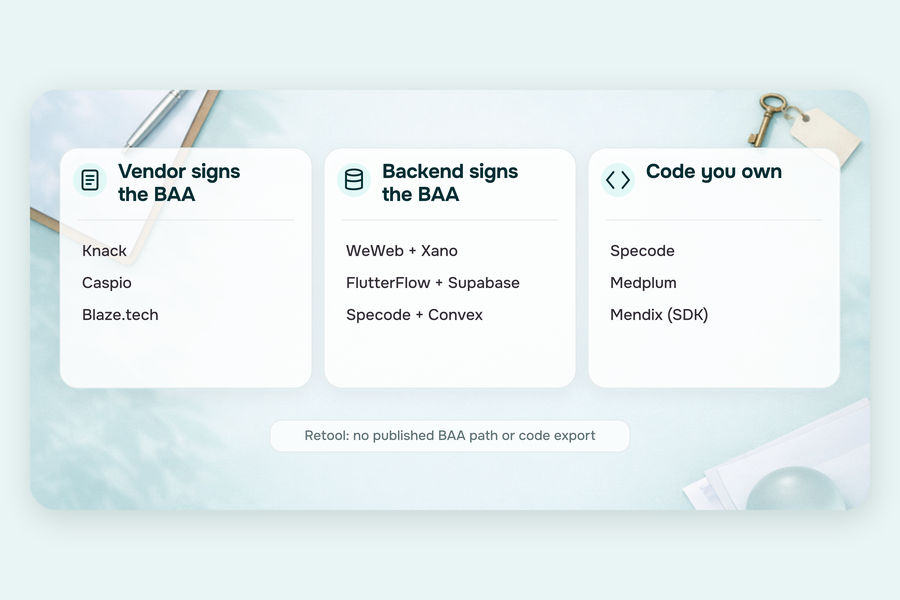
Building HIPAA compliant software still depends on how you configure whatever you pick, so treat the table as a shortlist, not a verdict. The bubble io alternatives that fold a BAA into the plan (Knack, Caspio, Blaze) sit apart from the pairs where the backend signs instead (Xano, Supabase).
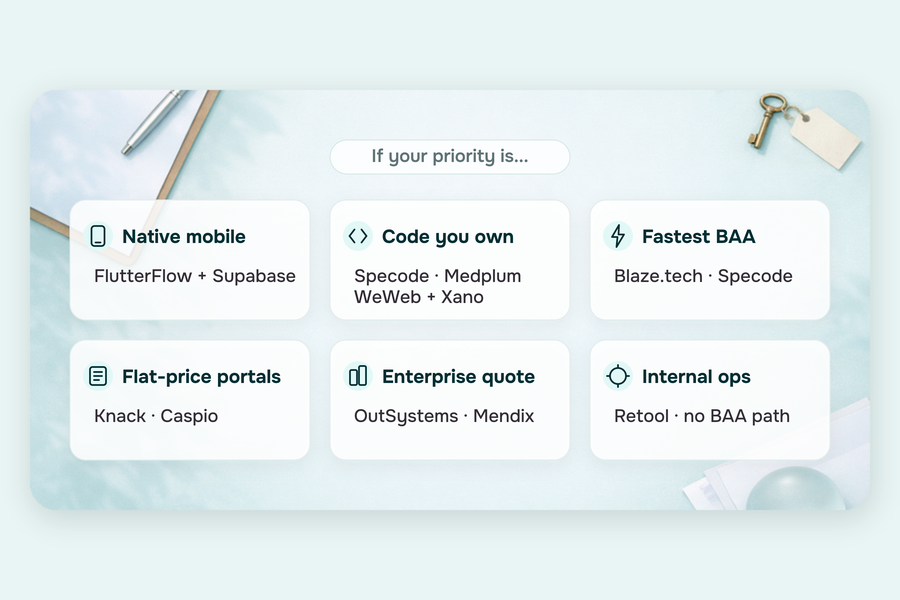
Tools that did not make the table: Airtable's BAA is Enterprise Scale only, per Airtable's HIPAA page, and is Airtable HIPAA compliant covers the details. AppSheet can support HIPAA as a business associate per Google's AppSheet HIPAA guide, but it is a Google Workspace-adjacent tool for internal apps; and no Firebase-branded product appears on Google Cloud's BAA-covered list.
What about keeping Bubble as a frontend?
You can keep the Bubble UI and move every piece of PHI to a HIPAA compliant backend; Bubble's own documentation allows third-party setups while saying Bubble itself cannot support HIPAA compliant apps. The risk never disappears, though: Bubble's workflows, logs, plugins, and email still sit between the user and your backend, so PHI must never transit them.
If you need HIPAA compliant hosting for that pattern, Aptible describes every deployment as including a signed BAA, encryption at rest and in transit, audit logging, network isolation, and HITRUST R2-certified controls.
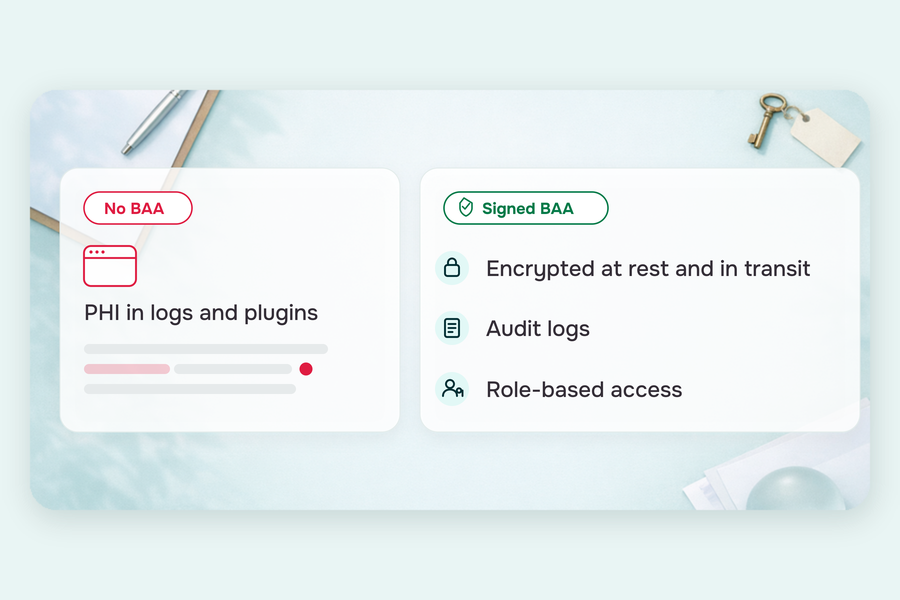
Firebase is the trap in this plan. Firestore appears on Google Cloud's HIPAA page covered-services list, but no Firebase-branded product does, and Firebase's own pages are silent on HIPAA. Is Firebase HIPAA compliant? Not in a way a Bubble workaround can lean on, so treat Firebase HIPAA compliance as unsupported unless Google's list says otherwise. That is exactly why a backend BAA alone still leaves gaps your team owns.
How to migrate a healthcare app off Bubble
How to build a HIPAA compliant app after Bubble comes down to sequence, not heroics. The steps below show how to make an app HIPAA compliant without a code export to lean on:
1. Audit where PHI lives. Data types and fields, uploaded files, plugins and API Connector calls, logs, and the development database.
2. Pick a target platform. Use the comparison table above and verify the BAA terms in writing.
3. Sign the BAAs. Every vendor in the chain, from hosting to email to analytics, before PHI moves.
4. Rebuild the data model. Bubble exports data through CSV and the API, not the app; the new platform gets a fresh model.
5. Migrate the data. Move records into the covered environment and reconcile counts before anything else touches them.
6. Re-create the workflows. Rebuild the logic the new platform cannot import, and drop the Bubble-side calls.
7. Test access controls and audit logs. Walk the roles, confirm every PHI read and write is logged, and fix what is missing.
8. Cut over. Point users at the new app, freeze the Bubble version, and launch with the old data exports archived.
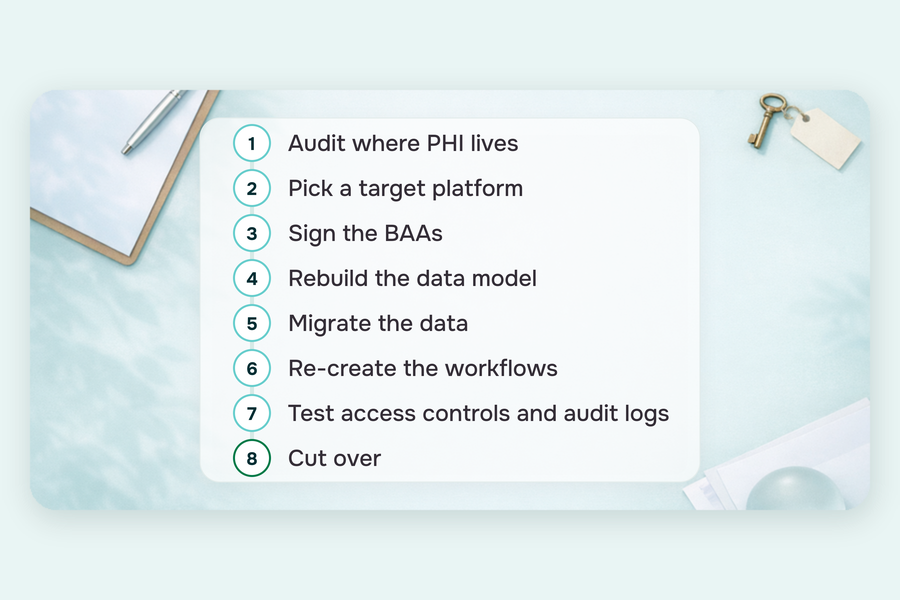
The PHI-safe rule behind the order: real patient data must reach a BAA covered environment before the workflows that use it, and prototypes that hold only synthetic data do not need this sequence yet.
If that sounds like a rebuild, it is, and Specode has a path for it. A Specode migration starts with a conversation with the Specode team rather than a self-serve flow. The team reads your codebase and builds a project map that sorts what transfers directly, what needs adjustment for compliance, and what will not work in a HIPAA environment, then reviews the plan with you before work begins.
Applications of simple to moderate complexity commonly move onto Specode in about a week, with viability confirmed after the team reviews your codebase, and real patient data never enters the build environment along the way.
When you are ready, migrate your app to a HIPAA-compliant platform with the Specode team.
What it costs to build a HIPAA app on no-code vs custom code
The verified October 2026 entry prices cluster tightly: Knack from $159 or $499 a month, Caspio from $800, Blaze from $750 plus an implementation fee, Xano roughly $724 to $749 with the add-on, Supabase Team from $599 plus an unpublished add-on, Medplum hosted from $2,000, and Specode Pro at $1,000 with production on your own Convex account.
If you want to build a HIPAA compliant product on a budget, the spread between $499 and $800 is real, and so are the gaps between them.
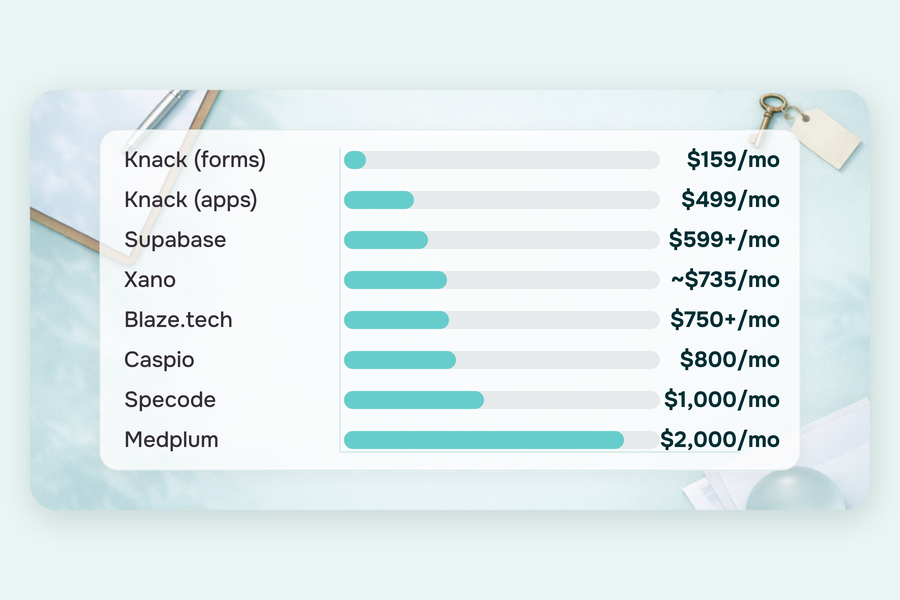
BAA coverage is itself a cost line. Xano charges $500 a month for the HIPAA plus BAA add-on, Supabase sells HIPAA as a paid add-on on Team and Enterprise, and Blaze adds a one-time implementation fee; Knack and Caspio fold the BAA into their HIPAA plans.
For total cost of ownership, add the platform fees, BAA-tier premiums, one-time onboarding, compliance tooling and review, and your development team's hours, with exit costs set by whether the platform exports code. A lean MVP on a BAA-signing builder usually beats custom code on time, while the long-run question is always the exit. See our healthcare app development guide for the full build math.
How Specode can help
Specode is the answer to the Bubble problem this article opens with: AI-assisted building with code you own, a hosting BAA you sign with Convex on Pro or higher, a Specode-signed BAA on Custom, and the HIPAA scan as the publishing gate. You retain rights in your code and apps and can export them during the term and for 60 days after termination, and the team's healthcare technology and compliance specialists stay involved on both plans.
If you want the hands-off version, Custom starts at $5,000 a month and the Specode team builds and maintains the app. Two ways in: create an account or book a demo with the team, and going live in production involves the Specode team either way. If you are weighing any other bubble alternative, the honest comparison starts with who signs the BAA and whether the code leaves with you; that is the test Specode was built to pass, and a telemedicine app development company can walk you through it.
Frequently asked questions
Specode first, for AI-assisted building with code you own and a BAA path; then Knack, Caspio, and Blaze, each with a signed BAA. The bubble io alternatives that fold a BAA into the plan sign fastest.
Only on paper. FlutterFlow exports Flutter code but signs no BAA and its terms bar HIPAA data, so it works only paired with Supabase on Team or above with the add-on.
Yes, on the hosted platform: Team customers from $599 a month and Enterprise can sign the BAA, with a paid HIPAA add-on whose price is not published, and you still configure the safeguards.
Roughly $750 to $2,000 a month in platform fees at the HIPAA tiers verified in this article, before compliance work and your team's time.
Yes. Knack, Caspio, and Blaze are no-code builders that sign BAAs, and Specode combines AI-assisted building with code you own.
Yes, but not as an export: Bubble has no code export, so you rebuild the app and migrate data under signed BAAs before cutting over.
Sign BAAs with every vendor that touches PHI, then apply the checklist: encryption, audit logs, role-based access, MFA, backups, and trained staff.


