Bask Health Review: Pricing, What's Included, and When to Build Your Own Instead

You can buy a bundle of telehealth tools and service connections, or build a product around the way you want to deliver care. The useful comparison starts with what you'll actually operate. This Bask Health review examines the platform's published scope, separates software fees from care costs, and explains when a custom application deserves a closer look.
Bask combines branded commerce, patient and clinician workflows, and pharmacy connections. That can fit a business whose requirements match the bundle. You still need to establish the contracted clinical scope, current prices and exit terms.
This is a desk review of public documentation checked October 19, 2026. It includes no product testing, private quotation or customer interviews. The current plans page doesn't publish monthly platform prices, so the cost model below keeps those amounts open.
Should you buy a bundled telehealth platform or build your own?
Consider a bundle when its workflows and contracted clinical services fit your business. Evaluate a custom product when essential workflow control, interfaces or ownership requirements justify the build and operating work. Compare matched service scope and current quotes before choosing.
Key Takeaways
- Published visit and ID-check rates do not establish the full budget. Get a current platform quote and include the other operating costs when comparing routes.
- The bundle can suit a branded treatment business with matching workflows. Confirm the clinical and pharmacy scope, responsibilities and exit terms in your agreements.
- A custom-build decision should start with a specific requirement. Compare workflow control, integrations and ownership alongside build and running costs, with equivalent clinical and fulfillment services on both sides.
- The reviewed evidence does not support an independent quality score. Seek references relevant to your treatment model and evaluate the actual clinical and pharmacy providers.
Bask Health review at a glance
Start with the buying decision: do the bundled workflows and service arrangements fit the operation you intend to run?
What is Bask Health and how does it work?
Your brand, software supplier, prescribing group and dispensing pharmacy can have different jobs even when the patient sees one branded experience. The useful answer to “what is Bask Health?” starts with those responsibilities.
Bask's platform overview describes telehealth infrastructure connecting patient, doctor and administrator portals with commerce and fulfillment workflows. Its white-label model lets you present a branded service while using connected tools and networks underneath.
A patient completes your configured intake. A clinical provider reviews the information and determines the appropriate care, including whether to prescribe. When a prescription goes to a partner pharmacy, that pharmacy handles dispensing and shipment. The patient portal and clinical tools support the continuing relationship.
Keep the parties clear in your operating plan:
- You run the brand.
- Bask supplies the platform and coordination tools.
- Clinicians provide care.
- Pharmacies dispense.
Bask's general terms identify its role as separate from providing clinical healthcare services. A connected experience still needs an agreement that identifies which organization owns each clinical and operational responsibility.
Bask Health pricing in 2026
Build your budget in layers: platform subscription, clinical services and transaction-related costs. The rates below were checked October 19, 2026. The live plans page and a dated vendor pricing article aren't synchronized, so a historical subscription figure shouldn't become the starting assumption in your current budget.
Core, Growth and Enterprise plans
Start with the current plan comparison and request a written quote for the configuration you need. To assess current Bask Health pricing, you need both the subscription and its separate usage charges.
Bask positions Core for small and medium businesses starting online treatment, Growth for larger businesses offering many treatments, and Enterprise for tailored needs. Growth's card also advertises cheaper credit-card processing; request the actual rate in your quote.
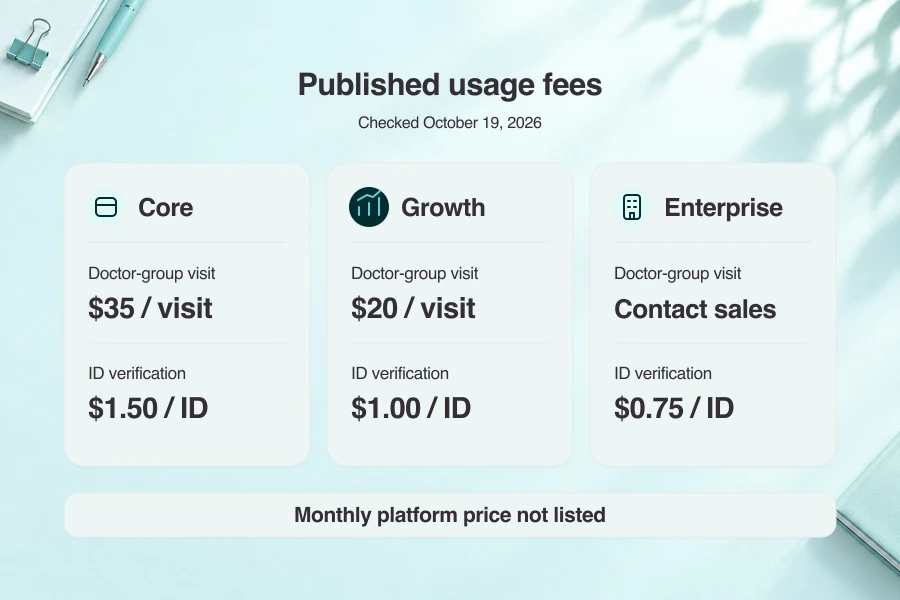
These are published USD usage rates, checked October 19, 2026. Confirm treatment-specific scope and minimums before budgeting.
The July 2026 plan article, dated July 31, lists Mini at $499/month and Growth at $3,500/month, with Enterprise custom-priced. The current page uses Core instead of Mini but doesn't establish a rename or matching price. Those historical amounts are excluded from the model below.
The plans FAQ offers a 14-day platform trial without payment details; you select a plan and enter payment details at trial end or store launch. Trial access does not waive care or medication charges. Confirm product entitlements in the demo.
The plans FAQ describes month-to-month plans, with annual or biennial options.
Per-visit, ID verification and payment fees
Count consultations and identity checks separately from the platform fee. A returning patient's visit doesn't automatically justify assuming another ID check; your budget needs its own estimate for each billable event.
Budget for payment processing separately. The plans FAQ says the built-in payment service adds no transaction fee above your specified rate. You still need to establish the processing rate, and no numeric rate was verified in the reviewed material. The FAQ also describes support for third-party payment providers with help from a Bask representative.
Request a quote identifying the consultation rate for your treatment, what makes a visit billable, any minimum commitments, and the identity-check basis. For payments, establish the applicable rate and refund or chargeback treatment. Network access and a software subscription don't tell you what every completed treatment will cost.
Variable costs to include in your budget
When you compare telehealth software pricing, identify who bills each service and what triggers a charge. A fee per dispensing appears in Bask's pharmacy fulfillment terms, but the inspected material doesn't supply a numeric dispensing, medication or shipping schedule.
If a proposal refers to per-order fees, ask whether that means a consultation, a dispensing event, a shipment or another defined service. A label without its billing basis won't support a reliable forecast.
Your complete telehealth platform cost should include:
- The medication and fulfillment arrangements you choose.
- Payment processing.
- Any applicable marketing tools, operational support and legal or compliance work.
Establish these budget categories without assuming Bask charges a hidden surcharge for each one. Confirm the terms if you plan to use your own pharmacy or shipping account.
What is included in the platform?
Review the bundle as four connected workflow groups. A published tool tells you what to examine in the demo; the configured package and service agreements establish what you can actually operate.
Storefront and questionnaire builder
Your intake should reflect the treatment and patient journey you're offering. Evaluate the Bask Health telehealth platform by walking through that journey, from the storefront to the completed questionnaire.
Bask documents a no-code questionnaire builder with branding, layout and logic tools. Its plans FAQ also supports using a custom domain you already own. These give you concrete configuration points to inspect when comparing a white label telehealth platform with a separate application build.
Bring your actual intake forms and ask the team to demonstrate the required configuration. If subscription billing is part of your business model, check that requirement in the proposed package too: establish the recurring-payment and cancellation behavior you need. A storefront and payment connection alone don't settle how that workflow will operate.
EMR, e-prescribing and physician network
Your care team needs a workable clinical process alongside the patient-facing experience. Bask calls its record product an EMR; its EMR and prescribing tools describe medical histories, prescriptions, visit records and treatment plans with an e-prescribing connection.
For a Bask Health telehealth operation, verify the physician network and encounter arrangements against the treatment you intend to offer. Access to a provider group doesn't establish the availability of a particular clinician, a prescription or the suitability of an encounter in every state.
- Ask the team to demonstrate async visits and synchronous appointments, including where the relevant healthcare providers work in the process.
- Growth's published card includes synchronous visits and scheduling.
- If you bring your own clinical services, confirm the applicable package and terms.
Use the EMR description as the starting scope. A connection to an external record system needs its own demonstration of the data exchange your workflow requires.
Pharmacy and compounding fulfillment
A prescription still needs a dispensing partner and a defined fulfillment arrangement. Bask routes prescriptions to partner pharmacies and describes options for using your own pharmacy or shipping account. Confirm the applicable terms, medication prices, dispensing charges and delivery arrangements for the program you're launching.
The platform markets GLP-1 programs. If your proposed program involves semaglutide or tirzepatide, evaluate the pharmacy network and clinical arrangements for that specific scope; the software description doesn't establish current product availability or prescribing eligibility.
Where a proposed partner is a 503A pharmacy, verify the applicable pharmacy, prescription and product requirements with the people responsible for your specific treatment program. The designation alone doesn't establish that every requirement has been met.
Keep the drug distinction clear: FDA guidance on compounded drugs states that compounded medications are not FDA-approved. A platform connection provides no separate authorization for a particular compounded product.
Payments, compliance and security
Your operating model determines which payment and compliance questions need answering. Ask: “What evidence supports calling our specific setup HIPAA compliant?” That directs the discussion toward your actual data flows, counterparties and responsibilities.
Bask's security materials describe encryption, access controls, monitoring and logging. Those are vendor descriptions of controls. For your planned program, establish the applicable agreements and the evidence needed to evaluate those controls in context.
HHS guidance on covered entities and business associates explains the US roles and applicable written business-associate arrangements. A business associate agreement, or BAA, covers its specified relationship; it doesn't by itself establish the compliance of the complete operation.
Advertising has its own scope. Under Google Ads healthcare policy, US telemedicine providers within its prescribing-related category need LegitScript Healthcare Merchant Certification and separate Google certification. Verify the applicable prescribing-related requirements for your particular business and destination. A vendor badge or application assistance doesn't establish approval of your brand, every advertisement or your clinical services.
Bask Health pros and cons
The bundle's appeal is the connection between tools and services. Weigh that against your specific launch requirements rather than counting green checks and red crosses.
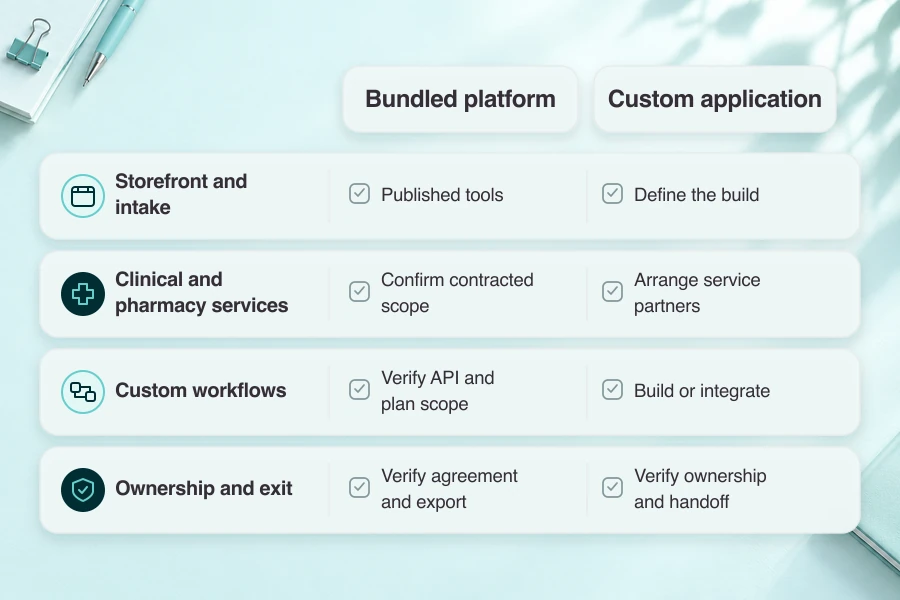
A strong fit is one you can demonstrate across these dimensions. An unanswered contract or workflow question belongs in procurement before it becomes an operating assumption.
Bask Health legitimacy and review evidence
Separate the existence of a documented platform business from the quality and suitability of the care delivered through a particular program. If you're asking “is Bask Health legit?”, its published platform offering and agreements give you a basis for evaluating the business. You still need to verify the actual clinical and pharmacy parties.
Bask's general terms identify its role as separate from providing clinical healthcare services. Identify the group that will prescribe and the pharmacy that will dispense, then check the services and responsibilities covered by your agreements.
When reading Bask Health reviews, distinguish an independent customer account from a vendor testimonial, an employee review or a rating of a mobile operations app. The public evidence reviewed here didn't establish enough independent customer experience for a defensible platform-quality score. That limitation doesn't show that reviews are absent everywhere or establish a negative service outcome.
Ask for references relevant to your treatment model and operating requirements. Evaluate their experience against the work you're buying, alongside the relevant agreements and security evidence, rather than treating a badge or testimonial as the whole answer.
Who is the platform best for?
Evaluate this route when your DTC brand has a defined treatment offering and workflows that match the proposed bundle. Put Bask Health on your shortlist if you want connected patient commerce, clinical tools and service access, and can verify that the configuration fits your operating plan.
For a telehealth startup assessing a weight loss program, that means examining the clinical and pharmacy arrangements as carefully as the intake experience. The marketed use case alone doesn't settle the fit.
When choosing a telehealth platform for startups, compare the requirements you can demonstrate today with the control you'll need over the product. Essential workflow differences, external-system needs, contract terms or a different clinical operating model justify evaluating other routes. Growth by itself doesn't establish that you should rebuild.
Bask Health alternatives
Choose alternatives by the part of the operation you want to buy. A clinical operating platform, a programmable backend and a custom product can leave your team with different responsibilities.
Healthie's entry-level subscription isn't a quote for an API and white-label configuration. Likewise, a custom application budget needs the service partners the business will use. Compare configured operations, with equivalent clinical and fulfillment scope, before ranking these routes by cost.
When to build your own telehealth platform instead
Start your build vs buy telehealth decision by naming the requirement driving it. Test these five triggers against a configured platform and a scoped custom proposal:
- Essential custom workflows. Demonstrate the process your team needs. Establish what configuration or API work can achieve before concluding that a new product is necessary.
- External systems and care models. Specify the exact EHR integration, insurance workflow or synchronous-care requirement. Ask for the data exchange and operating scope you need to verify.
- Data and contract control. Identify the ownership, access and exit rights your business requires. Compare actual agreements rather than assuming that every licensed or custom route grants the same rights.
- Comparable unit economics. Model the same clinical workload, fulfillment and operating scope. A lower software charge can coexist with different costs elsewhere in the operation.
- Product IP and engineering ownership. Decide which parts of the product your development team needs to control and maintain. Verify the handoff and tech stack rather than assuming ownership raises valuation.
Bask's published APIs make a hybrid route worth evaluating too. For the broader decision, consider how to buy or build a telehealth solution. If you plan to build a telemedicine app, define the service boundaries before choosing a telemedicine app development company. Assess scalability across the complete operation.
Check ownership and exit terms before you sign
You need to distinguish ownership of platform software, ownership of a custom application, patient data ownership and medical-record custodianship. Those can sit with different parties.
Bask's general service terms reserve the underlying platform software to Bask and its licensors and include patient-transfer assistance for continuity when service ends. Its API license terms distinguish your application's ownership from licensed API access. The public material reviewed didn't establish a complete patient-record export specification.
To evaluate vendor lock-in, ask for the transition terms in writing:
- Dataset and format: what can you export, and how is it delivered?
- Record scope: are attachments, consents, messages and audit logs included?
- Permissions and custody: who authorizes transfer, and who retains the medical record?
- Timing and cost: who initiates the process, and on what terms?
- Service transition: how do the clinical and pharmacy arrangements continue or change?
- Termination access: what remains available after the agreement ends?
Check the agreement that applies to your business. Treat merchant, provider and API arrangements separately; don't assume the same rights or restrictions apply to all three.
White label vs. custom build: cost comparison over three years
Compare a white label telehealth operation and a custom route using the same clinical workload. This illustration assumes 500 billable doctor-group visits and 100 ID checks monthly for 36 months: 6,000 visits and 1,200 checks annually, or 18,000 and 3,600 over three years. It is arithmetic using published usage rates, not a forecast or quote.
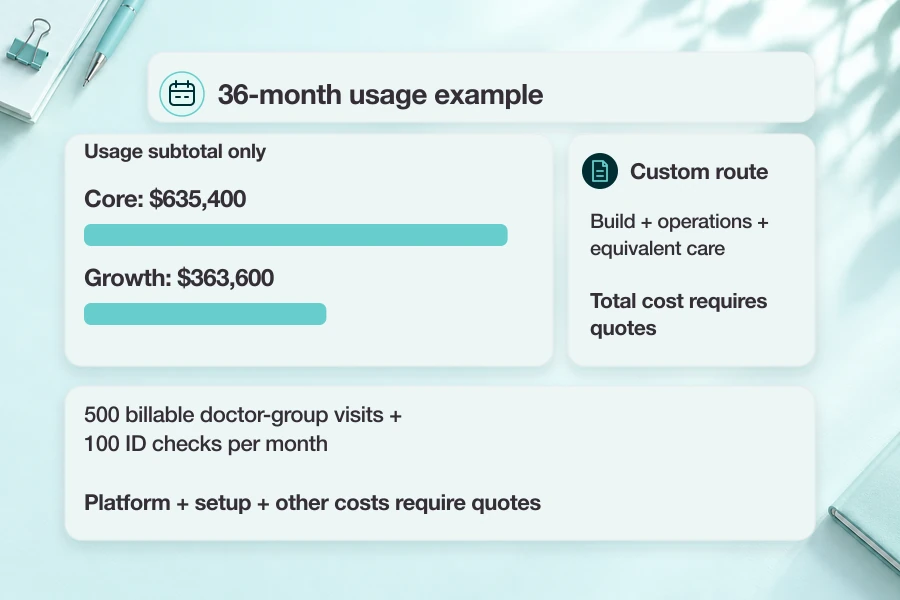
S is licensed setup; standard out-of-box Core/Growth setup is $0, while any separately scoped work needs confirmation. P is monthly platform cost. B is the initial custom build; M is monthly custom software/maintenance. N and K are total visits and checks; c and i are their respective unit rates. S and P vary by plan. R_b and R_c contain the remaining quoted horizon costs, counted once, including applicable marketing, compliance, support and engineering costs outside the other rows.
The general totals are S + 36P + N×c_b + K×i_b + R_b and B + 36M + N×c_c + K×i_c + R_c.
The known visit-and-ID subtotals are $635,400 for Core and $363,600 for Growth. Neither is total cost of ownership.
For steady monthly workloads, let V be billable doctor-group visits, J be ID checks, and r_b/r_c be other recurring operating costs per month, excluding setup, build and terminal exit charges. Define the monthly difference as D = (P + V×c_b + J×i_b + r_b) − (M + V×c_c + J×i_c + r_c).
If D is positive and B exceeds S, simple undiscounted operating break-even is (B−S)/D months. If D is positive and B is no greater than S, there is no extra upfront build cost to recover. When D is zero or negative, the model shows no monthly operating-cost advantage for the custom route.
Terminal exit costs belong in R_b/R_c for the separate horizon comparison. This illustration omits inflation, financing/discounting, seasonality, growth and tax; a real decision needs current quotes and workload estimates.
How Specode can help
With Specode, you retain rights in the data, content, code and applications you create. You can export your code and applications during the subscription and for 60 days after termination. You can define a healthcare product around your own requirements while preserving a contractual code-export path. Specode's platform IP and third-party services remain separate; its proprietary AI coder stays on the platform.
Specode's AI-powered builder accepts plain-English requirements for responsive web applications, including the UI, workflows, data model, permissions and integrations. Your clinical, legal, privacy, security, product and operating owners remain responsible for their decisions and validation.
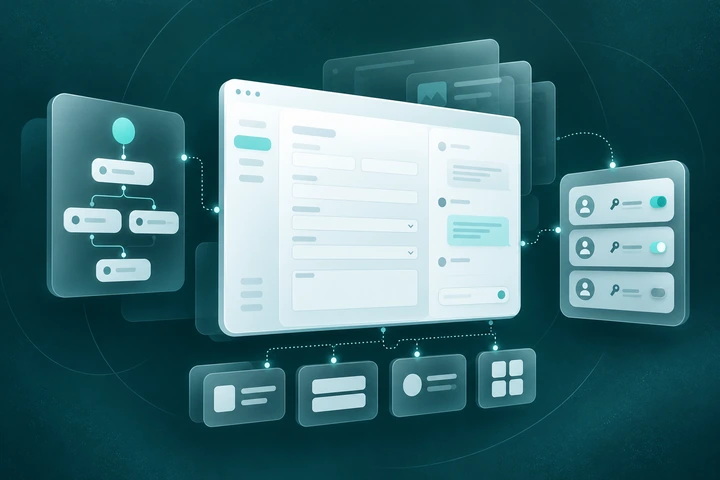
Production requires Pro or higher. Your backend runs in your own Convex account, where you sign Convex's standard hosting BAA. On Custom, Specode also signs a BAA with you. These agreements cover their respective relationships; they don't by themselves make the complete application HIPAA compliant. Integrated services may need separate agreements, and the team helps identify which apply. Budget separately for your hosting and external services.
You can choose the level of build support.
- Pro costs $1,000/month, billed month to month (checked October 2026). It includes consultation with a senior product manager, hands-on weekly team support, bug fixes and small implementations. The team includes healthcare technology and compliance specialists.
- Custom starts at $5,000/month and provides a hands-off build and maintenance option, with managed coding and dedicated support. Your own risk analysis and clinical, legal, privacy and compliance decisions remain yours; team guidance isn't legal advice.
- Customer-managed integrations remain your responsibility for configuration, maintenance, security, compliance and costs.
For an existing application, migration starts with a team conversation. The code needs to be in a GitHub repository or exportable to one. If source code can't be exported, moving the product means rebuilding its screens, data model and workflows. This migration path establishes no automatic transfer of Bask software, patients or records.
If you're comparing Bask Health competitors because your requirements call for a product you can define and control, bring your workflow requirements, clinical-service scope and proposed ownership model to a demo.
Frequently asked questions
Bask is a documented telehealth software and coordination business. Verify the actual prescribing group, dispensing pharmacy and agreements for your program. The public evidence reviewed doesn't support an independent platform-quality rating or treating badges as proof.
Request a current platform quote. The plans page checked October 19, 2026 lists Core, Growth and Enterprise without monthly subscription amounts. Published doctor-group visit and ID-check charges are separate, so they don't establish the monthly bill.
Bask offers access to provider groups and partner-pharmacy connections. The actual contracted clinicians provide care, and pharmacies dispense medication. Confirm your program's service scope and charges; access to these connections doesn't mean consultations or drugs are included.
The general service agreement includes patient-transfer assistance for continuity. Confirm the complete export dataset, formats, record custodianship, timing, fees and post-termination access in your agreement. The public sources reviewed don't establish a complete medical-record export specification.
Neither route is universally cheaper. Compare quoted software, build and maintenance costs with equivalent clinical and fulfillment services and the same workload. Published visit-and-ID subtotals alone don't establish the complete cost or a break-even point.