Best MCP Servers for Healthcare Developers: Model Context Protocol Servers for FHIR, EHRs and HIPAA, Tested

Model Context Protocol (MCP) servers now range from free code-lookup connectors to Epic's own agent plumbing, and they carry very different risk. For a team doing healthcare app development, the useful sort is by when a server is used and what data it can touch.
This page is the tested shortlist of the best MCP servers for healthcare, grouped into build-time tools for writing healthcare code and ship-time servers your product or agents call with patient data. Every server below is labeled with what it can write.
Written by the Specode team, which builds HIPAA-ready healthcare apps. Specode makes one of the servers covered here (the Specode MCP); no other vendor paid for inclusion.
Which MCP servers should a healthcare developer start with?
Start with Epic's open.epic MCP for documentation, then the WSO2 FHIR MCP against a synthetic HAPI FHIR sandbox, and add Anthropic's ICD-10, NPI, and CMS Coverage connectors for reference data. Run a HIPAA scanner such as the Specode MCP (ours) on the code your agent writes. For production patient data, use the server from the platform that already holds your PHI, whether AWS HealthLake, Medplum, or the EHR vendor, in read-only mode first, always with a BAA covering every hop.
Healthcare MCP servers at a glance
This is the tested shortlist of MCP servers for healthcare developers, grouped by when they're used. Roundups of the best MCP servers rank by vendor, and lists of best MCP servers for developers rarely separate PHI-touching tools from public reference data.
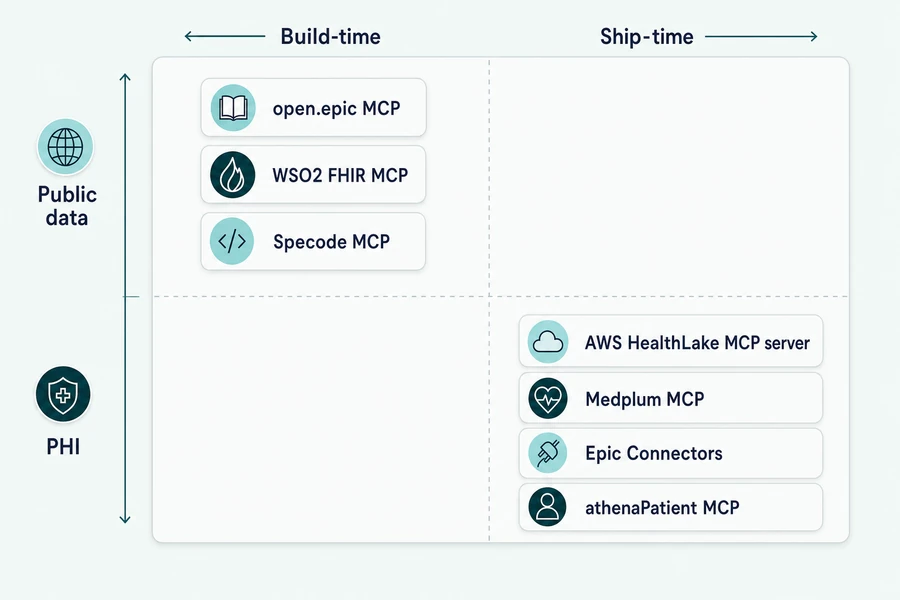
The Specode MCP is covered in its own section.
What an MCP server is, for healthcare developers
Model Context Protocol is an open standard that lets an MCP client, such as an AI coding assistant, call outside tools and data through an MCP server. A server exposes three kinds of things: tools the model can invoke, resources it can read, and prompts the client can reuse. The acronym also names the metacarpophalangeal joint in medicine, so read the context first.
What is MCP in healthcare? In practice, MCP healthcare tooling splits into two jobs. Build-time servers help you write healthcare code inside your coding tool, using public documentation and sandbox data. Ship-time servers are what your product or agents call in production, usually with PHI, and only those pull the compliance boundary toward you. MCP itself is a protocol, not a compliance status, which the HIPAA section expands on.
How we tested
On November 19, 2026 we installed and probed the servers over the same protocol that Claude Code, Cursor, and MCP Inspector speak: JSON-RPC MCP requests over stdio and Streamable HTTP. Every card below uses this date.
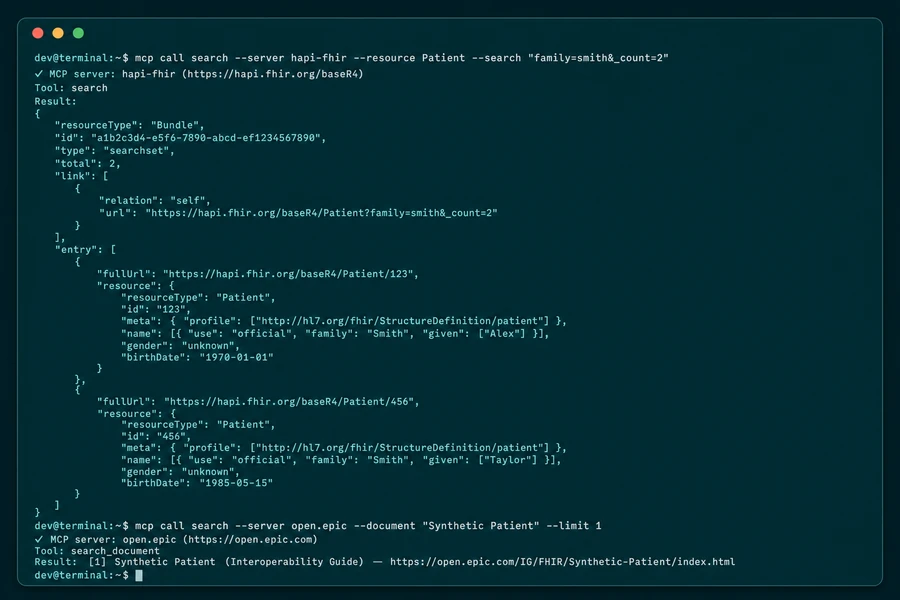
Every test ran against the public HAPI FHIR server, which returns synthetic data for read-only testing, with a local HAPI instance loaded with Synthea synthetic patients as the alternative. No real patient data was used.
The WSO2 server ships with authorization on by default, so every search failed with "User is not authenticated" until we disabled development authorization; after that, a Patient search against the public HAPI FHIR server returned synthetic patient data. The open.epic MCP document search returned real open.epic FHIR tutorial pages.
Across the page, Tested means we installed and ran the server on that date; Verified means we checked the vendor's own page on that date. Servers we could not run are never presented as tested.
Build-time MCP servers (help you write healthcare code)
Most teams searching for a FHIR MCP server want to write healthcare code faster without streaming PHI through an agent. These servers operate on public documentation, sandbox data, and your own code, and none requires a BAA. You will use them inside Claude Code, Cursor, or VS Code.
open.epic MCP server
open.epic MCP. Epic's documentation server for AI tools. Yes: there is an official Epic MCP server, a public remote server at MCP.open.epic.com over Streamable HTTP. Two tools, search_documents and get_document, search open.epic documentation including API specifications, interface summaries, data sharing playbooks, tutorials, and FAQs.
Epic says it does not provide guidance and is not designated to handle PHI or confidential information. Our document search returned real open.epic FHIR tutorial pages. Gotcha: it covers documentation and HL7v2 material, and it does not connect to a health system's live patient data. Epic's MCP documentation.
Healthie Dev Assist MCP server
Healthie Dev Assist. Healthie's official MCP server for AI-powered exploration of Healthie's GraphQL API. One main tool, execute_healthie_code, runs sandboxed Node.js code with schema introspection and query methods. Schema search and introspection work without a key; query and mutate calls require a Healthie API key. Healthie's guardrail: staging only, never production. Clients: Claude Desktop, Claude Code, Cursor, and ChatGPT. Healthie Dev Assist repository.
WSO2 FHIR MCP server
WSO2 FHIR MCP. An open-source FHIR MCP wrapping any FHIR server or API, installed with uvx FHIR-MCP-server (Apache 2.0, version 0.11.0 at testing; stdio, SSE, Streamable HTTP, Docker). Seven tools: get_capabilities, search, read, create, update, delete, get_user, with FHIRPath filtering. Authorization is on by default; every search failed with "User is not authenticated" until development authorization was disabled.
Real endpoints use SMART on FHIR; demos run against HAPI FHIR and the Epic sandbox. The create, update, and delete tools mean it can write, so use a sandbox in development. FHIR-MCP-server on PyPI, WSO2 GitHub repository, SMART on FHIR development.
Anthropic ICD-10, NPI and CMS coverage connectors
Anthropic's three code-set connectors. The ICD-10 Codes connector covers the complete ICD-10-CM diagnosis and ICD-10-PCS procedure code sets through nine tools including lookup_code and validate_code. The NPI Registry connector does lookup, search, and validation of US provider NPIs through three tools.
The CMS Coverage connector exposes Medicare Part B National Coverage Determinations (NCDs) and Local Coverage Determinations (LCDs) from the CMS Coverage Database through eight tools including search_lcds and search_ncds, so NCD and LCD checks run in one call. All three are read-only Claude connectors by Anthropic.
PubMed and ClinicalTrials.gov connectors
PubMed and Clinical Trials. The PubMed connector searches biomedical citations and PubMed Central full text through seven tools, including search_articles and get_article_metadata. Anthropic's healthcare announcement describes PubMed as providing access to more than 35 million pieces of biomedical literature.
The PubMed MCP connector runs inside Claude, which suits the pubmed MCP workflow for research. The Clinical Trials connector searches ClinicalTrials.gov through six tools, including search_by_eligibility and search_by_sponsor. Both are read-only, Anthropic-made, added to Claude's connector directory in January 2026 (PubMed, November 2025).
Apple Health MCP server
Apple Health MCP. Momentum's community Apple Health MCP repository queries a local Apple Health XML export with DuckDB; no write tools. Export Apple Health XML, place the file, and the server imports and parses it. The apple health MCP suits wearable prototypes; this apple health MCP server alone touches personal data here. Open Wearables is the repository's successor, so the XML workflow is a legacy path for wearable app development prototypes.
Ship-time MCP servers (what your product or agents call with PHI)
The moment a healthcare AI tool with FHIR MCP integration reads real patient data, it becomes ship-time, and every hop needs coverage. Ship-time servers are what your product or agent calls in production, usually with PHI, and only they drag the BAA chain into scope. For telehealth app development teams, healthcare ai agents get the same scrutiny as any PHI pipeline.
AWS HealthLake MCP server
AWS HealthLake MCP server. AWS Labs' server for HealthLake FHIR datastores: 11 tools covering discovery, CRUD, search, patient-everything, and import/export jobs for Bulk FHIR-style data movement. Install: uvx awslabs.healthlake-mcp-server@latest (version 1.30.0 at testing); it refuses to start without an AWS region and credentials. --readonly prevents all mutating operations; create, update, and delete exist otherwise, so start in read-only mode.
AWS describes HealthLake as a HIPAA-eligible service under the customer's AWS agreement, which does not make any MCP server HIPAA compliant. An SSRF flaw (CVSS 7.3) affected versions before 0.0.14, where it is fixed. AWS Labs HealthLake MCP docs, CVE history. Install and tool list only; not run against a paid AWS datastore.
Medplum MCP
Medplum MCP. Medplum's hosted endpoint at https://api.medplum.com/mcp/stream, a Streamable HTTP endpoint with OAuth sign-in. The main FHIR-request tool performs full FHIR CRUD, with search and fetch tools for client compatibility. An unauthenticated initialize request returned Unauthorized, so OAuth is required before tools are usable. FHIR-request can write and delete when the signed-in account has those rights, so scope the account. For a Medplum-hosted FHIR project, the Medplum MCP is the natural ship-time choice. Medplum MCP docs.
CharmHealth MCP
CharmHealth MCP. 16 tools covering patients, encounters, medications, labs, and appointments, plus messaging and task tools. The tools create and update patient and encounter data, so this is a PHI server. OAuth 2.0 credentials via environment variables, with sandbox or production base URLs. CharmHealth's own warning: PHI-capable, requiring a HIPAA-compliant LLM under a signed BAA with zero retention and no training. CharmHealth MCP repository.
FDB MedProof MCP
FDB MedProof MCP. First Databank's server grounds AI agents in FDB's clinically validated drug knowledge for medication workflows, generally available since March 31, 2026. No public pricing; access goes through FDB's contact form, making it an enterprise reference server rather than a free trial. Data class: licensed reference data, read-oriented for grounding; it is not a general-purpose PHI store. FDB MedProof page.
Epic Connectors
Epic Connectors. MCP-based links that let Agent Factory agents call outside software, announced October 21, 2026. Epic documents connector listings on Showroom starting March 2027 (Q1 2027), with review of what each connector can read and change, so a startup cannot simply plug one in today. Health systems enable and review connectors for their own agents, making this a procurement question for the health system's EHR integration team.
The Epic MCP story has two parts: open.epic for documentation, and Connectors for agents. A vendor channel, separate from the tested ranking. Epic's Connectors announcement, Becker's conference coverage, how to integrate with Epic.
athenaPatient MCP
athenaPatient MCP. Launched November 2, 2026, letting US Claude Pro and Max users connect their own athenaOne record. Patients sign in with their athenahealth portal credentials, choose what Claude can reference, and can revoke access; data classes include labs, medications, vitals, conditions, immunizations, and visit history.
Reference access to a patient's own record, with no write-back described, so treat it as read access unless athenahealth documents otherwise. It is patient-directed and US-only, so a startup still needs its own integration path to athenaOne. A vendor channel, separate from the tested ranking. athenahealth's launch release, Fierce Healthcare launch coverage, patient portal platform.
HIPAA, PHI and BAAs: where MCP changes your compliance boundary
MCP is a protocol, not a compliance status. Once PHI passes through an MCP server, every hop needs coverage: the AI vendor, the MCP server host, and the data store. Anthropic's BAA page says MCP connectors are available to use, but data sent to third parties through them is not covered under Anthropic's BAA, and administrators who enable connectors answer for workforce use.
That sentence is worth reading slowly, because the connector directory makes enabling connectors one click away. An agentic AI healthcare architecture uses MCP and FHIR to move data across three hops, and each hop is either covered by a business associate agreement (BAA) or carries public data only.
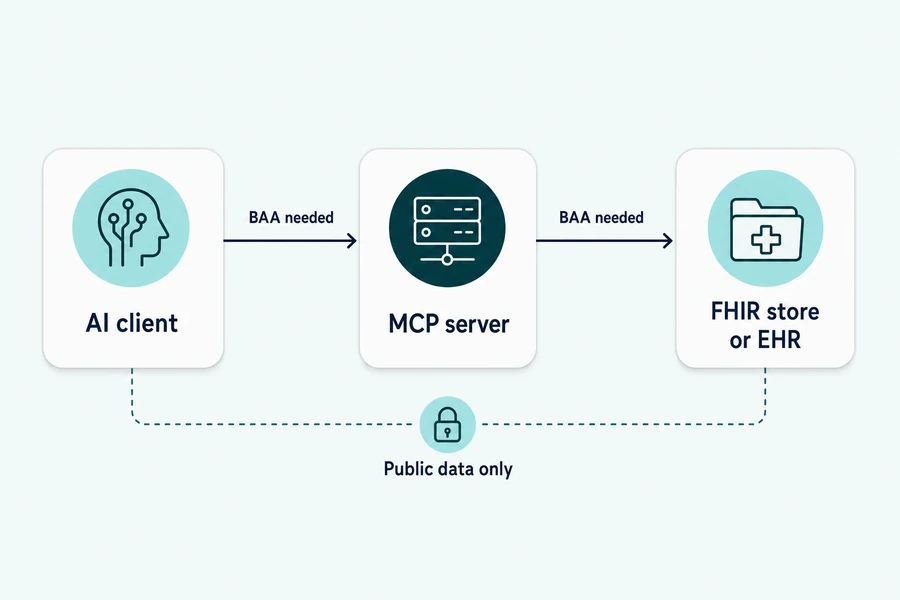
Your agent calls the MCP server, the server reads the FHIR store or EHR, and a gap anywhere in that chain is a gap you own. That three-hop shape is exactly what the diagram above shows. Keep public-data connectors free of patient identifiers and treat their inputs as de-identified data. Use synthetic data in development, the same rule our tests followed. Treat patient-authored text as a prompt injection risk to the agent, because a patient can type instructions as easily as symptoms.
Teams running Claude for healthcare workflows should check which tools are HIPAA compliant before connecting any connector. Anyone doing HIPAA compliant app development owns the BAA chain end to end, and a concrete setup path exists in how to connect Claude Code to a HIPAA-compliant backend. Read Anthropic's BAA article for the exact vendor wording.
Security checklist before you connect real patient data
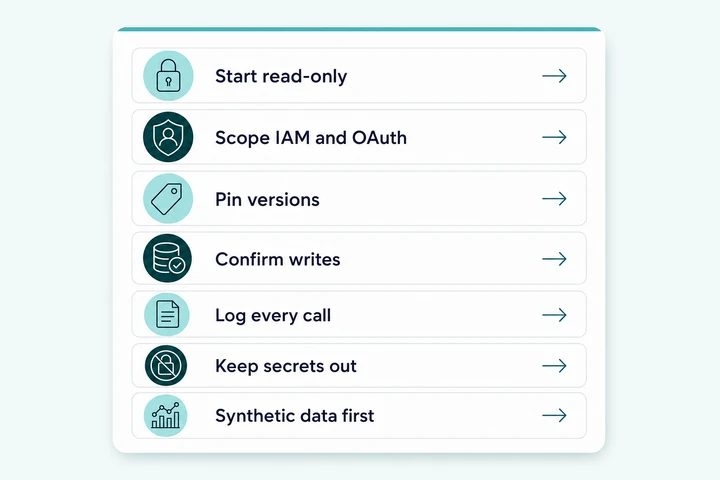
These are the FHIR MCP implementation best practices to check off before real patient data flows through any server on this page.
- Start in read-only mode, and stay there until every hop in your BAA chain is signed.
- Scope IAM and OAuth with least privilege and no wildcard resources, per agent, per environment.
- Pin server versions and watch CVEs; the HealthLake SSRF fix in 0.0.14 is the neutral example.
- Require human confirmation for every write, and keep tool permissions as narrow as the workflow allows.
- Log every tool call as audit logs you can hand to a reviewer, with the request and the outcome.
- Keep secrets out of client configurations; use environment variables and a secret manager, never a committed config file.
- Prefer vendor-maintained servers for PHI so security updates arrive without your team doing the work.
- Test against synthetic data first, on the public HAPI FHIR server or a local Synthea instance, before any PHI-touching test.
- Confirm support for the current MCP specification dated 2026-07-28 before you pin anything else.
The card below renders these nine items as a shareable card, so you can hand the same list to a security reviewer before your first PHI request.
Build your own FHIR MCP server, or use an existing one?
Use an existing server when your data already lives in HealthLake, Medplum, or a standard FHIR R4 endpoint. MCP then adds an agent layer with its own permissions on top of the same FHIR API a traditional integration would call, so you get faster agent workflows without changing your data layer.
An agent can search and read the same records your application code already touches, under its own permission scope. The platform vendor maintains the server and its audit story, which makes the existing server the pragmatic default for most teams.
Build your own when you need narrow task-specific tools, custom audit rules, or non-FHIR sources, and start from a single read-only tool rather than wrapping every operation. A small server is easier to review than a large one, and the review is where the compliance value lives. Every extra tool multiplies the review surface, so start small. Add write tools only after the confirmation and logging story exists. The minimum shape of a read-only FHIR tool looks like this:
If your requirements go beyond a wrapper, for example when the integration must span non-FHIR systems, that is a custom healthcare software conversation.
Our own HIPAA MCP server: the Specode MCP (separate from the ranking)
Full disclosure: this one is ours, so the Specode MCP sits outside the at-a-glance table and ranking.
The Specode MCP connects Specode's HIPAA tooling to Codex, Claude Code, or Cursor, so the agent can start a HIPAA-ready app, add a HIPAA compliant backend to an existing frontend, scan TypeScript, JavaScript, and SQL for HIPAA issues, fix, recheck, or dismiss findings, and get HIPAA guidance while building. The MCP does not deploy applications.
Claude Code, Codex, and Cursor connect directly; Lovable and Replit connect through GitHub with scans, fixes, and new-project backend setup; Base44 and Bolt are partially supported (Specode's MCP launch post has details).
Server URL: https://app.specode.ai/mcp. Codex sandboxes network access by default, so the network_access change may be required for sign-in. Specode MCP setup guide has commands.
Cursor uses the same URL in ~/.Cursor/MCP.json or the project MCP.json.
Scored on the same criteria: setup, one command plus Specode sign-in; transport, Streamable HTTP; auth, Specode sign-in; safety, no deploys, synthetic-data-only backend; logging, scan history and HIPAA score in the dashboard; maintenance, the Specode team, launched November 17, 2026.
Most teams arrive here from searches like "Claude Code HIPAA" and "Cursor HIPAA," and backend questions usually look like "Supabase HIPAA" or "Convex HIPAA." The scanner's coverage is most complete on React plus TypeScript frontends with either backend. Specode is an AI-powered healthcare app builder that develops responsive web applications from plain-English requirements, the HIPAA-compliant app builders framing.
- The scanner reads TypeScript, JavaScript, and SQL only.
- Best coverage on React plus TypeScript frontends with Convex, Supabase, or Node.js plus Postgres backends.
- Other stacks still scan, with less complete results.
- A first full scan takes 10 to 50 minutes on Specode's servers.
- MCP-created projects appear as read-only external projects in the dashboard.
- The MCP does not deploy, and a scan does not make an app HIPAA compliant or replace compliance review.
Going to production: the Convex backend created through the MCP is a development deployment that is not under a BAA and is not for real PHI. Production means the customer's own Convex deployment under Convex's standard BAA (available at $25 per month), fresh secrets, a final full scan, and BAAs with every other vendor that touches PHI. Teams wanting Specode to handle deployment move the app into the platform on the Pro plan at $1,000 per month. going live with Specode covers it.
MCP access needs a Specode account; Basic, $250 per month, includes the MCP connector with Claude Code and Codex and 300 monthly scan credits.
How can Specode help?
Pick servers by job and data class: reference-data connectors are low-risk wins today, while PHI servers need read-only mode, scoped auth, and a BAA at every hop. Epic and athenahealth are opening MCP channels, so revisit this list of healthcare MCP servers monthly. The Specode MCP puts the scan inside the tool you already code in, so HIPAA gaps show up while the agent writes.
Building a healthcare app with Codex, Claude Code or Cursor? Connect the Specode MCP and run a HIPAA scan on the code your agent wrote.
Frequently asked questions
A server that gives an AI assistant controlled access to outside tools and data through Model Context Protocol. In healthcare it connects coding agents to FHIR servers, EHRs, code sets, or compliance tooling.
Start with open.epic MCP, WSO2 FHIR MCP, and Anthropic's reference connectors, add a HIPAA scanner like the Specode MCP, and for PHI use your platform's own server read-only with BAAs at every hop.
Yes. Epic's open.epic MCP server is live and public, with two tools that search and retrieve open.epic documentation. Epic Connectors arrive through Showroom from Q1 2027.
Yes. US Claude Pro and Max users add athenaPatient MCP and sign in with their athenaOne portal credentials, choosing what Claude can reference and revoking access anytime.
No server is HIPAA compliant by itself. MCP is a protocol, not a compliance status. Coverage depends on BAAs with the AI vendor, the server host, and the data store, plus your own safeguards.
Some can. Medplum, WSO2, CharmHealth, and HealthLake all include create, update, or delete tools. Start in read-only mode or a sandbox, and require confirmation for every write.
open.epic MCP, WSO2 FHIR MCP, Apple Health MCP, and Anthropic's reference connectors are free; HealthLake and Medplum ship free server software, but you pay platform usage costs.
Yes. The Specode MCP connects Codex, Claude Code, and Cursor to Specode's HIPAA tooling so an agent can start a HIPAA-ready app, add a development backend, and scan, fix, and recheck findings. It does not deploy.
WSO2 maintains the open-source FHIR MCP server, AWS Labs the HealthLake MCP server, and Medplum its own. Several EHR vendors build internal ones, so check each vendor's repository before adopting.