How to Start a Peptide Business: A Compliant Playbook for 2026

If you're working out how to start a peptide business in 2026, establish what you can lawfully offer before choosing a menu. Selling to people requires licensed prescribers and pharmacies, with each substance's FDA status checked separately. The 2026 category changes and advisory votes didn't remove those requirements.
For US founders, clinicians and clinic operators, the work spans ownership, clinical responsibility, pharmacy partners and payments. This guide explains the business decisions and their costs. For the software build, use our companion guide to a telemedicine platform for peptide clinics.
The approach here is prescription-only. It offers no research-use-only workarounds or claims about what peptides treat. State rules vary, so involve healthcare counsel before committing to a structure or launch plan. Start with the clinical model; choose technology to support it.
What do you need to launch a compliant peptide clinic?
A prescription-only operation needs a legal structure that fits state corporate practice of medicine rules, a medical director and licensed clinicians, a licensed compounding pharmacy, written protocols and informed consent, and a HIPAA compliant platform for intake and visits. Confirm each peptide's current FDA status with your pharmacy before building the treatment menu.
Key Takeaways:
- The legality question depends on the substance, not the marketing. FDA-approved drugs follow licensed pharmacy channels; BPC-157 remains outside the bulks lists and interim categories as of October 2026. Research-only labels did not protect the sellers named in FDA's 2025 and 2026 letters.
- A compliant clinic operates through licensed prescription care. Build around licensed prescribers, a licensed compounding pharmacy and state ownership rules. Non-clinical founders commonly use a physician-owned professional entity plus an MSO.
- Budget against published ranges with stated assumptions. Legal, clinical, pharmacy, technology and marketing costs depend on the model and state. Recurring costs include the platform and merchant account; assess membership and retention against your own results.
- Recheck every peptide's FDA status before you launch. The July 2026 PCAC votes were advisory and added no peptide to the bulks list. Verify each substance with your pharmacy and healthcare counsel, and watch for further FDA action through 2026.
What a peptide business looks like in 2026
You'll be operating through licensed clinical channels. A peptide business connects prescribers, a pharmacy and patients, whether care happens in person or through telehealth. To judge the opportunity, separate drug-market estimates from the revenue a clinic could earn.
The Business Research Company estimates the global peptide therapeutics market at $49.21 billion in 2025 and $54.62 billion in 2026, forecasting $83.57 billion by 2030. Its scope is therapeutic drugs, excluding clinics and compounding; other vendors' broader definitions produce much higher estimates.
BCC Research values the global GLP-1 analogues market at $54.8 billion in 2024 and projects $268.4 billion by 2030. Separately, Truveta's US health-system data puts GLP-1 prescriptions above 7% of prescriptions as of December 2025.
The April 2026 FDA actions and July advisory votes drew commercial attention. WIRED reported companies and pharmacies preparing compounded-peptide pipelines ahead of the vote. By September, AJMC reported peptide therapy mentions up 281% year over year and peptide search interest overtaking Ozempic.
A July 2026 Gallup survey found that 15% of US adults had used GLP-1 medications for weight loss and 11% currently took them. These are usage and interest signals. The $50-$75 billion unapproved-market projection for 2028 is an expert estimate, not measured clinic revenue.
AmSpa reports US medical aesthetics revenue above $17 billion, growing by more than $1 billion annually. AestheticHires reports roughly 10,500 US med spas in 2023 and around 1,000 net new locations annually. The Business Research Company estimates the global longevity clinic market at $5.35 billion in 2025, forecasting $9.55 billion by 2030.
The Partnership for Safe Medicines observes that compounded peptides already reach patients through wellness clinics, medical spas and online platforms. Those channels explain the commercial interest; your proposed menu still needs to pass the substance-specific legal test.
Is it legal to sell peptides in the US?
Yes, peptides can be sold through licensed channels where the substance's legal status permits it. If you're asking is it illegal to sell peptides, distinguish an FDA-approved drug dispensed on prescription from an unapproved substance marketed for human use. A research label doesn't settle that distinction.
The practical question, is it legal to sell peptides, depends on what you sell and how it reaches the patient. FDA-approved drugs follow normal pharmacy channels. Compounded preparations require a licensed pharmacy, a valid prescription under 503A and a substance the applicable framework permits.
Compounded drugs are not FDA approved. FDA doesn't review them for safety, effectiveness or quality before marketing. The agency says compounding may be appropriate when an approved drug cannot meet a patient's medical need or is not commercially available. That is a conditional pathway, rather than approval of a particular compounded product.
For your launch plan, examine the approved-versus-compounded distinction, the interim 503A categories, the changes announced in 2026 and the enforcement record for research-use-only products. State licensing and ownership rules also apply. Have your pharmacy and healthcare counsel assess each proposed preparation's current FDA status, the supply channel and applicable state licensing and ownership requirements before you build the menu.
FDA-approved peptides vs compounded peptides
For your menu, FDA-approved peptide drugs and compounded preparations require different assessments. Branded GLP-1 drugs such as semaglutide and tirzepatide reach patients through licensed prescription channels. Compounded preparations do not carry FDA approval or premarket review for safety, effectiveness or quality.
FDA's page on unapproved GLP-1 drugs says compounding may be appropriate when an approved drug cannot meet the patient's need. That determination belongs alongside the prescription and substance-specific requirements, rather than a general assumption that any compounded menu is permitted.
FDA resolved the tirzepatide injection shortage on December 19, 2024 and the semaglutide injection shortage on February 21, 2025. The Fifth Circuit affirmed both determinations in August 2026. As of October 2026, neither drug appears on the shortage list or the 503B bulks list.
FDA proposed excluding semaglutide, tirzepatide and liraglutide from the 503B bulks list in April 2026. The corresponding notice was preliminary; no final determination had been issued as of October 24, 2026.
Patient-specific 503A compounding requires a valid prescription for an identified patient. For essentially-copy products, the prescriber must determine and document a patient-specific significant difference. FDA's stated discretion concerning four or fewer essentially-copy prescriptions per calendar month is an enforcement posture that can change.
Enforcement also affects platform design: FDA issued 30 telehealth warning letters over compounded GLP-1 marketing in March 2026. Its September Empower Pharmacy letter challenged platforms offering prescribers pre-selected menu options to justify significant differences, describing those mechanics as undermining individualized clinical judgment.
503A compounding and the bulks list categories
Your pharmacy partner must work within the applicable compounding framework. Section 503A covers a licensed pharmacist in a state-licensed pharmacy or federal facility, or a licensed physician, outside the outsourcing-facility framework. It requires a valid prescription for an identified patient, with limited anticipatory compounding allowed.
Section 503B covers FDA-registered outsourcing facilities. They may compound without patient-specific prescriptions, including for office stock, and must meet current good manufacturing practice requirements. Those CGMP requirements do not apply to drugs compounded under the conditions of 503A.
For nominated bulk drug substances, FDA's interim 503A policy uses three categories:
FDA does not intend to categorize substances nominated on or after January 7, 2025. The interim categories are distinct from the final regulatory list, and their membership and enforcement posture can change.
As of October 2026, the 503A bulks list, in 21 CFR 216.23, contains six substances and no peptides. It has not changed since 2019. The 503B list contains five non-peptide substances, so it provides no current pathway for the six PCAC-recommended peptides.
State boards of pharmacy primarily oversee 503A pharmacies day to day, with FDA surveillance and for-cause inspections. FDA primarily oversees 503B facilities on a risk-based schedule. Check your partner's state licensure and the framework it uses.
What changed in 2026
On September 29, 2023, FDA placed BPC-157, TB-500 and other nominated peptides in Category 2, citing significant safety risks and withholding Category 1 enforcement discretion. Some summaries give November 2023 and nineteen peptides; the FDA placement dates are September 29.
In April 2026, twelve peptides were removed from 503A Category 2 after their nominations were withdrawn, as recorded on FDA's Category 2 safety page. They included BPC-157, TB-500, MOTS-c, KPV, Semax, Epitalon and emideltide. Removal brought neither Category 1 status nor approval, a bulks-list entry or enforcement discretion.
As of the May 14, 2026 list update, those withdrawn substances sat in no interim category. Meanwhile, the Federal Register notice of April 16 scheduled the July 23-24 Pharmacy Compounding Advisory Committee meeting to consider seven peptides for the 503A list.
Contemporaneous reporting by the FDA Law Blog (Hyman, Phelps & McNamara) gives the July 23 FDA webcast tallies: BPC-157, KPV and TB-500 each 8-6-1, and MOTS-c 7-5-2. On July 24, Epitalon received 7-4-1 and Semax 8-5-1; emideltide was declined 6-7-1. FDA had not posted a formal vote record as of October 24.
FDA staff had proposed against adding every substance. The six favorable votes were advisory, and FDA's meeting page states that committee recommendations are non-binding.

As of October 24, 2026, no final decision or rule had added these peptides to the bulks list, and formal rulemaking had not begun. Holland & Knight reported an October 14 HHS/FDA peptide-policy submission to OMB that remained unissued; no public OMB record was available at retrieval.
A further PCAC consultation was expected before the end of February 2027, with no date set. Verify each substance's current status with your pharmacy and healthcare counsel before building the menu, and recheck it at publication.
Why research use only is not a business model
Most of what a search for how to sell peptides surfaces is the research-use-only route. It is not a lawful path for products intended for people. Evidence of intended human use determines drug status, even when the label says research use only.
FDA's February 26, 2025 USApeptide.com, March 31, 2026 Pink Pony Peptides and August 24, 2026 Royal Peptides letters each found that website evidence established intended human use despite research use only or not for human consumption labels. The findings concerned those named sellers and their products.
In the warning letter to Pink Pony Peptides, FDA cited injectable products marketed with weight-loss language and sold alongside bacteriostatic water. It treated them as unapproved new drugs under the FD&C Act.
The payment requirements reinforce the distinction. Prescription-related card transactions fall under the networks' registration rules, while LegitScript generally excludes businesses selling research-use-only chemicals from healthcare certification. Certification eligibility does not establish what a seller may lawfully offer. There is no sourcing, labeling, payment or advertising workaround offered here.
Peptide business models compared
Choose the delivery model and the platform approach together. They affect capital requirements, clinical supervision and how much control you have over the service. Five options cover the choices in this guide:
An existing med spa has a different capital starting point from a founder building a clinical operation and its own platform. White-label and custom options describe the technology choice; neither replaces the licensed clinical team.
A wellness clinic already running functional medicine through a functional medicine app can assess peptides as an extension of its existing clinical service and patient relationships, subject to the same substance-specific requirements.
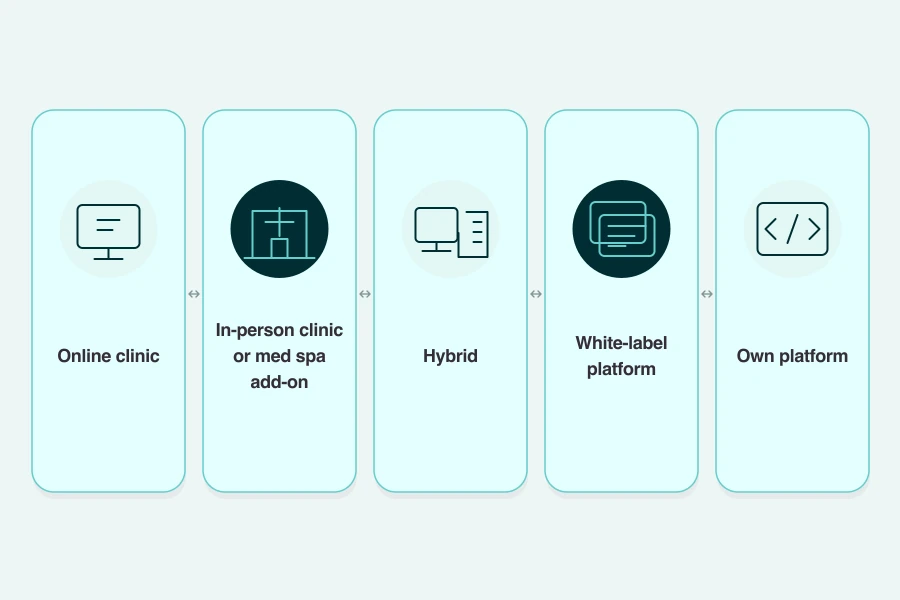
Whichever combination you choose, licensed providers retain the clinical decisions. The platform decision determines what you build or license to support them. Put that division of responsibility into the launch plan before committing capital.
How to start a peptide business in nine steps
Work through the nine steps in order. Your model shapes the treatment menu and legal structure; the clinical team and pharmacy establish what you can offer. Protocols then guide the platform, followed by payments, marketing and the operating work of retaining patients.
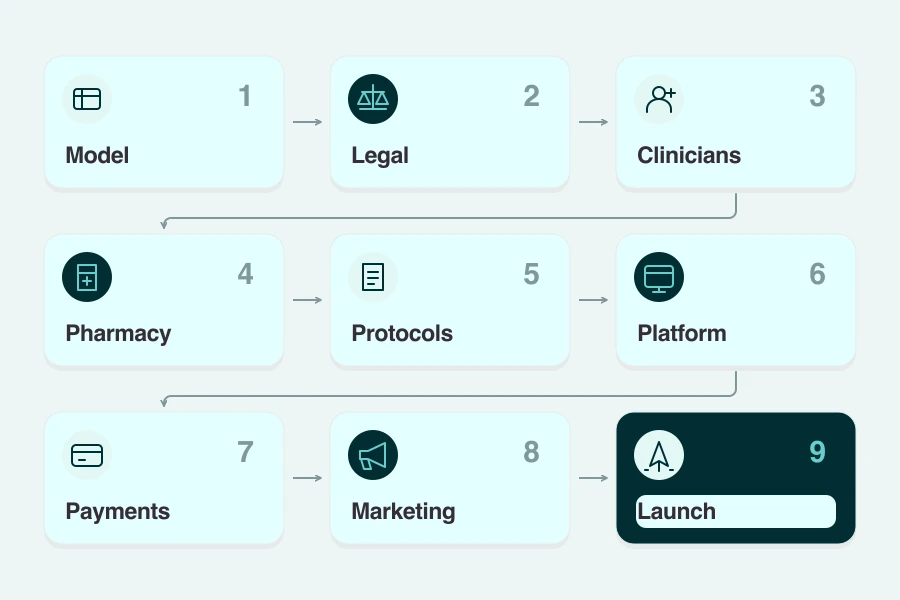
Choose your model and treatment menu
Make a short, protocol-defined treatment list the medical director's first deliverable. A peptide therapy clinic should start with FDA-approved drugs and consider compounded preparations only where the substance's current status and a licensed pharmacy permit them. The menu needs to reflect protocols and prescriber judgment.
Develop that menu before marketing it. FDA's September 2026 Empower Pharmacy letter challenged third-party platforms that supplied prescribers with pre-selected options for statements of significant difference. FDA described those mechanics as undermining individualized clinical judgment.
Have the medical director define the protocols, with each proposed preparation assessed by the prescriber and pharmacy. A pre-built dropdown of justifications cannot substitute for the prescriber's individualized, patient-specific clinical determination. For each proposed service, establish which prescriber makes that determination and which pharmacy will fulfill the valid patient prescription.
Set up the legal structure
For a non-clinical founder, the common structure separates a physician-owned professional entity from a management services organization, or MSO. The professional entity delivers clinical care. The MSO supplies administrative and operational services under a management services agreement.
The MSO can handle marketing, scheduling, billing and technology, but it does not employ physicians to provide medical services or control their clinical decisions. Physicians retain ownership and control of the practice, subject to state rules.
Corporate practice of medicine requirements and their enforcement vary by state. Have healthcare counsel assess ownership, control and the management services agreement before you commit. An MSO supports the business operations; it does not provide an exemption from those requirements.
Hire a medical director and licensed clinicians by state
Appoint a medical director to oversee protocols, delegation and clinical operations. The supervising provider's license authorizes the practice to deliver medical services. Requirements vary by state, including who may serve and, in some states, how far the director may be from the clinic.
Texas illustrates the specificity of state oversight: its elective IV-therapy rules require physician delegation and adequate supervision of the physician assistant or advanced practice registered nurse. That example is not a national rule.
Your staffing plan needs licensed physicians and appropriately licensed nurse practitioners. NP practice and prescribing authority vary from independent practice to an ongoing physician relationship, depending on state licensure, as NCSL's scope-of-practice page explains.
Telehealth prescribing carries the same standard of care as in-person care, and a practitioner-patient relationship is generally required. Check the applicable state's rules with CCHP's telehealth policy tracker and counsel.
The temporary controlled-substance telemedicine flexibilities run through December 31, 2026, subject to conditions and state law. Most peptides are not controlled substances, so this is prescribing context rather than a peptide-clinic permission.
Partner with a licensed compounding pharmacy
Partner with a state-licensed compounding pharmacy that works under 503A on valid prescriptions. State boards of pharmacy have primary day-to-day oversight, with FDA surveillance and for-cause inspections. A 503B outsourcing facility has different registration, prescription and CGMP conditions.
Before signing, ask:
Get the substance-specific answer in writing and keep state licensure current. A 503B facility has a federal adverse-event reporting duty; 503A has no equivalent explicit federal condition, though state reporting duties may apply.
Write protocols, consent and safety monitoring
Put physician-approved protocols in place before care begins. Medication standing orders can authorize qualified staff to administer medications under predefined conditions where state law allows. They need regular review and updates, and must match the applicable scope-of-practice, supervision and documentation rules.
Informed consent covers the diagnosis when known, the proposed intervention's purpose, and the burdens, risks and expected benefits of the options, including forgoing treatment. Document the discussion and the patient's decision in the medical record; specific consent statutes vary by state.
Maintain the clinic's adverse event reporting and safety-monitoring process, and review events and protocols with the medical director. Reporting through FDA's MedWatch program is voluntary for healthcare professionals. The pharmacy's own reporting duties are separate and depend on its framework and state rules.
Build or license your telehealth platform
Choose a system that can support the clinical workflow you have defined. Patient intake, visits, consents and messages involve protected health information, so the telehealth platform must be HIPAA compliant in operation. Keep scheduling, consent capture and follow-up together in one system within the planned clinical workflow.
An off-the-shelf platform prioritizes speed; a custom build gives you control over how the protocols translate into the application. Weigh the work of building against the fit and code ownership you need, alongside the recurring platform cost.
Evaluate the hosting and business associate agreement structure as part of that choice. In the customer-owned hosting arrangement described here, patient data stays out of the builder's preview environment and production runs on your own account. Establish which party signs each BAA before choosing the platform.
Set up payments and LegitScript certification
Plan for a high-risk merchant account before launch. Prescription telemedicine and pharmacy card sales fall within the networks' high-integrity risk framework. Most acquirers require accreditation or certification from a body the networks recognize, such as LegitScript; that does not remove the high-risk classification or guarantee approval.
LegitScript's fee schedule, checked in October 2026, lists a $975 nonrefundable application fee per website and $2,150 annually per website, due on approval. Recheck fees before budgeting. Research-use-only chemical sellers are generally ineligible for healthcare certification.
Published processing ranges run 2.5%-5.0% per transaction. Rolling reserves may withhold 5%-15% of daily volume, commonly held for 90-180 days. Actual rates and reserve terms are quoted per account at underwriting. Allow for the reserve in your working capital rather than treating withheld funds as available revenue.
Market within FTC and platform ad rules
Keep advertising within substantiated claims about the care you provide. Unsupported health claims violate FTC rules against deceptive practices and can conflict with platform ad policies. Certification also screens advertising. Have clinical owners review proposed claims, including testimonials and before-and-after promises.
Practice Growth Co's med spa benchmarks report $15-$30 per Meta lead, $100+ per Google lead and roughly $70-$600 for first-visit patient acquisition. These are directional figures from one agency's med spa clients, rather than a peptide-clinic forecast.
For budget comparisons, Growth99's report hosted by AmSpa cites a recommendation of 5% of revenue. Pronk's AmSpa-based compilation reports about 7% in actual med spa spending. Use those as separate reference points and assess your own booked consultations and acquisition costs.
Launch, measure and retain patients
Set up the measures you will use to judge patient retention and recurring revenue. Pronk's med spa membership benchmarks report roughly 85% membership prevalence, an average $89 monthly fee and about 2.5x member spending compared with non-members. Those med spa observations do not establish that membership caused the spending difference.
Separately, GLP1Cost's telehealth membership comparison lists consumer GLP-1 platform or program fees around $74-$149 per month after an introductory month. Medication is priced separately. This is a comparison of consumer telehealth programs, not expected revenue for your clinic.
Track rebooking and subscription results once you launch, and review protocols with the medical director. Use your own operating results to decide whether the membership model is retaining patients. The benchmark fees and spending observations do not promise recovery of startup or marketing costs.
What it costs to start a peptide business
Your startup costs depend on the clinical model, state and menu. These published ranges come from adjacent med spa, pharmacy and telehealth models. Use their assumptions to identify the costs you need quoted for your own plan.
MedSpa Standards' startup guide puts bootstrap solo med spas at $50,000-$120,000, standard physician-led practices at $150,000-$300,000 and premium build-outs at $400,000-$1,000,000+. Its assumptions include one-time pre-opening spend and a three-month operating reserve.
Business Plan Firm separately estimates $325,000-$920,000 for a typical med spa. These guides vary with premises, room count and service menu; they are not measured prescription peptide-clinic totals. No free AmSpa startup-cost figure is available.
ClinikEHR's telehealth startup estimate is $1,000-$3,500 for a general single-state, private-pay solo practice. That is a scoped vendor planning estimate, not a complete prescription peptide-clinic launch budget. Separately, EmbedCare estimates an assembled prescription telehealth business at five figures upfront plus a four-to-five-figure monthly run rate before the first patient.
If you plan to own a pharmacy, NCPA's retail benchmark calls for at least $50,000 cash and $500,000-$600,000 combined debt and equity. An SBA lender's sterile-cleanroom estimate adds $150,000-$600,000 or more. There is no authoritative compounding-only startup total.
Medical director retainers are estimated at $1,500-$8,000+ per month, paid at fair market value rather than as a revenue share. MedSpa Standards and AestheticHires provide market estimates; there is no BLS medical-director series behind them.
Homewood's telemedicine insurance estimates put annual malpractice premiums at $3,500-$7,500 for low-to-moderate prescribing and $6,000-$15,000+ for higher-risk GLP-1 and hormone practices. These are broker-published ranges; premiums are quoted for the practice. A peptide clinic should budget against the higher-risk comparison without treating it as a quote.
Platform seat prices in the table are October 2026 vendor list prices, not a complete operating stack. Processing terms require underwriting. Keep the separate med spa marketing recommendation and spending observation distinct, and use actual retention results to assess membership economics.
Tech stack for a peptide telehealth business
Define what the system must support before choosing the software. Telehealth peptide therapy needs intake, consults, consent records, refills and safety follow-up inside a HIPAA compliant workflow. Include video visits, e-signature records, protocol checklists, adverse-event tracking and payments in that assessment.
Before selecting a vendor, map who records consent, who reviews the clinical information and how follow-up reaches the patient. Use that same workflow to compare a licensed product with a custom build, including the responsibilities each option leaves with your team.
Our guide to a telemedicine platform for peptide clinics covers the full build. For the business decision here, decide how the telehealth software will support scheduling and payments alongside the clinical records and follow-up requirements.
If you prefer licensing an existing application, compare a white label telehealth platform with the workflow control you need. For a custom build, the telehealth app development guide explains the development scope and cost considerations.
The patient-facing telehealth website needs to support the booking journey, with service information, pricing pages and FAQs. Keep the relationship between that experience and the intake process clear when you scope the application.
Check the contractual arrangement too. In the customer-owned hosting setup, patient data stays out of the builder's preview environment, production runs on your account and the hosting BAA is between you and the hosting provider. Third-party integrations may need their own agreements; a hosting BAA covers that relationship alone.
Common mistakes that shut peptide businesses down
- Treating the July 2026 PCAC vote as approval. The recommendations were advisory and had added no peptide to the bulks list as of October 2026. Building a menu on a favorable vote alone can leave you offering substances outside the permitted compounding framework, with enforcement exposure.
- Skipping the corporate practice of medicine review. Ownership and clinical-control rules vary by state. A non-clinical founder needs a compliant structure and healthcare counsel's assessment; an MSO cannot take control of patient care. Getting that division wrong puts the clinical practice and its license at risk.
- Running a research-use-only adjacent menu. FDA's 2025 and 2026 letters show that labels did not protect the named sellers when the evidence established intended human use. LegitScript generally excludes RUO chemical sellers from healthcare certification, leaving this route exposed to enforcement and payment-access problems.
- Treating the merchant account as standard. High-risk registration, published processing ranges of 2.5%-5.0% and rolling reserves affect the cash you can use. Actual terms come from underwriting. A budget that assumes ordinary processing can miss the funds withheld in reserve and the conditions of payment access.
- Launching without protocols, consent and adverse event tracking. Physician-approved protocols, documented consent and safety monitoring belong in the operating plan, with state-law conditions respected. Without them, the team lacks the agreed basis for care and for responding to adverse events, exposing patients to harm and the practice to clinical risk.
How Specode can help
Specode is an AI-powered healthcare app builder. You describe requirements in plain English and define the UI, workflows, data model, permissions and integrations.
Specode keeps patient data out of its build and preview environment. Production runs on your own Convex account; on Pro, you sign Convex's standard hosting business associate agreement. Specode does not handle your Pro patient data because Convex stores it.
On Pro, Specode's guided publishing flow connects your own GitHub repository and Convex production deployment. When the HIPAA Agent scan is incomplete, you run it and fix all Must-Fix issues. Publishing checks for a green scan status before allowing you to proceed.
The HIPAA Agent separates must-fix findings from recommended hardening. You can send a finding to the AI coder and rerun the scan. Your validation, risk analysis, safeguards and operating responsibilities remain necessary; green status is a publishing condition, not proof of compliance.
On Custom, Specode signs a BAA with you. For Custom or team-assisted deployments, a Specode team member reviews the app for security and HIPAA readiness before production.
You retain rights in generated data, content, code and applications, with code and application export during the subscription and for 60 days after termination.
Pro includes senior product manager consultation, weekly hands-on support and bug fixes; Custom adds managed services and coding. As verified in September 2026, Pro costs $1,000 monthly, billed month to month, and Custom starts at $5,000 monthly. Your hosting and third-party services are billed separately.
While you work out how to start a peptide company, bring your clinical workflow to the Specode team to discuss the platform you need.
Frequently asked questions
Through licensed prescription channels: FDA-approved drugs require a pharmacy license, while compounding requires a licensed pharmacy and valid prescription. Unapproved peptides such as BPC-157 remain off the bulks lists as of October 2026; research-only labeling does not authorize human-use sales.
Yes, for nearly every lawful path. Selling prescription drugs requires a pharmacy or manufacturer license, and operating a clinic requires licensed clinicians. A non-clinical founder can own the management company, but cannot practice medicine or dispense.
Yes, through a physician-owned professional entity with an MSO, subject to state corporate practice of medicine rules. As a non-clinical founder, you manage the business side; a licensed medical director and clinicians handle the medical services.
Costs depend on the model, state and menu. Med spa startup benchmarks range from $50,000 to over $1 million, rather than defining a peptide-clinic total. The costs section separates those estimates and their assumptions from other operating models.
BPC-157 is not FDA approved and sits on no bulks list or interim category as of October 2026. The July PCAC recommendation was advisory. Verify its current status with your pharmacy and healthcare counsel before prescribing.
No. Prescription peptide sales require licensure. Selling unapproved peptides labeled research use only for human use violates the FD&C Act; FDA's 2026 warning letters found intended human use despite those labels.