Multi-Tenant Architecture for HIPAA-Compliant Healthcare Platforms: A Complete Guide

You've already decided to serve more than one provider organization from one codebase. What's left is where the tenant boundary sits, and what that boundary is contractually on the hook for. In a multi-tenant healthcare SaaS, that's a schema decision with a breach-notification deadline attached, and both halves get settled in the same migration file. Neither one is easy to revisit once real patients are in the tables.
In a corrective action plan, the HHS Office for Civil Rights (OCR) made a dental practice software vendor hand each covered-entity client a list of that client's own affected patients, to the extent possible.
AWS puts the scenario to ISV engineering leaders this way: retrofit tenant-level isolation into a deployment that's already running, because one enterprise buyer asked for it, and you've spent 6 months.
Schema-per-tenant is the defensible default for a healthcare platform through Series A. The BAA commitments come with it, the enforcement it needs sits in more places than the database, and the bill arrives the day an enterprise contract forces you off it.
How should a HIPAA-compliant healthcare platform handle multi-tenant architecture?
Put the tenant boundary at schema-per-tenant from seed through Series A, where the separation is structural and the audit conversation is shorter. Enforce it in layers, because a user can be authenticated, authorized, and still reach another tenant's data, and PostgreSQL row-level security has 4 documented bypasses. Then prove it: a cross-tenant authorization test run from a second live tenant account. A leak is a reportable breach you owe every affected covered entity inside 60 days.
Key Takeaways:
- One leak is simultaneously every tenant's reportable breach. Your BAA obliges you to notify each affected covered entity, and OCR has made a vendor produce a per-client patient list.
- Schema-per-tenant is the defensible default through Series A, and tenant tier has to be changeable from day one. Promoting a tenant to its own database only works on a system that can already route it independently.
- The proof and the code that produces it are the same asset. An enterprise review wants the query-scoping code, a cross-tenant test from a second live account, and a fix when it fails.
Your second location and your second customer need opposite things
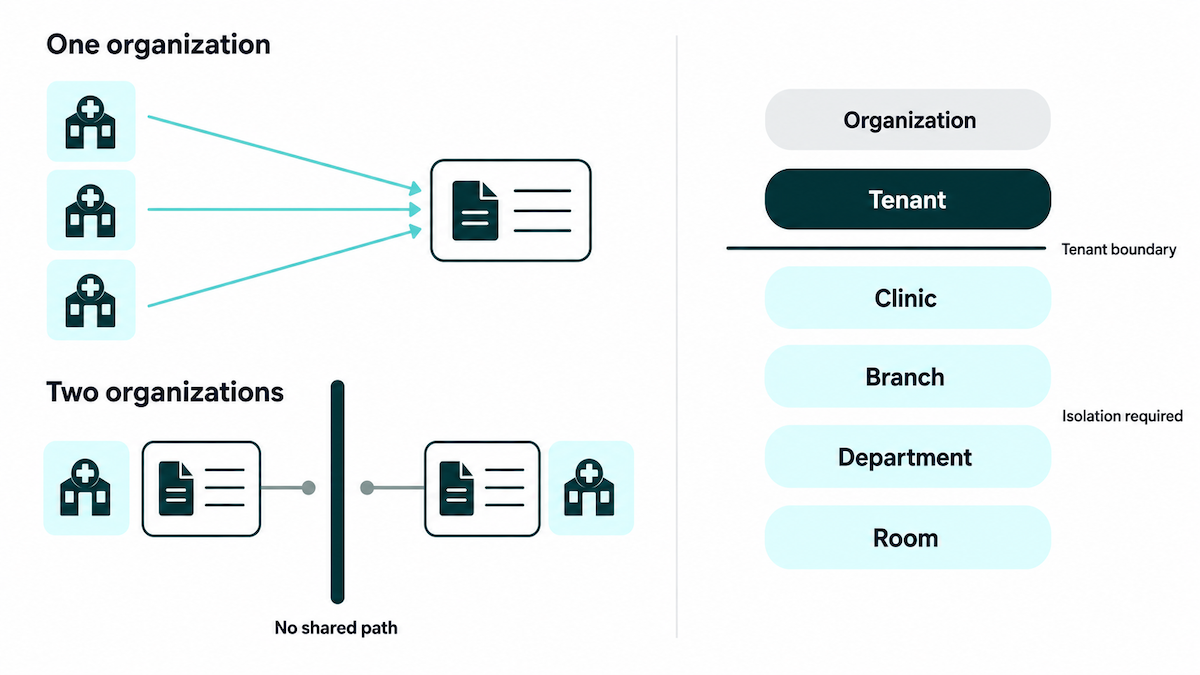
"Support more clinics" arrives in the roadmap as one line. It gets estimated as one line and built as one thing. The trouble is that "clinic" names a room inside one practice and an entire paying customer, and a roadmap line doesn't distinguish. Underneath it sit 2 different data models, and only one of them is a tenancy problem.
A clinic group adding a site wants one shared patient record across every location. A receptionist covering a shift at the other branch pulls up the same chart, with the same permissions, and never creates a second account. That build pushes data together.
A second provider organization needs data pushed apart. 2 independent practices run on your software and neither can see a row of the other's data. That's a multi-tenant EHR: many separate provider organizations on one multi-practice platform.
You can watch the confusion in the tooling. Off-the-shelf practice management software usually ships a multi-location workaround in place of a tenancy model, and it starts bending by site 3 or 4. Teams scoping a medical practice management app for a group practice tend to hit that ceiling on the way to building their own.
The ceiling is lower in healthcare than elsewhere because of what gets shared. A retail chain opening locations shares inventory logic. A healthcare chain shares patient records under HIPAA.
Most real platforms need both at once, so tenancy becomes a hierarchy rather than a flat list of tenants:
- organization
- tenant
- clinic
- branch
- department
- room
Pick which level in that chain never leaks and you've picked your tenant. Everything above it is org chart. At or below it, isolation is on you.
Pool, bridge, and silo: what each multi-tenant SaaS architecture costs you in healthcare
Pool, bridge, and silo are isolation strategies, and every backend implements them its own way. Whatever yours runs on, a multi-tenant SaaS architecture puts the tenant boundary at one of 3 depths.
What each model actually isolates
The naming comes from AWS, which lists them as silo, pool, and bridge.
- Pool. Every tenant shares the same tables, and a tenant identifier on every row keeps them apart. One shared schema.
- Bridge. Every tenant gets its own schema inside one database, each schema holding the same set of tables. Schema-per-tenant.
- Silo. Every tenant gets its own database. Database-per-tenant, nothing shared below the application.
Your backend may not offer that choice. Teams building a patient management platform on a managed backend often find it already made: Convex gives each project one main production deployment, so one deployment is one database.
The stage recommendation below assumes you get to pick where the boundary sits. When you don't, it moves up into the query layer and your model is pooled whether you chose it or not. Enforcement and testing carry the whole burden from there.
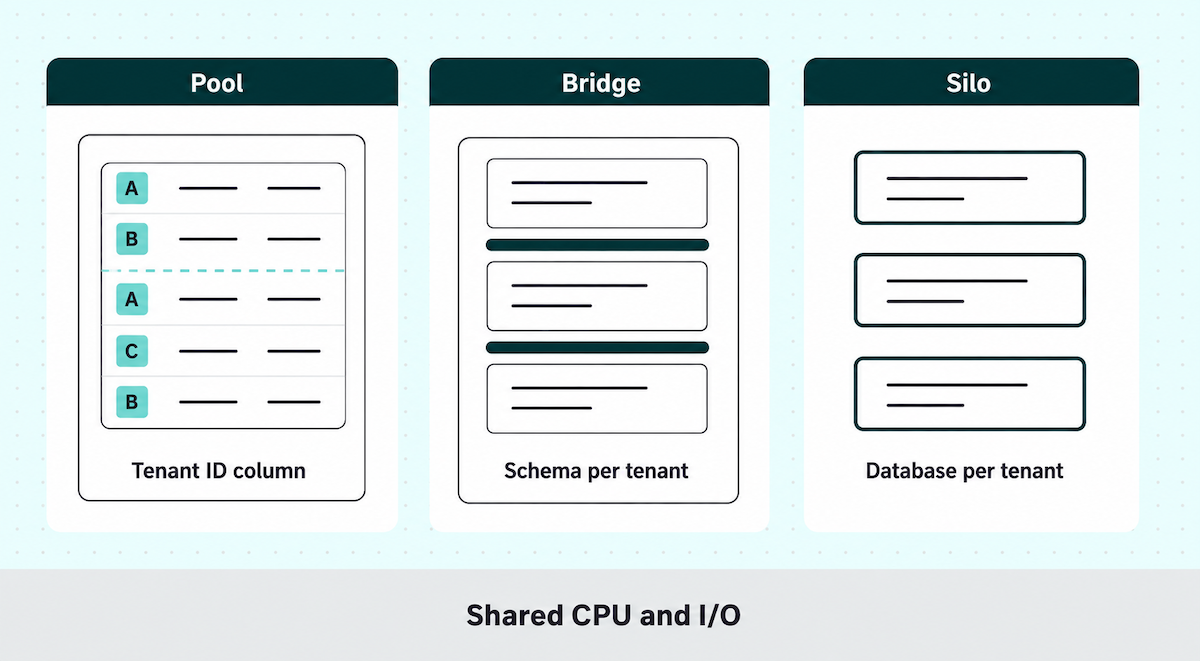
Isolation strength and performance isolation are different axes
Its own connection pooling, backup schedule, and migration run per tenant. Manageable around 20 tenants, an engineering project by 500.
The middle row is the recommendation. Schema per tenant is where a healthcare platform belongs from seed through Series A, and the reason is where the boundary sits: in the database, so a tenant's role has no path to another tenant's schema. You can say that to an auditor in a sentence instead of walking them through your query layer. That settles silo vs pool vs bridge multi-tenancy for a company holding PHI.
PlanetScale recommends shared-schema for general SaaS, and they're right that it's cheaper to operate and simpler to migrate.
Their scope is different. General SaaS is built to hold down operating cost, and the cheapest place for every tenant is one multi-tenant database. HIPAA evidence gets shorter as that boundary moves down a layer, and a healthcare platform answers for both.
Tenant tier belongs in the data model on day one
Tier has to be a first-class field a tenant can change. The alternative is finding out mid-negotiation that promoting one customer means a rewrite. That holds whether you're writing the migrations yourself or standing up a custom EHR system without coding.
Moving a tenant out of the shared schema and into its own database takes 4 moves:
- Provision the dedicated database and replicate the schema.
- Dual-write that tenant's writes to both stores while backfilling history.
- Reconcile row counts and checksums until they match exactly.
- Flip that tenant's routing, then decommission its rows from the shared tables.
That's what tenant provisioning has to be able to do, and it only works on a system that can already route one tenant on its own. Buy that part on day one.
A cross-tenant leak is a reportable breach, and your BAA already says so
The model you pick comes with obligations. A HIPAA multi-tenant architecture answers to the Security Rule and the Breach Notification Rule, and both have opinions about the boundary you just drew.
A cross-tenant disclosure is an impermissible disclosure
One tenant seeing another tenant's records is a disclosure of protected health information (PHI) to a party with no right to it. That makes multi-tenant PHI isolation a Privacy Rule question, and it makes a leak a reportable breach instead of a ticket you close quietly. OCR has treated that kind of exposure as an impermissible disclosure.
The contract puts the clock on you. A business associate agreement (BAA) binds you to the Breach Notification Rule's duty to tell each affected covered entity, and each of those organizations then has 60 days from your notice to run its own notifications.
That's the blast radius. One platform serving many covered entities turns one failure into a reportable breach at every one of those organizations at once. The chain runs upward too: every subprocessor you depend on carries the same obligation to you.
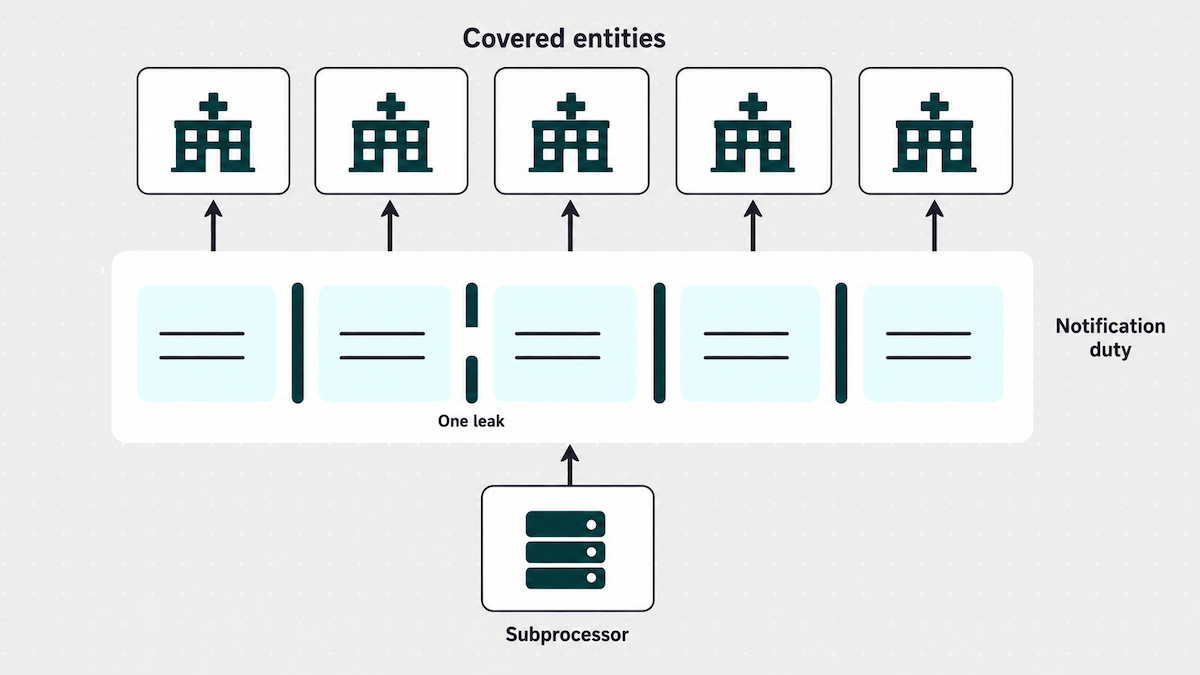
OCR Director Paula M. Stannard has said a business associate has to notify affected covered entities within 60 calendar days of discovery, because that timing is what lets each of them meet its own obligations. The calendar-year penalty cap for willful neglect not timely corrected is $2,190,294.
OCR made one vendor produce a client-by-client patient list
MMG Fusion, a Maryland company, sold practice management and patient communication software to oral healthcare providers as a business associate to hundreds of dental practices. An unauthorized actor reached its systems in December 2020 and accessed data on roughly 15 million individuals; OCR announced the settlement on March 5, 2026. The intrusion came from outside rather than from one tenant reading another's rows.
What matters for a tenancy model is the corrective action plan. MMG Fusion had to give OCR a comprehensive list of every affected client, then notify each affected covered entity along with a list of the identities of that client's patients whose ePHI was reasonably believed to be involved, to the extent that is possible. Among OCR's stated potential violations was failure to notify those clients at all.
Producing one organization's records, and only that organization's, on demand is a legal deliverable. That qualifier, to the extent that is possible, is what it looks like when a system can't.
Per-tenant evidence is an architecture requirement
2 separate required standards apply here:
- Audit controls, 45 CFR 164.312(b), for recording activity in systems that hold ePHI
- Review, 45 CFR 164.308(a)(1)(ii)(D), for regularly reviewing those records
An unread log satisfies one and fails the other.
Unique user identification at 45 CFR 164.312(a)(2)(i) reaches software processes and service accounts, so every application touching ePHI has to be identifiable on its own. Set that against a pooled model where the app holds one database connection: you can prove a query ran and not who ran it against whose record. Application code is the only place left to close the gap.
The trail has to resist tampering, which means an immutable audit log on write-once storage and restricted administrative access to the log itself. Convex logs function calls; field-level PHI access is yours to record.
The proposed Security Rule update would delete the addressable column
The HIPAA Security Rule update proposed in January 2025 would make network segmentation for ePHI systems explicit and delete the addressable-versus-required distinction at 45 CFR 164.306(d). It's still a proposal. The comment period closed in March 2025, more than 4,700 comments are under review, and the May 2026 target for a final rule came and went without publication.
The same proposal moves encryption and multi-factor authentication (MFA) into the required column. The rule names controls, and a reviewer expects implementations:
- encryption at rest (AES-256)
- encryption in transit (TLS 1.2/1.3)
A segmentation requirement that isn't final still shapes a decision you're making now, because the boundary you ship this quarter is the one you'll defend against it.
Row-level security won't carry tenant isolation by itself
Isolation gets enforced in layers, and each layer leaves something open for the next one. Authentication, authorization, and a database policy all take a turn at tenant isolation. HIPAA doesn't care which layer failed, only that the record moved.
A cross-tenant read can pass authentication and authorization
Tod Golding, Principal Partner Solutions Architect for AWS SaaS Factory, states the tenet directly: a user can be authenticated, authorized, and still reach another tenant's resources.
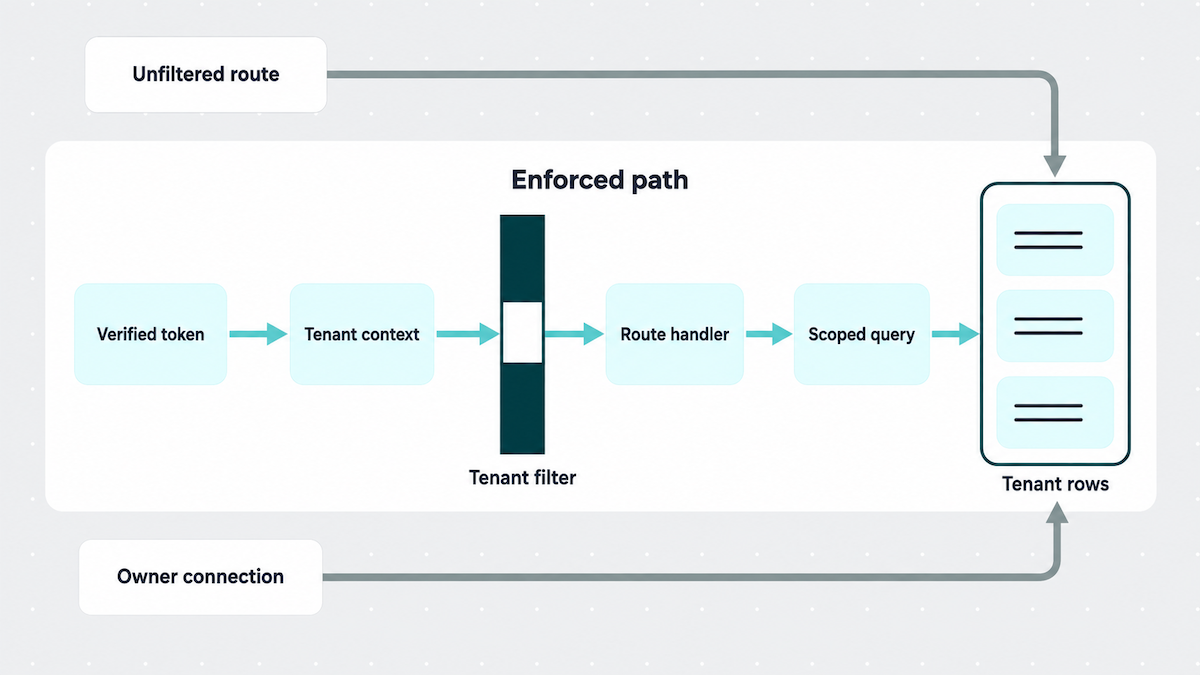
So the stack has 3 steps, in the order a request meets them. A verified JSON Web Token (JWT) arrives carrying a tenant claim, which is where secure authentication in healthcare apps hands off to isolation.
The tenant context gets resolved once from that claim, so the client has no way to influence which tenant a query runs against. That tenant ID then applies to every query the request makes, injected by middleware that runs ahead of every route handler. A route handler can't skip a filter it never had to call.
Middleware over a helper function, because a helper is something a developer has to remember to call, and the query written at 6pm before a demo is the one that forgets.
Role-based access control (RBAC) and least privilege sit alongside all of this, deciding what a caller may do once you know which tenant they're in. Neither decides which tenant.
Row-level security has 4 documented ways around it
PostgreSQL's own documentation lists 4 ways a row security policy doesn't apply, and every one of them is a configuration default.
Table owners
A table's owner isn't subject to that table's policies unless ALTER TABLE ... FORCE ROW LEVEL SECURITY is set, and plenty of applications connect as the owner.
Superusers and BYPASSRLS
Any role holding either always bypasses the system.
Referential integrity checks
These always bypass it too, and the documentation flags covert-channel leaks through them: in a shared table, a unique constraint on a patient email or record number will confirm whether that person exists in another tenant.
Whole-table operations
TRUNCATE and REFERENCES sit outside row security entirely.
PostgreSQL row-level security (RLS) earns its place as a backstop for data isolation, and it can't be the only thing standing between 2 tenants, because the conditions that switch it off are ordinary. Plenty of teams put the whole boundary on row-level security. Healthcare platforms that do are one connection string away from a cross-tenant read.
Existence is a disclosure your tests probably miss
Most isolation testing asks one question: did another tenant's data come back? The subtler failure is the system admitting that a record exists. In healthcare that's a disclosure on its own, because the existence of a treatment relationship is protected.
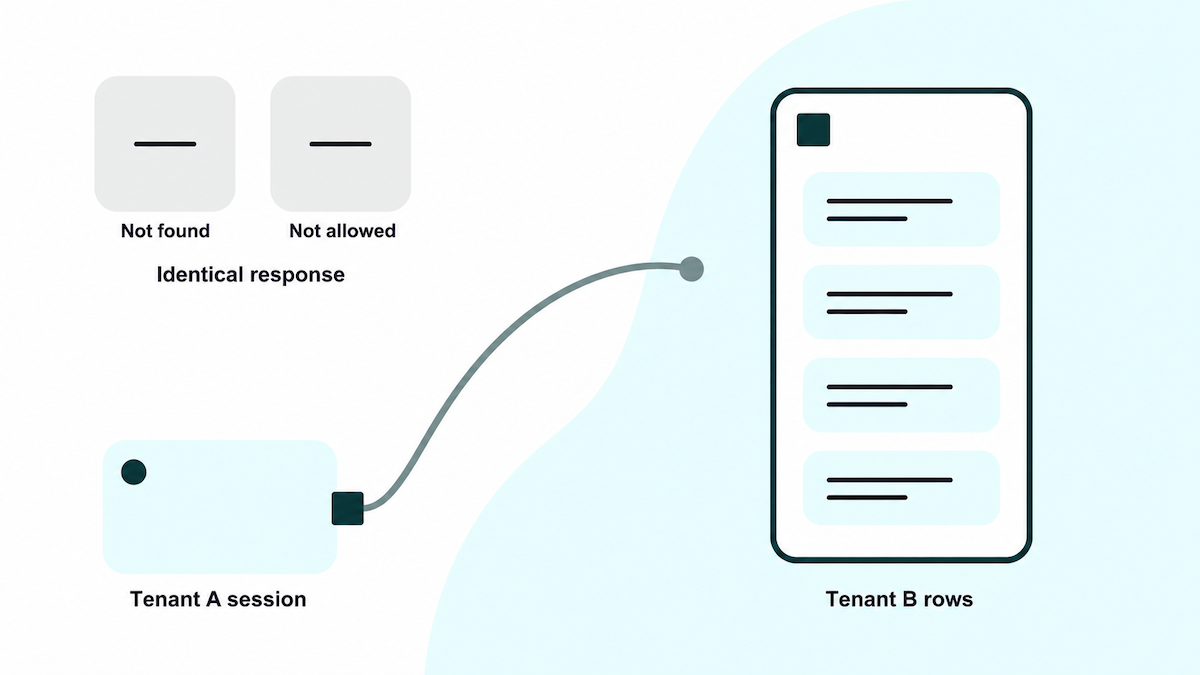
Return the identical error for a record that doesn't exist and for one the caller may not see. Two different responses tell the caller which is which.
MongoDB's engineering blog puts the document-store position plainly: the applications and services fetching data have to enforce that a tenant identifier is present in every query, because MongoDB's role-based access control runs at collection level and not per document. On Convex, one production deployment per project makes the query layer the only enforcement point.
On a document backend there's no database-layer policy to fall back on, so every guard above has to hold on its own. Which puts the weight on whether you've tested that it does, from a session that belongs to somebody else.
Run the cross-tenant authorization test before an enterprise security review does
A buyer is going to ask you to prove the isolation you just described. The proof is one test.
One test proves the boundary your tenancy model sells
Teams build the isolation, ship it, and never write the test that proves cross-tenant data can't leak. Every other test in the suite exercises a feature. This one exercises the boundary, which is the thing a tenancy model actually promises a customer.
The failure it catches is OWASP's top API risk, broken object level authorization (IDOR), listed as API1:2023 and holding the number one position on the OWASP API Security Top 10 since 2019.
The test itself is small. Authenticate as tenant A, send tenant B's object identifier, and confirm the response reveals nothing, with a missing record looking identical to a forbidden one. That needs 2 or more live tenant accounts, because testing each account alone never exercises the boundary between them.
Then run it against the surfaces that get skipped:
1. Background jobs and scheduled tasks
They run outside the request path that carries tenant context, which makes them the most commonly missed surface.
2. Admin and break-glass paths
Support tooling is built to see across tenants on purpose, so it needs its own authorization test instead of an exemption.
3. File and object storage
Documents and images get scoped by a URL or a key, not by the middleware that scopes the database.
4. Session tokens
Confirm a token issued for one tenant can't be replayed against another.
The same standard covers the property-level variant: API3:2023, Broken Object Property Level Authorization, absorbed the entries once listed separately as Excessive Data Exposure and mass assignment. For running the test, OWASP ZAP modifies object identifiers systematically across authenticated user contexts and runs in a pipeline.
An annual engagement tests the boundary once. A refactor 6 months later can drop the tenant filter on any Tuesday, and a test in CI is what notices.
What an enterprise security review asks to see
Your own engineering signs off on your multi-tenant architecture. Healthcare buyers then ask again, in a form you don't control, and the test above is the evidence they're asking for.
Procurement arrives as a named questionnaire: SIG, CAIQ, or VSA. A buyer-side review checks tenant separation, access control, compliance, and incident response, then asks for either a penetration test or your own evidence of separation.
Most penetration tests aren't scoped to answer the tenant-isolation question, so 4 things to ask a vendor before you sign:
- Does the methodology attempt cross-tenant access using 2 or more live accounts, instead of testing each account on its own?
- Does the report separate exploitable findings from theoretical ones?
- Does retesting confirm the same cross-tenant path is closed?
- Does the report satisfy customer security questionnaires and a SOC 2 auditor without a second engagement?
The questionnaire itself walks through penetration testing, SOC 2 Type II, HITRUST, single sign-on (SSO), and data residency, and you'll be asked about all of them.
Wire this into your healthcare app deployment checklist before the first enterprise conversation. All of it assumes you can read the code that enforces isolation, run a test against it, and change it when the test fails.
The multi-tenant problems that only show up at tenant 20
You pick a healthcare SaaS architecture before the first tenant is onboarded, and the bills for it arrive around tenant 20. Nothing in the decision surfaces them, because nothing at tenant 1 does.
Timeouts and per-tenant configuration are the same problem
One tenant's runaway query saturating shared resources is a config fix. At the database layer the levers are statement_timeout and idle_in_transaction_session_timeout. At the application layer it's a per-tier timeout, so a standard-plan tenant's query gets killed before it costs anyone else. Noisy neighbor, solved in config.
The fork is the harder one, and it always starts as a favor. One tenant needs a different intake flow, someone branches the component, and the branch outlives whoever agreed to it.
Tenant differences belong in data the system reads at runtime. On a healthcare platform the same cost shows up 3 ways:
- per-tenant configuration
- feature flags
- white-label branding
Fork any one of them into code and you've bought a maintenance cost that compounds with every tenant after it.
Restore one tenant, then check what your admin tools can see
Design the backup scheme so it can restore or delete a single tenant without touching the others. Point-in-time recovery and disaster recovery both get planned per tenant from then on.
The Security Rule update proposed in January 2025 would put 72-hour data restoration and a 48-hour recovery point on contingency planning.
The last cost is one you build yourself. Cross-tenant reporting exists to see every tenant at once, for support, for usage metering, and for cost attribution per tenant, which means your admin tooling deliberately walks around the isolation you just built.
So the boundary gets exactly one authorized exception, and it belongs to the tooling with the widest read access in the system. Design that exception on purpose, and log every query it runs.
Build vs. buy for a multi-tenant healthcare platform: the retrofit is the real price
The expensive part of a tenancy decision arrives later, on the day a buyer makes you move the boundary you already shipped. That's what build vs buy for a multi-tenant healthcare application is actually pricing.
6 months is only payable if the code is yours
AWS puts the scenario to ISV engineering leaders directly. You're 3 years into a successful multi-tenant deployment. A new enterprise prospect is ready to sign, and then its compliance team comes back asking for dedicated resources, tenant-level encryption, and a private audit log. Your team can build all of it, and they estimate 6 months. AWS's point is that an architecture with isolation and flexibility designed in from the start never pays that 6 months at all.
That estimate exists because the tenancy model lives in code you can read and change on a schedule you set, which is what full code ownership in healthcare buys you long before you need it. Per-tenant encryption keys are the usual mechanism behind a request like that one, and you can put that migration on next quarter's roadmap.
You can't hand a security review code you can't obtain
Bubble's documentation states that a Bubble app can only run on the Bubble platform, and there's no way to export the application as code. Customers own their data and their app's design; Bubble retains ownership of the underlying code that powers the app, a split the documentation compares to Microsoft owning Word without owning your documents. Moving off the platform means rebuilding the application logic.
The data itself does come with you. Bubble provides automatic CSV export of user-created data plus an API for scripted access.
An enterprise security review wants the code that scopes queries, the tests that prove the boundary holds, and a fix when a test fails. On a platform whose application logic you have no way to obtain, the deal that asks for those is one you can't close, and closing it later means custom healthcare software development from scratch.
Buying speed is a reasonable trade. Time to market is a real reason to make it, and plenty of good healthcare companies made it. The question is whether what you bought can produce evidence when a buyer asks, because that's when the trade gets settled.
How Specode can help
Isolation has to be provable from another tenant's session. One organization's access records have to come out on their own. A builder can answer both on day one.
Specode is a healthcare AI app builder. Its organization topology skill configures the structure the app gets built around: single provider, multi-provider, multi-clinic, or full multi-tenant. Every other healthcare skill builds on whichever one you pick, so the AI-generated healthcare app starts with the topology settled.
Audit logging goes in inline, at every PHI read and write surface you approve, with scalar-only metadata that never carries PHI values. That's what produces a list per client, which is what the MMG Fusion corrective action plan demanded.
The built-in HIPAA compliance agent scans the codebase on demand, and 4 of its categories are the ones a pooled tenancy model actually fails: role-based access control, API security including IDOR prevention, PHI exposure in UI and URLs, and audit logging. Auth-enabled apps also ship with example logins for each role, which is what the cross-tenant authorization test needs on day one.
You own the full source code under the terms of service, and it runs on your own backend under a BAA you sign. For procurement, that backend is SOC 2 Type II certified.
Answer both up front and a small team can build a multi-tenant healthcare app without a dev team standing up the foundation first. If you're about to build a healthcare SaaS platform serving more than one provider organization, schedule a demo and bring your tenancy question.
Frequently asked questions
One codebase serving separate provider organizations, with each organization's records invisible to the others. Different problem from one organization operating several sites.
Enforced isolation and per-tenant access records you can produce on demand are what decide it. All 3 models can pass, and all 3 can fail.
No rule requires it. It buys the shortest audit conversation and costs the most to operate, which is why it usually sells as a premium tier.
Table owners, privileged roles, and integrity checks all bypass row security policies, so RLS belongs in a layered design as one guard among several.
Show the code that scopes queries and the cross-tenant authorization tests running in CI. A penetration test has to be scoped to attempt cross-tenant access with 2 or more live accounts.
A builder that generates the HIPAA-ready foundation as exportable code gets you there. The constraint is producing isolation evidence later, which is why code ownership matters.