Healthcare Staffing App Development Guide

The shift feed is the easy part. Healthcare staffing app development gets hard everywhere else: proving a clinician's license is current on the day they walk onto a floor, deciding whether that clinician is your employee or an independent contractor, and moving money to them lawfully. Those three decisions constrain what the software is allowed to do, so they come before the marketplace interface.
This guide is scoped to US facilities and clinicians, and almost every requirement that matters varies by state: licensure, agency registration, biometric and location capture, pay frequency, and the classification test itself.
The route from here runs through how these platforms work, four operating models, the features across three surfaces, credential verification, payments and classification, the technology, monetization, the failure modes that kill these products, a seven-step build sequence, and how to estimate cost.
What does building a healthcare staffing app actually take?
Pick the operating model first, because it decides whether clinicians are contractors or employees, and the federal standard there is split. Then build credential verification as the product's core record rather than a document upload, since the sources you may lawfully use are limited. Ship one complete shift from posting to payment before scaling into jurisdictions whose rules you have read.
Key takeaways
- The classification decision comes before the product decision. The federal test is unsettled, and Minnesota requires a nursing agency to document that staff it places into health care facilities are employees, not contractors. That decision sets overtime exposure, reporting obligations, and available payment rails.
- Verification is the product a facility is actually buying. A facility carries liability for who works its floor, so it needs an exportable, timestamped record rather than an uploaded document.
- Filling shifts is not a clinical outcome claim. Staffing levels are associated with patient outcomes, but no evidence connects platform-sourced staffing to them. Market the operating benefit and leave the outcome claim alone.
Why build a healthcare staffing app?
The nursing shortage in most pitch decks is not the one in the federal data. The HRSA nurse workforce projections model a national registered nurse gap of 8% in 2028, narrowing to 3%, or 108,960 full-time equivalents, by 2038, with a much wider gap outside metro areas: 24% against 5% in 2028, also narrowing.
Those are model projections, not measurements: HRSA assumes historical attrition, graduation and participation hold constant.
Why separations, not growth, make demand recur
A narrowing national gap is a weak demand case. Churn is a better one. BLS projects about 180,800 registered nurse openings a year on average over 2025 to 2035, of which roughly 161,300 come from occupational separations rather than from the 194,700 jobs of growth across the decade. An opening is a projected hiring event, so a recurring position is counted every year. That is what makes shift-level demand recur.
The two nurse populations you cannot treat as one market
The two nurse populations move in opposite directions, so nurse staffing app development that treats them as one market will misprice both.
On the same HRSA model, projected licensed practical and vocational nurse supply meets 83% of demand in 2028 but only 70% in 2038, a shortfall of 245,950 full-time equivalents.
Who pays, and whether that spending holds
Then ask who pays. MedPAC reports hospital spending on direct patient-care contract labor fell by $8 billion in 2024, about 25% below 2023. Surge staffing budgets fall when the surge does.
Nursing staff turnover at the median skilled nursing facility ran 46% over 12 months in 2024, mostly nursing assistants, and improved from 49% in 2023, though a 2024 methodology change makes the two years not directly comparable. Do not assume this spending stays where it is.
How on-demand staffing platforms actually work
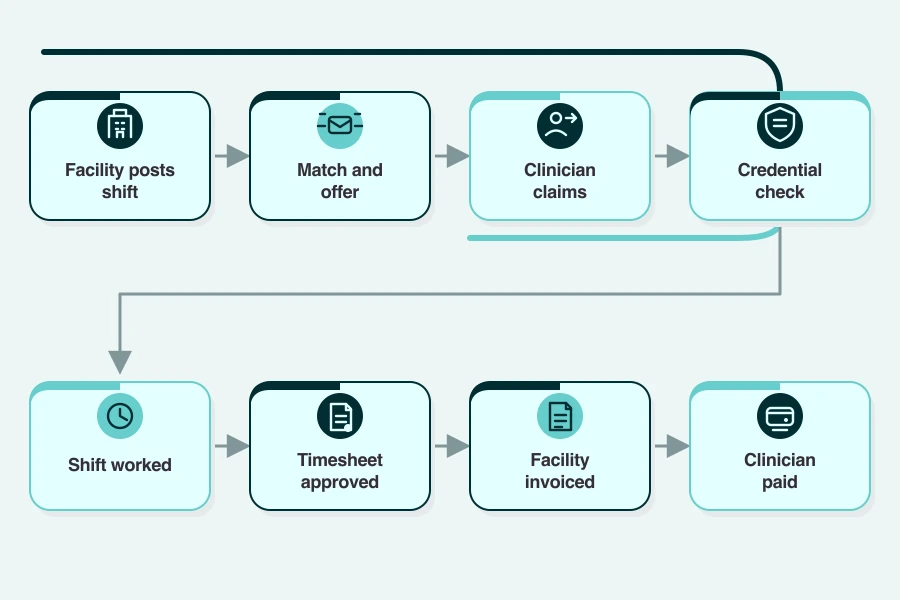
The transaction is one chain:
- a facility posts a shift
- the platform matches and offers it
- a clinician claims it
- a credential check gates the confirmation
- the shift is worked
- the timesheet is approved
- the facility is invoiced
- the clinician is paid
Break any link and you have a scheduling tool rather than a marketplace.
Scale alone will not make a market liquid
Liquidity is the hard problem in any two-sided marketplace, and healthcare staffing marketplace development inherits a version that scale alone does not solve. The best evidence comes from outside healthcare: in TaskRabbit data covering 2010 to 2014 across 18 US cities, doubling buyers and sellers only doubled matches, with no network effect in matching.
Efficiency instead tracked how close the two sides lived and how standardized the requests were, though the authors read their estimates as associations. That is gig economy evidence borrowed by analogy, not nursing evidence, and it makes shift standardization a design lever.
What your architecture decides about urgent shifts
Architecture decides which demand you can serve at all. On a Swiss per-diem platform where nurses post availability and institutions book it, the median lead time between booking and shift was 24.1 days. Only around 15% of bookings fell inside seven days, because a facility cannot post an urgent vacancy there for nurses to claim.
So measure fill rate, not registered supply. NCSBN's 2024 survey carries three numbers worth separating:
- 17.8% of actively employed registered nurses hold more than one nursing position, which is self-reported status rather than appetite for app-based per-diem work
- the share identifying as travel nurses fell from 6.2% in 2022 to 5.3% in 2024
- the practical and vocational nurse travel share rose from 4.7 to 7.1% over the same two years
Matching facilities and clinicians inside one metro is the job; counting licensed bodies nationally is not.
Four operating models, and why you pick one first
Four archetypes show up here, and they differ less in software than in who pays, who employs the clinician and what breaks first. The same product gets sold as a per diem nursing app or a PRN staffing app depending on the buyer, so start from the model, not the label.
The surfaces will look familiar if you have scoped doctor on-demand app development or a home health care app; the models below are where an on-demand nurse staffing platform diverges.
Operator names in the table are self-descriptions, not an industry norm, and none settles classification. Who you sell to changes the company you become: AMN reports approximately 48% of its 2025 consolidated revenue through managed services, its own mix rather than a market share. Float pool evidence is thin in both directions.
Core features across three surfaces
Three surfaces, three jobs:
- The facility app posts shifts and approves the timesheets that come back.
- The clinician app handles shift matching against license, role, distance and availability, then claiming.
- The admin console is where a human resolves what the other two cannot, and it belongs in the first release: early on, a person resolves every exception by hand.
It is tempting to build a healthcare staffing app the way you would a shift scheduling app, then bolt payment on at the end. If you have shopped for HIPAA-compliant scheduling software, you know the calendar is the easy half.
What federal law requires you to record
Hours records are a federal obligation: 29 CFR 516.2 requires records of hours worked each workday and each workweek. The Wage and Hour Division's bulletin at 29 CFR 785.48 accepts rounding start and stop times to the nearest 5 minutes or quarter hour, provided the practice does not over time underpay for hours worked.
That is an enforcement posture, not a legal permission. It binds no court and no private plaintiff, and state wage and hour law can exceed this federal floor.
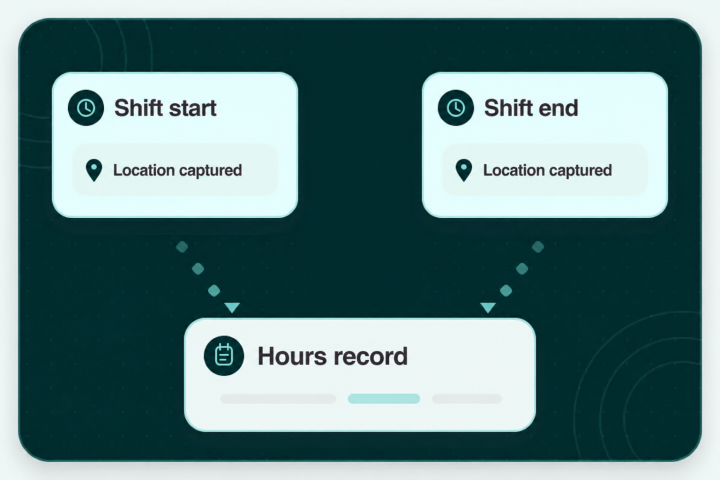
GPS clock-in is narrower than it sounds. Capturing location once at clock-in and once at clock-out is a different product, and a different permission posture, than following a clinician through a shift; geofencing at the door is not continuous monitoring.
State law decides how much of either design you can ship:
- Illinois bars obtaining a biometric identifier, such as a fingerprint or face scan, without prior written notice of purpose and term plus a written release
- Texas requires notice and consent before capturing one commercially, enforced by the attorney general at up to $25,000 per violation
- California treats precise geolocation, a radius of 1,850 feet or less, as sensitive personal information; its employee and contractor exemption ended January 1, 2023
- Connecticut requires prior written notice of electronic monitoring, satisfied by a conspicuously posted notice
Four states, four designs, and none of this is legal advice about yours.
What happens when a claimed shift is dropped
A dropped claim is a product problem before it is an operations one. Three things belong across the surfaces on day one:
- a cancellation window with a consequence
- a backfill path that re-offers the claim immediately
- a reliability signal on the clinician record
Your ratings and reviews surface is that signal: show cancellation history, not star sentiment.
Credential verification and compliance
Start from who is on the hook. Under the Medicare hospital Conditions of Participation, a hospital's nursing service must have a procedure ensuring that personnel for whom licensure is required hold valid and current licensure.
That duty binds the hospital, not you. What it buys from you is an exportable record, never a claim of compliance, which is why credential verification comes first in healthcare staffing software development.
Why the free license lookup cannot build your record
Nursys is a primary source equivalent database agreed with the participating boards of nursing, and its free QuickConfirm lookup is the obvious place to start license verification. But it publishes no API, and its terms bar automated extraction or copying data for a third party's use. Its only documented API, e-Notify, returns just the nurses already on an institution's own list. Your client facilities are third parties, so verification is a first-release design constraint, not a later integration.
Coverage is uneven too. Some boards do not participate for Advanced Practice, California, New York and Pennsylvania among them, and each board feeds Nursys on its own schedule.
Where a nurse has to be licensed to take the shift
Licensure follows the patient. The Nurse Licensure Compact covers registered and practical or vocational nurse licenses in most states, but not advanced practice authority, so those roles need licensure in every state of practice.
What exclusion screening actually requires
OIG sets no statutory or regulatory frequency for checking the List of Excluded Individuals and Entities, but recommends monthly screening because the list updates monthly. A hospital using agency nurses carries overpayment liability and may face penalty liability. Outsourcing does not move that duty, and OIG advises documenting every search.
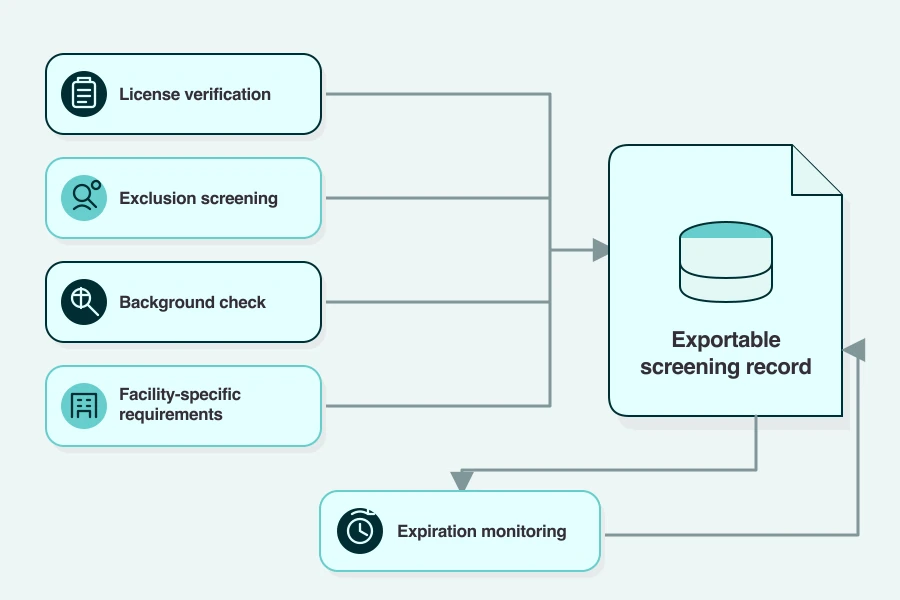
Background checks add a fixed sequence to onboarding whenever a consumer reporting agency supplies the report:
- a stand-alone written disclosure
- authorization before the report is obtained
- the report plus the CFPB summary of rights before adverse action
- an adverse action notice
State and local fair chance laws add to that federal floor..
When the agency itself needs a license
Joint Commission certification is voluntary. State registration is not:
- Minnesota requires annual registration of a supplemental nursing services agency, with a fee per location
- Oregon licenses temporary staffing agencies through its Health Licensing Office
- Illinois licenses nurse agencies through its Department of Labor
Registering in one state satisfies nothing in another. And separate law from contract: a facility can demand a screening cadence no statute imposes, and you owe both.
Payments, payroll, and worker classification
Worker classification gates the money path, and the federal ground is moving: as of September 10, 2026 the Department of Labor has not replaced its 2024 contractor rule, so investigators and the courts apply different standards. Legal tests decide the 1099 vs W2 answer, not preference, so take it to employment counsel before anyone writes payout code.
Where state law overrides the federal answer
California presumes a worker is an employee unless the hiring entity proves all three ABC conditions. Minnesota requires nursing agencies to document that staff placed in health care facilities are employees.
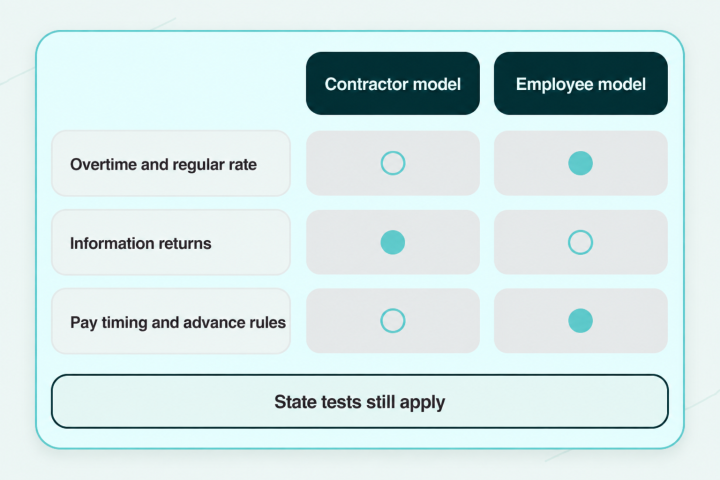
How classification changes what you file and what you pay
For 2026 payments you file Form 1099-NEC above $2,000, up from $600, and Form 1099-K only above both $20,000 and 200 transactions. Employing clinicians also changes the payroll arithmetic: 207(j) allows a 14-day work period with overtime beyond 8 hours a day and 80 in the period, and shift differentials count in the regular rate. None of it touches a correctly classified contractor.
Who has to be licensed before the money moves
Same-day pay is its own licensing question:
- New York requires manual workers to be paid weekly
- Maryland treats earned wage access as a loan needing a license
- Indiana requires a separate license a money transmitter license does not cover
Develop a healthcare staffing app that pays clinicians directly and you are in money transmission. Stripe's licensing does not transfer to you, its Instant Payouts cost 1%, and its $600 Connect rule is a product setting, not a tax threshold.
Payout speed is a balance-sheet decision: pay before the facility settles and you finance the gap. If protected health information touches this flow, HIPAA-compliant payment processing is a separate question.
Key technologies for healthcare staffing app development
What FHIR gives you, and what it does not
Do not invent the workforce data model. HL7 FHIR R4 already covers it:
- Practitioner represents individuals engaged in healthcare with formal responsibility and holds credentials in Practitioner.qualification, with code, validity period and issuer;
- PractitionerRole records the roles a practitioner is authorized to perform for an organization;
- Schedule and Slot model bookable time and the units inside it.
Borrowing those shapes for on-demand staffing platform development saves a data-model argument and nothing more: only the qualification code is required, so the standard forces no expiry date and no issuer, and supplies no credential data. R4 is Trial Use, superseded by R5.
Why a shift offer cannot depend on a push arriving
Push notifications are best effort, which matters when the offer is time-critical. Apple defines three APNs priority values, from immediate at 10 down to lowest at 1, and treats background notifications as low priority: no delivery guarantee, possible throttling.
Firebase calls high priority an attempt rather than a guarantee, and deprioritizes high-priority messages that produce no user-facing notification. Build the offer flow so a missed push costs nothing.
What asking for background location costs you
Ask for background location and you enter store review, not just a permission dialog. Google Play allows it only where it gives a significant benefit relevant to core functionality, and requires an approved permissions declaration; without one, the app can be removed.
Google counts convenience among the minimal justifications. On Android 11 and higher the system dialog offers no always-allow option.
Whether HIPAA obligations attach to you at all
HIPAA compliance is a conclusion you reach, not an assumption you start with. Obligations attach only to covered entities and business associates, and that turns on whether you create, receive, maintain or transmit protected health information on a covered entity's behalf.
Where that usually leaves a staffing platform:
- employment records a covered entity holds as employer are excluded, and HHS set a purpose test rather than defining the term
- licenses and timesheets therefore sit outside protected health information, a message about a patient may not
- your cloud provider is a business associate if it maintains that information, even holding only encrypted data without the key
Reach the conclusion with counsel, and again when the data flow changes.
Monetization follows from who sets the price
The revenue mechanic follows from who controls the shift price. Nursa has facilities approve it before each shift posts, so the platform earns around a price it does not set. ShiftKey has professionals bid their own rates, putting the platform between two prices.
Enterprise deals change it again. AMN reports roughly 48% of its own 2025 revenue through managed services, not an industry share, and ShiftMed sells health systems a no-conversion-fee float pool. Those are operators describing themselves, not a closed set.
Part of what you pay the supply side is flexibility. A study of Uber drivers estimated they earn more than twice the surplus of a less flexible arrangement, modeled rather than observed, and in ride-hailing rather than nursing.
The failure modes that actually kill these platforms
Why a better match makes leakage more likely
Disintermediation is structural here. A randomized experiment on a large online freelance marketplace found that showing freelancer satisfaction scores raised trust and raised leakage among high-scoring freelancers, offsetting the gains from better hires. That is remote knowledge work measured indirectly, so it transfers as analogy. Once a facility and a clinician have worked together twice, your fee is the only thing between them.
Why market selection is part of the build
Thin liquidity kills quietly. Density and standardization, not raw scale, tracked efficient matching in the earlier marketplace study, so a platform spread across five states can fill fewer shifts than one owning one metro. The general healthcare marketplace development playbook carries over, with one addition: anyone working out how to build a nurse staffing app should treat market selection as part of the build.
What happens when the auditor asks who was licensed
A verification record you cannot produce on demand is a commercial failure before it is a compliance one: when a facility's auditor asks who was licensed on a date, a folder of uploaded PDFs costs you the renewal.
The patient-outcome claim you cannot make
The last is a temptation. Staffing levels are associated with patient outcomes: in 168 Pennsylvania hospitals and in 300 European hospitals, each additional patient per nurse was associated with a 7% increase in the odds of surgical patients dying within 30 days.
AHRQ's 2007 evidence report found the same direction while calling the association not necessarily causal, and its April 2025 rapid review found no eligible randomized trials.
A 2026 review of gig nursing across three countries adds that studies are too limited to separate platform-mediated staffing from temporary staffing generally. No evidence connects a filled shift to a better outcome, so do not claim or imply that your platform improves patient care.
How to build a healthcare staffing app in seven steps
The order below is a dependency order rather than a convenience one. Each step produces the decision the next step needs, which is why two legal questions sit ahead of any code. Skip one and you will rebuild whatever you skipped.
Step 1. Choose the operating model and the side you serve first.
Everything downstream forks here. An open marketplace, an internal float pool, contract placement and a talent marketplace ask different classification questions, carry different compliance surfaces and earn money differently. Commit to one, then commit to which side you make liquid first, because that choice follows from the model rather than from which side is easier to sell.
Step 2. Fix the jurisdictions and clinician types you will launch in.
Name the roles, not only the states. License verification coverage, compact status and agency registration all vary by jurisdiction, so a national launch multiplies your compliance surface before it multiplies revenue. Advanced practice roles carry rules that registered and practical nurses do not, so scope them in deliberately or leave them out deliberately.
Step 3. Design the credential record before the shift feed.
Model the record first. Its sources, timestamps and expiry fields have to exist before the feed is built, because the feed reads eligibility from that record rather than from a folder of documents. This is also where you settle which verification sources you may lawfully use, since that decides what the record is allowed to contain.
Step 4. Settle classification and money movement with counsel.
Classification comes before payout code. The answer decides what the payment architecture is allowed to do: which returns you file, whether overtime arithmetic applies at all, and which payment rails are open to you. Employment and payments counsel own this decision, and the build waits on their answer instead of guessing and refactoring later.
Step 5. Build the thinnest complete shift, end to end.
Ship one shift that travels the whole path: posted, matched, claimed, verified, worked, clocked out, approved, invoiced, paid. A break anywhere in that chain breaks the product, so breadth of features buys nothing until the chain closes. The operator tooling ships inside that first complete shift, because someone has to unstick it when it stalls.
Step 6. Pilot with one facility and measure fill, not signups.
One facility, real shifts, real exceptions. Instrument fill rate, cancellation and repeat booking; clinician signups are a vanity number that will make a failing pilot look healthy. A pilot is also the only way to reach the exception paths that a demo never touches, a failed verification or a disputed timesheet.
Step 7. Expand by adding density around a working market.
Add depth around a market that works before adding new ones. The marketplace study from earlier applies as analogy rather than nurse staffing evidence: match efficiency tracked geographic density and how standardized the request was, which argues for depth over thin coverage. Every new state also reopens licensure, agency registration and classification from the top.
What it costs, and how to estimate it honestly
What a traditional build costs
Built the traditional way, a staffing platform of this shape runs roughly $30,000 to $150,000. Where you land inside that range is mostly scale: how many jurisdictions, how many clinician types, and how much of the verification and payout path you integrate rather than handle by hand. Treat it as a planning figure, not a quotation.
What the same build costs on Specode
AI development changes the arithmetic. The same application is very likely to come in at $6,000 to $10,000, including a few months of a $1,000 per month Pro subscription and nothing else. That is a likely outcome rather than a fixed price, it carries no timeline or feature guarantee, and it does not cover the clinical, legal, privacy and security work you still own.
What recurs on every shift
Anyone asking how to build a healthcare staffing platform for a single number is missing the half that never stops.
On September 10, 2026, Checkr listed self-serve background checks at $29.99, $59.99 and $94.99 per report plus at-cost passthrough court, DMV and database fees; Twilio listed US SMS from 0.83 cents a message plus carrier fees; Firebase's Cloud Messaging was free and Apple's Developer Program $99 a year; Nursys lookups were free; Minnesota's agency registration was $2,442 per location; and Stripe charged platforms 1% for Instant Payouts. Every figure is a list price from one day; recheck them.
How Specode can help
Specode is an AI-powered healthcare application builder. It accepts plain-English app requirements and lets you define the application's UI, workflows, data model, permissions and integrations.
It builds responsive web applications, and one prompt does not produce a production-ready or legally compliant system; clinical, legal, privacy, security, product and operating owners are still required.
Most of this article is a list of requirements to bring to that conversation:
- Shift posting, claiming and approval across facility, clinician and admin roles
- Credential records carrying sources, timestamps and expiry
- Role-based permissions separating the three surfaces
- Timesheet approval feeding a payout integration
Those are requirements to define, not prebuilt staffing modules.
From the Compliance Center, Specode's HIPAA Agent scans the code and reports findings across eleven categories, separating must-fix issues from recommended hardening. You can send a finding to the AI coder to change the code, then re-run the scan.
The scan does not make an application HIPAA compliant and does not replace a risk analysis, an audit, or legal, privacy or security review. Before an application goes to production, a member of the Specode team also reviews it for security and HIPAA readiness.
If you want to create a healthcare staffing app, bring the three decisions this guide keeps returning to: operating model, launch jurisdictions, classification answer. Talk to Specode about your staffing platform.
Frequently asked questions
Facilities post open shifts, and verified clinicians claim them or are matched to them. The platform does the work in between: credential verification, time capture at clock-in and clock-out, timesheet approval, and payment to the clinician.
Hospitals need a procedure ensuring valid, current licensure under Medicare conditions of participation; providers billing federal health care programs carry exclusion exposure; staffing agencies register under state law. The platform only produces evidence, and the rules vary by state.
Tests decide this, not preference. The federal standard is currently split. California presumes employment unless the hiring entity rebuts its ABC test, and Minnesota requires nursing agencies to document that staff placed into health care facilities are employees.
It follows from who sets the shift price. Operators publish different answers: Nursa has facilities approve the shift price, ShiftKey has professionals bid their own rates, and AMN reports about half its 2025 revenue through managed services relationships.
This guide prints no timeline, because no source meeting its evidence standard publishes one. Your schedule is set by how long license verification integration takes and how long the classification decision takes.