
Medicine Delivery App Development Guide for 2026

Updated: September 2026.
Medicine delivery app development got harder and more interesting since this guide first ran. FDA ended the compounded GLP-1 era, Amazon put same-day prescription delivery on track for nearly 4,500 cities and towns, CVS shut another 221 stores, and the Drug Supply Chain Security Act got teeth for everyone but the smallest pharmacies.
The prize hasn't shrunk. US pharmacies dispensed $751 billion of prescriptions in 2025, and only about 12% of maintenance medications reach commercially insured patients by home delivery. That gap is what you're building into.
A medicine delivery app in 2026 has to carry the features patients and pharmacists expect, handle a GLP-1 channel that rewrote direct-to-consumer economics, clear three compliance regimes (HIPAA, DSCSA and e-prescribing) that decide whether you can operate at all, and do it at a cost that depends on how much of the plumbing you buy.
We build healthcare apps for a living, so the last section is about how we'd do it. Everything before it is the guide.
How do you build a medicine delivery app in 2026?
The short version of how to build a medicine delivery app: pair a licensed pharmacy (a partner, or your own license in every state you ship to) with e-prescribing through a Surescripts-certified pharmacy system, couriers that handle ID checks and cold chain, a payment processor that will board a pharmacy, and a compliance stack covering HIPAA and DSCSA product tracing, plus DEA's rules if you ship controlled substances. Industry estimates put a from-scratch build at $40,000 to $80,000 for an MVP and $80,000 to $150,000 for a mid-complexity app over 3 to 9 months; a prototype on an AI healthcare builder like Specode fits inside a month.
Key takeaways
- Compliance decides whether you can operate; features decide whether anyone uses you. HIPAA covers the data, DSCSA the drug from manufacturer to pharmacy, DEA and CMS the prescription. The pharmacy is the regulated party; a routing app that never owns the product inherits its partner's license footprint.
- Budget for the market rate, then decide how much of it you actually need to spend. 2026 benchmarks put a mid-complexity healthcare app at $80,000 to $150,000. A working prototype on Specode fits inside one month of a $1,000 Pro subscription and a releasable MVP inside 2 to 3 months, 30 to 60% faster than a traditional custom build.
- GLP-1s moved the demand curve. 12% of US adults are on one and the manufacturers now sell direct with home delivery. Cold-chain handling went from a niche feature to a baseline requirement.
The growing demand for medicine delivery apps
Four forces drive demand in 2026: a drug class refilled monthly, retailers racing on same-day delivery, patients who rate mail order above the counter, and a shrinking retail pharmacy network.
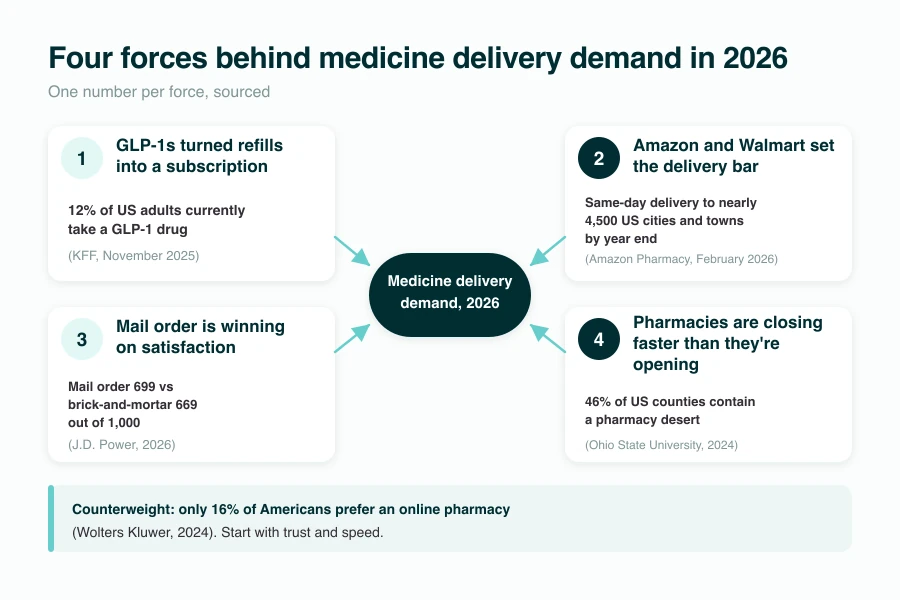
GLP-1s turned refills into a subscription
KFF's November 2025 poll found 12% of US adults currently taking a GLP-1 drug. They refill monthly, and a growing share never see a counter: Lilly said 35% of new Zepbound prescriptions in Q2 2025 were filled through LillyDirect, its home-delivery channel.
The GLP-1 section below covers what that does to your product.
Amazon and Walmart set the delivery bar
Walmart took same-day pharmacy delivery to 49 states in January 2025. Amazon Pharmacy said in February 2026 that same-day delivery would reach nearly 4,500 US cities and towns by year end. Patients who've had a prescription arrive in hours will judge your app by that.
Mail order is winning on satisfaction
In J.D. Power's 2026 U.S. Pharmacy Study, as reported by Pharmaceutical Commerce, mail-order pharmacies scored 699 out of 1,000 while brick-and-mortar pharmacies slipped 7 points to 669. UnitedHealth Group estimates only about 12% of maintenance medications for commercially insured adults are filled through home delivery (2024).
Pharmacies are closing faster than they're opening
CVS closed roughly 900 stores between 2022 and 2024 and 221 more in 2025; Walgreens announced about 1,200 closures over three years in October 2024.
Some 46% of US counties contain a pharmacy desert, an area with no retail pharmacy within 10 miles (Ohio State University, 2024). The effects show up as demand for delivering medicine to doorsteps that used to have a pharmacy around the corner.
One counterweight: only 16% of Americans told a 2024 Wolters Kluwer survey they prefer an online pharmacy, while 59% worried about losing access as pharmacies close. Start with trust and speed; that's what you compete on.
Every build hits the same five walls
Whatever the pharmacy model, online medicine delivery app development runs into the same five:
- state-by-state pharmacy licensing
- e-prescribing connectivity
- payment processors that treat pharmaceutical sales as a restricted category
- cold-chain logistics for refrigerated drugs
- an accessibility bar set by elderly patients on five or more medications
The rest of this guide takes each of them on.
Learn more about digital health in pharma for the manufacturer side of this shift.
Medicine delivery market overview
Medicine delivery app development services get pitched with a market number attached. Here's the one we stand behind.
One market figure, sourced
Fortune Business Insights (updated August 2026) values the global ePharmacy market at $150.7 billion in 2025 and projects $733.38 billion by 2034, a 19.4% CAGR. Other 2026 forecasts start lower and point the same way.
The US number that matters more to you is dispensing revenue: $751 billion in 2025, up 10% year over year (Drug Channels Institute, 2026). Behind it sit more than 7 billion prescriptions filled in 2024 (IQVIA, 2025). Every one of those fills is a delivery you could be routing.
Six key players in medicine delivery, plus the savings layer
The names worth studying:
- Amazon Pharmacy: same-day delivery slated for nearly 4,500 cities and towns by the end of 2026.
- CVS Pharmacy: roughly 9,000 locations and delivery in as little as an hour.
- Walmart Pharmacy: same-day delivery from about 4,600 pharmacies in 49 states, controlled and refrigerated drugs excluded.
- Capsule: free same-day courier delivery in a limited set of US cities.
- Mark Cuban Cost Plus Drugs: mail order at cost plus a flat 15% markup, mostly cash-pay.
- Hims & Hers: subscription prescriptions shipped to the door, nearly 2.9 million subscribers as of mid-2026.
GoodRx is the savings layer, with 5.3 million monthly active consumers in Q4 2025 (GoodRx, 2026); the pharmacy still fills the script.
The PBMs sit between you and the payment
CVS Caremark (CVS Health), Express Scripts (Cigna) and Optum Rx (UnitedHealth Group) processed 80% of US equivalent prescription claims in 2025 (Drug Channels Institute, 2026), and each parent owns an insurer and mail and specialty pharmacies. So the PBM adjudicating your claim may be competing with you for the fill.
Where a new entrant fits
Customers have gaps the big chains don't fill, and so do hospitals and clinics:
- specialty and chronic-care solutions for one condition
- a medicine ordering app for a regional health system's discharge patients
- delivery into a pharmacy desert, more than 10 miles from the nearest counter
- a GLP-1 program with the cold-chain handling Walmart's same-day service excludes
The health app development playbook applies: pick a niche a chain can't serve profitably, and partner with the pharmacy that already holds the license.
Must-have features for medicine delivery apps
Medicine delivery application development services sell the same feature list. Ours adds two they leave out: e-prescribing that reaches a real pharmacy, and an insurance eligibility check against the PBM.
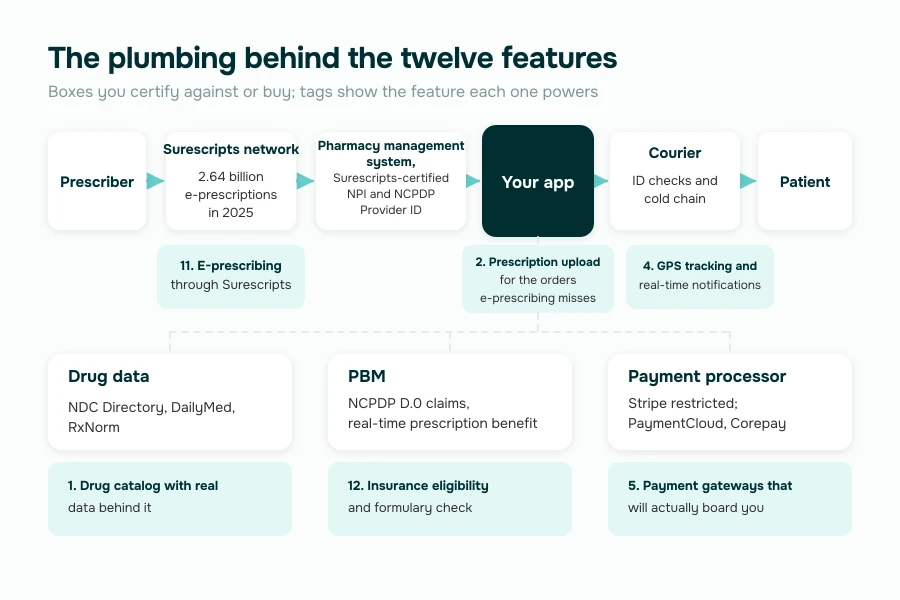
1. Drug catalog with real data behind it
A searchable drug catalog runs on three federal datasets:
- FDA's National Drug Code Directory for product identity
- NLM's DailyMed for labeling (active ingredients, dosage and side effects)
- RxNorm for naming
2. Prescription upload for the orders e-prescribing misses
Photo or PDF upload, plus an AI verification step behind a pharmacist. Read feature 11 before you over-invest: for most orders the e-prescription arrives on its own.
3. Patient profiles with caregiver access
Allergies, conditions, medications and insurance in one profile, plus a caregiver role that manages orders for a dependent.
4. GPS tracking and real-time notifications
Real-time order status with live GPS tracking and route planning for the courier. Add photo or signature proof of delivery; a pharmacy order can't be left on a doorstep like a grocery bag.
5. Payment gateways that will actually board you
The payment gateways behind cards and benefit cards are where pharmacy apps get stuck. Stripe's restricted-business list names online pharmacies, card-not-present prescription products, prescription delivery services and telehealth; approval is case by case, and BAA-signing processors such as PaymentCloud and Corepay are the alternative.
FSA and HRA cards need substantiation: under IRS Notice 2008-104 a pharmacy merchant either runs an IIAS or registers under the SIGIS 90% rule.
Build against PCI DSS v4.0.1 and tokenize at the gateway. And keep every diagnosis, drug name and visit reason out of the transaction record, whatever processor you use.
6. Medication reminders and dosage alerts
CDC estimates one in five new prescriptions is never filled and about half of those filled are taken incorrectly, costing $100 billion to $300 billion a year (CDC MMWR, 2017). Dose-time reminders and refill nudges are the medication adherence tools that move that number.
7. Support for elderly users
Elderly care app development rules apply in full: large type, voice input, one-tap reorder, a phone line, and the caregiver role from feature 3. The elderly patient on five medications is your best customer and least forgiving one.
8. Security features patients never see
MFA, role-based access, encryption in transit and at rest, and audit trails on every PHI read and write. The compliance section covers the rest.
9. Support and chatbots with a pharmacist behind them
A bot for order questions, a pharmacist line for clinical ones. Amazon Pharmacy pre-checks prescriptions with generative AI and a pharmacist signs off (Amazon, 2024). Copy that split. Use our healthcare AI agents guide to scope the bot's permitted actions and escalation to staff.
10. Multi-language support
Localized content and voice prompts in your delivery zone's languages, plus a pharmacist who counsels in them.
11. E-prescribing through Surescripts
For most orders the prescription arrives at a licensed pharmacy over Surescripts, which carried 2.64 billion e-prescriptions in 2025 (Surescripts Annual Impact Report, March 2026). Either integrate with the pharmacy's management system or take your own software through Surescripts certification.
The pharmacy also needs an NPI and an NCPDP Provider ID, the seven-digit number a prescriber's software routes to.
12. Insurance eligibility and formulary check before the patient pays
Coverage runs through the PBM twice: claim adjudication over NCPDP Telecommunication Standard D.0, and a real-time prescription benefit request at prescribing that returns out-of-pocket cost and formulary status (Surescripts). Show that price before the patient confirms, with the cash alternative beside it.
The GLP-1 opportunity
Medication delivery app development in 2026 has a demand driver the 2025 version of this guide didn't have. GLP-1s added $14 billion to US net medicine spending growth in 2025, $9.6 billion of it from obesity products (IQVIA, April 2026).
Lilly booked $22.97 billion for Mounjaro and $13.54 billion for Zepbound in 2025. These are chronic, monthly-refill GLP-1 medications that ship cold, which is a delivery app's whole use case in one drug class.
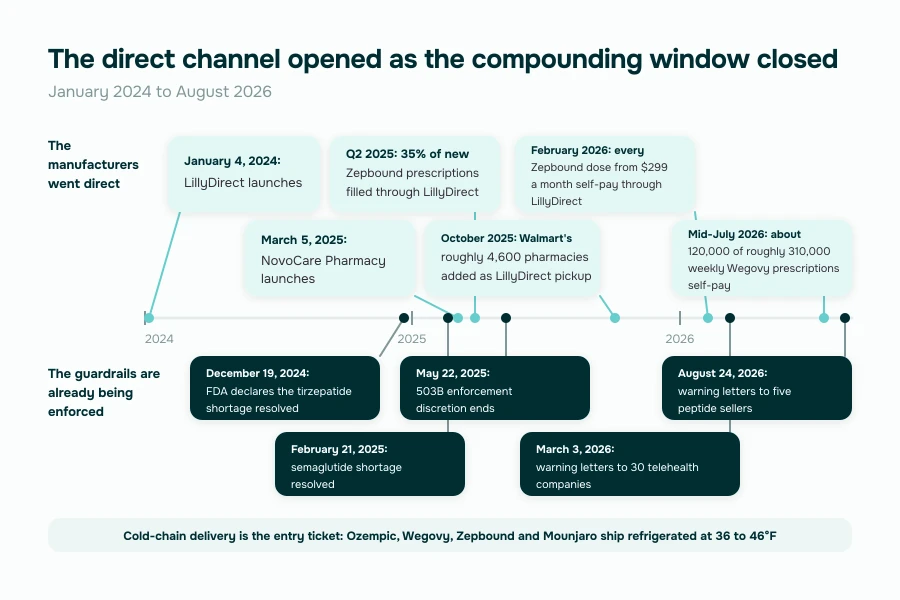
The manufacturers went direct
Lilly launched LillyDirect on January 4, 2024: telehealth referral plus home delivery through third-party pharmacies. By Q2 2025, 35% of new Zepbound prescriptions were filled through LillyDirect.
Novo Nordisk followed with NovoCare Pharmacy on March 5, 2025, and reported that by mid-July 2026 about 120,000 of roughly 310,000 weekly US injectable Wegovy prescriptions ran through the self-pay channel.
The prices move often, so cite dates. As of Lilly's February 2026 KwikPen launch, every Zepbound dose starts at $299 a month self-pay through LillyDirect.
What it means for your build
Five things get missed, in this order:
- Cold-chain delivery is the entry ticket: Ozempic, Wegovy, Zepbound and Mounjaro all ship refrigerated at 36 to 46°F, so your courier layer needs temperature logging.
- The time budget differs per product: 56 days after first use for an Ozempic pen, 28 days for a Wegovy single-dose pen, per the 2026 labels. The courier's clock has to know which product it's carrying.
- Telemedicine integration is the front door: 17% of GLP-1 users got the drug from an online provider or website (KFF, 2025), and the telehealth players pair the visit with the shipment.
- Pickup persists: Lilly added Walmart's roughly 4,600 pharmacies as a pickup option for LillyDirect vials in October 2025, and GoodRx says 67% of its weight-loss subscribers choose retail pickup over mail. Offer both.
- Chronic means adherence: these patients refill for years, so the refill nudges and dose scheduling from feature 6 earn their keep here.
The guardrails are already being enforced
The compounding window is closed: FDA declared the tirzepatide shortage resolved on December 19, 2024 and semaglutide on February 21, 2025, with 503B enforcement discretion ending May 22, 2025.
Since then FDA has sent warning-letter waves to online sellers (September 2025), to 30 telehealth companies (March 3, 2026) and to five peptide sellers (August 24, 2026). Sell the approved products and price them honestly. "Generic Ozempic" is the phrase that draws the warning letter.
Compliance: HIPAA, DSCSA, and e-prescribing
Pharmacy delivery app development lives under three regimes; most guides stop at the first. All three follow, plus the licensing and card rules that decide whether you can take an order at all.
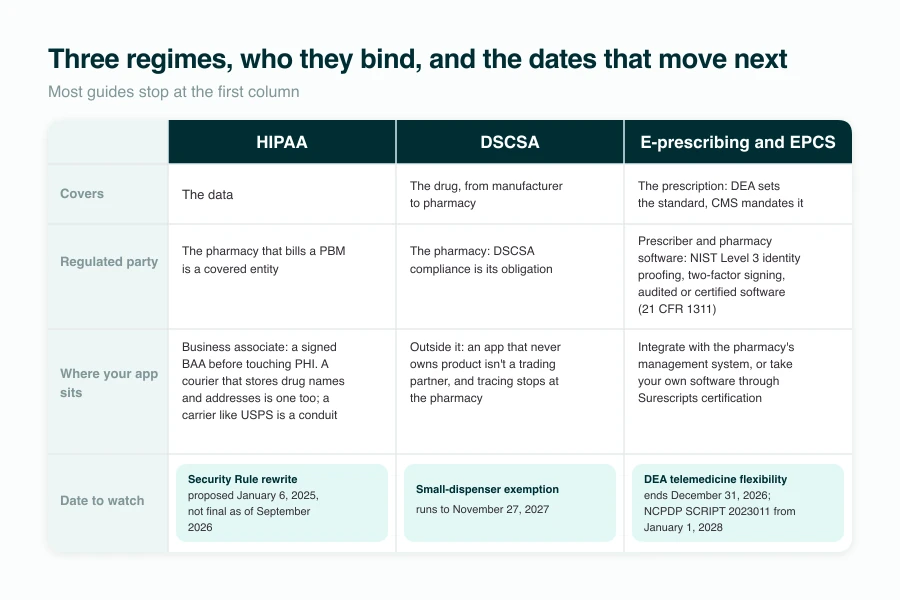
HIPAA: the pharmacy is covered, the courier is usually a conduit
A pharmacy that bills a PBM is a covered entity. Your developer, host, telehealth platform and chat or video vendor are business associates and need a BAA before touching PHI (45 CFR 160.103, 164.502(e)).
HHS's 2013 Omnibus Rule preamble keeps a conduit exception for a carrier like USPS, whose access is random, infrequent and transient. A platform storing drug names and patient addresses has persistent access and is a business associate.
Design the hand-off so the driver sees a sealed package and an address, nothing else.
HHS's proposed Security Rule rewrite (January 6, 2025) isn't final as of September 2026; build to it, don't call it current law.
DSCSA: tracing stops at the pharmacy
DSCSA puts a product identifier on every package; trading partners exchange transaction data via GS1 EPCIS and keep it six years.
Package-level tracing took effect November 27, 2023, and FDA's stabilization period and staggered exemptions have since expired for everyone except small dispensers. The one open date: on August 6, 2026 FDA extended the small-dispenser exemption (25 or fewer full-time pharmacists and technicians) to November 27, 2027. If you serve independents, build for 2027.
DSCSA compliance is the pharmacy's obligation, and tracing stops there: a filled prescription handed to a patient isn't a DSCSA "transaction," so neither the courier nor an app that never owns product is a trading partner.
E-prescribing and EPCS: DEA sets the standard, CMS mandates it
DEA's EPCS rule (21 CFR 1311) sets the controlled-substance standard (NIST Level 3 identity proofing for each individual prescriber, two-factor signing, audited or certified software) and is federally optional.
CMS requires Schedule II to V drugs under Medicare Part D to be e-prescribed, and names the standards: NCPDP SCRIPT 2023011 from January 1, 2028.
DEA's telemedicine flexibility for prescribing controlled substances without an in-person visit runs through December 31, 2026; plan for it to lapse or change on January 1, 2027.
Licensing and cards: a license per state
Every state you ship into treats the filling pharmacy as a nonresident pharmacy needing that state's license (California's Business and Professions Code 4112 is typical).
Google Ads requires NABP accreditation or LegitScript certification. Mastercard's merchant rules, as quoted by NABP in 2018, require verification by a recognized third party, in practice LegitScript or NABP, for card-not-present prescription sales; confirm the current text with your acquirer.
FDA's BeSafeRx page tells patients a safe online pharmacy requires a prescription, lists a US address and phone, has a pharmacist to answer questions and appears in the state board's license lookup; put all four on your public surface.
Where Specode fits: the HIPAA half
Specode's HIPAA Compliance Agent scans your codebase across 11 categories (access control, audit logging, PHI in URLs, third-party BAA handling), and before go-live our team reviews the app for security and HIPAA compliance in 1 to 2 business days. DSCSA tracing and licensing stay with your pharmacy partner; data protection in the code you ship is the agent's job.
Steps to develop a medicine delivery app
To develop a medicine delivery app that survives its first state board inspection, run the eight steps in order.
Step 1: Validate the idea with a pharmacy partner
Find the pharmacy that will fill your orders and ask what they'd need from you. Their answer sets your feature list. Then pick the persona (chronic patient, caregiver, discharge nurse, GLP-1 self-payer) and the revenue model: delivery fees, subscription, a per-fill margin from the pharmacy, or a mix.
Step 2: Decide who holds the license
Partner with licensed pharmacies, or run your own and build the multistate license map before launch. The compliance section has the rules. Most first builds partner.
Step 3: Choose the tech stack
- Frontend: a responsive web app first; React Native or Flutter if you need a native mobile app with in-app purchases or device features on day one.
- Backend: Node.js or Django on a HIPAA-eligible host that signs a BAA.
- Integrations: pharmacy management system, courier API, a payment processor that boards pharmacies, and the EHR touchpoints in step 6.
Step 4: Design for the patient on five medications
The medication reminder app development design rules carry over: large type, one-tap reorder, voice input, caregiver access. Test the design on an actual 75-year-old before sign-off.
Step 5: Build the core features
Build the first six features above (catalog, prescription intake, profiles, tracking, payments and reminders), plus the admin panel for the pharmacy staff who'll live in it. Ship the pharmacy panel before the patient app is pretty.
Step 6: Integrate with the healthcare systems that already exist
Three rails, none optional:
- Pharmacy integration: the Surescripts-certified management system where the e-prescription actually lands.
- EHR integration: Epic and Cerner first, so a discharge order becomes a delivery without re-keying.
- Courier APIs: Uber Direct or a pharmacy-specific network like ScriptDrop. Uber Direct checks ID on prescription drop-offs; hold every courier to that bar.
If healthcare providers will prescribe inside your app, add telehealth; see e-prescription app development.
Step 7: Test the things an inspector will test
Compliance testing against the rules in the compliance section and usability testing with elderly patients and caregivers come first. Then load-test the Monday-morning refill spike.
One caveat if you prototype on an AI builder: preview environments aren't HIPAA-compliant (ours aren't, and assume the same of any other builder), so test with synthetic patient data only.
Step 8: Launch where the rules let you
Soft-launch in one state whose license you hold. Submit to the App Store as a legal entity; Apple's guideline 5.1.1(ix) requires it for healthcare apps. Google Play bans apps that facilitate prescription drug sales without a prescription.
Then create the dashboard you'll actually watch: fill-to-delivery time, temperature excursions, refill rate, cost per delivery.
Read more on pharma app development
Best practices in medicine delivery app development
An on demand medicine delivery app development company is judged on the boring things: whether the refill arrived cold, whether the pharmacist could see the order, whether the app still worked when the chain pharmacy down the road closed, as 221 CVS stores did in 2025. Six practices that keep the boring things boring.
Treat compliance as a build input
The compliance section is the spec. Encrypt everything, log every PHI access, run MFA, and re-check the rules each quarter; the DSCSA and DEA dates above will move again.
User engagement comes from the order itself
One-tap refills, an honest ETA, a price shown before checkout, and a pharmacist who answers. That's where user engagement comes from. Gamification adds little here: a badge for taking a blood pressure pill patronizes the patient.
Pick logistics partners who already carry cold chain
Pharmacies supply inventory and prescription validation; logistics partners supply the last mile. Courier API options with a pharmacy track record:
- DoorDash Drive: Sam's Club launched prescription delivery on it in October 2020.
- Uber Direct: ID verification built in; ScriptDrop's default for select pharmacies in 37 states in 2021.
- Instacart: Costco since 2020, Kroger pharmacies since August 2026.
- Roadie: UPS-owned, ScriptDrop's rural partner since 2020.
- Health-system couriers: Phox Health, which says Ochsner and MultiCare use it.
Ask each about temperature logging before you ask about price.
Plan the license map before you scale across state lines
Each new state means a nonresident pharmacy license and, in Texas and California among others, a pharmacist-in-charge licensed there.
The custom healthcare software development discipline that matters most here: separate the parts that change per state from the parts that don't.
Instrument the operation
Track fill-to-delivery time, order accuracy, refill rate and temperature excursions alongside the usual retention numbers.
Use AI where a pharmacist checks it
Prescription intake, document classification, refill prediction and support chat are the AI jobs that pay off. Amazon Pharmacy reports a 90% cut in prescription processing time from generative AI, with a pharmacist reviewing every script (AWS, 2025).
A 2025 randomized trial in JMIR Medical Informatics found that AI showing its own uncertainty helped pharmacists catch wrongly approved misfills more often (83.3% versus 76.7%) than black-box AI. Make the software show its confidence.
Cost to create a medicine delivery app
Medicine delivery app development cost turns on four decisions: whether you build the pharmacy or partner with one, how many states you launch in, whether you ship cold chain, and how much of the plumbing you buy instead of writing.
From scratch, budget for the mid tier
| Tier | What's in it | Cost | Timeline |
|---|---|---|---|
| MVP | Patient app, OTC catalog, cart and checkout, prescription photo upload, order status, one admin panel | $40,000 to $80,000 | 3 to 5 months |
| Mid-complexity | Adds pharmacy and courier apps, real-time tracking, refill reminders, multiple payment options, HIPAA-grade infrastructure and audit logging | $80,000 to $150,000 | 5 to 9 months |
| Full-featured | Adds pharmacy management system and e-prescribing integration, insurance eligibility and claims, third-party courier APIs, multi-location inventory, analytics | $150,000 to $300,000 or more | 9 to 12+ months |
Industry estimates compiled from Clutch (September 2026), GoodFirms (April and August 2026), Business of Apps (June 2026) and agency guides (Appinventiv, Code Brew, Space-O, 2026). Tier boundaries and feature lists are editorial; offshore teams at $25 to $49 an hour land lower, US teams at $50 to $100 higher.
The mid tier is where a working product usually lands. GoodFirms' 2026 healthcare benchmark puts it at the same $80,000 to $150,000, with HIPAA safeguards adding 20 to 30% when designed in from day one.
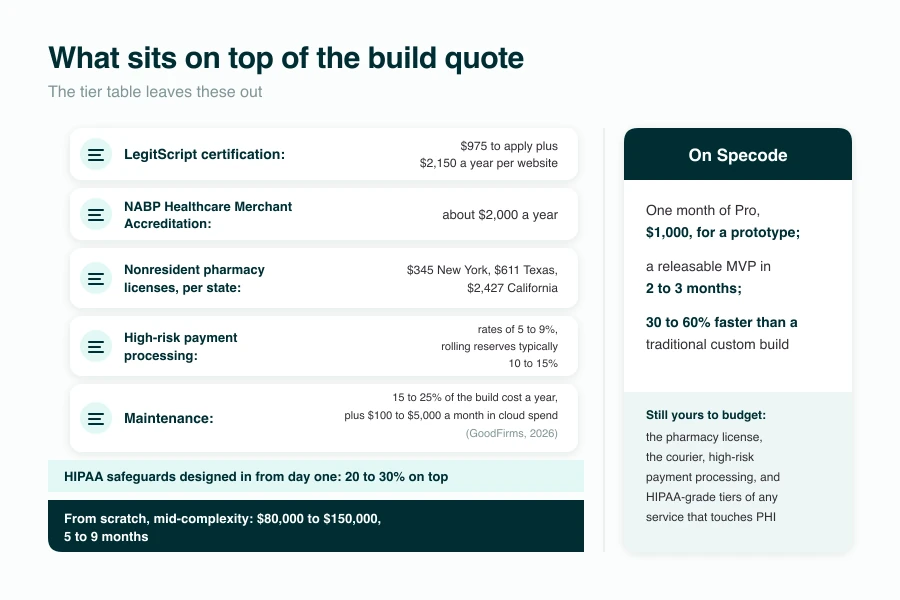
On Specode, the same scope is a subscription plus third-party fees
A working prototype fits inside one month of the Pro plan, $1,000, plus third-party service fees. A releasable MVP takes 2 to 3 months, 30 to 60% faster than a traditional custom build.
Pro covers the builder and its HIPAA-ready hosting, BAA included; the pharmacy license, the courier, high-risk payment processing and the HIPAA-grade tiers of any service that touches PHI are yours to budget separately.
Complex builds with large or legacy EHR integrations and our engineers on them have landed at $25,000 to $97,000, with a median of $49,000. A medicine delivery app developer quoting you the top of the table is pricing hand-written plumbing. The table is what that plumbing costs.
The line items founders forget
The table leaves these out.
- LegitScript certification: $975 to apply plus $2,150 a year per website.
- NABP Healthcare Merchant Accreditation: about $2,000 a year including the .pharmacy domain.
- Nonresident pharmacy licenses: $345 in New York, $611 to apply in Texas, $2,427 in California, per state, plus renewals.
- High-risk payment processing: published GLP-1 and telehealth rates of 5 to 9% with rolling reserves that typically run 10 to 15%.
- Maintenance: 15 to 25% of the build cost a year, typically $15,000 to $75,000, plus $100 to $5,000 a month in cloud spend (GoodFirms, 2026).
Future trends in medicine delivery app development
Medical delivery app development has 4 trends worth planning around in 2026.
AI and robots are already in the pharmacy
Robots and AI landed in central fill first: Walgreens' micro-fulfillment centers fill about 3.5 million prescriptions a week (Walgreens, May 2025), and CVS Health's AI tool reads prescriber directions across roughly 9,000 pharmacies. Central fill gets faster and cheaper, so the last mile is where you differentiate.
Prescription drones belong to health systems for now
Intermountain and Cleveland Clinic are flying prescriptions; Amazon's College Station program made its last deliveries on August 31, 2025. Plan rural coverage around couriers and mail order, and keep drones on the watch list.
GLP-1 direct-to-consumer runs on the telemedicine habit
In 2022, 30.1% of US adults had a telemedicine visit in the prior 12 months (CDC/NCHS, 2024), and the GLP-1 makers built their direct channels on that habit. The telemedicine app development pattern of visit-plus-shipment, which Hims & Hers and Ro run, is what a manufacturer partnership now looks like.
Whole-person care is the thing a chain can't copy
Smart pill dispensers are real products now, and the business case is the adherence math from feature 6. The refill is a touchpoint: apps that pair medication delivery with mental health app development features or chronic-care check-ins turn a courier transaction into a care relationship, and a chain's home delivery has no answer to that.
Why Specode is ideal for bootstrapping medicine delivery apps
Every medicine delivery app development company will tell you compliance is built in. What that means when we say it, and where the edges are:
What you get on day one
You describe the app in plain English and Maestro's three agents (planning, design, implementation) build it on a HIPAA-ready foundation. A first working build lands in about 10 minutes.
HIPAA-ready infrastructure and the backend hosting BAA come with the Pro plan. You own the code (terms, Section 8.2) and can export it any time.
The integrations this guide keeps naming
Specode connects to EHRs (Epic, Cerner), lab systems, pharmacy networks, insurance verification, and any courier or e-prescribing vendor with an API: you bring the keys, the AI wires it.
Stripe is the default. Online pharmacy and prescription delivery are Stripe-restricted categories, so approval is case by case; our team helps customers through it, and BAA-signing high-risk processors remain the alternative.
Web first, store-ready when you need it
Specode ships a responsive web app. Wrapping it for the App Store and Google Play with Capacitor is about a week of setup plus a week of polish; in-app purchases and other native-only pieces need real build work. For pharmacists at a desk and patients on a phone browser, that's usually the right order.
The compliance work you'd otherwise hire for
The HIPAA Compliance Agent scans the codebase across 11 categories; Maestro adds audit logging and MFA when you ask. Before go-live our team reviews the app, 1 to 2 business days.
Behind the platform is Topflight, 12 years of health-tech work in Irvine, California, with clients including Cedars-Sinai and Merck.
What it costs
One month of Pro, $1,000, for a prototype; 2 to 3 months for a releasable MVP; Custom from $5,000 a month when you want our engineers on a complex build.
The cost section above has the market ranges next to those numbers. If you're weighing a custom build against a platform for medicine delivery app development, that comparison is the honest one to run.
Frequently asked questions
HIPAA, DEA's EPCS rules for controlled substances, CMS e-prescribing standards for Medicare Part D, state board licensing wherever you ship, and DSCSA tracing at the filling pharmacy.
Use courier networks like Roadie and ScriptDrop, mail order for maintenance medications, and routing that knows where the pharmacy deserts are. Scaled rural prescription-by-drone delivery doesn't exist in the US as of 2026.
Cards and digital wallets are the baseline, plus FSA or HRA cards with IIAS or SIGIS 90% rule substantiation, all on a processor that boards pharmacies (restricted on Stripe). Tokenize at the gateway under PCI DSS v4.0.1.
Most orders should be Surescripts e-prescriptions with no upload. AI pre-checks uploaded scripts and a pharmacist signs off on every one, as Amazon Pharmacy does.
Show what FDA's BeSafeRx tells patients to check: a prescription requirement, a US address and phone, a pharmacist who answers questions, and a state board license lookup.
It's the front door for GLP-1 and other direct-to-consumer programs: the visit produces the e-prescription, the app produces the delivery. Controlled substances ride on DEA's telemedicine flexibility through December 31, 2026.
Large type, voice input, one-tap reorder, a phone line, and a caregiver role that orders for a dependent. Test with actual elderly patients.
2026 industry estimates: $40,000 to $80,000 for an MVP, $80,000 to $150,000 for mid-complexity, $150,000 to $300,000 or more for full-featured builds. A Specode prototype fits inside one month of Pro at $1,000, plus third-party fees.
From scratch, 3 to 5 months for an MVP and 5 to 12 months or more for fuller builds (2026 agency and review-site benchmarks), plus pharmacy licensing. A Specode prototype takes about a month, a releasable MVP 2 to 3 months.


