The Non-Technical Founder's Guide to Building a HIPAA-Compliant Health App Without a Dev Team

By the time most non-technical healthcare founders Google how to build a HIPAA compliant health app, their health app idea has already cleared the clinical-validation stage. The next month gets burned evaluating Lovable, Bubble, and Replit. Then they hit Bubble's own docs, where the team admits apps built on Bubble won't achieve HIPAA compliance, and the search resets.
From there, the two obvious paths are both bad. Hire an agency for $70K-$150K over 3-6 months. Or pick a no-code tool that signs a BAA and accept platform lock-in for the life of the app. Neither path fits a healthcare founder with a clinical idea and a runway you can count in months.
2026 changed the math. AI healthcare builders now scaffold production-grade healthcare apps from a plain-English description, with HIPAA controls baked into the foundation.
Here's what that path looks like for a non-technical founder: what HIPAA actually requires, which platforms can legally hold PHI, the 7-step build path, and what to budget.
How does a non-technical founder build a HIPAA-compliant health app without a dev team?
Pick a platform that signs a BAA, map every vendor in the BAA chain before writing features, build the MVP with the platform's AI agents, run a HIPAA compliance scan against the risk analysis gap OCR is fining for, and deploy to a HIPAA-ready production environment. Realistic timeline runs 2-3 months for production-ready, with line-item costs that replace the $70K-$150K agency benchmark.
Key Takeaways:
- The BAA gate is the binary platform decision for any HIPAA compliant build. Without a BAA, the platform legally cannot process PHI for a covered entity. Lovable, Replit, Bubble, Base44, and Bolt fail it; Blaze, Knack, and Specode pass it.
- Risk analysis is the document OCR settlements cite first, every time. Every 2025-26 OCR enforcement against a software business associate began with the same deficiency: no thorough risk analysis. The technical safeguards conversation comes after.
- A 2-3 month path to production-ready is realistic with an AI healthcare builder. The 7-step build replaces the traditional $70K-$150K agency engagement when the scope fits AI-builder territory.
- Specode is the third path between agency-priced custom development and PHI-incompatible no-code shortcuts. Maestro builds the app, the HIPAA Compliance Agent scans it, the Convex backend BAA is included, and code export is supported from day one.
Who this guide is for (and who it isn't)
This non-technical founder health app guide is for:
- Clinical entrepreneurs with a hypothesis that's survived real-user testing
- Physician founders building the tool they wished existed during residency
- Ops or admin leads at a clinic who can sketch the workflow but not the code
- Solo health tech founders pre-seed or bootstrapped, one window to ship
All four share one constraint: a clinical hypothesis they can describe in detail and zero ability to write the code that runs it.
It isn't for:
- Enterprise teams with in-house dev resources
- Founders building pure wellness apps with no clinician in the data flow
- Founders who already have a CTO and a dev team
- Founders looking for full custom development from day one
Most generic healthcare app for non-technical founders advice glosses over this split.

Where non-technical founders get stuck building health apps
Three weeks into building, the AI tool happily ships your patient intake form. Then you realize the email service it picked doesn't sign BAAs, and the launch stalls until you find one that does. To build a health app fast, most of the work turns on plumbing decisions like that one.
To build a health app without a developer, you own every tech stack decision before any product feature matters. Backend, auth, hosting, encryption at rest and in transit, audit logs, a BAA chain across every vendor that touches PHI. Each item is a research project. The complexity of running six in sequence is what a development team usually handles. Solo, it lands on you.
Most non-technical founders learn how the BAA chain works by failing one link in it. Every vendor that creates, receives, maintains, or transmits PHI has to sign a BAA.
- cloud hosting
- video calls
- payments
- analytics
Most have a separate HIPAA-eligible tier that costs three to ten times the standard plan and isn't on the marketing page. You discover the tier the first time you ask your $15/month email provider for a BAA. The next vendor on the chain doesn't sign BAAs at all, and the launch date you owe physicians and other healthcare providers slips again.
Generic AI app builders handle code-writing well. Compliance is a different problem they don't solve, unless the builder is healthcare-specific. The pattern is the same in every digital health startup we've worked alongside:
- a working MVP in weeks,
- then a vendor wall when you try to wire up email, payments, video, or analytics.
Whether you call your project a health tech startup or a medical app without a developer, the failure points are identical.
The PHI test: does HIPAA apply to your app?
How to make a HIPAA compliant app starts with one question: does your app touch protected health information (PHI)? That's the variable HIPAA cares about. If your app handles patient data tied to identifiers, HIPAA applies and the rest of this guide matters. If it doesn't, you're likely outside HIPAA scope, and a lot of this guide is overkill for your build.
What counts as PHI (and what doesn't)
PHI requires two things at once: data that identifies a person, and data that relates to their health condition, treatment, or payment. Both halves are required. Without the combination, you have either an identifier (name, email) or health data (a diagnosis code). The combination is what triggers HIPAA.
Four examples that meet the bar:
- A patient's name in medical records that also list a diagnosis
- An email address tied to an appointment booking with a clinician
- An IP address tied to a health query made inside a covered entity's portal
- A lab result attached to any patient identifier
The flip side: a wellness app logging steps and calories without any covered entity in the data flow usually sits outside HIPAA. Pure fitness data, pure consumer use. The carve-out disappears the moment a clinician or insurer starts using the health data for patient care.
When HIPAA actually applies to your app
The PHI definition is one input; the second is who's in your data flow. The moment a covered entity (clinician, hospital, pharmacy, or insurer) processes data through your app, HIPAA applies. The same dataset can fall on either side of the line depending on who's handling it.
The HIPAA Privacy Rule defines what counts as PHI and how it can be used. The HITECH Act, passed in 2009, added the tiered civil penalty structure and the breach notification rule that drives most of OCR's enforcement work today. GDPR is the non-US comparison most founders ask about: it covers any personal data of EU residents, health or otherwise, and runs alongside HIPAA when your users include the EU.
The gray zone is digital therapeutics. Apps that make clinical claims or process data on behalf of a provider cross from wellness into regulated territory, FDA software-as-a-medical-device scope included. For the build implications, see digital therapeutics app development. Mental health apps used by clinicians fall into the same gray zone; see mental health app development for where the HIPAA line falls in that category.
The one-line rule: if your app processes PHI on behalf of a covered entity, HIPAA applies.
What it actually takes to make a HIPAA compliant app
How to build a HIPAA compliant app is operational work. The HIPAA Security Rule shows up in your code, your BAAs, your documentation, and your incident response. All of it is checkable from the outside. Four pieces matter most for a non-technical founder shipping a first build:
- the technical safeguards your app enforces on day one,
- the BAAs across every vendor that touches PHI,
- the 2026 penalty math you actually face if the program slips,
- and the pattern in what OCR is fining health apps for in 2025-26.

The 5 technical safeguards your app needs on day one
These five categories sit under 45 CFR 164.312. They're the operational requirements the Security Rule treats as non-negotiable for ePHI handling, the ones a non-technical founder either implements in the build or pays for in audit later.
- Access control. Unique user IDs, emergency access procedure, automatic logoff after inactivity, encryption and decryption of PHI at rest. This is the foundation the other four build on, including role-based access control (RBAC) for any clinical workflow.
- Audit controls. Every PHI access event has to write to immutable audit logs: who accessed what, when, from where.
- Integrity controls. Mechanisms that prevent improper alteration or destruction of PHI, plus a way to confirm data hasn't been changed since it was stored.
- Person or entity authentication. The app verifies that the user or system requesting PHI is who they claim to be. MFA is part of this in 2026.
- Transmission security. Data encryption in transit between every system touching PHI. TLS at minimum, with documentation that proves it.
A platform that signs a BAA usually handles the infrastructure half of these. The app-level half, including RBAC, audit log instrumentation, secure messaging between users, and session timeout logic, lands on you. Strong data security here is what every other safeguard depends on.
Why every vendor in your stack needs a BAA
The business associate agreement extends HIPAA's obligations from the covered entity to anyone handling PHI on its behalf. Without one, that vendor cannot legally hold PHI. The rule: every vendor that creates, receives, maintains, or transmits PHI signs a BAA before any patient data touches their systems.
The common chain runs through five vendor types: cloud hosting, transactional email, video calling, payments, and analytics. Each is a separate negotiation, sometimes a separate paid tier. Stripe signs a BAA on standard terms; Mailgun and CometChat have separate HIPAA plans that cost meaningfully more than their standard plans.
The frequent gap is analytics. Most general-purpose tools (Google Analytics standard, Mixpanel default tier, Segment default tier, Amplitude default tier) don't sign BAAs at all. Instrument behavioral events on screens where PHI shows up and the analytics layer becomes a HIPAA violation on its own.
The 2026 penalty math founders actually face
The HIPAA fine schedule got updated by HHS in January 2026 (Federal Register, January 28). If you're working off the $100 to $50,000 per violation figures from older guides, those numbers are stale.
The current tiers, by culpability:
Tier 4 is the one that should keep a non-technical founder honest. The per-violation maximum and the annual cap are the same number, so a single uncorrected willful-neglect violation can hit the full annual cap in one event. This is why what OCR is currently fining for matters more than the tier table itself.
What OCR is fining health apps for in 2025-26
OCR launched its Risk Analysis Initiative in late 2024 and has issued 11+ enforcement actions by early 2026. Every single settlement cited the same primary deficiency: no thorough security risk analysis. The foundational document the rest of the compliance program rests on, skipped.
MMG Fusion, March 2026. $10,000 settlement plus a three-year corrective action plan. MMG is a Maryland software company, a business associate to covered entities, with software that communicated directly with patients. 15 million individuals had names, addresses, emails, and appointment data posted on the dark web after a data breach.
OCR cited no accurate risk analysis and a failure to comply with the HIPAA Breach Notification Rule. The small dollar reflected MMG's financial condition. The shape of the company is the point: a small software business associate processing PHI for clinicians. That's exactly what a non-technical founder becomes the moment their app goes live.
Solara Medical Supplies, January 2025. $3 million settlement, largest of 2025. California supplier of insulin pumps and glucose monitors. Phishing attack compromised employee email accounts for months. 114,000 patients had SSNs and clinical details exposed. OCR cited the same deficiency.
The pattern: every safeguard conversation comes after the risk analysis conversation. Skip the analysis and the rest of the program rests on nothing. This is the gap Specode's HIPAA Compliance Agent was built to close.
Why most no-code platforms cannot build a HIPAA compliant app
Picking a HIPAA compliant app builder collapses to one binary question: does this platform sign a BAA? If yes, it can legally process PHI on behalf of a covered entity. If no, it cannot, regardless of how slick the demo is or how fast the build runs. This single question filters out most of the AI builder and no-code platform market and leaves you with a much smaller decision tree.
Most no code HIPAA compliant app evaluations end at the gate, before any feature comparison. The HIPAA app builder list of platforms that actually pass it is short, and the no-code healthcare options narrow further when code ownership comes up.
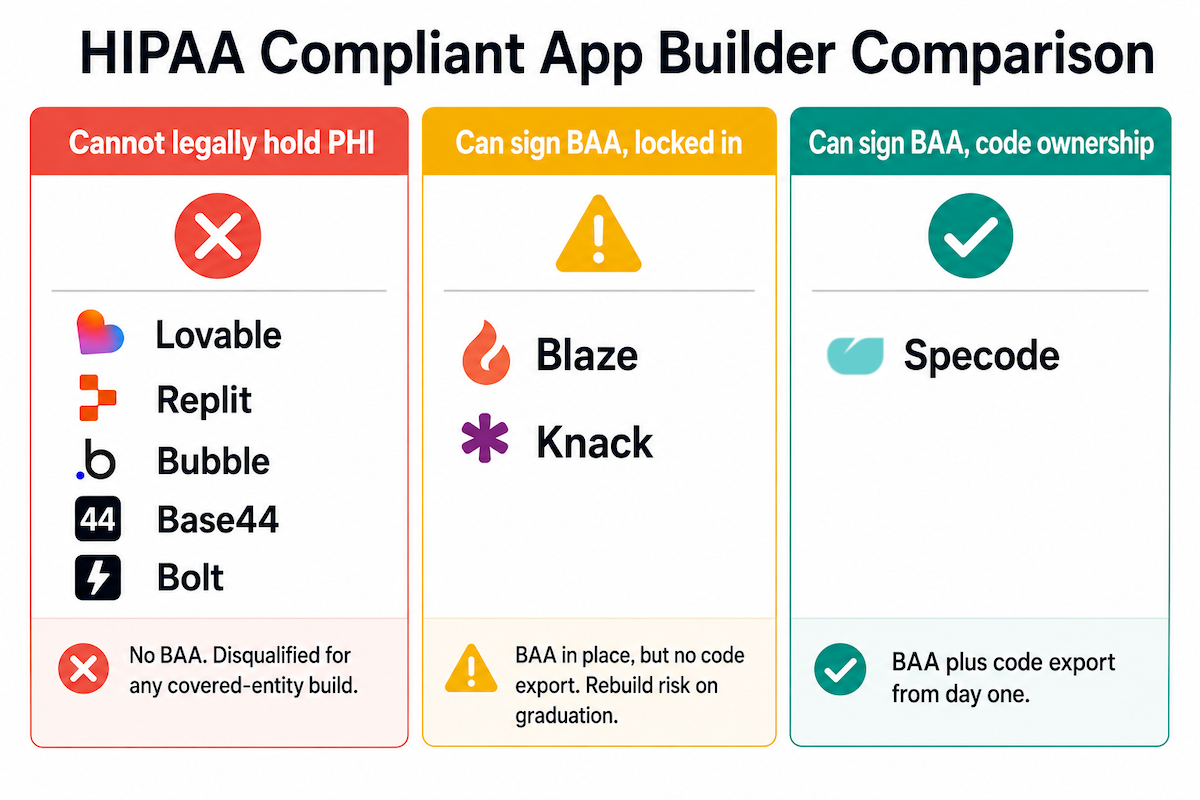
Platforms that cannot legally hold PHI
These five no-code platforms cannot sign a BAA as of mid-2026. If any of them is in your shortlist for a healthcare industry build, the shortlist is wrong.
- Lovable. No BAA. Plus an active security track record: CVE-2025-48757 (May 2025), disclosed by researcher Matt Palmer, exposed 170+ Lovable-generated apps because the platform shipped missing Row Level Security policies. The public anon_key in the client let unauthenticated attackers dump entire database tables. A second incident in April 2026 (BOLA disclosure) exposed source code, database credentials, and AI chat histories from thousands of pre-November-2025 projects. Vibe-coded health apps on Lovable can leak before they launch. See Lovable vs Replit for healthcare apps for the full comparison.
- Replit. A general-purpose cloud IDE with no BAA and no healthcare posture. Prototype-grade for a healthcare app at best. If you've already built a Replit prototype, graduating from your Replit prototype covers the path off.
- Bubble. Per Bubble's own docs at manual.bubble.io: "apps built on Bubble won't achieve HIPAA compliance." Workarounds that route PHI outside Bubble exist, but they don't make Bubble itself HIPAA compliant.
- Base44. No explicit HIPAA or BAA posture per public materials. Treat as non-PHI only. See using Base44 for a health app for where the line falls.
- Bolt. Cannot sign a BAA as of early 2026. Same posture as Base44, same disqualification for any covered-entity build.
The pattern across all five: low-code or vibe-coding speed, with no legal path for PHI underneath. Fine for non-healthcare prototypes. Disqualified for any app that processes patient data on behalf of clinicians or healthcare organizations, where compliance is the binding constraint.
Platforms that can sign a BAA, with one tradeoff to know
Three platforms pass the BAA gate. Blaze and Knack are no-code with significant lock-in. Specode is built differently.
- Blaze. Signs BAAs. HITRUST e1 and SOC 2 Type 2 certified. Healthcare pricing starts around $1,500/month. It's a legitimate HIPAA compliant no code platform. The tradeoff: no code export. When your app outgrows Blaze (and most apps do, past Series A), the rebuild starts from scratch on a different stack.
- Knack. Signs BAAs. HIPAA tier runs $625 to $999/month. Strong for relational data and clinic ops scenarios. Same tradeoff as Blaze: platform lock-in, no code export. Healthcare startup no code teams using Knack ship fast and then carry the rebuild risk for the life of the product.
- Specode. Signs BAAs through its backend hosting (included on the Pro plan). Code export is supported from day one, so the lock-in tradeoff doesn't apply. The full Specode breakdown is in the healthcare app builder overview and in the Specode section below.
The honest take across this list: Blaze and Knack are real options. They solve the BAA problem cleanly. They don't solve the platform-graduation problem, and that's the bet you make when you pick one. An AI builder with code export changes the math on that bet.
How to build a HIPAA compliant health app without a dev team in 7 steps
These 7 steps are how to build a healthcare app without a dev team in practice, the path that's worked for non-technical founders we've shipped alongside in 2025-26. Each step is a separate decision or action; skip one and the next one starts in the wrong place. Realistic timeline to production-ready, with all seven done properly: 2-3 months. The development process is sequential. The 10-minute prototype the marketing pages promise is a different artifact; this path is for an app you can actually launch and operate.
Step 1. Decide whether HIPAA applies to your app
Run the PHI test from Section 4. If your app handles patient data on behalf of a covered entity, HIPAA applies and the remaining six steps are mandatory. If it doesn't and you're building pure consumer wellness, the rest of this guide is overkill. The decision sets every downstream constraint, so don't skip it because you're "pretty sure" it applies. Confirm it explicitly.
Step 2. Pick a platform that can legally hold PHI
Reuse Section 6's rubric. Two honest paths for a non-technical founder:
- AI healthcare builder with BAA: code ownership, no platform lock-in
- Blaze or Knack: BAA, full platform lock-in, no code export
Trying to retrofit Bubble, Lovable, Replit, Base44, or Bolt into HIPAA scope is a wasted month at best and a security incident at worst. The platform decision cascades into every step that follows, so get it right before writing a single feature.
Step 3. Map your BAA chain
List every service that will create, receive, maintain, or transmit PHI. Confirm each can sign or already has a standard BAA you can countersign. The common chain you'll need to map:
- Hosting. Backend hosting BAA confirmed before any patient data lands in production.
- Email. Mailgun's HIPAA plan specifically. Resend isn't BAA-eligible.
- Video. CometChat's HIPAA plan if you're doing video visits.
- Payments. Stripe signs on standard terms.
- Analytics. Most general analytics tools don't sign; either skip them or move to BAA-eligible tiers.
Each missing BAA is a launch blocker. Map them all before Step 4.
Step 4. Build your MVP with an AI builder
Building a healthcare app without coding starts here. Describe what the app does in plain English: who the users are, what they do in it, what data flows between them, and what gates access. The AI builder scaffolds screens, data models, basic workflows, and role-based access patterns, then you iterate by chatting. Common first-build types are telemedicine, remote patient monitoring, prescriptions, patient portal, and appointment scheduling. For a worked example of a telemedicine build from scratch, see telehealth app development. A first functional version of a healthcare MVP usually lands within the first week of credit spend.
Step 5. Run a HIPAA compliance scan
The MVP runs but it isn't compliant yet. Run a HIPAA compliance scan against the build before any other quality assurance work. The Specode HIPAA Compliance Agent is the concrete tool, with this workflow:
- Run the scan (3-4 minutes per pass)
- Review findings tagged Critical, High, Medium, Low
- Fix Critical and High items through the AI Coder chat
- Re-run until Critical and High are clean
This is the step that closes the gap OCR fines health apps for skipping.
Step 6. Deploy to a HIPAA-ready production environment
Production deployment is its own checklist. On Specode Pro, that means GitHub (Specode team as collaborators), Vercel frontend, Convex backend with the hosting BAA included, custom domain DNS pointed at Vercel, and Mailgun DNS records for transactional email. Cloud infrastructure stays managed for these defaults; AWS and Google Cloud become relevant only when an electronic health records integration or custom data residency requirement enters scope. EHR integration over FHIR or HL7 (Epic, Cerner) sits on the Custom plan because of the engineering depth involved.
Step 7. Document your risk analysis and set up ongoing review
Document the initial analysis, treat the identified risks, then schedule the annual review. This is the document OCR settlements cite first, every time (see Section 5). The single biggest determinant of HIPAA audit readiness is whether this document is current and shows risk treatment to completion. Founders who document continuously also ship faster on the next milestone, because launch and time to market both shorten when the compliance program isn't a separate audit prep sprint.
What HIPAA compliant app development actually costs
The cost of HIPAA compliant app development comes down to which path you pick and how deep the build goes. Health app development without coding has a different cost structure than traditional dev work, but neither comes with a sticker price.
Traditional development: the $70K-$150K line
Industry estimates for a HIPAA-compliant healthcare MVP through a traditional agency run $70K to $150K, with 3-6 month timelines from kickoff to launch. That's the common agency-pricing range across the healthcare-aware shops we've watched founders use. Why the range is that wide:
- A dev team of 3-5 engineers and a tech lead
- DevOps for HIPAA-ready infrastructure setup
- A compliance audit pass before launch
- A security review (pen test plus vulnerability scan, with threat modeling for clinical workflows)
- Project management and quality assurance across the build
Each line above is a separate billing column, and the same scope expands or contracts based on integrations and clinical complexity. This is the HIPAA app development cost benchmark you're working against when you evaluate any AI-builder alternative.
What an AI-builder path actually costs you
The AI-builder path for a healthcare MVP without a dev team comes in as line items rather than a sticker. The components most builds need:
- Platform subscription. Specode Pro $1,000/month. Custom plan starts at $5,000/month and includes custom integration scope, e.g. complex EHR wiring. Recurring while you build, so cost grows with build duration.
- Build duration. 1-2 weeks for a basic functioning app, 2-3 months for production-ready with the full BAA chain wired in.
- Third-party BAA-tier services. Mailgun's HIPAA plan if email handles PHI, CometChat's HIPAA plan for video, Stripe (BAA on standard tier), Telegra (optional for telehealth). HIPAA-eligible tiers typically run 3-10x the marketing-page tier.
- Optional pen test. $3,000 one-time, in-house through Specode. Common request for procurement or enterprise onboarding.
- Domain plus DNS. $15-30/year, plus DNS setup work.
- Convex backend. Included on Pro, with the hosting BAA included.
- EHR integration. Triggers the Custom plan because of the engineering depth (Epic, Cerner, FHIR mapping, HL7 message handling).
Every founder's number is different, and that's the honest answer. Plan against the structure; refine the sticker as scope locks in. The line-item path keeps runway and product-market fit timelines flexible while protecting investor-ready milestones.
How Specode helps non-technical founders ship HIPAA compliant apps
Most healthcare app development paths in 2026 cost six figures over months or can't legally hold PHI. Specode is the third path:
- HIPAA controls in the foundation,
- code ownership at the end,
- AI builder in the middle.
For healthcare founders without a CTO, this is the route we built.
Specode runs on Maestro, a three-agent system. The Planning Agent asks user and workflow questions and produces a roadmap. Once you sign off, the Design Agent builds a brand-aware system from your reference images, attending to user experience details that determine clinical adoption. The Implementation Agent codes against the approved roadmap and design. You approve each handoff. Timeline runs from 20-30 minutes for a prototype to 2-3 months for production-ready with the full BAA chain.
The HIPAA Compliance Agent runs in the same workspace. It's the answer to the risk analysis gap OCR has been fining every 2025-26 settlement for. A scan takes 3-4 minutes, runs multi-agent verification and returns findings tagged Critical, High, Medium, or Low. The verification step produces high quality findings you can act on directly.
Pro plan includes the Convex backend BAA, removing a separate hosting negotiation from your stack. Code export works from day one, which is the line that separates Specode from Blaze and Knack on platform graduation. Before you go live, the Specode team runs a pre-launch review on the build.
Specode's preview and demo URLs aren't HIPAA-compliant. The HIPAA stack activates at production deployment. Don't share live PHI inside a Vercel preview link, even briefly. Wait for production.
If you're ready to ship a HIPAA compliant healthcare app without hiring a dev team, try Specode on a Pro plan or talk to our team about Custom services for EHR-heavy builds. The company has ten-plus years of experience behind the engineering. That's the expertise behind the workflows your clinicians actually use, including the ones where accurate diagnoses are on the line.
Frequently asked questions
Yes, if the MVP touches real PHI. A clickable prototype with synthetic data is outside HIPAA scope, but the moment a real patient or clinician puts data into the app, HIPAA applies.
A signed legal agreement between your business and any vendor handling PHI on your behalf. HIPAA requires one with every vendor in the chain that touches patient data.
Yes, with the right platform. AI healthcare builders that sign BAAs make the build path real. Skip any platform that doesn't sign one.
OCR fines run $145 to $2.19M per violation under the 2026 schedule, plus a multi-year corrective action plan and reputational fallout.
No. Neither signs a BAA. Lovable also had two documented security incidents in 2025-26 (CVE-2025-48757 and an April 2026 BOLA disclosure).
Prototype in ~10 minutes. Basic functioning app in 1-2 weeks. Production-ready with the full BAA chain in 2-3 months. EHR integrations push that further.
No single number. The line items: platform subscription, third-party BAA-tier services, build duration, optional pen test, and EHR integration scope when it applies.
PHI is data that identifies a person and relates to their health condition, treatment, or payment. Both halves are required; either alone isn't PHI.
Wellness apps with no covered entity in the data flow store fitness data outside HIPAA scope. Healthcare apps process PHI on behalf of a covered entity, inside HIPAA scope.