Vibe Coding in Healthcare: Why It’s a Security Nightmare and How Specode Avoids That Trap

Most early healthcare teams don’t ignore security—they just sprint toward a demo for a clinic or investor, cross their fingers, and hope no one asks how PHI is actually flowing through the thing. That’s how vibe coding sneaks in: a little GitHub, a little AI glue code, a template you once used for a marketing site, and suddenly you’re handling protected health information with patterns that were never meant to see the inside of an audit.
If you’re a clinician-founder or a health-tech operator, this isn’t just a technical debt story—it’s how partnerships stall, how due-diligence flags get raised, and how promising startups lose momentum right when they need it most. This guide walks through the failure modes we keep seeing, why AI quietly amplifies them, and how to build fast without inheriting a security hangover you can’t afford.
Key takeaways
- Most early healthcare breaches come from boring, avoidable mistakes—auth, roles, logs, PHI handling, and cloud config—not exotic zero-days.
- AI doesn’t make you insecure; it just lets you scale whatever security habits you already have, good or bad, across the codebase faster.
- The alternative to vibe coding is not “move slow,” it’s assembling on hardened, HIPAA-aware components and only improvising where it’s safe to do so.
The Real Security Problem in Early Healthcare Builds
The uncomfortable truth: most early healthcare apps don’t get hacked because an APT group decided to target them. They get owned by boring, avoidable mistakes in the first 6–12 months of building.
The core problem isn’t “can attackers break this?” It’s “have we accidentally left three side doors open while racing to an MVP?”
You’re Shipping a Clinical Workflow, Not a Landing Page
In an early build, the pressure stack looks like this:
- Ship something investors/users can see
- Prove the clinical workflow works
- Add “AI” somewhere
- Figure out security “once we have traction”
That’s how you end up with:
- PHI in logs or analytics tools “just for debugging”
- Staging environments with real patient data
- One admin role that can see everything “until we have time to split it out”
- No auditable trail of who saw what, when
None of this feels risky at the time. It’s just “being pragmatic.” It only turns into a legal/financial disaster when:
- A misconfigured bucket gets scanned
- A contractor walks away with a db dump
- An investor’s due diligence team asks for your audit trail and you have… screenshots
Security Debt Compounds Faster in Healthcare
In SaaS, security debt is annoying. In healthcare, it’s existential.
- Healthcare data is consistently the most expensive breach category (multi-million average incident costs in U.S. healthcare).
- OCR fines are only part of it — the real damage comes from remediation, downtime, class actions, and lost deals.
For a small team, one serious security incident can erase years of runway and reputation. And you don’t need nation-state attackers to get there; a badly locked S3 bucket plus PHI is enough.
It’s why any credible healthcare mobile app development guide ends up sounding repetitive about role design, logging, and environment boundaries—because those are the levers that decide whether you’re growing a product or rehearsing incident-response scripts.
The Three Repeatable Failure Patterns
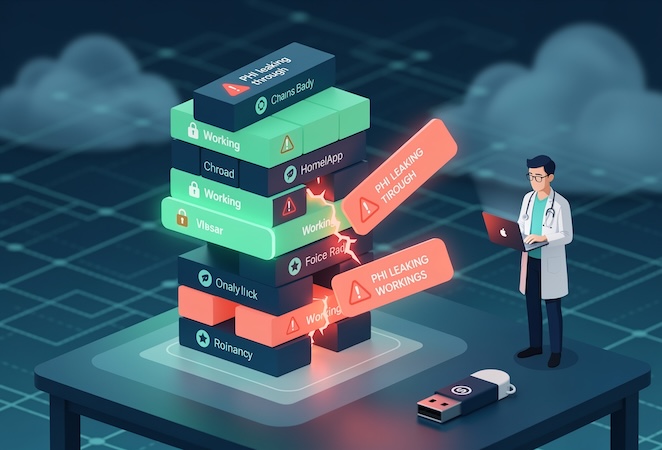
If you look across most early healthcare builds, the same patterns keep repeating:
- Security as a feature, not a foundation
“We’ll add auth, logs, and proper roles after we validate the idea.”
Translation: PHI flows through a system that was never designed to handle PHI. - Copy-pasted patterns from non-healthcare projects
Teams reuse the stack and patterns they know from generic SaaS:- Same deployment practices
- Same logging strategy
- Same access controls
Only now, the data is diagnoses, meds, and lab results.
- “Smart people will remember” instead of process
Roles, data flows, and safety checks live in people’s heads and Slack threads.
There’s no written model of:- Who can access what
- Where PHI actually sits
- Which events get logged and for how long
So the real security problem in early healthcare builds isn’t that founders don’t “care” about security. It’s that speed, ambiguity, and generic tooling quietly push them into architectures that were never meant to carry PHI.
What Typically Breaks in Healthcare Apps
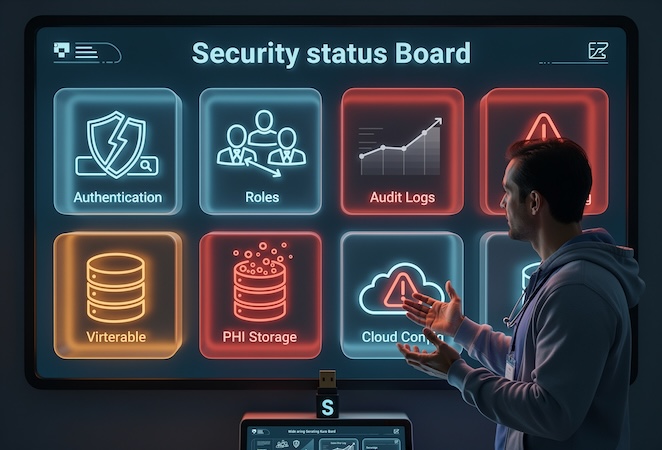
The punchline: it’s almost never some exotic zero-day. It’s the same five things breaking over and over in slightly different outfits.
Authentication & Session Handling
Early-stage pattern: “Let’s ship basic email + password now, we’ll tighten it later.”
What actually happens:
- Weak or inconsistent session rules
- Sessions that never expire (“it’s just staging… oh wait, staging has PHI now”).
- Remember-me tokens that outlive your company runway.
- No MFA hooks
You don’t have to force MFA on day one, but if you don’t even design for it, retrofitting will be a mess. - DIY auth glued together from tutorials
Tutorials aren’t written with HIPAA in mind. They’re written to get you a login screen in 20 minutes.
Once PHI shows up, this “we’ll fix auth later” posture becomes a liability. The entire security posture rests on something built like a proof of concept.
Role Scope Confusion (Patient, Provider, Admin… and “God Mode”)
This is where vibe coding really shines — in a bad way. Typical issues:
- One super-admin role that can see everything
“We’ll split roles once we know how people use it.” They never split. - Providers can accidentally see data outside their panel
Because “scoping by provider” wasn’t baked into the data model, it’s patched into queries. Patches drift. - Ops and support roles with way too much reach
Customer support “temporarily” gets direct DB access. “Temporarily” becomes “standard operating procedure.”
In a clinical setting, “role confusion” isn’t an edge case — it’s your default state unless you deliberately design for least privilege.
Missing or Useless Audit Logs
Almost every founder says, “We log everything.”
Then you look:
- Events aren’t tied to who did what (user IDs missing, or shared accounts).
- Logs don’t capture read access to PHI — only writes.
- There’s no clear retention policy, so either logs are auto-deleted too fast… or someone is hoarding them in an S3 bucket with guessed permissions.
- No one can answer, “If OCR asked who accessed this patient record on May 3rd, could we prove it?”
In healthcare, missing or broken logs aren’t just a security gap — they’re a compliance failure. You can’t investigate what you never recorded.
PHI Stored in Unsafe Patterns
This is where non-healthcare patterns sneak in:
- PHI in analytics and error tools
- Full names and conditions ending up in:
- Log aggregators
- APM tools
- “Temporary” CSVs for quick reporting
- Full names and conditions ending up in:
- PHI in screenshots and Slack
The fastest “feature” in any startup: screenshot-as-debugger. - Flat, over-shared schemas
A single users table with every possible sensitive field, accessible from every part of the codebase.
Misconfigured Cloud Defaults
Most cloud providers are secure. Your configuration usually isn’t.
Common themes:
- Buckets, blobs, or object stores set to over-permissive access
- Security groups wide open “for convenience during dev”
- Staging and production sharing resources because “it’s cheaper and we’ll separate them later”
- No clear boundary between PHI-bearing and non-PHI services
Almost every high-profile healthcare breach story has at least one of these: public endpoint + sensitive data + nobody realized it until someone scanned it.
Debug “Helpers” That Turn Into Vulnerabilities
Some of the worst offenders start as “temporary” helpers:
- Hidden “support” endpoints that bypass normal flows
- Admin panels wired without proper auth because “internal only”
- Diagnostic dumps that include entire request bodies with PHI
These never make it into architecture diagrams. But they absolutely make it into breach reports.
So when people say, “Healthcare security is hard,” they’re not completely wrong — but the real issue isn’t cryptography or advanced exploits. It’s mundane, repeatable breakage around auth, roles, logs, PHI handling, and cloud configuration.
Nowhere is this more obvious than in any serious telemedicine app development guide, where half the work is just getting identity, consent, and PHI flows to behave under real visit patterns instead of collapsing the first time a provider runs behind or a patient reconnects from a different device.
The whole point of a HIPAA-first platform is to make these five categories painful to get wrong by default, instead of hoping everyone on the team remembers all the rules every time they push a feature.
Why AI-Generated Code Can Magnify Security Risks
AI doesn’t make you insecure.
AI just lets you get to insecure faster.
If you’re not intentional about how you use it, you don’t get a “smart co-pilot”; you get a junior dev who types at 10,000 WPM and never sleeps, happily baking your blind spots into every new file.
Inconsistent Patterns Everywhere
Traditional teams at least try to keep one mental model:
- “This is how we do auth.”
- “This is how we hit the DB.”
- “This is how we log things.”
With unchecked AI use, you get:
- Three different auth flows in the same codebase
- Slightly different role checks copy-pasted into 12 endpoints
- Five logging styles, none of which capture a full audit trail
Every time someone hits “regenerate,” the model has a chance to drift a little further from your intended patterns. Over time, the app becomes a museum of one-off decisions — which is exactly what you don’t want when PHI is involved.
No Threat Model, Just “It Works on My Machine”
AI doesn’t know your risk model. It sees:
- “User needs to log in” → generates login
- “Provider needs to fetch records” → generates query
- “Admin needs a quick export” → generates data dump
What it doesn’t see:
- Your organization’s risk appetite
- HIPAA-specific expectations
- Contractual obligations to customers and payers
- How OCR or a hospital security team will read your architecture
Without an explicit threat model, AI optimizes for compilation success and happy-path usage — not for “what happens if someone abuses this endpoint for 6 months straight without us noticing.”
Phantom Components the Model Invents
Give a model a vague prompt like: “Add a quick admin panel so staff can review patient notes.”
You might get:
- A new route
- A basic UI
- A direct DB query that ignores row-level access
- Zero audit logging, because you never mentioned it
From the AI’s perspective, it did everything right: you asked, it delivered. From a security perspective, you just created a backdoor with excellent usability.
The worst part? Phantom components often:
- Bypass existing security helpers
- Ignore reusable policies you already have
- Never show up in higher-level diagrams or docs
They’re invisible until something goes wrong.

Demo-Grade Logic That Quietly Reaches Production
AI is fantastic at whipping up demo logic:
- “Assume this endpoint is internal.”
- “Assume this is just a prototype.”
- “Assume only trusted users will ever call this.”
Then real life happens:
- The prototype endpoint gets wired into a production route.
- “Internal” slowly becomes “customer-facing, but we’ll document it.”
- Trusted users share accounts because onboarding is behind schedule.
AI doesn’t move that code to prod — humans do. But when everyone’s rushing, AI makes it too easy to keep stacking “temporary” shortcuts that never got a proper security review.
The “Surprise!” Moment: Audits and Due Diligence
The pattern is depressingly predictable:
- Team builds fast with a mix of manual code + AI completions.
- Product “kind of works.” Users like it.
- A hospital, payer, or investor asks:
- “Show us your access model.”
- “Show us how you log PHI access.”
- “Show us your environment segregation and incident runbook.”
- Everyone dives into the codebase and discovers:
- Different patterns in different modules.
- Security checks duplicated and slightly modified everywhere.
- “Temporary” endpoints that nobody documented.
That’s when speed flips from asset to liability.
AI isn’t the villain here.
The problem is vibe-driven use of AI — asking for code without defining the rails:
- No shared security patterns
- No enforced components
- No consistent way to express roles, PHI handling, and logging
In other words: if you don’t design a secure foundation first, AI will happily help you scale your inconsistency, line by line, feature by feature.
The Alternative: Secure-by-Default Component Assembly
If Sections 1–3 are the “how to dig yourself a hole” part of the story, this is the opposite: don’t start from raw dirt. Start from a foundation that already assumes PHI, HIPAA, and audits are real.
That’s what secure-by-default component assembly is about.
Start From Hardened Healthcare Plumbing, Not Blank Canvas
In a typical stack, every team re-implements the same 80%:
- Auth + roles
- Patient and provider dashboards
- Intake and consent
- Secure messaging and telehealth
- Basic EMR, tracking, notifications
And every time, the security model is reinvented with slightly different trade-offs.
In a component-first approach like Specode’s, you start on top of that 80% — already modeled for healthcare: patient, provider, admin portals; PHI-aware workflows; and HIPAA-friendly defaults baked into common features.
Underneath that, the leanest stack to build compliant healthcare apps is intentionally boring: a small set of proven services, predictable data flows, and components you can actually harden, monitor, and explain to a hospital security team.
HIPAA-Aware Defaults Instead of “We’ll Lock It Down Later”
The key shift is defaults:
- Authentication & roles
You’re not inventing your own god-mode admin; you assemble on top of components that already separate patients, providers, and admins with least-privilege in mind. - Audit logs
Access to clinical data is designed to be loggable and auditable from day one — not bolted on when someone asks for an incident report. - PHI storage and encryption
Data models and infrastructure patterns are chosen assuming PHI, not “maybe later we’ll add healthcare.” Components are built around PHI-safe flows rather than debug-friendly shortcuts. - Consent and intake
Intake forms, history, and visit context are structured so you can actually prove what patients agreed to, not just “we had a checkbox somewhere.”

Real Code You Own, Not a Walled Garden
Security reviews hate black boxes. A secure-by-default platform that still outputs real code you own has two big advantages:
- You can audit it.
- Internal security teams can read the code.
- External pentesters can test behavior and trace it back to actual implementation.
- You’re not stuck with “trust us, the platform handles that internally.”
- You can extend it without breaking the model.
- Your devs can add logic and new components while staying inside the same patterns.
- If something platform-level ever isn’t good enough, you can replace it without rewriting the entire product.
That combination — hardened components + AI assembly + code ownership — is what makes “move fast without vibe coding” realistic. You get speed from the assistant and reusable plumbing, and you keep trust because security isn’t hidden behind proprietary magic.
Short version: the alternative to vibe coding isn’t “move slow.” It’s change what you’re allowed to improvise.
- Don’t improvise auth, roles, PHI handling, and logs.
- Do improvise UX, clinical nuance, and business logic — on top of a stack that already assumes OCR, BAAs, and pentesters are in your future.
Pentesting: When to Do It, How Often, and What Actually Matters
Pentesting is where a lot of health-tech teams try to buy absolution: “We’ll ship the MVP, then pay someone to hack it once and call it secure.” That’s vibe coding with a purchase order attached.
When to Test: Three Key Moments
For HIPAA-bound products, a reasonable cadence looks less like “annual checkbox” and more like three distinct passes tied to real risk changes:
- Early architecture sanity check (pre-MVP)
Not a full red-team; a focused review or light pentest once your basic auth, roles, and PHI flows exist. Goal: catch “we accidentally exposed half the DB” issues before real patients ever touch it. - Pre-production / first real customers
Once you have real workflows wired (onboarding, visits, messaging, reports), bring in testers to attack exactly those flows. This is where you validate that your “we’ll log everything” and “roles are scoped” claims survive contact with an adversary mindset. - After major changes
New care model, new integration (EHR, payments, telehealth provider), or new region/state rules? That’s a new attack surface. You don’t need a full test every sprint, but tying pentests to major feature waves keeps you ahead of surprise regressions.
What Good Pentests Actually Look For in Healthcare
A decent pentest report for a social app is not enough for a clinical workflow. Beyond OWASP Top 10, you want people explicitly trying to break:
- Role boundaries
Can a provider see outside their panel? Can support impersonate anyone? Can a patient escalate to god-mode with a crafted request? - Audit trails
If an attacker abuses an endpoint for weeks, would you even know? Testers should probe log completeness, tamper resistance, and whether read access to PHI is visible at all. - Environment segregation
Can they pivot from a “non-prod” system into something with real PHI? Are credentials and secrets reused between dev/stage/prod? - Third-party integrations
EHRs, payment processors, telehealth vendors, analytics: any place PHI leaves your core system is a place testers should be poking.
If your pentest report is just “SQL injection: none found,” you bought a vulnerability scan, not a healthcare pentest.
Using Pentests to Kill Vibe Coding, Not Just Collect PDFs
The real value isn’t the PDF you wave at investors; it’s the feedback loop into your build habits:
- Turn recurring findings (role drift, missing logs, unsafe helpers) into patterns your team is no longer allowed to improvise.
- Make fixes part of your platform or shared components, not one-off patches scattered across endpoints.
- Track which issues come from “AI threw this in and we never reviewed it” vs “we didn’t have a pattern,” and adjust how you use AI accordingly.
Pentests don’t replace secure design or a HIPAA-aware platform. They tell you whether your current mix of humans, AI, and process has quietly turned into vibe coding again — before an auditor, payer, or hospital security team is the one to prove it.
Common Security Traps for Healthcare Founders
Healthcare founders almost never set out to cut corners on security. What actually happens is more mundane: tight runway, an impatient stakeholder, a shiny tool that promises “production-ready in days,” and suddenly you’ve built something you’d be embarrassed to show a hospital CISO.
These are the patterns that quietly push teams back into vibe coding—even when they think they’re being “careful enough.”
Building on Generic No-Code Stacks
The first trap is mistaking “fast UI builder” for “healthcare-grade foundation.” Generic no-code tools are optimized for demos and internal dashboards, not systems that store PHI and survive audits.
The risk isn’t that they’re “bad,” it’s that they’re deliberately vague about how identity, data segregation, and logging actually work under the hood.
Founders feel productive—screens are shipping, flows are live—but the real architecture is defined by a vendor whose roadmap has nothing to do with HIPAA, HIE integrations, or hospital security reviews.
Trusting AI-Generated Logic Without Review
The second trap is existential: treating AI as a staff engineer instead of an over-caffeinated junior. AI is great at producing “working” code that appears coherent, passes a happy-path test, and gets the feature off your plate. The problem is that no one stops to ask, “What assumptions did this code just make about identity, data access, or failure modes?”
When AI output ships directly to production, the team has effectively outsourced threat modeling to a model that has
- never been on a breach call
- never sat through an audit
- never been yelled at by a hospital compliance officer
Deploying Without Environment Segregation
Under schedule pressure, it’s tempting to run everything in a single “prod-ish” environment: same database, same secrets, same infra. Test accounts blur into real patient records, one-off experiments run against live data, and engineers assume they’ll “set up proper staging later” when things calm down—which they never do.
By the time you’re talking to a health system, you’re explaining why every developer, contractor, and integration vendor had access to the same environment where PHI lives. That’s not a technical problem; that’s a governance failure that started with “we’ll clean this up after the demo.”
Incomplete Audit Trails
Many teams assume “the platform logs things” and stop there. What they discover later is that the logs exist, but not in a way that answers the questions auditors actually ask:
- who accessed what
- under which role
- from where
- what changed
The trap isn’t missing logs; it’s unusable logs—verbose, noisy, and impossible to reconcile with real user behavior. At that point, “we technically log everything” doesn’t help you reconstruct a suspicious access pattern or prove a non-event to a regulator.
Vendors Claiming “HIPAA-Compatible” Without a BAA
“HIPAA-ready,” “HIPAA-friendly,” “HIPAA-compatible”—none of these phrases mean the vendor is willing to sign a Business Associate Agreement and share liability. Founders hear the marketing language, assume it’s equivalent to a BAA, and then discover—usually via counsel or a hospital IT team—that there is no legal commitment backing the claims.
If a vendor won’t sign a BAA, what they’re really telling you is: “We don’t want to be on the hook if something goes wrong.” That should be treated as a hard boundary, not a minor procurement detail.
Over-Permissive Roles and ACL Mistakes
Finally, there’s the “just give them access for now” pattern. Early teams collapse multiple responsibilities into a single super-admin role, grant broad access to unblock operations, and promise to refine access later.
- support staff get admin rights
- contractors get production access
- long-forgotten test users never lose their privileges
On paper, the app has roles and permissions. In practice, the effective model is “everyone can see everything if they shout loudly enough.” That’s not a one-line misconfiguration—it’s a slow, cumulative drift away from least privilege that almost guarantees trouble once the system meets real scale and real scrutiny.
What Founders Should Expect From a HIPAA-First Build System
Calling a platform “HIPAA-first” should mean more than a logo on the homepage and a checkbox in the sales deck. If you’re putting PHI anywhere near it, you’re entitled to treat the platform like a critical vendor in your risk register—not a fancy prototype tool.
At a minimum, a HIPAA-first build system should give you all of the following out of the box.
Default-Safe Architecture
In a real HIPAA-first stack, “secure configuration” is the default state, not a week of cleanup after your initial demo:
- PHI is never dropped into random buckets or generic “app data” tables by default—it flows into clearly scoped, encrypted stores.
- Least-privilege roles aren’t an advanced feature; they’re how the system ships, with patient, provider, support, and admin separated from day one.
- Environment segregation isn’t a custom dev task—staging vs production are first-class concepts with different secrets, different data, and different blast radius.
If you have to fight the platform to turn these on, it’s not HIPAA-first. It’s “HIPAA-optional.”
Reusable Components With Known Behaviors
A HIPAA-first system shouldn’t just give you “components”; it should give you components whose security behavior is predictable and documented:
- Auth modules that clearly define how sessions, refresh tokens, and device trust are handled.
- Messaging and telehealth components with explicit rules for who can see what, how long it’s retained, and how it’s tied back to patient records.
- Storage patterns that spell out where PHI lives, which services touch it, and how it’s encrypted.
You’re not just reusing UI; you’re reusing battle-tested patterns that your security person and your pentester can actually reason about.
Understandable Code Paths
Even if the platform accelerates build with templates or AI, you should still be able to answer a basic question: “From this screen, through which code and services does PHI flow, and where does it land?”
That means:
- You get real code, not an opaque configuration blob you can’t audit.
- You can trace a request from front end → API → data store without reverse-engineering someone else’s internal DSL.
- Your own engineers can review and extend the implementation without breaking the safety guarantees the platform provided.
If no one on your team can follow the path from click to database row, you’re not running a build system—you’re running a magic trick.
Compliance Artifacts Ready for Audits
A HIPAA-first platform should treat audit prep as a design requirement, not a professional services upsell. At minimum, you should be able to easily export or surface:
- Access logs that tie user, role, resource, action, timestamp, and origin together in a way auditors recognize.
- Configuration snapshots or histories that show how roles, permissions, and data flows have evolved over time.
- Clear maps (even basic ones) of which modules handle PHI, which are purely operational, and where third-party services are in the path.
When an auditor or hospital security team asks “show us,” your answer shouldn’t be “give us a few weeks to wire that up.”
Where Customization Still Requires Caution
Even the best HIPAA-first system can’t save you from yourself. You should expect the platform to make the common paths safe, and just as clearly highlight where you’re leaving the guardrails:
- Custom AI flows that interpret or generate clinical content.
- New third-party APIs (e.g., niche labs, payment gateways, obscure telehealth vendors).
- Novel workflows that push PHI into channels the platform didn’t originally harden (e.g., ad-hoc exports, “quick” CSV tooling, backdoor dashboards).
A serious platform should make those edges visible: warnings, documentation, sample threat models—not silent failure modes. That way, you’re making conscious tradeoffs instead of drifting back into vibe coding with nicer tooling.
The Specode Path: Secure-By-Default, Without the Vibe Coding Hangover
If everything above sounds like the opposite of how early healthcare MVPs usually get built… good. That’s the point. What founders actually need is a way to move fast without quietly drifting into the security traps we just covered. That’s exactly where Specode fits.
Specode is an automated platform built on reusable, HIPAA-compliant components—not a blank canvas, not a generic no-code playground. You start on a healthcare foundation that already knows how to behave under PHI, audits, and real clinical workflows.
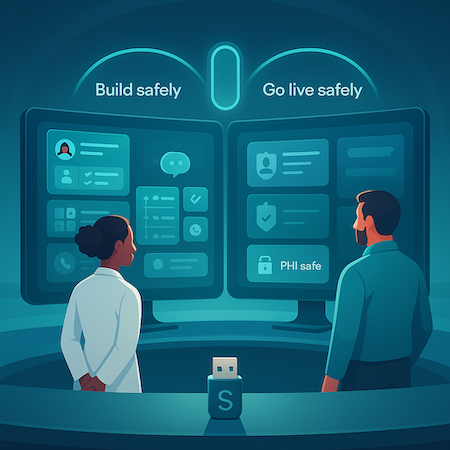
When you’re building with the AI assistant: zero PHI, zero exceptions
The fastest way to end up in trouble is letting real patient data slip into a system that’s not yet deployed in a protected environment. So Specode takes the opposite stance:
- While you’re building your app conversationally with the AI assistant, you should not use any PHI—period.
- The builder gives you HIPAA-friendly patterns (auth, roles, safe storage defaults), but it’s still a development context.
- You get working screens, flows, dashboards, messaging, scheduling, EMR patterns, and more—just with test data.
The benefit is simple: you get to explore, iterate, and shape the product fast, without accidentally creating a security incident before you even launch.
When you want to go live: we set up the real HIPAA environment
Once your AI-assembled app is ready for real users, Specode steps in with the exact layer most teams mishandle: the production environment.
Here’s what “moving to production” actually means with us:
- We configure a dedicated, fully isolated HIPAA-protected deployment for your app.
- PHI-safe infra, storage, encryption, secrets management, audit logs, and role scopes are set up correctly from day one.
- We sign the BAA—because at this point, we’re your actual HIPAA business associate, not a tooling vendor waving friendly marketing language.
- You retain full code ownership; nothing locks you in.
In short: once you’re ready for real patient data, we flip you from “prototype safely” to “operate safely.”
Or our engineers run the build from the start (HIPAA-compatible from day one)
Some teams don’t want to build on their own—they want our engineers to drive the first version so they can focus on clinical workflows, operations, and fundraising.
When the Specode team takes over the build:
- We set up the dev environment in a HIPAA-compatible configuration from the start.
- We assemble your V1 using pre-hardened components and expert engineering, not vibe coding.
- You still get all the benefits of the platform—reusable components, AI-driven iteration, and full code ownership—just without needing to build it yourself.
Think of it as the “done with you” path, optimized for founders who need to hit a deadline or show a working system to investors or clinic partners.
Why This Matters
The real win isn’t speed; it’s avoiding the cleanup. Most teams spend months untying the knots created by rushed early decisions—misconfigured auth, noisy logs, shared environments, AI code no one reviewed.
Specode eliminates those paths entirely: Build fast in a safe sandbox → then deploy into a hardened, PHI-ready environment → with a BAA → and code you fully own.
In practice, that’s how to use Specode to quickly launch a health app: prototype with zero PHI on hardened rails, then promote the same code into a HIPAA-ready environment once you’re confident in the workflow and ready to sign a BAA.
If you want the secure-by-default route to V1—without paying for the mistakes of vibe coding later—we can help.
Frequently asked questions
Vibe coding is building a healthcare app by feel: copying patterns from non-healthcare projects, gluing in AI-generated code, and pushing features based on “it works on my machine” instead of explicit security and compliance requirements.
In generic SaaS, you can sometimes get away with it; in healthcare, the same shortcuts can leak PHI into logs, analytics tools, or misconfigured cloud resources and trigger regulatory, legal, and commercial fallout that a small team can’t absorb.
AI accelerates inconsistency: it happily invents new admin panels, queries, and helpers that bypass your existing security patterns, leading to multiple auth, role, and logging styles living side-by-side in the same app.
Default-safe architecture (roles, PHI storage, env segregation), reusable components with documented behavior, understandable code paths, and built-in audit/readiness for real security reviews—not just a “HIPAA-friendly” badge and a marketing page.
Specode lets you assemble healthcare apps from pre-hardened, HIPAA-aware components using an AI assistant, but keeps PHI out of the build phase and then moves you into a properly isolated, BAA-backed production environment once you’re ready to go live, with full code ownership retained on your side.