
How to Create a Telehealth App Like Bask Health

If you have spent any time watching Hims, Ro, or any of the hundred-plus brands powered by Bask Health, you already know the playbook: a sharp niche, a tight intake flow, a provider network behind the scenes, and medication shipped to the door.
The model is working, and founders without a clinical background or a venture round are launching nationally in weeks. So the real question is not whether to enter the space. It is how to create a telehealth app like Bask Health that holds up once it scales.
This guide walks the full build end to end: the features, the tech, the compliance, the costs, and the trade-offs that decide whether you launch fast or launch right.
How do you create a telehealth app like Bask Health?
You build four things in parallel: an async questionnaire-based intake flow, a multi-state provider network with e-prescribing, integrated pharmacy fulfillment, and a HIPAA-compliant infrastructure with BAAs across every PHI-touching vendor. Most teams ship a working MVP in 3 to 5 months for $40K-$150K, then expand state by state. AI-assisted builders like Specode can compress that to weeks while preserving full code ownership.
Key Takeaways
- Bask is a reference architecture, not a destination. The async intake, multi-state provider network, integrated pharmacy, and subscription billing pattern works across men's health, GLP-1, mental health, derm, and beyond. Pick a vertical, copy the architecture, and go deeper than the platforms can.
- Compliance is a permanent operational layer, not a launch checklist. State licensure, DEA flexibilities (extended through December 2026), LegitScript, and HIPAA audits are line items every quarter. Build the workflows that absorb regulatory change without re-architecting.
- Recurring Rx is the moat. D2C health CAC runs $100-$500+ per patient, and you need 6 to 12 months of retention to break even. The monetization model you pick on day one decides whether you survive the payback period.
What Is Bask Health and Why It Matters
Bask Health is the infrastructure layer underneath a growing slice of D2C healthcare. Twin brothers Zachary and Elias Dorf founded it in 2021 in New York after their own direct-to-consumer telehealth brand collapsed on the integration work. The company raised a $760K seed in early 2024, stayed bootstrapped beyond that, and now powers more than 100 telehealth companies. The team calls it "the Shopify for e-Prescribing," and the analogy fits.
What Bask Health Actually Packages
The reason Bask Health app development became a category of its own is that the platform is vertically integrated. Instead of stitching together six vendors, you get:
- A nationwide provider network of healthcare providers (physicians, NPs, pharmacists)
- Compounding and retail pharmacy partners with automated prescription fulfillment
- An EMR with patient management and intake history
- A drag-and-drop questionnaire builder for the async clinical workflow
- A patient portal, payment processing, and an online pharmacy app surface that handles prescriptions and medication delivery end to end
Why It Matters for Anyone Building in This Space
Bask productized the Hims and Ro launch playbook for founders who would never get that far on their own. It compressed what used to take six to nine months of business development, legal work, and integration into something a pharmacist or operator could spin up in days. That is the bar. Whether you build on Bask, build like Bask, or build something better, this is the reference point the market now uses.
Why Build a Telehealth App Like Bask Health
If you are reading this, you are probably one of three people: a healthcare entrepreneur who wants a defensible D2C brand, a pharmacist or physician sitting on a clinical edge that no platform serves well, or an operator who has already validated demand and now needs to own the stack. The case to build your own platform, rather than rent one, comes down to economics, control, and timing.
The Opportunity in D2C Telehealth
Zachary Dorf has said it bluntly in his Entrepreneur columns: telehealth is the next big D2C wedge because it offers higher margins, recurring revenue, and far less competition than physical-goods e-commerce. Subscription medication is sticky in a way that supplements and apparel never will be. Patients refill, providers retain, and the LTV math actually works if you can hold a patient for 6 to 12 months.
That dynamic is why nearly every venture-backed D2C health brand looks structurally similar to Bask-powered companies. The model is proven. What is not crowded is the vertical depth underneath it.
The Real Question: Build vs. Use a Bask Health Alternative
A turnkey platform gets you live in days. The trade-off is the part most founders underestimate at signup:
- Margin. Per-transaction fees and platform pricing compound as you scale.
- Differentiation. If your intake flow, clinical logic, and patient experience all live inside someone else's UI, your moat is your marketing budget. That is not a moat.
- IP and exit-readiness. Acquirers pay for owned technology. They do not pay a premium for a Shopify-of-telehealth tenant.
- Workflow depth. The moment your clinical model gets specific (microdosed GLP-1s, bundled labs, hybrid sync/async, custom compounded formulations), you outgrow what any all-in-one platform exposes.
The pattern shows up in customer conversations constantly: a founder paying a four-figure monthly bill to a turnkey platform (like Bask Health), still unable to ship the product they actually want. Cheap to start, expensive to outgrow.
"We're paying for a platform every month and still can't build what we actually need. The flexibility just isn't there."
A custom build flips that trade-off. Every Bask Health alternative worth building front-loads the launch effort, but in exchange you own the patients and doctors relationship, the data, and the workflow.
The choice to build a telemedicine app from scratch is the bet more founders are making in 2026, and it is increasingly the right one as AI-assisted development collapses what used to be a 9-month engineering grind into a few weeks of focused work.
The expertise you need to pull this off is real, but it is no longer rare.
Telehealth Market Overview
The numbers behind telehealth app development are not subtle. Global telehealth is expected to hit $191.88 billion in 2026 and reach $1.4 trillion by 2035, growing at a 24.7% CAGR over the decade. The US share alone is projected to climb from $65.35 billion in 2026 to nearly $359 billion by 2034.
Those are the headline figures. The more interesting story is in the segment Bask Health and its competitors actually compete in.
D2C Telehealth Is Outpacing the Broader Market
The US D2C segment was valued at $1.47 billion in 2023 and is projected to reach $9.53 billion by 2030, a 30.3% CAGR. That growth rate is meaningfully higher than the rest of the healthcare industry, which tells you something important: while the healthcare organizations and hospital systems are still figuring out hybrid care, the consumer segment is already running.
Adoption metrics back this up:
- 32.3% of US adults use telehealth services as of 2025
- 71.4% of physicians report using telehealth weekly in their practice
- More than 7 million prescriptions for controlled medications were issued via telemedicine in 2024 alone
What Is Driving the Curve
Three forces are pulling the market faster than analysts expected even two years ago:
- GLP-1 demand. The weight-loss segment is projected to reach $71.6 billion by 2030. Every major D2C telehealth brand has either launched or expanded a GLP-1 line in the last 18 months.
- Big retail entering. Walgreens launched Walgreens Weight Management in February 2026. Walmart expanded Better Care Services in April 2026. Amazon, CVS, and even the federal government (TrumpRx) are now playing in the same lane Bask was built for.
- Better telehealth solutions on the supply side. Async-first clinical models, AI-assisted intake, and HIPAA-eligible cloud infrastructure have driven medical care delivery costs down meaningfully.
The market is large, growing fast, and structurally favoring purpose-built D2C brands over generalist platforms. That is the window.
Key Features of a Bask Health-Style Telehealth App
Telemedicine app development for a Bask-style brand breaks into four feature buckets. Skip any one of them and you have a partial product.
Patient-Facing Features
- Async questionnaire-based intake. The Bask signature. A well-designed clinical questionnaire converts higher than a video-first model and creates a structured record the provider can review in minutes. The intake is your funnel.
- Account creation and identity verification. Required for HIPAA, prescribing, and payment processing.
- Secure messaging. Pre-visit questions, post-visit follow-ups, and refill requests all live here.
- Appointment scheduling for sync visits. When video calls are needed, the booking flow has to handle real-time availability across a multi-state provider pool.
- Subscription management and refill flow. Patients should be able to pause, skip, switch dosage, and reorder without contacting support.
Provider-Facing Features
- Provider dashboard with intake review, prescription writing, and follow-up triggers
- HD video consultations with screen sharing and automatic session logging
- E-prescribing with pharmacy network routing and contraindication flags
- Automated follow-up workflows that surface patients who need attention
- Role-based access so MAs, NPs, and supervising physicians each see what they should
Pharmacy and Fulfillment
This is the layer most generic telemedicine mobile application templates skip, and it is the layer that defines the Bask model.
- Integrated pharmacy network routing prescriptions to compounding partners, retail, or mail-order based on drug, state, and patient preference
- Medicine delivery app development patterns for shipment tracking, patient notifications, and refill cadencing
- Cold-chain handling for GLP-1s and other temperature-sensitive medications
- Refill automation with payment retry logic, address verification, and adherence nudges
Compliance and Operational Features
- HIPAA-compliant data handling for all patient data, including electronic health records, medical records, and complete health records across the patient lifecycle
- Comprehensive audit logs capturing every PHI access, prescription event, and consent capture
- PHI-safe analytics that separate operational metrics from anything identifiable
- Payment processing at Stripe-grade reliability, including HSA/FSA and subscription billing
- Remote patient monitoring hooks for verticals involving connected devices, vitals tracking, or asynchronous care between visits
The brands that beat the platforms do not necessarily build more features. They build these features deeper.
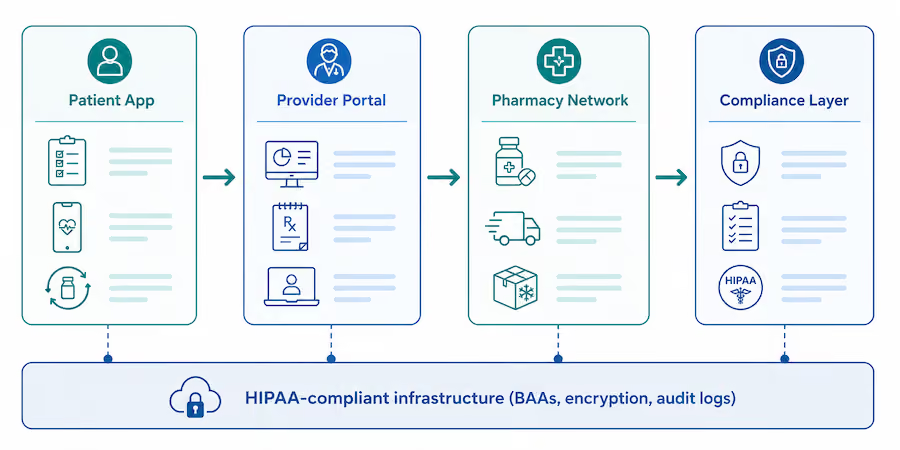
Types of Telehealth Apps Similar to Bask Health
The Bask architecture (async intake, multi-state providers, integrated pharmacy, subscription billing) is a template, not a product. Most founders looking to make a telemedicine app like Bask Health are choosing among the following lanes.
Men's Health
Hims, Roman/Ro, and Mosh defined the men's health telemedicine playbook with ED, hair loss, and TRT. Strong margins, high retention on daily regimens, manageable CAC.
Women's Health
Hers, Tia, and Kindbody serve birth control, fertility, hormone health, and postpartum mental health. Nuanced intake logic and sharper regulatory edges around cycle-tracking data.
Weight Loss and GLP-1
The fastest-growing vertical in 2025-2026. Ro Body, Calibrate, Sequence (acquired by WeightWatchers for $132M), and TrimRx all built around semaglutide and tirzepatide. Building a defensible weight loss platform now means navigating compounded vs. branded supply, FDA scrutiny, and cold-chain logistics. The category is on track to hit $71.6B by 2030.
Mental Health
Cerebral, Talkspace, and Brightside mix async messaging, medication management, and therapy. Higher clinical liability and a deeper compliance stack (PSYPACT, state licensing, controlled substances). The mental health app development playbook diverges from the Bask model.
Dermatology
Curology, Apostrophe, and Nurx run photo-based async consultation with custom-compounded topicals. Excellent unit economics.
Chronic Condition Management
Omada and Livongo combine connected devices, coaching, and medication management for chronic condition management. Typically B2B2C, not pure D2C.
Sexual Health
Roman, Hims, and Wisp serve ED, herpes, STI testing, and PrEP. Async intake fits the convenience-and-discretion value prop.
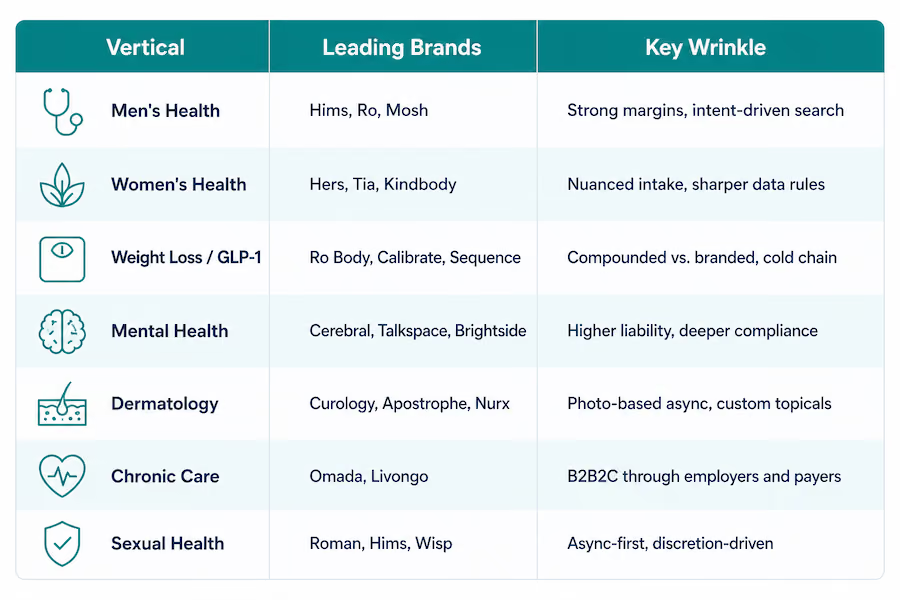
Each lane shares the same architectural backbone. What differs is intake nuance, pharmacy mix, regulatory edge, and brand voice. Pick one. Go deep.
7 Steps to Build a Telehealth App Like Bask Health
Knowing how to build a telehealth app is less about engineering and more about sequence. The brands that ship in months instead of years follow roughly the same path.
Step 1: Define Your Vertical and Clinical Model
Decide three things before a single line of code: which vertical you serve, whether visits are async, sync, or hybrid, and what the patient journey looks like end to end. A men's health TRT brand and a GLP-1 weight loss brand share an architecture but almost nothing else operationally. Intake logic, follow-up cadence, lab requirements, and pharmacy partners all flow from this decision.
Step 2: Validate the Regulatory Path
Map the regulatory landscape before you commit to a launch state list. This is not a checklist; it is a permanent operational layer.
- State licensure: launch states, provider license types (MD, NP, PA), applicable interstate compacts
- Controlled substances: Schedule II-V verticals operate under DEA flexibilities expiring December 31, 2026
- Drug-specific watchlists: compounded GLP-1s, hormone therapies, FDA shortage-status drugs
Step 3: Source Providers and Pharmacy Partners
The bottleneck most founders underestimate. The development team writing the code is not the team signing these contracts, and the BD work runs in parallel with Step 1.
- Provider network: 50-state strategy or a defensible narrower start
- Pharmacy partners: compounding for custom formulations, retail and mail-order for branded
- E-prescribing: routing for state rules, formularies, and DEA-controlled prescriptions
Step 4: Design the Intake and Clinical Workflow
The intake questionnaire is your conversion engine and your clinical record. This is where your years of experience as an operator (or your clinical advisor's) becomes the product.
- Decision-tree logic: captures history, routes to the right treatment path
- Escalation triggers: sync visits, lab work, or rejection instead of auto-approval
- Contraindication flags and follow-up cadences: protect patients, providers, and retention
Step 5: Build the MVP
Patient app, provider portal, admin dashboard, payment flow, and minimal pharmacy integration. Resist building everything in version one. The features you think you need on day one are usually the features you change twice in the first 60 days of real patient traffic.
Step 6: Wire HIPAA-Compliant Infrastructure From Day One
Encryption, audit logging, role-based access, BAAs with every PHI-touching vendor, and consent capture have to be baked in. Retrofitting compliance after launch is the most expensive way to learn this lesson, and the clinical workflows downstream depend on getting it right.
Step 7: Launch in One State, Then Expand
Pick one state with favorable telehealth rules and obsess over unit economics for 60 to 90 days before scaling. The development process does not end at launch.
- Starting state: Florida and Texas are common picks for clear rules and high demand
- Unit economics: retention, CAC, and clinical outcomes before multi-state complexity
- State-by-state scale: expand on evidence, not ambition
Done in this order, the build is hard but tractable. Done in any other order, it tends to stall around month four.
Tech Stack for a Telehealth App Like Bask Health
There is no single right stack for a telehealth app like Bask Health. There is a stack that signs BAAs cleanly, scales without surprise costs, and survives a security audit. That is the bar. Here is what teams shipping production telehealth in 2026 are actually using.
Frontend and Mobile
- React Native or Flutter for cross-platform mobile (one codebase for iOS and Android, native performance where it matters)
- React or Next.js for web portals (provider dashboards, admin panels, marketing surface)
- Tailwind or a design system for consistent component styling across patient and provider surfaces
For most D2C telehealth brands, the patient experience runs on a telehealth mobile app while providers and admins work in browser-based portals. That split keeps each surface optimized for its user.
Backend and Data
- Node.js or Python (FastAPI, Django) for the application layer; both have mature healthcare libraries and HIPAA-eligible hosting paths
- PostgreSQL as the primary relational database; Redis for sessions, caching, and rate limiting
- Microservices for billing, intake, provider routing, and pharmacy integration once you scale past the MVP
- HL7 FHIR for any EHR integration via Redox, Particle Health, or direct connections to Epic and Cerner
Video, Communications, and Payments
- Twilio, Vonage, or Agora for video and messaging, all of which sign BAAs; Zoom for Healthcare is the fastest path if you want a turnkey option
- WebRTC if you need fully custom video infrastructure (longer build, lower per-minute cost at scale)
- Stripe for payments, including subscriptions, HSA/FSA support, and saved cards
- Mailgun on its HIPAA plan for transactional email; Twilio for SMS, with PHI scrubbed before any message leaves the system
Cloud and Compliance
- AWS or GCP with HIPAA-eligible services only; AWS HealthLake is worth a look if FHIR-native storage simplifies your data model
- TLS 1.3 for all API traffic, SRTP/DTLS for media streams, WSS for signaling
- OAuth 2.0 for auth, with MFA mandatory for any provider or admin account
- Audit logging at the database and application layer, with retention policies that match HIPAA's six-year requirement
A clean tech stack does not save a bad clinical workflow, and the most elegant telemedicine software in the world cannot fix a vendor that refuses to sign a BAA. The stack matters. The contracts matter more. Pick infrastructure where the data security posture, the BAA, and the accurate diagnoses your clinical model produces are all defensible in the same audit.
Compliance and Legal Requirements
If you are reading this, you already know what HIPAA is. You also probably already know that BAAs, encryption, and audit logs are table stakes. What is harder to find in one place is the current 2026 state of the rules that actually move when you create a telemedicine app.
What Actually Changed in 2026
The DEA's Fourth Temporary Extension (issued December 31, 2025) keeps the COVID-era flexibilities alive through December 31, 2026. Practically:
- Schedule II-V controlled substances can still be prescribed via audio-video telemedicine without a prior in-person evaluation.
- Audio-only prescribing is permitted for Schedule III-V buprenorphine and other FDA-approved opioid use disorder treatments.
- Permanent rules are coming. The DEA's proposed Special Registration for Telemedicine framework is expected to be finalized before the current extension expires, and it will likely add registration, recordkeeping, and PDMP-check requirements that do not exist today.
If your vertical depends on controlled-substance prescribing, treat the December 2026 deadline as a real product milestone. Build flexibility into your provider onboarding and prescription workflows now so you can absorb new registration requirements without re-architecting.
State Licensure Is Where Most Founders Get Burned
A clinician must hold an active license in the state where the patient is physically located at the time of the visit. That is the rule everywhere, with very narrow exceptions. The compacts ease the burden differently by profession:
- IMLC (Interstate Medical Licensure Compact) for MDs is an expedited pathway, not portability. You still get individual state licenses, just faster.
- NLC (Nurse Licensure Compact) is a true multistate license across 43 jurisdictions, which is why so many D2C brands lean heavily on NPs.
- PSYPACT (43 jurisdictions) for psychologists and the APRN Compact (17 states, but missing CA, NY, TX, FL) for nurse practitioners.
- Telehealth-specific registration in Florida and Colorado (launching 2026) lets out-of-state clinicians serve those markets without full licensure under specific conditions.
The licensure layer is operational, not legal. Build it into your provider onboarding software and credentialing workflows from day one.
FDA, LegitScript, and the Rest
- FDA SaMD scope kicks in if your app makes diagnostic or therapeutic claims (as opposed to providing access to clinicians who do). The line is narrower than most founders assume.
- Compounded GLP-1 scrutiny has increased through 2025-2026, with FDA warning letters issued to multiple telehealth companies for misleading marketing.
- LegitScript certification is required for paid ads on Google and Meta in any prescription category. Budget the time and the $1,600/year fee.
- State-specific telehealth consent rules vary; many require renewal annually and explicit acknowledgment of telehealth-specific risks.
Compliance is a living cost. Annual HIPAA audits, penetration tests, license renewals, and counsel retainers are line items, not project expenses. Staying HIPAA compliant year over year is operational work, not a launch milestone. The healthcare professionals on your platform care about this. The patient care quality depends on it. Plan accordingly.
Monetization Strategies for Telehealth Platforms
How you charge defines what you can build a telemedicine platform around. The model decides your CAC tolerance and your retention math.
Subscription (the D2C Default)
Monthly recurring access to a provider plus medication. Hims, Ro, and most Bask-powered brands run on this. The subscription model is predictable. Non-medication subscriptions cap around $40-$80/month; bundled-medication subscriptions push to $200-$500/month for GLP-1 programs.
Pay-Per-Visit
$49-$99 per consultation, medication separate. Walgreens Weight Management runs $49/visit. Lower friction at the top of the funnel, weaker LTV.
Bundled Care
Consult, medication, and check-ins for one fee. The dominant GLP-1 pattern at $199-$449/month. Simple for the patient, but you eat medication-cost volatility on compounded formulations.
B2B and B2B2C
Licensing the platform to clinics, employer programs, or insurance. Higher ACV, longer sales cycle. Most D2C brands layer this on top later, not at start.
Hybrid
The most defensible play. Ro and Hims run subscription, per-visit, and B2B in parallel.
In 2026, recurring Rx is the moat. CAC in D2C health regularly runs $100-$500+ per patient, and you need 6-12 months of patient care to break even. Pick a model that gives you that runway from the first transaction.
Challenges in Telehealth App Development
Building a telemedicine platform is hard for reasons that are mostly not technical. The actual challenges, in rough order of how often they kill brands:
Provider Acquisition and Licensing Scale
A 50-state network is a 12-18 month grind. Credentialing alone runs 30-45% of admin overhead in most D2C brands.
CAC Pressure
D2C health CAC has climbed to $100-500+ per patient. iOS privacy changes and ad platform restrictions on prescription categories hit harder here than almost anywhere else.
Retention Math
If a patient churns at month 2, you lose money. Subscription products need 6-12 months of median tenure to break even.
Intake Abandonment
Clinical questionnaires can drop off at 40-60% if they are not optimized. The intake UX is a unit economic, not a UX problem.
Pharmacy Logistics
GLP-1 cold chain, controlled-substance handling, multi-state pharmacy permits, and refill timing all compound as you scale.
Compounded vs. Branded Medication Risk
FDA scrutiny on compounded GLP-1s has tightened through 2025-2026. Brands that built their economics around compounding are re-pricing right now.
Trust vs. Incumbents
Hims, Ro, and Teladoc spend hundreds of millions on brand. The complexity of competing on awareness is unwinnable. Compete on vertical depth and clinical quality assurance instead.
Cost of Building a Telehealth App Like Bask Health
What it costs to develop a telehealth app depends on three things: scope, where your team sits, and how much of the compliance work you absorb in-house. Here is what 2026 pricing actually looks like.
Build Cost by Tier
Recurring Costs to Budget
The build is a one-time spend. Running a high quality telehealth application is a forever cost, and the operational stack is where most founders underestimate the user experience trade-offs:
- Infrastructure: Twilio/Agora $500-$5K/mo at scale; HIPAA cloud $1-5K/mo baseline; HIPAA email and SMS plans on top
- Compliance: Annual HIPAA audit $10-30K; pen test $3-15K; LegitScript $1.6K/year; counsel retainers
- Insurance and ops: Telehealth-specific malpractice riders, license renewals, ongoing credentialing
These items are line items, not project expenses. Most founders underestimate the recurring side by 40-60% in their first budget pass.
Build vs. White-Label vs. AI-Assisted Custom
Three structurally different paths:
- White-label telehealth platform (Bask, UpScript): live in days, capped differentiation, per-transaction take rate
- Traditional custom build: full ownership, 6-12 months, 10-50x the upfront spend
- AI-assisted custom build (platforms like Specode): full code ownership without the timeline or cost of traditional dev. The middle path that did not exist two years ago.
The right choice depends on whether your edge is speed-to-market or long-term defensibility. The good news in 2026 is that you no longer have to pick one at the cost of the other.
How Specode Can Help
Specode is an AI-powered healthcare app builder designed specifically for the kind of build this guide describes. Unlike generic no-code tools, Specode understands healthcare constraints (PHI handling, audit logging, the way health data flows between intake, provider, and pharmacy) from the first prompt and ships production code, not platform tenancy.
For a Bask-style D2C build, Specode handles the boilerplate that kills timelines:
- HIPAA-compliant by default. Auth, secure data models, end-to-end encryption, and BAA-ready hosting.
- Built-in HIPAA Compliance Agent. A multi-agent scanner runs against your codebase and flags violations by severity, with re-scan workflows to verify fixes.
- Full code ownership. Export your complete source code at any time. No vendor lock-in, no per-transaction fees, no platform dependency on exit.
- AI that understands the domain. Healthcare-specific intake flows, provider portals, and EHR integration patterns are first-class, not workarounds.
The result: a production-grade healthcare app builder experience that compresses what used to be a 9-month engineering project into weeks. If you are figuring out how to create a telehealth app that is defensible, owned, and ready to scale, Specode is the shortest credible path to launch.
Frequently asked questions
Bask Health is a no-code, white-label platform for launching D2C telehealth brands. It bundles providers, pharmacies, EMR, payments, and an intake builder under one stack.
Bask is infrastructure, not a consumer brand. It packages provider networks, pharmacy fulfillment, and payments into one platform so founders can launch without integrating six vendors themselves.
HIPAA compliance, state licensure where the patient is located, DEA flexibilities for controlled substances (extended through December 2026), LegitScript for paid ads, and state-specific telehealth consent rules.
A custom MVP runs 3-5 months. AI-assisted platforms like Specode can ship production-grade telehealth apps in weeks. Enterprise builds take 9-18 months.
MVPs start around $40K offshore or $80K-$150K US-based. Mid-tier builds run $100K-$250K. Enterprise platforms with full provider and pharmacy networks reach $300K-$500K or more.
Subscription bundled with medication is the dominant 2026 pattern. Pay-per-visit lowers funnel friction. Hybrid models combining subscription, per-visit, and B2B are the most defensible.
Expect deeper AI-driven intake, hybrid sync/async clinical models, more state-level telehealth registration pathways, and continued GLP-1 demand pulling new verticals into the D2C model.


