Corporate Wellness App Development

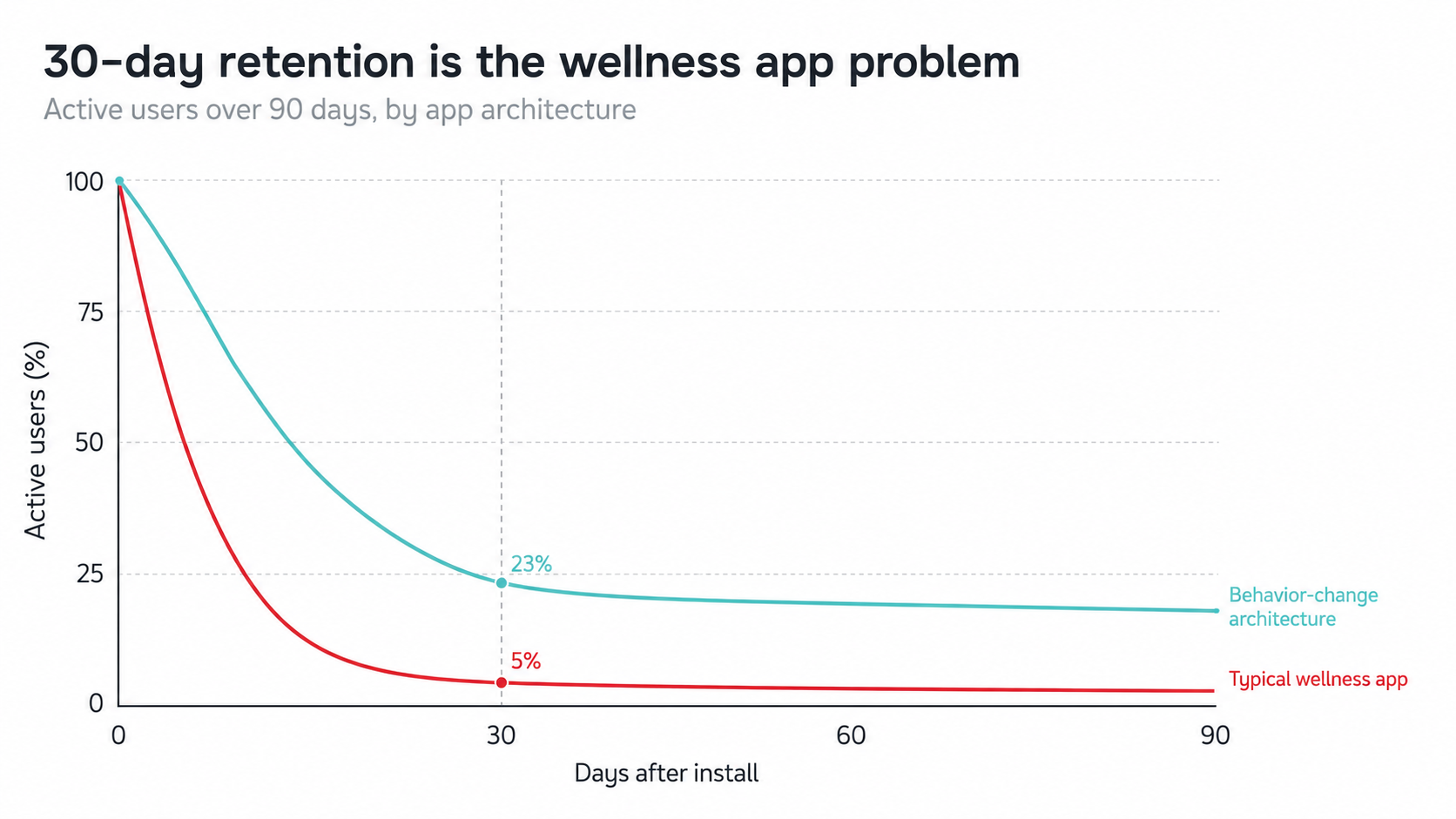
95% of users abandon a wellness app within 30 days. For mental health apps specifically, a peer-reviewed panel study put median 30-day retention at 3.3%. The 23% active-use-after-month-1 figure quoted in HR procurement decks is the optimistic end of that curve. Closing the rest is what corporate wellness app development has to do in 2026.
The employer math hasn't moved much. Gallup pegs global employee engagement at 21% as of 2025. Absenteeism and burnout prevention still dominate the wellness rationale, and remote workforce and hybrid work patterns mean the lunchroom yoga poster reaches no one. The app is the program now. This guide is for the two audiences who have to ship something:
- HR leaders procuring an internal tool
- health-tech founders building B2B SaaS for employers
The corporate wellness market sits around $8.4B in 2024 and grows at 13.8% CAGR through 2030, though estimates vary widely by definition. There's a baseline to beat now: 48.7% of U.S. adults used LLMs for psychological support last year, and only 18.5% of that use happened on purpose-built tools. The competitor is ChatGPT.
How do you build a corporate wellness app that people actually use?
Build the behavior-change architecture first (self-monitoring, goal-setting, feedback loops), then wire it into the systems employees already touch: HRIS, SSO, wearables, Slack or Teams bots, and existing benefits like EAP. Treat FTC Health Breach Notification Rule compliance as seriously as HIPAA, since most wellness apps now fall under it. Budget $30K to $300K+ depending on scope, and make sure the AI feature actually beats ChatGPT for the employer-specific context.
Key takeaways
- Behavior-change architecture decides retention. The peer-reviewed literature converges on self-monitoring, goal-setting, and feedback loops. Apps that ship 30 features without that architecture retain like content libraries.
- The four regulations that matter in 2026 are HIPAA, FTC HBNR, ADA/GINA, and GDPR. HIPAA applies less often than wellness builds assume, and FTC HBNR (updated July 2024) is the regulation most teams miss at $51,744 per violation.
- Integrations decide enterprise procurement. HRIS via Finch or Merge.dev, SSO with Okta or Microsoft Entra, wearable APIs, EAP bridges, and SOC 2 Type 2 are what HR procurement actually audits.
- Your AI feature has to beat ChatGPT. 48.7% of U.S. adults used LLMs for psychological support last year. If the in-app feature isn't better for the employer-specific context, employees use the free tool already on their phone.
Corporate wellness apps split into two builds
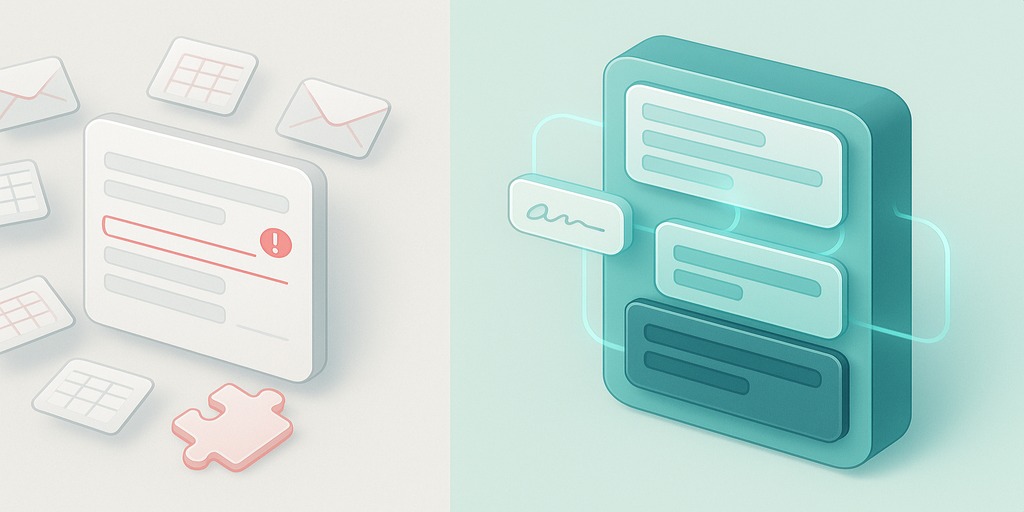
Both builds get pitched as a wellness app for companies or a corporate health app, which is true and useless. The labels collapse a real distinction. One build is an internal HR tool for a single workforce, owned by the employer and rolled out to its own staff.
The other is a B2B SaaS wellness platform sold to HR teams across many companies. The audience split changes every downstream choice that follows:
- features
- integrations
- compliance scope
- cost
- timeline
Build one: an internal HR tool for one workforce
The audience is the human resources team and its executives. The constraints are bounded: one HRIS, one SSO, one compliance posture, one wellbeing budget. Most procurement questions that haunt external vendors are non-questions here, because everything's decided in-house.
The hard problem is adoption. An employee wellness platform with 60% sign-up and 8% sustained use makes a clean rollout slide and a real failure. Behavior change inside one workforce is the entire job.
Build two: a B2B SaaS wellness platform sold to employers
The audience is HR teams in many companies, and procurement is the first wall. A SaaS wellness platform aimed at B2B wellness sales has to support:
- 250+ HRIS providers (Finch or Merge.dev abstracts most of this)
- dozens of SSO setups (Okta and Microsoft Entra ID dominate enterprise)
- multiple wearable APIs
- SOC 2 Type 2 by the first 1,000-employee customer
Employee wellness app development at this scale is mostly integration-breadth work. Feature depth is the next problem. The hard problem is enterprise procurement.
Consolidation is the other trajectory worth naming: standalone wellness platforms are getting absorbed into broader benefits suites that bundle wellness with health plan administration and navigation. Personify Health (formerly Virgin Pulse, brand sunset January 1, 2025) is the cleanest current example.
Corporate wellness platforms worth knowing in 2026
Three categories now define corporate wellness platform development, and the lines between them hardened after 2023.
- Enterprise benefits suites are absorbing the top of market.
- Mid-market generalists compete on price.
- Mental health specialists hold the most defensible territory.
The healthcare industry has watched standalone wellness vendors get bought up or pushed downmarket. Building a corporate wellness platform now means picking a category to fight in before picking features to ship.
More on mental health app development
Enterprise benefits suites are the new top of market
Two names anchor the enterprise wellness category in 2026. Personify Health was Virgin Pulse until the November 2023 HealthComp merger. Backing comes from New Mountain Capital, Blackstone, Marlin Equity, and Morgan Health.
Custom enterprise pricing, no public per-employee rate. Positioning now sits in health plan administration, navigation, and wellbeing in one contract. Microsoft Viva Insights plays the other half: bundled into Microsoft 365, pulling Office 365 and Teams telemetry, with privacy-protected aggregated insights for HR. Best fit when the buyer already lives in Microsoft 365.
Mid-market generalists trade depth for price
The mid-market is crowded, and the pricing tells you why. Three names worth knowing:
- Vantage Fit: $1/user/month, owned by Vantage Circle. AI-powered challenges, gamification, wearables. Cheapest in the category, lightest on depth.
- Wellable: $4/user/month Essentials, $6/user/month Pro. G2 sits at 4.7/5 across 900+ reviews. Content-driven and broad in scope.
- BetterMe Business: D2C-origin platform now bundling physical and mental health for employer rollouts. Lighter on enterprise admin tooling.
These platforms are priced for activation. HRIS-deep integration and mental-health regulatory alignment live in other categories.
Mental health specialists are the most defensible category
Headversity built its corporate wellbeing platform around mental fitness. ISO 45003 alignment is the headline framework. Compliance covers SOC 2 Type 2 along with GDPR and PIPEDA for cross-border deployments. 18+ countries, 3 million lives. The pitch: "Duolingo for mental fitness," with AI coaching as primary entry.
Talkspace for Business comes from consumer therapy and connects employees to licensed healthcare providers through text and video clinical care; payer-side revenue grew 33% YoY in Q1 2025.
ComPsych GuidanceResources is the giant: world's largest EAP, 78,000+ organizations. Regulatory alignment and clinical infrastructure are the moats here, and neither price plays nor generalists clear that bar without years of build.
Calm for Business and Headspace for Work are content licenses with no leaderboards or HR analytics. They typically deploy alongside a real platform.
Features that drive corporate wellness app retention
The retention numbers from the intro tell you why feature lists are mostly noise. A corporate wellness app with 30 features and 6% sustained use is the industry default. Behavior change is what features are supposed to deliver, and the design literature is clear about which features actually do it.
Behavior change is what makes features stick
The peer-reviewed literature on health behavior change converges on a short list of features that actually move users:
- self-monitoring of performance,
- goal-setting tools,
- and feedback mechanisms.
Everything else is supporting cast. Wellness programs that build around these three earn higher sustained use than feature-rich apps without them. The design implication is concrete: every feature on the roadmap should pass through a behavior-change filter before it ships.
Step counting works because it bakes in daily self-monitoring with immediate feedback. A 400-track meditation library doesn't, because content alone is not behavior architecture.

Physical health features that earn their place
Physical health features split into two layers. The wearable-sync layer covers activity tracking, fitness tracking, sleep tracking, and nutrition tracking. These are table stakes in 2026, and the data only matters when it feeds into goal-setting and feedback loops.
The engagement layer adds:
- health challenges,
- gamification,
- rewards and incentives,
- step competitions.
This is where most platforms run their flashiest features, but gamification reliably moves activity for 4-6 weeks and then plateaus.
After the badge novelty wears off, you're back to whether the app fits into someone's actual day. Our fitness app development guide covers the architecture when physical activity is the primary use case.
Coaching tools and 1:1 virtual training fit here too. Live or async sessions with a human or AI coach measurably outperform standalone content libraries, especially for return-to-fitness cohorts. The deeper build pattern lives in our personal trainer app development write-up.
Mental health features carry most of the engagement
Mental health features carry more sustained engagement than physical features in 2026 data, partly because the underlying need is more chronic and partly because consumer AI has trained employees to use chat-style support continuously.
The standard mental health stack covers:
- meditation
- mindfulness exercises
- mood tracking
- stress management content
- journaling
- SSO bridges into the employer's EAP
Our meditation app development guide has the dedicated build pattern.
The competition is the meaningful part. Earlier this guide cited 48.7% of U.S. adults using LLMs for psychological support and only 18.5% of that on purpose-built tools.
Your meditation script or stress chatbot is in direct competition with ChatGPT's. Either the in-app feature beats general-purpose AI for the employer-specific context (the user's role, schedule, manager, last week's HRV), or employees route around your app to the consumer tool that's already on their phone.
The nudge layer is where most apps under-invest
The nudge layer decides whether the rest of the app gets opened a second time, and most teams under-invest here. Two visible failure modes:
- Default-template push notifications at default times. Opt-out rates above 40% by the end of week two are the norm. The design assumes every employee's day looks identical, and notifications hit users in the middle of meetings or after they've already logged off.
- Personalized health plans generated once at signup. Never updated against actual usage, so the user files them under marketing.
The version that earns its place tunes notification timing to each person's actual schedule (after a long meeting block, before the calendar gap), and keys rewards and personalization to the user's own behavior baseline.
This is where most employee health and wellness app builds quietly fail, and where employee wellbeing app teams end up competing on the wrong axis.
The integrations that decide adoption
Integrations decide whether HR procurement keeps the contract past year one. The HRIS connection is the first thing procurement audits, and the rest of the stack determines whether the app shows up inside the systems employees already use. The list is shorter for HR-side internal builds and longer for B2B SaaS.
HRIS integration is what HR procurement actually checks
HRIS integration is the first wall in any enterprise wellness contract. The two abstraction layers worth knowing are Finch and Merge.dev. Finch is HRIS and payroll-focused, with 250+ provider integrations and deeper data normalization for the fields wellness apps actually care about:
- employee roster,
- role,
- employment status,
- manager hierarchy.
Merge.dev is a broader unified API spanning HR, payroll, accounting, CRM, ATS, and ticketing. For wellness apps specifically, Finch's narrower focus usually wins. EHR integration rarely comes up outside clinical workflows, so most wellness builds skip it.
Wearables, SSO, and chat bots are the integrations users actually feel
Wearable integration runs through a growing list of APIs:
- Apple HealthKit (iOS, primary US market)
- Google Health Connect (replaced Google Fit API in 2024 for Android)
- Fitbit Web API (Google-owned since 2021)
- Garmin Health API (notable approval lag)
- Oura API (the rising one)
SSO integration breaks down by buyer size. Okta and Microsoft Entra ID (formerly Azure AD) own enterprise; Google Workspace handles SMB. SAML and SCIM are the protocols every B2B SaaS wellness platform supports by default. Slack and Microsoft Teams bot frameworks are real engagement channels in their own right.
Native chat bots beat email nudges on response rate, and they're often the difference between an app users open and an app users forget. API integration choices age slowest in the stack, so pick deliberately.
Bridges into the existing benefits stack quietly do the most work
Three bridges into the employer's existing benefits stack matter most:
- Employee assistance program (EAP) integration: SSO bridges into ComPsych, Lyra Health, Spring Health, Modern Health, or whichever EAP the employer already runs. Most builds want one click from the wellness app into the employer's existing therapy network.
- Telehealth as wellness benefit: virtual care access through the wellness app is fast becoming an expected feature. The deeper telehealth app development build pattern lives in our dedicated write-up.
- ICHRA and HRA reimbursement flows: Take Command, HealthEquity, and PeopleKeep run these pre-tax reimbursement arrangements; integrating with one lets employees submit wellness expenses without leaving the app.
Where AI helps and where it's theater
The AI section of every wellness pitch deck reads the same in 2026. The shipping reality is narrower. Some AI features earned their place by doing measurable work; others are still marketing language wrapped around features the science hasn't backed yet.
The AI features doing real work in 2026
The list of AI applications doing real work inside corporate wellness deployments is shorter than the pitch decks suggest. The features earning their place in 2026:
- Microsoft Viva Insights as the dominant enterprise burnout-analytics tool, pulling Office 365 and Teams telemetry into privacy-protected aggregated views for HR.
- Early-warning signals for burnout drawn from HRV, screen time, and calendar overload. Gartner reports point at 88% accuracy for the best-tuned models in 2026, though that figure is the upper bound; real-world deployments run lower.
- AI chatbots built on CBT-trained NLP (Woebot is the named example) handling first-contact mental health conversations at scale.
- Federated learning frameworks that let platforms train models without centralizing employee data, which solves part of the privacy problem cleanly.
- Personalized program recommendations grounded in actual behavior models, including chronic disease prevention pathways, which overlap with digital therapeutics app development.
Where the AI marketing outruns the science
Two AI claims dominate vendor decks without much science to back them. Organizational Network Analysis (ONA) for burnout detection sits at the top of the list: the research is still nascent, replication studies haven't confirmed it, and vendors sell it regardless.
Generic "AI-powered personalization" is the other one. It often ships as a content recommender re-skinned for wellness, with no actual behavior model underneath.
The other tension worth naming: employee-level AI insight versus HR aggregation. Done badly, it kills trust. The ChatGPT question from earlier sharpens here. If your AI feature isn't beating a 90-second ChatGPT prompt for the employer-specific context, employees are already using ChatGPT, and the feature counts as revenue without doing the work.
Compliance shifted in 2024
The regulatory picture for wellness apps moved in 2024. Most agency posts still describe the 2019 version. Four regulations matter most:
- HIPAA (less often than most assume)
- the FTC Health Breach Notification Rule (the one most teams miss)
- ADA and GINA for biometric programs
- GDPR for any EU-resident employee data.
ISO 45003 and state laws round out the picture.
HIPAA applies less often than wellness builds assume
HIPAA applies only when the wellness program is part of a group health plan, and the plan itself is the covered entity. Standalone wellness apps offered outside that plan generally aren't HIPAA-covered, and the wellness vendor becomes a business associate only when serving the plan.
Writing for IAPP in March 2025, Kirk Nahra at WilmerHale notes that the HIPAA privacy rule "was never intended as an overall health information privacy law." Calm illustrates this. Outside HIPAA for individual subscribers, BAA on request when Calm for Business works with self-insured employer health plans.
The implication: over-engineering HIPAA when it doesn't apply wastes audit-prep budget, and being HIPAA compliant when you're a business associate to a self-funded plan is mandatory. Our healthcare app development guide covers the broader compliance scoping.
The FTC HBNR is now the regulation most teams miss
The FTC Health Breach Notification Rule got its final-rule update on July 29, 2024. It now applies to virtually any health and wellness app not already covered by HIPAA. Civil penalty: $51,744 per violation, 2025 inflation-adjusted.
The enforcement track record is the warning. GoodRx hit the first-ever HBNR action in 2023. Premom (fertility tracker) and BetterHelp (online mental health) followed. The pattern in each case: third-party advertising SDKs receiving health-related events without consent that matched the privacy policy.
The 2024 update went further. "Unauthorized disclosure" now covers analytics SDKs sharing health data inconsistent with stated policy, and "dark patterns" do not constitute meaningful consent.
ADA, GINA, GDPR, ISO 45003, and state laws round out the stack
ADA and GINA only trigger when the wellness program collects biometric screening data or runs a health risk assessment. Smoking-cessation classes or step challenges without those don't apply.
The EEOC's 2016 incentive limit (30% of self-only coverage) was vacated by AARP v. EEOC in 2017 and formally removed from the CFR in July 2024. Only de minimis incentives are clearly safe now, and the 2022 City of Chicago GINA case remains unresolved.
The remaining stack:
- GDPR compliance: 4% of global annual revenue, applies to any EU-resident employee data wherever the company sits. Special-category health data requires explicit consent and a DPIA, plus data security controls demonstrable on demand.
- ISO 45003:2021: a guidance standard with no formal certification path. Victoria, Australia made psychosocial regs mandatory from December 1, 2025, pulling global employers toward 45003 alignment anyway.
- State laws: Washington My Health My Data Act, California CCPA/CPRA, Illinois BIPA, Texas DPA. Most have employment-data carve-outs, but the scope around wellness apps is untested.
Tech stack for building a corporate wellness app
The stack choices for a corporate wellness app are mostly settled by 2026. The interesting decisions are upstream: build-vs-buy, and how deep to commit on enterprise procurement readiness before you have customers. The right answer depends on whether you're building for one workforce or many.
The stack worth choosing in 2026
For most corporate wellness software development efforts, the default tech stack in 2026 is:
- Mobile: React Native or Flutter for cross-platform. Native iOS or Android only when wearable integration is the primary use case.
- Backend: Node, Python, or Go.
- Database: PostgreSQL for the primary store, Redis for caching.
- Auth: Firebase Auth or AWS Cognito.
- Comms: Twilio for SMS, native push for in-app nudges.
- Analytics: Segment or Amplitude; Mixpanel for engagement tracking specifically.
- Observability: Datadog.
- HRIS: Finch or Merge.dev as the abstraction layer.
- AI: OpenAI, Anthropic, or Azure OpenAI, with a BAA in place when the wellness app itself is a business associate.
SOC 2 Type 2 is the enterprise procurement bar for any B2B SaaS wellness platform serious about 1,000+ employee customers. HITRUST shows up only in the very large enterprise or regulated industry deals.
Build vs. buy, with a note on B2B SaaS monetization
HR buyers should buy. The math almost never favors building internal for a single workforce; the engineering cost outruns even multi-year procurement contracts, and the development team you'd staff isn't easy to keep through the post-launch maintenance phase.
B2B SaaS founders building a corporate wellness app should build the differentiated parts (engagement design and integration strategy) and integrate everything else: HRIS, SSO, wearables, EAP bridges.
On the monetization side, per-employee-per-month is the entire pricing model in this market. Vantage Fit anchors $1/user. Wellable sits at $4 to $6/user. Personify Health and ComPsych run custom enterprise contracts. User experience drives pricing power more than feature count.
The quality assurance work and development process you lock in before launch are what produce that UX at scale.
Where wellness app builds quietly fail
The wellness app builds we've watched fail share the same shortlist of root causes. Six failure modes account for almost every cancelled contract and quiet shutdown we've seen since 2023, and most sit upstream of engineering. Two are product mistakes visible in employee retention and engagement numbers. Four surface later, in compliance audits or procurement rounds.
Product mistakes that show up in retention numbers
- Shipping a feature list with no behavior-change layer underneath. The 95% 30-day drop-off in the intro is a design failure. The NCBI evidence is clear: self-monitoring, goal-setting, and feedback mechanisms drive behavior change. Apps that ship 30 features without that architecture retain like content libraries, and never move employee productivity in any measurable way.
- The kitchen-sink platform with 14 modules. Activity, mental health, EAP, nutrition, sleep, financial wellness, ergonomics, mindfulness, manager training, DEI, and the rest. Onboarding never finishes, employees never form a habit with any one module, and the "comprehensive employee wellness platform" deck loses the workforce two weeks in. A workplace health app trying to do twelve things ends up doing none of them. Pick three to do well.
Compliance and integration mistakes that surface later
- HIPAA mismatch in either direction. Over-engineering when the program isn't part of a group health plan wastes audit-prep money. Under-engineering when the wellness vendor IS a business associate to the plan is the exposure side. Both ways cost real money; the second can also draw regulatory attention.
- Ignoring the FTC HBNR. Third-party analytics SDKs sharing health-related events without explicit consent now means $51,744 per violation. The GoodRx, Premom, and BetterHelp enforcement actions establish the pattern. Most wellness builds we've seen don't audit their SDK stack for HBNR-relevant data flows.
- Skipping HRIS integration. Manual onboarding stalls every enterprise rollout we've watched. HR procurement asks at week 2. The deal stalls when the answer is "we'll add it post-contract." Finch or Merge.dev integration belongs in the product before sales conversations start.
- Not benchmarking the AI feature against consumer AI. With 48.7% of adults using LLMs for psychological support, your in-app meditation script or stress chatbot is in direct competition with ChatGPT. Either your workplace wellness app development effort beats it for the employer-specific context, or employees use the free tool already on their phone.
Cost to build a corporate wellness app in 2026
How to build a corporate wellness app in 2026 breaks into three well-known cost bands. The agency quotes usually leave out what hits after signing: recurring SaaS subscriptions, the SOC 2 audit cycle, integration approval lag, and OCR readiness work when HIPAA applies. Complexity ramps with the size of the customer, even when the feature list stays small.
What each cost band actually buys
The question of how to create a wellness app for employees splits cleanly into three bands by use case and customer size:
- MVP, $30K to $60K. Single-platform mobile, 3 to 4 core features, basic auth, one wearable API, no SOC 2 yet. Timeline: 3 to 6 months.
- Mid-level, $60K to $150K. Cross-platform mobile, HRIS via Finch or Merge.dev, SSO with major providers, the full behavior-change feature set, SOC 2 Type 2 audit prep underway. Timeline: 5 to 7 months.
- Enterprise AI platform, $150K to $300K+. AI features (burnout analytics, NLP chatbots, personalization with real behavior models underneath), full integration suite, SOC 2 Type 2 completed, HITRUST if a regulated buyer needs it. Timeline: 6 to 9 months.
- AI builder route, $3K to $9K. Healthcare-app boilerplate is pre-generated (and/or is coded faster); team time goes to engagement design and integrations. Best when the goal is shipping one product fast. Timeline: a few weeks.
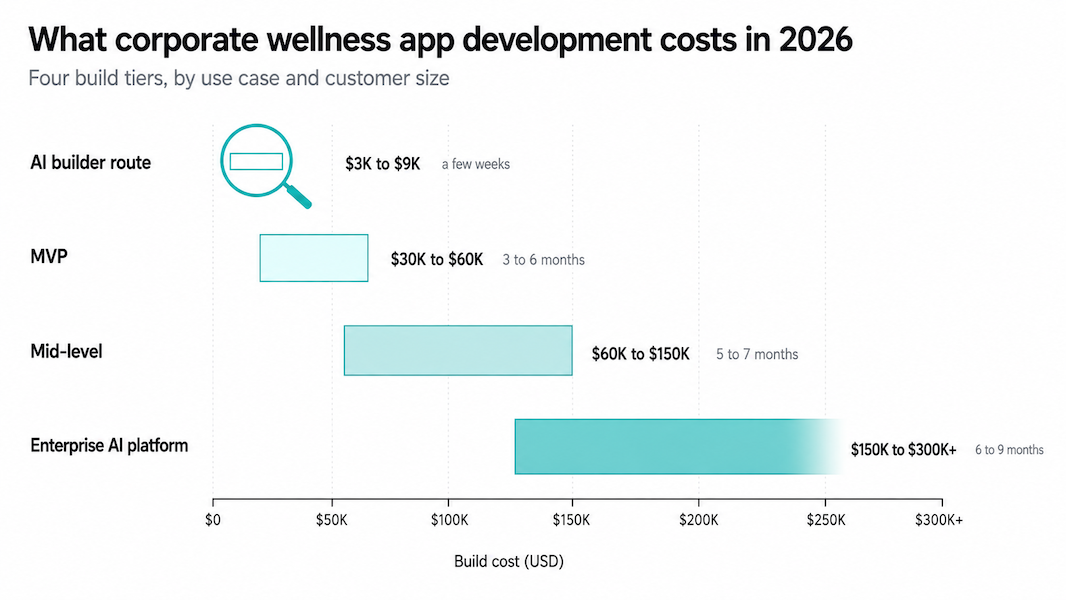
AI-assisted code generation is changing what each band buys when you build a workplace wellness app. The boilerplate 60% (auth, audit logging, encryption-at-rest, role-based access control) compresses fast, and the freed budget moves toward engagement design and integration depth. Return on investment at any tier comes down to retention design more than feature count.
Hidden costs the agency quote leaves out
The budget items that don't appear in the agency quote often add 20% to 30% to the all-in cost in year one. Finch or Merge.dev runs as a recurring SaaS subscription throughout the contract. SOC 2 Type 2 audit runs $25K to $40K in year one with ongoing observation costs after. BAA negotiation overhead matters when the vendor chain handles PHI for a self-funded plan. Wearable API approval lag (Garmin in particular) can push timeline by months. Add OCR readiness work if HIPAA actually applies.
Where Specode fits in
Specode is built for the part of the wellness app build where most teams lose time. AI-generated scaffolding handles the boring 60% of healthcare-app boilerplate:
- Auth
- Encrypted storage
- Role-based access
- BAA-eligible patterns
The team time that gets freed goes to engagement design and integrations, which is where wellness apps actually win or lose. When group-health-plan integration is in scope, the HIPAA-ready architecture is pre-baked, with backend hosting BAA included.
Cost sits well below the agency bands earlier in this post. Building a corporate wellness app with a builder like Specode typically runs $3,000 to $9,000 total, depending on complexity and integration breadth. Current plan options live on Specode pricing. The expertise behind the platform comes from years of experience at Topflight shipping healthcare apps across telehealth, mental health, and chronic care.
If you're ready to develop a corporate wellness app, start a Specode project. A working build is usually ready in the first week, and you can create a corporate wellness app demo to show stakeholders well before the typical agency contract gets signed.
Frequently asked questions
A digital platform that runs an employer's wellness program. Combines tracking, content, and engagement nudges across physical and mental health, usually connected to the HRIS and benefits stack.
Behavior-change mechanics drive retention: self-monitoring, goal-setting, and feedback. Wearable sync and mental health tools support them. Feature count matters less than the design behind it.
HIPAA applies only when the program is part of a group health plan. FTC HBNR applies to most others at $51,744 per violation. Both have teeth.
3 to 6 months for an MVP. 6 to 9 months for an enterprise AI platform with full HRIS, SSO, wearable, and EAP integrations.
B2B SaaS, per-employee-per-month. Vantage Fit anchors $1/user. Wellable sits at $4 to $6/user. Enterprise platforms run custom contracts.
Burnout analytics from tools like Microsoft Viva Insights, plus NLP chatbots for first-contact mental health support. The marketing version oversells what the science backs.
HRIS via Finch or Merge.dev, SSO via Okta or Microsoft Entra, wearables (Apple Health, Google Health Connect), Slack or Teams bots, and EAP bridges.