Asynchronous Telehealth Platform Development: What Done Right Requires

Presbyterian's urgent care physicians worked through 50,000 low-acuity visits asynchronously and averaged 2 minutes per encounter. A typical video visit runs 15 to 18 minutes. That 2021 comparison is the reason anyone builds an asynchronous telehealth platform, and the instinct behind it is sound.
What breaks is downstream of that decision. Most async builds we look at are fragile the same way: the founder checked whether their state permits async telehealth, got a yes, and stopped reading.
There's a second question, and it lives in a different rulebook. Does a questionnaire plus a clinician's asynchronous review count as an adequate examination to establish the relationship and issue a prescription?
That answer decides your intake design, your record model, your escalation paths, and the disclosures you owe the patient. It also decides whether the build survives a board complaint 2 years in, which is a different test from surviving launch.
Everything below is the specification for the second question, ordered the way a build actually needs it.
What does it take to build an asynchronous telehealth platform that holds up?
4 stages sitting on a defensible encounter record: adaptive intake, a licensure-partitioned review queue, an e-prescription or care plan, and follow-up. The choice that shapes the architecture is whether your state's medical board treats a questionnaire plus asynchronous clinician review as an adequate examination, which is a separate lookup from whether the state permits async at all.
Key Takeaways:
- Async wins on provider minutes, and cash-pay is the constraint that comes attached. Presbyterian averaged 2 minutes per async encounter against 15 to 18 for a video visit, while Medicare excludes store-and-forward from telehealth payment and 40 state Medicaid programs reimburse it.
- 2 legal questions decide the architecture, and the telehealth statute answers only one of them. Whether your state permits async is a separate lookup from whether a questionnaire plus asynchronous review counts as an adequate examination, which lives in the medical board's prescribing rules.
- Where the law blesses async, it blesses clinical artifacts reviewed by a clinician. Iowa requires an adaptive interview over a static form, Arkansas rejects a forwarded medical history outright, and Texas conditions the route on images or relevant clinical records.
- Build async as the default path and synchronous as the escalation, budgeted before launch. Controlled substances, clinical ambiguity, and patient requests each force a live visit, and DEA's flexibility through December 31, 2026 does not cover store-and-forward.
- The encounter record is the part founders underestimate. Iowa specifies its required contents and Florida demands in-person-grade documentation, and it is the only piece of the build that has to make sense to someone who was not there.
Asynchronous telehealth, store-and-forward, and text based telehealth all name the same care model
3 terms: one in HHS guidance, one in your state's statute, one on the vendor's site. Nothing on the page tells you whether that is 1 care model or 3.
HHS states the equivalence outright: async telehealth is also known as store-and-forward, and it gets used most often for patient intake or follow-up care. HHS also spells out what counts: secure messaging with a defined response window, image capture and submission, and uploads of records, labs, imaging, or health histories. Most of it arrives through a patient portal, which is a delivery detail carrying no legal weight.
The vocabularies aren't interchangeable in law, and that gets expensive. New York's telehealth definition includes store-and-forward but excludes electronic messaging on its own unless it is paired with a recognized modality. A term that reads as a synonym can carry a different legal result.
Why async is eating D2C telehealth: the economics of questionnaire-based care
Async is an economics story before a convenience story, and the economics are provider time.
Async wins on provider minutes per encounter
Presbyterian's number again: 50,000 low-acuity visits at 2 minutes of physician time each, against 15 to 18 minutes for a video call on the same complaint. Roughly an order of magnitude, and it's the whole business case.
Price it from the other side and you land in the same place. An async visit runs about $20 nationally, some health systems give them away, and $20 is what 2 minutes of clinician attention costs once scheduling disappears.
The mechanism is dull, which is why it holds. No appointment gets booked, the reviewing clinician pulls submissions into gaps between other work, and the intake has already taken the history that would otherwise eat the first 5 minutes of a call.
Who pays for asynchronous care, and why the answer is usually the patient
Follow the money and the model narrows fast.
- Medicare: no. The implementing regulation behind the Balanced Budget Act of 1997 barred asynchronous store-and-forward from telehealth payment, and Medicare still wants two-way interactive audio-video, with narrow audio-only allowances added January 1, 2025.
- Medicaid: partial. 40 state programs define and reimburse store-and-forward as of CCHP's Fall 2025 report, which excludes states limiting it to teleradiology. Connecticut and New Jersey joined since Fall 2024.
- Live video: all 50 states plus DC, and Medicare.
- Audio-only: 46 states plus DC, in some capacity.
Medicaid reimbursement is the line with real movement in it, and it's still 40 states out of 50. The constraint on the whole category sits in that list: the modality with the best unit economics has the worst coverage.
So cash-pay is what the coverage picture leaves you. It explains why the first verticals to run questionnaire-based care at volume were the ones people already paid for out of pocket, and why D2C telehealth clustered around dermatology, hair loss, contraception, and now GLP-1s. Peptide clinics followed the same logic, which we walked through in our peptide and longevity clinic platform guide.
Cash-pay also changes which number you watch. With no payer in the loop, the conversion rate from intake started to plan issued is the business, and an async funnel has fewer places to lose a patient.
Asynchronous vs synchronous telehealth vs audio-only: most D2C builds need two of the three
You arrived planning async-only, because that's where the economics are.
Modality is an encounter-level decision. The asynchronous vs synchronous telehealth choice gets made per patient, sometimes twice for the same patient, and the platform has to carry both paths from launch.
3 forces will each demand a synchronous path
Only one is clinical. Plan the other telehealth modalities in from the start.
Controlled substances
DEA's fourth temporary extension runs January 1 through December 31, 2026, scoped by modality: audio-video for Schedules II through V, plus audio-only for opioid use disorder. Store-and-forward review is not on that list, so anything scheduled in your formulary means you are building video visits.
Clinical ambiguity
In Loane's 2000 comparison, the dermatologist recommended at least one hospital appointment for 69% of patients after store-and-forward, against 45% after a real-time consult. The magnitude won't transfer to your service line; the mechanism will. A reviewer who cannot ask one follow-up question escalates instead of guessing.
The patient asking for one
Vermont turns that request into a right the patient holds, which shows up again once you design the queue.
Async is genuinely comparable where it fits, and the evidence has a wrinkle
The best head-to-head across all 3 modalities is from 2008. Dermatologists reached identical diagnoses in 64% of 110 patients, and agreement with in-person examination ran 80% for live-interactive against 73% for store-and-forward, which was not statistically significant.
Same study, different measure, and this is the part that gets left out. Diagnostic confidence was highest in 87% of in-person exams, against 59% live-interactive and 54% store-and-forward, both significantly below in-person. Concordance and clinician confidence are separate measurements, and only one ends up in a marketing claim.
Build async as the default path and synchronous as the escalation, and budget both before a state or a patient forces the issue.
Where asynchronous care is clinically appropriate, and where it isn't
The question we get is which service lines can run async. The answer isn't a list of conditions, because 2 clinics treating the same condition can land on opposite sides of the line.
The test is what the encounter can produce
Here is the test worth using: can this encounter support a diagnosis and a management plan that would hold up next to an in-person visit for the same complaint? 2 halves, and the second half is where async gets into trouble.
The teledermatology data says so plainly. In a randomized cohort of 360 patients, store-and-forward diagnostic concordance with in-person assessment ran 79% on photos patients took themselves and 87% on clinician-taken images. Treatment concordance in the same study ran 38% to 45%.
Async identifies conditions well and diverges on what to do about them, which is the honest ceiling of the model.
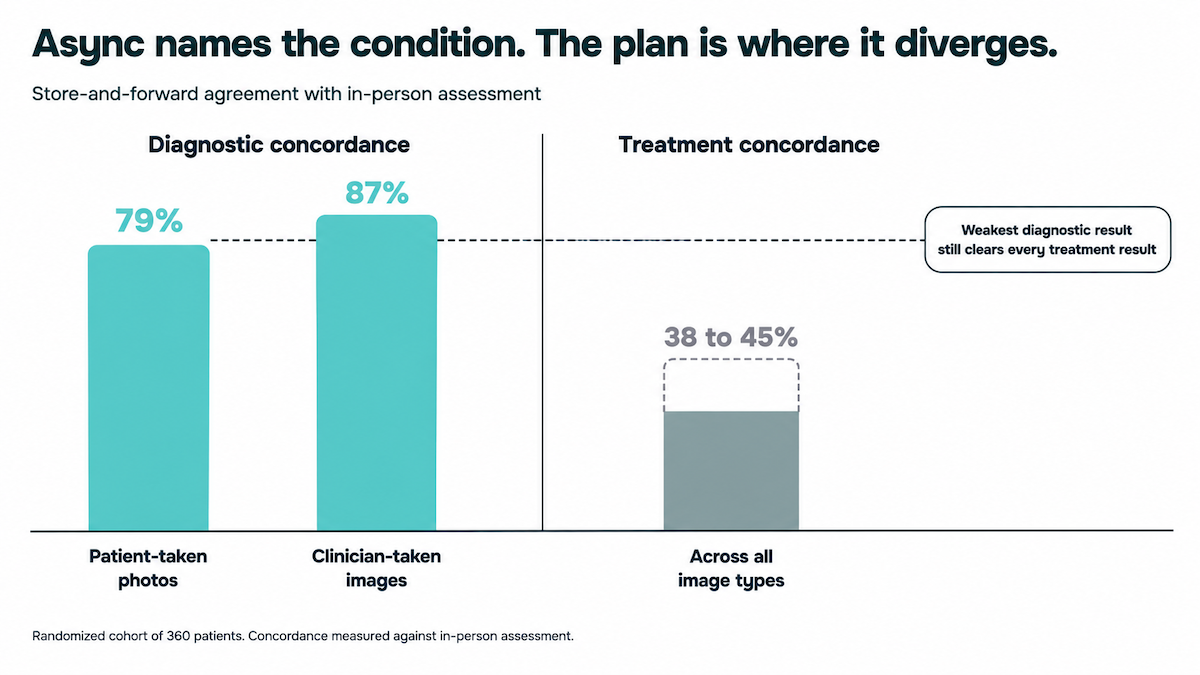
Acne showed the highest diagnostic match across every image type in that study, which is why the async acne vertical is the one that works cleanly. Run your own service line against those 2 numbers before you run it against a state statute.
What a defensible encounter contains, per the people who set the standard
For the flagship async vertical there is now a specification, and it did not come from a platform. The Obesity Association, a division of the American Diabetes Association, published its pharmacologic treatment standards in January 2026, endorsed by the Obesity Medicine Association and The Obesity Society.
It calls for a comprehensive pre-treatment evaluation before an obesity medication is selected, covering weight history, weight-related comorbidities, physical examination, and relevant laboratory investigations.
2 of those 4 items don't travel over a questionnaire.
The guideline says what to do about that, too: practices unable to implement the recommended infrastructure should refer patients to clinicians with competency in obesity medicine. A clinical society telling a thin async model to send the patient elsewhere is about as direct as this literature gets.
It also asks for individualized, incremental goals with periodic reassessment, which puts monitoring cadence inside the standard of care instead of on the retention roadmap.
Our build a GLP-1 virtual clinic walkthrough covers the rest of that stack.
A service line whose value proposition is skipping the labs and the reassessment has a scope problem in asynchronous care, and platform design doesn't fix scope problems.
The evidence on asynchronous telemedicine is thinner than the industry implies
Somewhere in your deck there's probably a line saying async is as safe as synchronous care, with a citation attached. 2 props hold that claim up in the D2C literature, and both are weaker than they look.
The clinical position everyone cites does not exist
The most-quoted version attributes a position to the Obesity Medicine Association: that asynchronous or remote prescribing must not lower the standard of care. It sounds like something a clinical society would say, and OMA hasn't said it.
A full-text read of OMA's telehealth clinical practice statement, which is organized around its ADAPT practice model, contains nothing on asynchronous or remote prescribing. Three separate attempts to locate the claimed position came up empty. The trail ends at a commercial lab-panel vendor's platform comparison page, citing a footnote that resolves to nothing.
A citation circulating without a source is the first thing an opposing expert checks.
The flagship safety study was written by the platform it evaluates
The second prop is real peer-reviewed work, which is exactly the problem. A 2022 paper in JMIR Formative Research compared patient-reported side effects across async and synchronous encounters and found no statistically significant difference: 1.44% against 1.12%, odds ratio 0.77, P=.26. Its 4 authors were employed by, and held stock options in, the direct-to-consumer platform that supplied the data, and that platform published the work as company research.
It also carries a published correction. The original had swapped the asynchronous and synchronous labels for every side effect in its table. The journal states the interpretation is unaffected, which may well be true; set that next to effect sizes this small and weigh it yourself.
An independent systematic review in World Journal of Men's Health flags the conflict directly, so this is the literature's own assessment rather than ours.
Asynchronous telemedicine can be safe. Proving it falls to you, which is why the section above handed you a test instead of a citation, and why your own monitoring data outweighs anyone's published patient safety claim.
The legal layer: state rules, prescribing standards, and controlled substance limits
Founders read "async is permitted here" off a telehealth definition and stop there. The second question is not printed next to the first, and it's the one that decides the architecture.
2 questions, and the telehealth statute only answers one
Ask them separately, every time.
- Does the state permit asynchronous telehealth as a modality?
- Does a questionnaire plus asynchronous provider review count as an adequate examination to establish the patient-provider relationship and prescribe?
The first answer lives in the telehealth statute. The second lives in the medical board's examination and prescribing rules, which is a different document, often a different chapter of code, sometimes just a set of board minutes.
Georgia is the cleanest illustration on record. In September 2025 the state medical board was asked directly whether async telehealth can establish a valid relationship for prescribing non-controlled medications such as PDE5 inhibitors. The board's answer: async does not meet the requirements, and synchronous telehealth may be permitted.
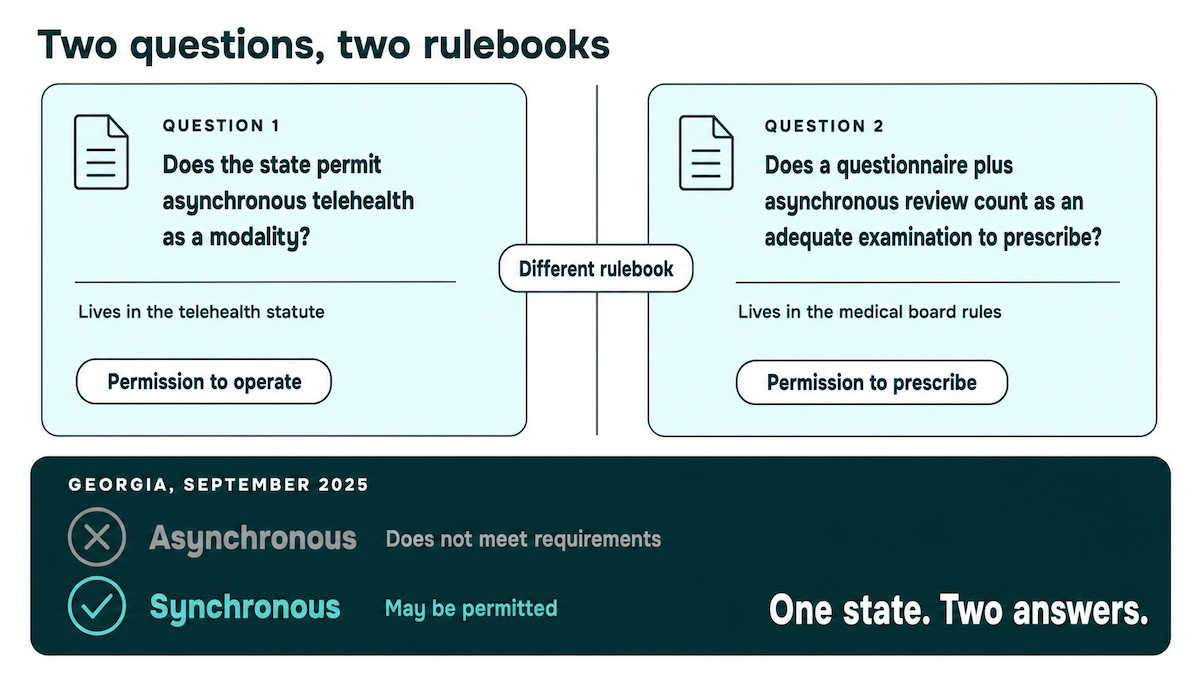
Same state, same modality. The answer depended on which question you asked.
What the permissive statutes actually require
Where state telehealth laws do bless async, read what they bless.
Iowa
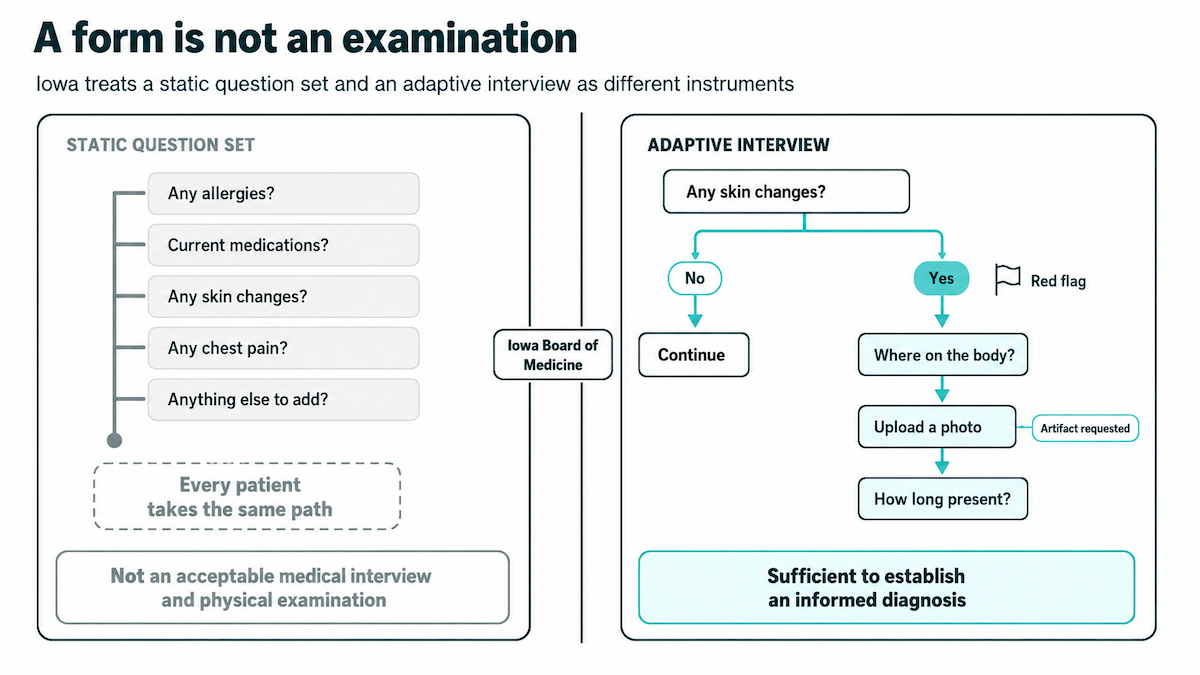
Iowa draws the sharpest line found anywhere. A static set of questions answered with a static set of answers does not constitute an acceptable medical interview and physical examination for treatment or prescriptions, per the Iowa Board of Medicine's telemedicine standards. An adaptive, interactive and responsive online interview is treated differently.
Arkansas
Arkansas rejects the conflation outright. A patient completing a medical history online and forwarding it to a provider is not sufficient to establish the relationship, and it does not qualify as store-and-forward technology either. That second clause is the one to sit with.
Texas
Texas shows what does qualify. Async store-and-forward is a valid route where the practitioner uses clinical information from clinically relevant photographic or video images, or the patient's relevant clinical records, and the method has to give the practitioner what the standard of care would require.
3 statutes converge on one pattern. Where the law blesses async, it blesses clinical artifacts reviewed by a clinician. A bare questionnaire is the weakest async artifact there is, and in at least one state it isn't store-and-forward at all.
The permissive end, and the federal layer that closes at the end of the year
Florida sits at the permissive end. Its telehealth definition covers synchronous or asynchronous technology and excludes only email and fax. No prior in-person exam, no video requirement, no FQHC limitation.
Then Florida bounds it, and the bounds are the lesson. Care has to meet the prevailing professional standard of practice for in-person care, documented in the medical record to the same standard used in person. The most permissive state in the country still wants in-person-grade judgment and in-person-grade records.
Federal law is narrower than most founders assume. DEA and HHS extended telemedicine flexibilities for controlled substances from January 1 through December 31, 2026, scoped to audio-video plus audio-only for opioid use disorder. Store-and-forward review is not covered.
The special registration proposed in January 2025 remains unfinalized, and as drafted it would add PDMP checks, audio-video requirements, and Schedule II restrictions.
That window closes inside this article's shelf life, with permanent rules anticipated before the end of 2026. Verify status before scoping against it.
Controlled substances are a synchronous product line, and treating them as an async feature is the fastest route to a board complaint.
4 questions to run against any state, in this order:
- Does it recognize store-and-forward as a modality?
- Does it treat a questionnaire as an examination?
- Does the board's prescribing rule say anything the telehealth statute does not?
- Does it impose async-specific disclosures?
CCHP's Policy Finder answers 1 and 2 quickly and telehealth.hhs.gov carries the federal layer. Questions 3 and 4 mean reading the state board's own rules, which is slower, and it's where the surprises live.
Anatomy of an async telehealth platform: intake, review queue, prescription, follow-up
The architecture is 4 stages, and the part that decides whether it survives scrutiny sits underneath all of them.
- Intake. An adaptive questionnaire, photo or document capture, identity and state-of-residence capture, and consent. This is the clinical instrument, covered below.
- Provider review queue. Submissions land, route to a clinician licensed in the patient's state, and get worked against a clock.
- Prescription or plan. The reviewer approves, modifies, declines, or escalates to a live visit. 2 integrations surface at this stage:
- e-prescribing out to the pharmacy network
- the encounter note the decision gets written into
- Follow-up. Scheduled check-ins, refills, re-review of anything that changed, and a route back into the queue when it did.
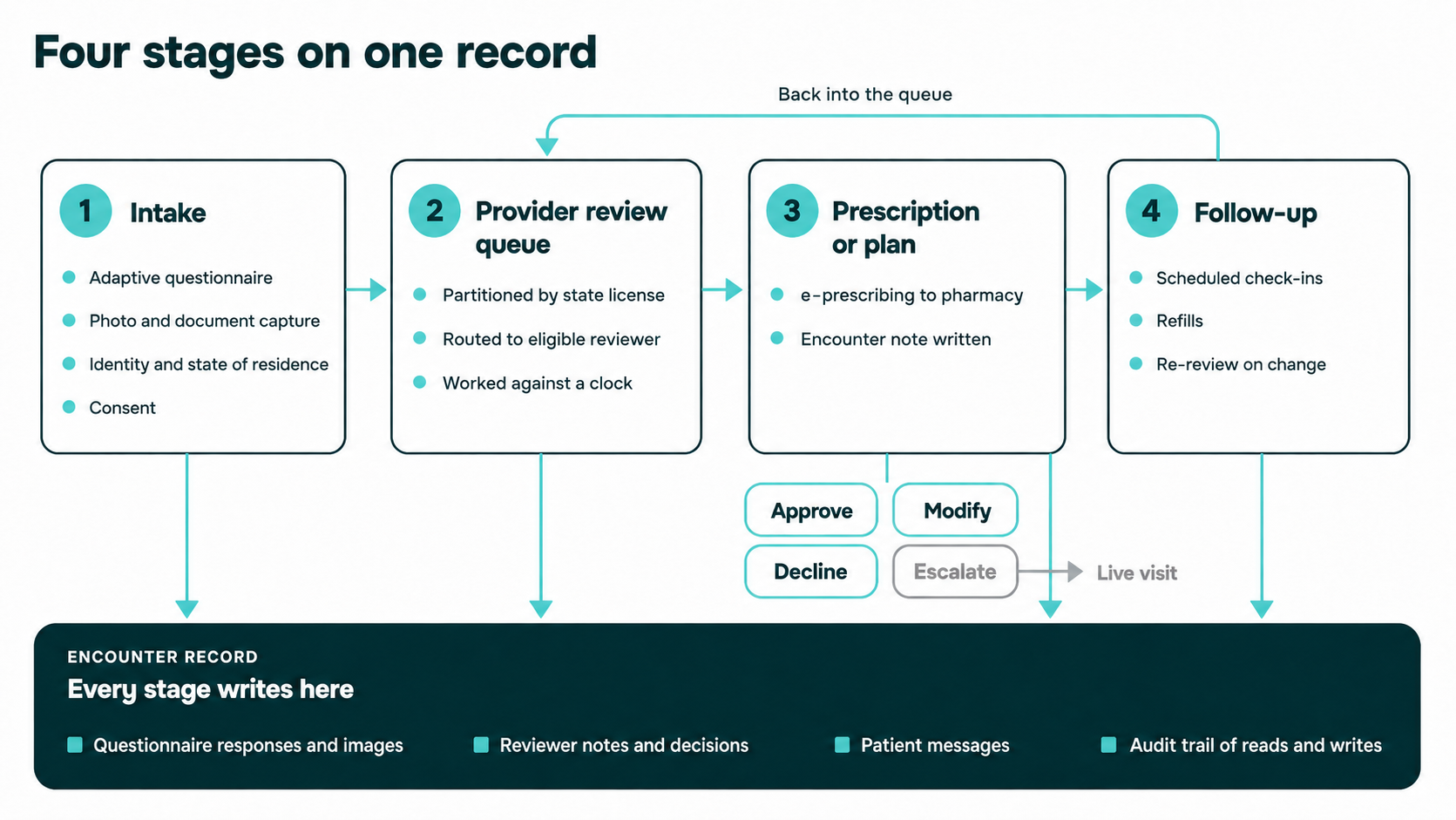
None of that is exotic as a tech stack: a form engine, a queue with routing rules, a prescribing integration, and a record store you can still query in 3 years. The last one is where builds go wrong.
The lightweight EHR underneath, and what it has to hold
A lightweight record store is enough here, and 3 states have already specified what goes in it.
Iowa lists the required content of the telemedicine record: all patient-related electronic communications, records of past care, test results, evaluations, prescriptions, and instructions. Florida, the most permissive state examined here, still requires telehealth services documented to the same standard used in person. Texas defines store and forward technology as technology that stores and transmits or grants access to clinical information for review by a health professional at a different location, which is a legislature describing an encounter record without using the term.
In practice that means the SOAP notes your reviewer writes, the questionnaire responses and images that produced them, every message exchanged with the patient, and an audit trail showing who read what and when. Patient messaging counts as part of the record, which is why we treat it as a compliance surface in our HIPAA compliant messaging breakdown.
The record is what a board or a plaintiff reads. It's the only part of the build that has to make sense to someone who wasn't there.
E-prescribing sets your timeline, and the build-versus-middleware call is the whole decision
Middleware puts an iFrame in your app in 2 to 6 weeks. Certifying directly with Surescripts runs 12 to 18 months and upward of $500,000 before a single prescription moves. The full spread sits in the cost section below.
EPCS layers its own record regime on top of either path: tamper-evident logging of all EPCS activity, plus annual third-party audits.
The decision rule is short: direct certification makes sense when e-prescribing infrastructure is the business you are in, which for a D2C care platform it isn't. If you are benchmarking against a named incumbent, our build a telehealth app like Bask Health teardown covers what that stack contains.
Designing clinical questionnaires and protocols that hold up
Most teams treat the intake questionnaire as a form to be filled in. Both of the things that decide whether it holds up are invisible when you look at it that way.
Adaptive versus static is a legal distinction
Iowa already made this call, and the legal layer above covered why it binds. As a design constraint it reads like a spec: a static question set answered with static answers does not count as an acceptable medical interview and physical examination.
Iowa states the bar underneath it plainly: the interview and examination need not happen in person where the technology is sufficient to establish an informed diagnosis as though they had been performed in person. That is the height your branching logic has to clear.
What the reviewer receives decides what the reviewer can conclude
The teledermatology literature has already measured this. Brief standardized training on how to take the photo moved store-and-forward diagnostic concordance from 79% to 84%. The same intervention cut the rate at which reviewers had to go back and request additional history from 64% down to 47%.
That second number is the one to plan around: nearly half of a reviewer's re-work was created upstream, in the intake, before physician review started.
Some failures at this layer wear a clinical costume. One teledermatology service rejected 20% of referrals, mostly for inadequate imaging. The JMIR Dermatology review agrees from the literature side, with image quality and dermoscopy bearing considerably on how well store-and-forward performs.
Capture quality is a clinical variable.
Arkansas turns the same idea into a rule, requiring the provider to obtain a detailed explanation of the patient's complaint. Your form either produces that or it doesn't.
5 rules fall out of those 2 axes, and together they are the substance of your clinical protocols:
- Branch on the answers. Every red flag opens a path, and the path belongs in the protocol before it exists in the UI.
- Ask for artifacts. A photo, a lab result, or a prescription history carries weight that a self-reported yes never will.
- Guide the capture. Standardized photo instructions bought 5 points of diagnostic concordance above, cheaper than anything else on this list.
- Place red-flag questions where they force escalation, rather than where the form flows nicely.
- Version the protocol. When someone asks which questions produced a given encounter, you want to answer with a version number.
Provider review gets easier in direct proportion to how much of this you settle before launch.
The provider side: review queues, response SLAs, and escalation paths
A queue sounds like one queue.
Licensure turns one queue into a routing problem
The rule is simple and the consequences aren't. A clinician generally has to be licensed where the patient is physically located at the time of the encounter, whatever state the clinician sits in.
So the eligible reviewer set is a function of the patient's address. Your review queue partitions by state, and the clock on any given submission starts only once a licensed reviewer exists for that partition. The same code can produce a 6-hour turnaround in California and a 3-day backlog in Montana.
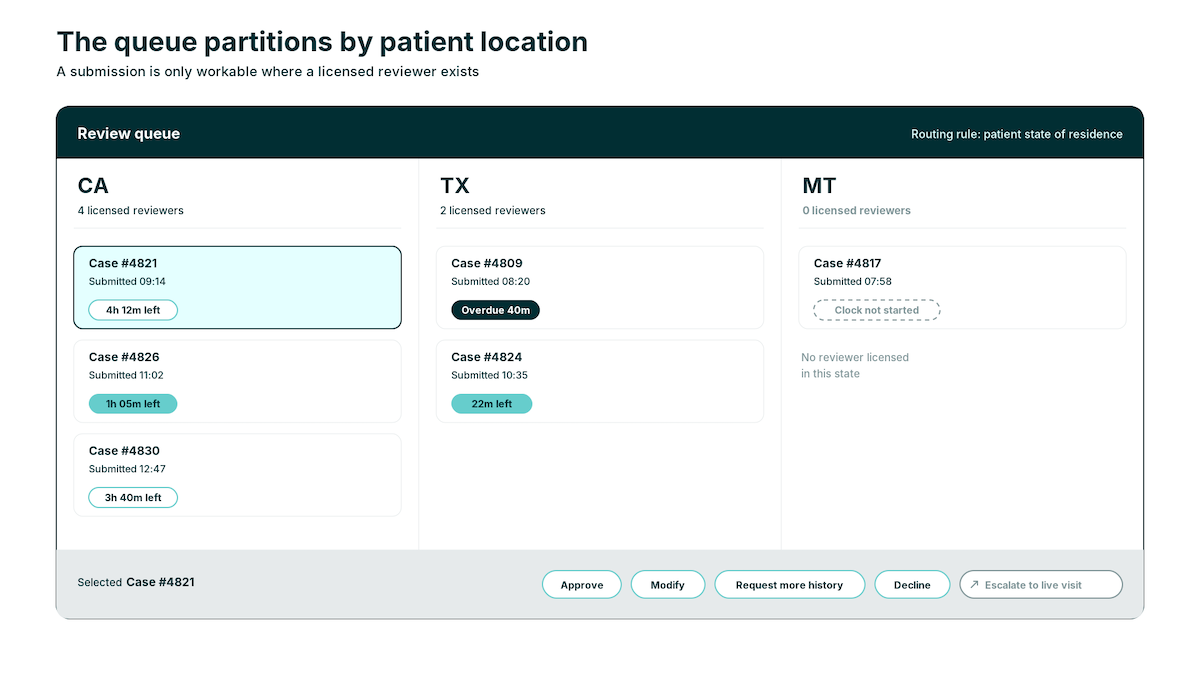
Building that reviewer supply or buying it is a separate problem. Vendor selection and clinician network economics are covered in our scaling a D2C telehealth app guide.
SLAs and escalation are obligations before they are service levels
Presbyterian's physicians typically answered within 15 minutes. Other health systems allow up to 24 hours. That brackets the design space, and both ends are defensible depending on the service line.
Telling the patient is the part that isn't optional. Iowa requires disclosing how long messages sent via telemedicine technologies take to answer, which makes your SLA a disclosure obligation before a product decision. Publish a number you can hold on your slowest partition.
Vermont goes further from the patient's side. Someone receiving store-and-forward services has to be told they can refuse that format and request real-time or in-person care, and receiving async cannot preclude live care later. Escalation to synchronous visit is a patient right there, so it belongs in your informed consent language and in the reviewer's toolbar from the first release.
Staffing then falls out of 3 inputs: partition count, SLA target, escalation rate. None is a launch-week decision, and underestimating the third is how a queue quietly turns into a backlog.
AI in asynchronous workflows: triage, drafting, and guardrails
AI earns its keep inside an async queue in 3 places: routing submissions, drafting responses for clinician review, and documentation support. 2 design choices decide whether any of it becomes a regulated medical device, and both are answerable before anyone writes the feature.
Who receives the output, and does it touch the image
FDA reissued its Clinical Decision Support Software guidance on January 29, 2026, superseding a January 6, 2026 version that had itself replaced the 2022 guidance. 2 revisions in one month is a fair prompt to re-read the current text before shipping.
The first question is who reads the output. Non-device CDS requires recommendations to go to healthcare providers, and the professional has to be able to independently review the basis rather than relying primarily on it. AI triage telling the patient they are async-appropriate is a different regulatory animal from AI briefing the reviewing clinician on the same submission.
Same prompt, opposite sides of the line.
The second question is whether it looks at the image. The first statutory criterion excludes software intended to acquire, process, or analyze a medical image, or a signal from an in vitro diagnostic or signal-acquisition system. An async platform whose intake is photographs sits one product decision away from device territory, and that decision usually gets made casually in sprint planning.
General triage mechanics live in our telemedicine app development guide.
The guardrails, and the Vermont rule that breaks ambient documentation
The 2026 change matters most for what a review screen may show. FDA now intends enforcement discretion for software offering a single recommendation where only one option is clinically appropriate and the other criteria hold, conditioned on the clinician being able to review the logic, data sources, and guidelines behind it. A single suggested plan became viable, provided the screen also exposes why.
FDA still asserts authority over opaque models and over software that substitutes for clinical judgment, and it keeps time-critical decision tools inside its remit, which matters the moment you put a clock on an AI output. Those are your clinical guardrails, and each names a shortcut that looks like a feature.
Then the one that catches teams sideways. Vermont prohibits a provider or patient from creating a recording of a telemedicine consultation, which runs straight into AI transcription and ambient documentation. A feature that draws no attention in most states is prohibited in at least one.
Be plain about the gap. This guidance says nothing about generative AI despite arriving with AI framing, and it doesn't address clinician-facing chatbots or AI-drafted prescription renewals, which are the features teams are actually shipping. Keep a human approving every clinical output, and keep that approval documented.
Asynchronous telehealth platform development cost and timeline
The app isn't the expensive part.
Your own certified connection, and a second business to run
E-prescribing sets your timeline, which the table prices. EPCS pushes it further out, because controlled substances arrive with tamper-evident logging of all EPCS activity and annual third-party audits attached, so pulling scheduled drugs into scope is a cost decision as much as a legal one.
Multi-state licensure is the second driver, and it has no end date. Per-state applications, fees, renewals, and credentialing form a recurring operating line, and coverage in a new state costs money before it earns any.
The third is the encounter record, which is cheap to build up front and expensive to retrofit once you have 18 months of encounters in the wrong shape.
That's the framing that should change how you budget asynchronous telehealth platform development: 2 of those 3 drivers keep charging you after launch. A development process quoted only against the app is pricing the cheapest third of the problem.
How Specode can help
Every hard part of an async build is shaped like a compliance requirement. Adaptive intake. The encounter record. The e-prescribing integration. The disclosures your state demands. The questionnaire screens are the easy afternoon.
Specode's job is speed on exactly those parts. Its AI builder carries healthcare-specific skills, so a build starts from patterns that already account for staged intake and role separation:
- multi-step intake with per-step routing
- provider profiles carrying credentials and certifications
- admin patterns that separate clinic-admin from provider roles
Audit logging gets its own pass. The builder inspects your repo, confirms each PHI surface with you, walks the retention and access decisions, then wires logging into every approved read and write. A compliance agent scans the codebase afterward and sorts findings into must-fix and nice-to-fix.
Your e-prescribing vendor, lab, or pharmacy network connects as an API integration the AI wires up with your keys. HIPAA compliance ships with the foundation, and you own and can export the whole codebase.
What stays yours:
- the clinical protocols
- the service-line decision
- which states you open
- the standard of care you hold yourselves to
No platform supplies those.
Async carries more patients per clinician hour than anything else in telehealth. Build an asynchronous telehealth platform where "done right" is a set of choices you made before launch, and the compliance layer stops being the reason you're late.
Frequently asked questions
Same care model; HHS uses store-and-forward as the synonym. The distinction that bites: some states define store-and-forward around images and records, excluding plain messaging.
Not in all states. Most treat a questionnaire alone as inadequate to establish the prescribing relationship, and one board has said async cannot establish it at all.
Generally no. DEA's 2026 flexibility covers audio-video plus audio-only for opioid use disorder, so store-and-forward review doesn't qualify. Verify status; the window closes December 31, 2026.
Neither alone. Most viable D2C builds run async as the default path with synchronous as the escalation, because law, clinical ambiguity, and patient requests each force one.
The platform is weeks to a few months. E-prescribing sets the real timeline, from 2 to 6 weeks on middleware up to 3 to 6 months on a full API.
Either works. What matters is that the encounter record holds what your state's rules require and stays queryable years later.
No. Arkansas, Idaho, Florida, and Texas each tie telehealth explicitly to the standard of care that applies in person.